
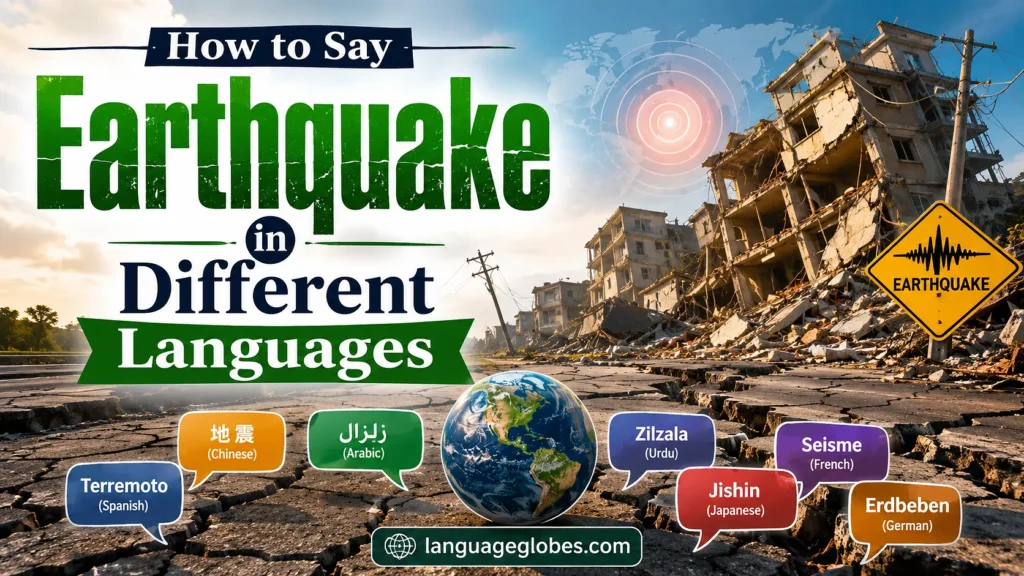
An earthquake is a natural phenomenon caused by sudden energy release beneath the Earth’s crust. Learning how to say earthquake helps language learners understand earthquake terminology, vocabulary, and multilingual translations.
This guide explores earthquake in different languages, with clear pronunciation and translation examples. These language translations also support global communication, emergency communication, and cultural understanding.
From Spanish and Italian to Urdu and Mandarin Chinese, each language offers unique expressions. Understanding this natural disaster terminology builds multilingual vocabulary while revealing linguistic diversity across different languages.
Whether you are studying languages, traveling, or learning earthquake safety, these translations provide useful language insights and practical communication skills.
Also Read This: How to Say Eagle in Different Languages
Interesting Facts About Earthquake
- The word “earthquake” combines two simple English words: “earth” and “quake,” meaning a shaking of the ground.
- Earthquakes occur due to movements of tectonic plates beneath the Earth’s surface.
- Thousands of earthquakes happen worldwide every day, although most are too small to be felt.
- Japan is one of the countries most experienced in earthquake preparedness due to its frequent seismic activity.
- Different languages often describe earthquakes using words that literally mean “earth shaking” or “ground movement.”
- Ancient civilizations often believed earthquakes were caused by gods, spirits, or mythical creatures.
- The science that studies earthquakes is called seismology.
- Earthquakes can trigger tsunamis, landslides, and other natural hazards.
- Many earthquake-related terms are internationally recognized due to scientific collaboration.
- Learning the word “earthquake” in different languages can be useful during international travel and emergency situations.
How to Say Earthquake in Different Languages
European Languages
Europe is home to many language families, including Germanic, Romance, Slavic, Celtic, and Baltic languages. Although these languages differ greatly, many have developed unique words to describe earthquakes. Learning these terms offers insight into the continent’s rich linguistic heritage.
| Language | Country/Region | Translation | Pronunciation | Example Sentence |
| 🇺🇸 American English | USA | Earthquake | urth-kwayk | The earthquake shook the city. |
| 🇬🇧 British English | UK | Earthquake | urth-kwayk | The earthquake was felt across the region. |
| 🇦🇺 Australian English | Australia | Earthquake | urth-kwayk | The earthquake caused minor damage. |
| 🇫🇷 French | France | Tremblement de terre | trahm-bluh-mon duh tair | Le tremblement de terre a surpris tout le monde. |
| 🇪🇸 Spanish | Spain | Terremoto | teh-reh-mo-to | El terremoto sacudió la ciudad. |
| 🇵🇹 Portuguese | Portugal | Terremoto | teh-heh-mo-tu | O terremoto foi forte. |
| 🇮🇹 Italian | Italy | Terremoto | teh-rreh-mo-to | Il terremoto ha colpito la regione. |
| 🇩🇪 German | Germany | Erdbeben | ert-bay-ben | Das Erdbeben war stark. |
| 🇳🇱 Dutch | Netherlands | Aardbeving | ahrt-bay-ving | De aardbeving veroorzaakte schade. |
| 🇸🇪 Swedish | Sweden | Jordbävning | yord-bev-ning | Jordbävningen kändes långt bort. |
| 🇳🇴 Norwegian | Norway | Jordskjelv | yord-shelv | Jordskjelvet var kraftig. |
| 🇩🇰 Danish | Denmark | Jordskælv | yor-skelv | Jordskælvet rystede området. |
| 🇫🇮 Finnish | Finland | Maanjäristys | maan-ya-ris-tus | Maanjäristys tapahtui aamulla. |
| 🇮🇸 Icelandic | Iceland | Jarðskjálfti | yarth-skyowlf-ti | Jarðskjálftinn var mikill. |
| 🇵🇱 Polish | Poland | Trzęsienie ziemi | tshen-she-nye zhe-mi | Trzęsienie ziemi było silne. |
| 🇨🇿 Czech | Czech Republic | Zemětřesení | ze-me-tre-she-ni | Zemětřesení zasáhlo město. |
| 🇸🇰 Slovak | Slovakia | Zemetrasenie | ze-me-tra-se-nye | Zemetrasenie bolo silné. |
| 🇭🇺 Hungarian | Hungary | Földrengés | fuld-ren-gaysh | A földrengés erős volt. |
| 🇷🇴 Romanian | Romania | Cutremur | koo-tre-moor | Cutremurul a fost puternic. |
| 🇬🇷 Greek | Greece | Σεισμός | sis-mos | Ο σεισμός ήταν ισχυρός. |
| 🇷🇺 Russian | Russia | Землетрясение | zem-le-trya-se-ni-ye | Землетрясение было сильным. |
| 🇺🇦 Ukrainian | Ukraine | Землетрус | zem-le-trus | Землетрус був сильним. |
| 🇧🇬 Bulgarian | Bulgaria | Земетресение | ze-me-tre-se-ni-ye | Земетресението беше силно. |
| 🇷🇸 Serbian | Serbia | Земљотрес | zem-lyo-tres | Земљотрес је био снажан. |
| 🇭🇷 Croatian | Croatia | Potres | po-tres | Potres je pogodio grad. |
Asian Languages
Asia is the largest continent and contains thousands of languages spoken by billions of people. Many Asian countries experience seismic activity, making the word “earthquake” especially important in everyday communication, education, and disaster preparedness.
| Language | Country/Region | Translation | Pronunciation | Example Sentence |
| 🇨🇳 Chinese (Mandarin) | China | 地震 | dee-zhen | 地震发生了。 |
| 🇯🇵 Japanese | Japan | 地震 | ji-shin | 地震が起きました。 |
| 🇰🇷 Korean | South Korea | 지진 | ji-jin | 지진이 발생했습니다. |
| 🇮🇳 Hindi | India | भूकंप | bhoo-kamp | भूकंप बहुत तेज था। |
| 🇵🇰 Urdu | Pakistan | زلزلہ | zal-za-la | زلزلہ بہت شدید تھا۔ |
| 🇧🇩 Bengali | Bangladesh | ভূমিকম্প | bhoo-mi-kom-po | ভূমিকম্প হয়েছিল। |
| 🇵🇰 Punjabi | Punjab | ਭੂਚਾਲ | bhoo-chal | ਭੂਚਾਲ ਆਇਆ ਸੀ। |
| 🇮🇳 Gujarati | India | ભૂકંપ | bhoo-kamp | ભૂકંપ આવ્યો હતો. |
| 🇮🇳 Marathi | India | भूकंप | bhoo-kamp | भूकंप झाला. |
| 🇮🇳 Tamil | India | நிலநடுக்கம் | nila-na-dukkam | நிலநடுக்கம் ஏற்பட்டது. |
| 🇮🇳 Telugu | India | భూకంపం | bhoo-kam-pam | భూకంపం వచ్చింది. |
| 🇮🇳 Kannada | India | ಭೂಕಂಪ | bhoo-kam-pa | ಭೂಕಂಪ ಸಂಭವಿಸಿತು. |
| 🇮🇳 Malayalam | India | ഭൂകമ്പം | bhoo-kam-pam | ഭൂകമ്പം ഉണ്ടായി. |
| 🇳🇵 Nepali | Nepal | भूकम्प | bhoo-kamp | भूकम्प आयो। |
| 🇱🇰 Sinhala | Sri Lanka | භූමිකම්පාව | bhoo-mi-kam-pa-wa | භූමිකම්පාවක් ඇතිවිය. |
| 🇹🇭 Thai | Thailand | แผ่นดินไหว | pen-din-wai | แผ่นดินไหวเกิดขึ้น. |
| 🇻🇳 Vietnamese | Vietnam | Động đất | dong-dat | Động đất đã xảy ra. |
| 🇮🇩 Indonesian | Indonesia | Gempa bumi | gem-pa boo-mi | Gempa bumi terjadi tadi malam. |
| 🇲🇾 Malay | Malaysia | Gempa bumi | gem-pa boo-mi | Gempa bumi berlaku semalam. |
| 🇵🇭 Filipino | Philippines | Lindol | lin-dol | Nagkaroon ng lindol kahapon. |
| 🇰🇭 Khmer | Cambodia | រញ្ជួយដី | ron-joo-y-dey | មានរញ្ជួយដី។ |
| 🇱🇦 Lao | Laos | ແຜ່ນດິນໄຫວ | pen-din-wai | ເກີດແຜ່ນດິນໄຫວ. |
| 🇲🇳 Mongolian | Mongolia | Газар хөдлөлт | ga-zar hod-lolt | Газар хөдлөлт болсон. |
African Languages
Africa is home to extraordinary linguistic diversity, with more than 2,000 languages spoken across the continent. African languages reflect rich cultural traditions and unique ways of describing natural phenomena, including earthquakes and other geological events.
| Language | Country/Region | Translation | Pronunciation | Example Sentence |
| 🇿🇦 Swahili | East Africa | Tetemeko la ardhi | te-te-me-ko la ar-dhi | Tetemeko la ardhi lilitokea jana. |
| 🇿🇦 Zulu | South Africa | Ukuzamazama komhlaba | oo-koo-za-ma-za-ma | Ukuzamazama komhlaba kwenzekile. |
| 🇿🇦 Xhosa | South Africa | Inyikima | in-yi-ki-ma | Inyikima ibinamandla. |
| 🇿🇦 Afrikaans | South Africa | Aardbewing | ahrt-beh-ving | Die aardbewing was sterk. |
| 🇳🇬 Yoruba | Nigeria | Ìṣẹlẹ ilẹ̀ rírì | ee-she-le | Ìṣẹlẹ ilẹ̀ rírì ṣẹlẹ̀. |
| 🇳🇬 Igbo | Nigeria | Ala ọma jijiji | a-la o-ma ji-ji | Ala ọma jijiji mere. |
| 🇳🇬 Hausa | Nigeria | Girgizar ƙasa | gir-gi-zar ka-sa | Girgizar ƙasa ta faru. |
| 🇪🇹 Amharic | Ethiopia | የመሬት መንቀጥቀጥ | me-ret men-ke-te-ket | የመሬት መንቀጥቀጥ ነበር። |
| 🇸🇴 Somali | Somalia | Dhulgariir | dhul-ga-reer | Dhulgariir ayaa dhacay. |
| 🇲🇬 Malagasy | Madagascar | Horohoron-tany | ho-ro-ho-ron ta-ni | Nisy horohoron-tany. |
Middle Eastern Languages
The Middle East has been a crossroads of civilizations for thousands of years. Languages spoken in this region belong primarily to the Semitic, Turkic, and Indo-Iranian language families. Earthquake-related vocabulary is especially significant because several countries in the region are located near active seismic zones.
| Language | Country/Region | Translation | Pronunciation | Example Sentence |
| 🇸🇦 Arabic | Middle East | زلزال | zil-zal | حدث زلزال قوي. |
| 🇮🇷 Persian (Farsi) | Iran | زلزله | zel-ze-leh | زلزله شدیدی رخ داد. |
| 🇹🇷 Turkish | Türkiye | Deprem | dep-rem | Deprem çok güçlüydü. |
| 🇮🇱 Hebrew | Israel | רעידת אדמה | ra-a-dat a-da-ma | רעידת אדמה התרחשה. |
| 🇰🇼 Kurdish | Kurdistan Region | Erdhej | erd-hej | Erdhejek çêbû. |
| 🇦🇫 Pashto | Afghanistan | زلزله | zal-za-la | زلزله وشوه. |
| 🇦🇫 Dari | Afghanistan | زلزله | zal-za-la | زلزله رخ داد. |
| 🇦🇲 Armenian | Armenia | Երկրաշարժ | yer-kra-sharj | Երկրաշարժ տեղի ունեցավ։ |
| 🇬🇪 Georgian | Georgia | მიწისძვრა | mi-tsis-dzvra | მიწისძვრა მოხდა. |
| 🇦🇿 Azerbaijani | Azerbaijan | Zəlzələ | zel-ze-le | Zəlzələ baş verdi. |
Additional Languages Around the World
The world contains many other fascinating languages spoken across the Americas, Oceania, and indigenous communities. These languages demonstrate humanity’s incredible cultural and linguistic diversity while offering unique expressions for describing earthquakes.
| Language | Country/Region | Translation | Pronunciation | Example Sentence |
| 🇪🇪 Estonian | Estonia | Maavärin | maa-va-rin | Maavärin toimus eile. |
| 🇱🇻 Latvian | Latvia | Zemestrīce | ze-me-stri-tse | Zemestrīce bija spēcīga. |
| 🇱🇹 Lithuanian | Lithuania | Žemės drebėjimas | zhe-mes dre-bay-yi-mas | Žemės drebėjimas įvyko. |
| 🇮🇪 Irish | Ireland | Crith talún | krith ta-loon | Tharla crith talún. |
| 🏴 Welsh | Wales | Daeargryn | dye-ar-grin | Bu daeargryn ddoe. |
| 🇦🇱 Albanian | Albania | Tërmet | ter-met | Tërmeti ishte i fortë. |
| 🇸🇮 Slovenian | Slovenia | Potres | po-tres | Potres je bil močan. |
| 🇧🇦 Bosnian | Bosnia | Zemljotres | zem-lyo-tres | Zemljotres je bio jak. |
| 🇲🇰 Macedonian | North Macedonia | Земјотрес | zem-yo-tres | Земјотресот беше силен. |
| 🇱🇺 Luxembourgish | Luxembourg | Äerdbiewen | aird-bee-ven | D’Äerdbiewen war staark. |
| 🇲🇹 Maltese | Malta | Terremot | ter-re-mot | It-terremot kien qawwi. |
| 🇳🇿 Māori | New Zealand | Ru whenua | roo fenua | I puta he ru whenua. |
| 🇼🇸 Samoan | Samoa | Mafuiʻe | ma-foo-ee-eh | Na tupu se mafuiʻe. |
| 🇭🇹 Haitian Creole | Haiti | Tranbleman tè | tran-ble-man tay | Tranbleman tè a te fò. |
| 🇬🇱 Greenlandic | Greenland | Sajuppillatsitsineq | sa-yup-pil-lat-si-ne-k | Sajuppillatsitsineq pisoq. |
FAQs
What is an earthquake, and why does it happen?
An earthquake is a natural phenomenon caused by a sudden energy release within the Earth’s crust, creating ground shaking. It is one of the most powerful natural events affecting communities worldwide.
How do you say earthquake in different languages?
The phrase earthquake in different languages varies across world languages, reflecting rich linguistic diversity. This guide provides multilingual translations, pronunciation guides, and useful translation examples.
How do you say earthquake in Spanish, Italian, Urdu, and Mandarin Chinese?
Common translations include terremoto in Spanish, terremoto in Italian, زلزلہ in Urdu, and 地震 in Mandarin Chinese. Their pronunciation differs, making language learning more practical with clear examples.
What is the earthquake translation in Urdu?
The earthquake translation in Urdu is زلزلہ, commonly pronounced zilzala. Learning this earthquake word can help with language vocabulary and everyday communication skills.
Why learn earthquake vocabulary in different languages?
Learning earthquake vocabulary supports multilingual communication, emergency communication, and understanding safety instructions. It can also strengthen cross-cultural communication and practical language practice.
How can I improve my earthquake pronunciation in another language?
Use reliable pronunciation guides, listen to audio pronunciation, and practice the translated words aloud. Repeated practice makes vocabulary building easier for language learners.
What is the difference between earthquake terminology across languages?
Earthquake terminology can differ because languages use distinct words and expressions for the same natural disaster. These differences highlight linguistic expression, cultural diversity, and worldwide communication.
How can earthquake translations help with emergency communication?
Knowing earthquake translations can help travelers and language learners understand basic emergency instructions and earthquake safety messages. This knowledge supports clearer global communication during important situations.
Can learning the word earthquake improve language learning?
Yes, learning a common earthquake word can strengthen language foundation, vocabulary building, and practical language practice. Comparing translations also encourages language discovery and cultural understanding.
Where can I use these multilingual vocabulary translations?
These multilingual vocabulary terms can support language study, travel, educational resources, and everyday conversations. They also provide useful language insights for understanding different cultures and communication styles.
Conclusion
Understanding earthquake in different languages makes multilingual translations easier while revealing fascinating linguistic diversity and cultural understanding. Learning the earthquake translation, pronunciation, and earthquake vocabulary can strengthen language learning, communication skills, and global communication. Whether you study Spanish, Italian, Urdu, or Mandarin Chinese, these translations offer practical language insights for everyday use. They also help learners understand natural disaster terminology and communicate important earthquake safety information across cultures.

Lucy Carter is a curious mind and language lover who writes for Language Globes. She enjoys discovering new languages and sharing simple, helpful ideas that make learning fun and accessible for everyone.