
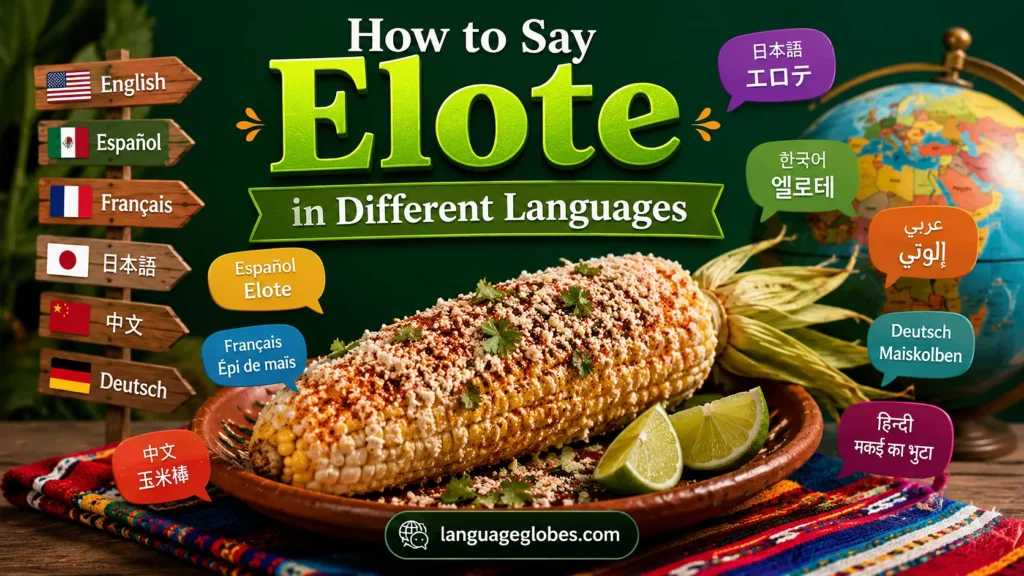
Elote is a beloved Mexican dish made from corn on the cob, often enjoyed as Mexican street food. Learning the elote translation can help language learners, travelers, and food enthusiasts understand local food vocabulary.
This guide explores how to say elote in different languages, along with useful pronunciation, meanings, and cultural context. You will also discover how Mexican Spanish, the Nahuatl language, and regional food terms connect this popular food with broader culinary culture.
Understanding elote meaning goes beyond a direct translation, because local names can reflect cultural differences, traditions, and everyday food communication.
Whether you are ordering street food, exploring international cuisine, or building your expanding vocabulary, these translations offer practical language support. The guide also highlights corn terminology, Spanish-speaking countries, and the cultural connection between food names and language diversity.
Also Read This: How to Say Elf in Different Languages
Interesting Facts About Elote
- Elote originated in Mexico and has roots dating back thousands of years.
- The word “elote” comes from the ancient Nahuatl language.
- Corn was first domesticated in Mexico over 9,000 years ago.
- Elote is a popular Mexican street food sold by vendors known as “eloteros.”
- Traditional elote is often topped with mayonnaise, cotija cheese, chili powder, and lime.
- A cup version of elote is called “esquites.”
- Elote has become popular worldwide due to Mexican cuisine’s growing influence.
- Different regions of Mexico prepare elote with unique toppings and seasonings.
- Many countries use their own words for corn on the cob rather than translating the dish directly.
- Elote is commonly enjoyed during festivals, fairs, and outdoor gatherings.
How to Say Elote in Different Languages
The translations below represent either the local word for corn on the cob, grilled corn, or the commonly used equivalent of elote.
European Languages
Europe is home to dozens of languages and diverse culinary traditions. While Mexican food has become increasingly popular across the continent, many European languages use their own native terms for corn on the cob. In some countries, the Spanish word “elote” is recognized in restaurants, while local equivalents are more commonly used in everyday conversation.
| Language | Country/Region | Translation | Pronunciation | Example Sentence |
| American English | 🇺🇸 United States | Corn on the cob | Korn on the cob | I love eating corn on the cob at summer barbecues. |
| British English | 🇬🇧 United Kingdom | Sweetcorn on the cob | Sweet-korn | Sweetcorn on the cob is a popular side dish. |
| Australian English | 🇦🇺 Australia | Corn on the cob | Korn on the cob | We grilled corn on the cob at the beach. |
| Spanish | 🇪🇸 Spain | Elote | Eh-lo-teh | Me gusta comer elote caliente. |
| French | 🇫🇷 France | Maïs en épi | Mah-eez on ay-pee | J’aime manger du maïs en épi. |
| German | 🇩🇪 Germany | Maiskolben | Mice-kol-ben | Ich esse gern Maiskolben. |
| Italian | 🇮🇹 Italy | Pannocchia | Pan-nok-kee-a | Mangio una pannocchia arrostita. |
| Portuguese | 🇵🇹 Portugal | Milho na espiga | Meel-yo na es-pee-ga | Gosto de milho na espiga. |
| Dutch | 🇳🇱 Netherlands | Maïskolf | Mice-kolf | Ik eet graag maïskolf. |
| Swedish | 🇸🇪 Sweden | Majskolv | Mice-kolv | Jag gillar majskolv. |
| Norwegian | 🇳🇴 Norway | Maiskolbe | Mice-kol-be | Jeg liker maiskolbe. |
| Danish | 🇩🇰 Denmark | Majskolbe | Mice-kol-be | Jeg elsker majskolbe. |
| Finnish | 🇫🇮 Finland | Maissintähkä | My-sin-tah-ka | Syön maissintähkää. |
| Polish | 🇵🇱 Poland | Kolba kukurydzy | Kol-ba koo-koo-rid-zi | Lubię kolbę kukurydzy. |
| Czech | 🇨🇿 Czech Republic | Kukuřičný klas | Koo-koo-rich-nee klas | Jím kukuřičný klas. |
| Slovak | 🇸🇰 Slovakia | Kukuričný klas | Koo-koo-rich-nee klas | Mám rád kukuričný klas. |
| Hungarian | 🇭🇺 Hungary | Kukoricacső | Koo-ko-ri-cha-choe | Szeretem a kukoricacsőt. |
| Romanian | 🇷🇴 Romania | Știulete de porumb | Shti-u-le-te | Îmi place porumbul. |
| Greek | 🇬🇷 Greece | Καλαμπόκι | Ka-lam-bo-kee | Μου αρέσει το καλαμπόκι. |
| Russian | 🇷🇺 Russia | Кукуруза | Koo-koo-roo-za | Я люблю кукурузу. |
| Ukrainian | 🇺🇦 Ukraine | Кукурудза | Koo-koo-rud-za | Я люблю кукурудзу. |
Asian Languages
Asia is the largest continent and contains thousands of languages and dialects. Corn is an important food crop in many Asian countries, and roasted corn is a popular street food in several regions. While the Mexican concept of elote may not always exist, similar corn-based snacks are enjoyed throughout Asia.
| Language | Country/Region | Translation | Pronunciation | Example Sentence |
| Chinese (Mandarin) | 🇨🇳 China | 玉米 | Yoo-mee | 我喜欢吃玉米。 |
| Cantonese | 🇭🇰 Hong Kong | 粟米 | Suk-mai | 我鍾意食粟米。 |
| Japanese | 🇯🇵 Japan | トウモロコシ | To-mo-ro-ko-shi | トウモロコシが好きです。 |
| Korean | 🇰🇷 South Korea | 옥수수 | Ok-soo-soo | 옥수수를 좋아해요. |
| Hindi | 🇮🇳 India | भुट्टा | Bhoot-ta | मुझे भुट्टा पसंद है। |
| Urdu | 🇵🇰 Pakistan | بھٹا | Bhatta | مجھے بھٹا پسند ہے۔ |
| Bengali | 🇧🇩 Bangladesh | ভুট্টা | Bhoot-ta | আমি ভুট্টা খেতে ভালোবাসি। |
| Punjabi | 🇮🇳🇵🇰 Punjab | ਭੁੱਟਾ | Bhoot-ta | ਮੈਨੂੰ ਭੁੱਟਾ ਪਸੰਦ ਹੈ। |
| Tamil | 🇮🇳 India | சோளம் | Cho-lam | எனக்கு சோளம் பிடிக்கும். |
| Telugu | 🇮🇳 India | మొక్కజొన్న | Mok-ka-jon-na | నాకు మొక్కజొన్న ఇష్టం. |
| Kannada | 🇮🇳 India | ಜೋಳ | Jo-la | ನನಗೆ ಜೋಳ ಇಷ್ಟ. |
| Malayalam | 🇮🇳 India | ചോളം | Cho-lam | എനിക്ക് ചോളം ഇഷ്ടമാണ്. |
| Marathi | 🇮🇳 India | मका | Ma-ka | मला मका आवडतो. |
| Gujarati | 🇮🇳 India | મકાઈ | Ma-kai | મને મકાઈ ગમે છે. |
| Thai | 🇹🇭 Thailand | ข้าวโพด | Khao-pod | ฉันชอบข้าวโพด |
| Vietnamese | 🇻🇳 Vietnam | Bắp ngô | Bap ngo | Tôi thích bắp ngô. |
| Indonesian | 🇮🇩 Indonesia | Jagung | Ja-goong | Saya suka jagung. |
| Malay | 🇲🇾 Malaysia | Jagung | Ja-goong | Saya suka jagung. |
| Filipino | 🇵🇭 Philippines | Mais | Ma-ees | Mahilig ako sa mais. |
| Khmer | 🇰🇭 Cambodia | ពោត | Pout | ខ្ញុំចូលចិត្តពោត។ |
African Languages
Africa is a continent rich in linguistic diversity, with more than 2,000 languages spoken across its regions. Corn, often called maize, is one of the most important staple crops in many African countries. Because of its popularity, most African languages have well-established words for corn and maize products.
| Language | Country/Region | Translation | Pronunciation | Example Sentence |
| Swahili | 🇹🇿 🇰🇪 East Africa | Mahindi | Ma-hin-dee | Ninapenda mahindi. |
| Zulu | 🇿🇦 South Africa | Ummbila | Oom-bee-la | Ngithanda ummbila. |
| Xhosa | 🇿🇦 South Africa | Umbona | Oom-bo-na | Ndiyathanda umbona. |
| Afrikaans | 🇿🇦 South Africa | Mielie | Mee-lee | Ek hou van mielies. |
| Yoruba | 🇳🇬 Nigeria | Agbado | Ag-ba-do | Mo fẹ agbado. |
| Igbo | 🇳🇬 Nigeria | Ọka | O-ka | A na m eri ọka. |
| Hausa | 🇳🇬 Niger | Masara | Ma-sa-ra | Ina son masara. |
| Amharic | 🇪🇹 Ethiopia | በቆሎ | Be-ko-lo | በቆሎ እወዳለሁ |
| Somali | 🇸🇴 Somalia | Galley | Gal-ley | Waxaan jeclahay galley. |
| Shona | 🇿🇼 Zimbabwe | Chibage | Chi-ba-ge | Ndinoda chibage. |
| Kinyarwanda | 🇷🇼 Rwanda | Ibigori | Ee-bee-go-ree | Nkunda ibigori. |
| Luganda | 🇺🇬 Uganda | Kasooli | Ka-so-li | Njagala kasooli. |
| Sesotho | 🇱🇸 Lesotho | Poone | Poo-ne | Ke rata poone. |
| Tswana | 🇧🇼 Botswana | Poone | Poo-ne | Ke rata poone. |
| Malagasy | 🇲🇬 Madagascar | Katsaka | Kat-sa-ka | Tiako ny katsaka. |
Middle Eastern Languages
The Middle East has a rich history of trade, agriculture, and cultural exchange. Corn is commonly eaten roasted, boiled, or grilled throughout the region. Many Middle Eastern languages have unique words for corn while still embracing international food traditions.
| Language | Country/Region | Translation | Pronunciation | Example Sentence |
| Arabic | 🌍 Middle East | ذرة | Zu-ra | أحب الذرة المشوية. |
| Persian | 🇮🇷 Iran | ذرت | Zo-rat | من ذرت دوست دارم. |
| Turkish | 🇹🇷 Turkey | Mısır | Muh-sur | Mısır yemeyi seviyorum. |
| Hebrew | 🇮🇱 Israel | תירס | Tee-rass | אני אוהב תירס. |
| Kurdish | 🌍 Kurdistan Region | Misir | Mee-sir | Ez misir hez dikim. |
| Azerbaijani | 🇦🇿 Azerbaijan | Qarğıdalı | Gar-ghi-da-li | Qarğıdalını sevirəm. |
| Armenian | 🇦🇲 Armenia | Եգիպտացորեն | Ye-gip-ta-tso-ren | Ես սիրում եմ եգիպտացորեն։ |
| Georgian | 🇬🇪 Georgia | სიმინდი | Si-min-di | მე მიყვარს სიმინდი. |
| Pashto | 🇦🇫 Afghanistan | جوار | Jo-war | زه جوار خوښوم. |
| Dari | 🇦🇫 Afghanistan | جواری | Jo-wa-ree | من جواری دوست دارم. |
Additional Languages Around the World
Languages continue to evolve and spread across every continent. The following list includes additional languages spoken in island nations, indigenous communities, and multilingual regions worldwide. Learning these translations demonstrates the incredible diversity of human communication.
| Language | Country/Region | Translation | Pronunciation | Example Sentence |
| Hawaiian | 🇺🇸 Hawaii | Kulina | Koo-lee-na | I like kulina. |
| Maori | 🇳🇿 New Zealand | Kānga | Kaa-nga | He pai ki ahau te kānga. |
| Samoan | 🇼🇸 Samoa | Saga | Sa-nga | Ou te fiafia i saga. |
| Tongan | 🇹🇴 Tonga | Koane | Ko-a-ne | Oku ou saiʻia e koane. |
| Fijian | 🇫🇯 Fiji | Sila | See-la | Au taleitaka na sila. |
| Haitian Creole | 🇭🇹 Haiti | Mayi | Ma-yee | Mwen renmen mayi. |
| Luxembourgish | 🇱🇺 Luxembourg | Mais | Mice | Ech hu Mais gär. |
| Icelandic | 🇮🇸 Iceland | Maís | Mice | Mér finnst maís góður. |
| Irish | 🇮🇪 Ireland | Arbhar | Ar-var | Is maith liom arbhar. |
| Welsh | 🏴 Wales | Ŷd | Eed | Rwy’n hoffi ŷd. |
| Basque | 🇪🇸 Spain | Artoa | Ar-to-a | Artoa gustatzen zait. |
| Catalan | 🇪🇸 Spain | Blat de moro | Blat de mo-ro | M’agrada el blat de moro. |
| Galician | 🇪🇸 Spain | Millo | Mee-yo | Gústame o millo. |
| Esperanto | 🌍 International | Maizo | My-zo | Mi ŝatas maizon. |
| Latin | 🌍 Historical | Frumentum Indicum | Froo-men-tum | Frumentum Indicum bonum est. |
FAQs
What does elote mean in English?
Elote is the Spanish word for corn on the cob, especially the Mexican corn on the cob enjoyed as Mexican street food. It commonly refers to seasoned or grilled corn served with flavorful toppings.
How do you say elote in different languages?
The elote translation varies by language and region, with many translations meaning corn on the cob or corn cob. Learning these translations is useful for language learners and international travelers.
How do you say elote in Mexican Spanish?
In Mexican Spanish, elote is the common local terminology for fresh corn on the cob. The Spanish word is widely used when discussing Mexican cuisine and traditional food.
What is the origin of the word elote?
The word elote comes from the Nahuatl language, where elotl referred to an ear of fresh corn. This connection shows the influence of the Nahuatl word on Mexican food vocabulary.
How is elote usually prepared?
Traditional elote may be grilled corn on the cob or boiled corn on the cob, then covered with salt, chili powder, lime juice, cheese, or other toppings.
What ingredients are commonly used with elote?
Popular corn seasoning includes lime, butter, cheese, mayonnaise, sour cream, spices, and chili powder. These ingredients create the rich flavor associated with seasoned corn.
Is elote the same as corn on the cob?
Not always. Corn on the cob describes the food generally, while elote usually refers to a Mexican-style corn dish prepared with seasonings and toppings.
How do you pronounce elote correctly?
The pronunciation of elote in Mexican Spanish is commonly close to “eh-LOH-teh.” Practicing the word through audio pronunciation can improve language learning and speaking confidence.
Why is elote important in Mexican culture?
Elote is closely connected to Mexican culture, food traditions, and street food culture. It represents how food names can preserve cultural history and encourage cultural appreciation.
Where can I learn corn in different languages?
A language guide covering corn translation, corn pronunciation, and food-related vocabulary can help you compare worldwide languages. It is especially useful for vocabulary building, travel, and cultural understanding.
Conclusion
Learning how to say elote in different languages reveals how food vocabulary, cultural understanding, and language diversity connect across cultures. From Mexican Spanish and the Nahuatl language to corn in different languages, these translations make communication easier for travelers and language learners. Understanding elote meaning, corn translation, and regional food terms also adds depth to Mexican culture, food traditions, and global culinary exploration. Explore the full language guide to build vocabulary and discover how this beloved Mexican dish is named around the world.

Grace Hall is a passionate language enthusiast and writer at LanguageGlobes, dedicated to making global communication simple and accessible. She shares insightful content to help readers explore new languages, cultures, and connections around the world.