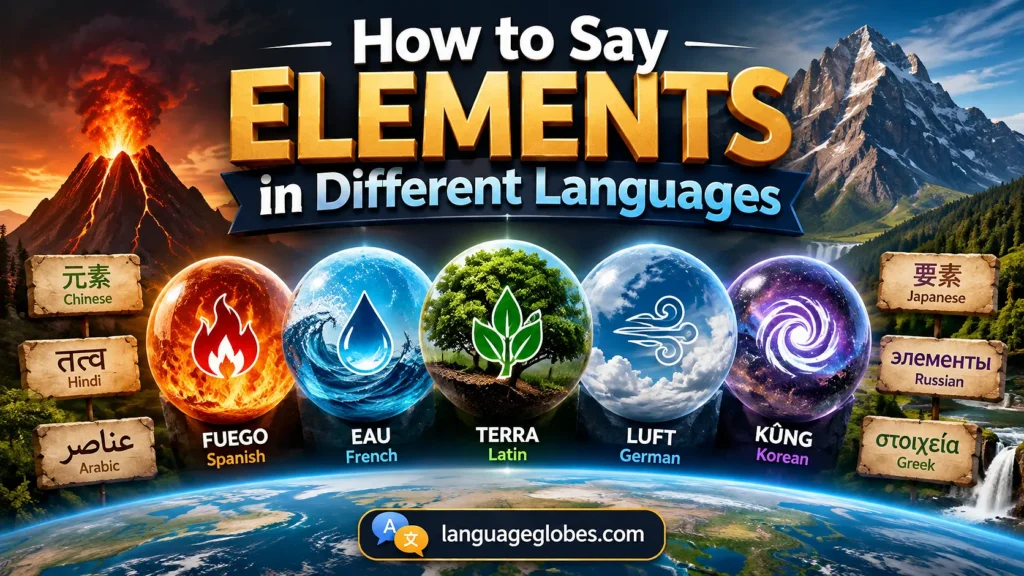
Chemical elements are fundamental components of matter, forming the basic building blocks of our universe. Learning the concept of elements across different languages connects science, chemistry, and linguistic diversity.
From oxygen and hydrogen to gold and carbon, these terms appear worldwide. Understanding scientific vocabulary can support education, language learning, and cultural understanding.
This guide explores how to say element and chemical elements in multiple languages naturally. It offers useful vocabulary, helping every student, teacher, traveler, and language enthusiast learn with confidence.
Exploring multilingual translations also makes scientific terminology easier to understand across cultures. This approach supports communication skills, knowledge, and fascinating language learning through meaningful words.
Also Read This: How to Say Elk in Different Languages
Interesting Facts About Elements
- The word “elements” is widely used in science, especially in chemistry and physics.
- Most languages have a specific scientific term for chemical elements.
- The modern concept of chemical elements was developed through centuries of scientific discovery.
- The periodic table currently contains more than 100 recognized chemical elements.
- Many languages borrow scientific vocabulary from Latin, Greek, or international scientific terminology.
- Learning scientific words in different languages helps students access educational resources worldwide.
- The pronunciation of “elements” varies greatly across language families.
- Some languages use native words, while others adapt international scientific terms.
- The study of elements is fundamental to chemistry, engineering, medicine, and environmental science.
- Scientific vocabulary often reflects the history and development of education in different cultures.
How to Say Elements in Different Languages
The word “elements” is translated differently around the world. Below you will find translations, pronunciations, and examples from more than 70 languages.
European Languages
Europe is home to dozens of languages from Germanic, Romance, Slavic, Celtic, and other language families. Scientific terminology in many European languages often shares roots from Latin and Greek, making some translations appear similar. Despite these similarities, pronunciation and usage vary significantly from country to country.
| Language | Country/Region | Translation | Pronunciation | Example Sentence |
| 🇺🇸 American English | USA | Elements | EL-uh-ments | The elements are listed in the periodic table. |
| 🇬🇧 British English | United Kingdom | Elements | EL-uh-ments | Students learn about elements in chemistry. |
| 🇦🇺 Australian English | Australia | Elements | EL-uh-ments | We studied the elements today. |
| 🇫🇷 French | France | Éléments | ay-lay-mon | Les éléments sont importants en chimie. |
| 🇪🇸 Spanish | Spain | Elementos | eh-leh-MEN-tos | Los elementos forman toda la materia. |
| 🇵🇹 Portuguese | Portugal | Elementos | eh-leh-MEN-tush | Os elementos são essenciais na ciência. |
| 🇮🇹 Italian | Italy | Elementi | eh-leh-MEN-tee | Gli elementi sono studiati a scuola. |
| 🇩🇪 German | Germany | Elemente | eh-leh-MEN-teh | Die Elemente stehen im Periodensystem. |
| 🇳🇱 Dutch | Netherlands | Elementen | eh-leh-MEN-ten | De elementen zijn belangrijk. |
| 🇸🇪 Swedish | Sweden | Element | eh-leh-MENT | Grundämnen är kemiska element. |
| 🇳🇴 Norwegian | Norway | Elementer | eh-leh-MEN-ter | Elementene finnes i naturen. |
| 🇩🇰 Danish | Denmark | Elementer | eh-leh-MEN-ter | Elementer bruges i kemi. |
| 🇫🇮 Finnish | Finland | Alkuaineet | AL-koo-ai-ne-et | Alkuaineet ovat tärkeitä. |
| 🇵🇱 Polish | Poland | Pierwiastki | pyer-VYAST-kee | Pierwiastki są podstawą chemii. |
| 🇨🇿 Czech | Czech Republic | Prvky | PRV-kee | Prvky jsou důležité. |
| 🇸🇰 Slovak | Slovakia | Prvky | PRV-kee | Prvky sa učia v škole. |
| 🇭🇺 Hungarian | Hungary | Elemek | EH-leh-mek | Az elemek fontosak. |
| 🇷🇴 Romanian | Romania | Elemente | eh-leh-MEN-teh | Elementele sunt utile. |
| 🇬🇷 Greek | Greece | Στοιχεία | stoi-HEE-a | Τα στοιχεία είναι σημαντικά. |
| 🇷🇺 Russian | Russia | Элементы | eh-leh-MEN-ty | Элементы изучают в химии. |
| 🇺🇦 Ukrainian | Ukraine | Елементи | eh-leh-MEN-ty | Елементи важливі. |
| 🇧🇬 Bulgarian | Bulgaria | Елементи | eh-leh-MEN-tee | Елементите са важни. |
| 🇭🇷 Croatian | Croatia | Elementi | eh-leh-MEN-tee | Elementi su važni. |
| 🇷🇸 Serbian | Serbia | Елементи | eh-leh-MEN-tee | Елементи су важни. |
Asian Languages
Asia is the largest continent and contains an extraordinary variety of languages and writing systems. Scientific vocabulary in Asian languages often combines native linguistic traditions with modern terminology developed through education and research. Learning these translations helps connect with millions of speakers across the region.
| Language | Country/Region | Translation | Pronunciation | Example Sentence |
| 🇨🇳 Chinese (Simplified) | China | 元素 | yuan-su | 元素是化学的基础。 |
| 🇹🇼 Chinese (Traditional) | Taiwan | 元素 | yuan-su | 元素很重要。 |
| 🇯🇵 Japanese | Japan | 元素 | gen-so | 元素を勉強します。 |
| 🇰🇷 Korean | South Korea | 원소 | won-so | 원소는 화학의 기초입니다. |
| 🇮🇳 Hindi | India | तत्व | tat-va | तत्व विज्ञान में महत्वपूर्ण हैं। |
| 🇵🇰 Urdu | Pakistan | عناصر | anasir | عناصر کیمسٹری کا حصہ ہیں۔ |
| 🇧🇩 Bengali | Bangladesh | মৌল | moul | মৌল রসায়নে গুরুত্বপূর্ণ। |
| 🇮🇳 Punjabi | India/Pakistan | ਤੱਤ | tatt | ਤੱਤ ਵਿਗਿਆਨ ਵਿੱਚ ਮਹੱਤਵਪੂਰਨ ਹਨ। |
| 🇮🇳 Gujarati | India | તત્વો | tat-vo | તત્વો મહત્વપૂર્ણ છે. |
| 🇮🇳 Marathi | India | मूलद्रव्ये | mool-dra-vye | मूलद्रव्ये रसायनशास्त्रात महत्त्वाची आहेत. |
| 🇮🇳 Tamil | India | தனிமங்கள் | tha-ni-mang-gal | தனிமங்கள் அறிவியலில் முக்கியம். |
| 🇮🇳 Telugu | India | మూలకాలు | moo-la-ka-lu | మూలకాలు ముఖ్యమైనవి. |
| 🇮🇳 Kannada | India | ಮೂಲಧಾತುಗಳು | moo-la-dhaa-tu-ga-lu | ಮೂಲಧಾತುಗಳು ಮುಖ್ಯ. |
| 🇮🇳 Malayalam | India | മൂലകങ്ങൾ | moo-la-ka-ngal | മൂലകങ്ങൾ പ്രധാനമാണ്. |
| 🇳🇵 Nepali | Nepal | तत्वहरू | tat-wa-ha-roo | तत्वहरू महत्वपूर्ण छन्। |
| 🇱🇰 Sinhala | Sri Lanka | මූලද්රව්ය | moo-la-dra-vya | මූලද්රව්ය වැදගත්ය. |
| 🇹🇭 Thai | Thailand | ธาตุ | thaat | ธาตุมีความสำคัญ. |
| 🇻🇳 Vietnamese | Vietnam | Nguyên tố | ngoo-yen-to | Nguyên tố rất quan trọng. |
| 🇮🇩 Indonesian | Indonesia | Unsur | oon-soor | Unsur dipelajari dalam kimia. |
| 🇲🇾 Malay | Malaysia | Unsur | oon-soor | Unsur penting dalam sains. |
| 🇵🇭 Filipino | Philippines | Elemento | eh-leh-MEN-to | Ang elemento ay mahalaga. |
| 🇰🇭 Khmer | Cambodia | ធាតុ | thia-tu | ធាតុសំខាន់ណាស់។ |
| 🇱🇦 Lao | Laos | ທາດ | thaat | ທາດເປັນພື້ນຖານ. |
| 🇲🇳 Mongolian | Mongolia | Элемент | eh-leh-ment | Элемент чухал. |
African Languages
Africa is one of the most linguistically diverse continents in the world, with thousands of languages spoken across its regions. Scientific education continues to grow throughout Africa, and many languages have developed terminology for discussing chemistry, physics, and other sciences.
| Language | Country/Region | Translation | Pronunciation | Example Sentence |
| 🇿🇦 Afrikaans | South Africa | Elemente | eh-leh-MEN-teh | Elemente is belangrik. |
| 🇿🇦 Zulu | South Africa | Izakhi | ee-ZAH-khee | Izakhi zibalulekile. |
| 🇿🇦 Xhosa | South Africa | Izakhi | ee-ZAH-khee | Izakhi zibalulekile. |
| 🇰🇪 Swahili | East Africa | Vipengele | vee-pen-GEH-leh | Vipengele ni muhimu. |
| 🇪🇹 Amharic | Ethiopia | ንጥረ ነገሮች | nit-reh neh-ge-roch | ንጥረ ነገሮች አስፈላጊ ናቸው። |
| 🇳🇬 Yoruba | Nigeria | Eroja | eh-ro-ja | Eroja ṣe pataki. |
| 🇳🇬 Igbo | Nigeria | Ihe mejupụtara | ee-heh meh-joo-pu-ta-ra | Ihe mejupụtara dị mkpa. |
| 🇳🇬 Hausa | Nigeria | Sinadarai | see-na-da-rai | Sinadarai suna da muhimmanci. |
| 🇸🇴 Somali | Somalia | Curiye | koo-ri-ye | Curiye waa muhiim. |
| 🇲🇬 Malagasy | Madagascar | Singa | seen-ga | Zava-dehibe ny singa. |
Middle Eastern Languages
The Middle East has a rich history of scientific discovery and scholarship. Many modern scientific terms in the region are influenced by classical Arabic, Persian, and Turkish traditions. Learning these words provides insight into cultures that contributed greatly to the development of science and mathematics.
| Language | Country/Region | Translation | Pronunciation | Example Sentence |
| 🇸🇦 Arabic | Middle East | عناصر | an-a-sir | العناصر مهمة في الكيمياء. |
| 🇮🇷 Persian (Farsi) | Iran | عناصر | ana-ser | عناصر مهم هستند. |
| 🇹🇷 Turkish | Turkey | Elementler | eh-leh-MENT-ler | Elementler önemlidir. |
| 🇮🇱 Hebrew | Israel | יסודות | ye-so-dot | היסודות חשובים במדע. |
| 🇰🇷 Kurdish | Kurdistan Region | Element | eh-leh-ment | Element girîng e. |
| 🇦🇲 Armenian | Armenia | տարրեր | ta-rer | տարրերը կարևոր են։ |
| 🇬🇪 Georgian | Georgia | ელემენტები | eh-leh-men-te-bi | ელემენტები მნიშვნელოვანია. |
Additional Languages Around the World
The world includes many other languages spoken across the Americas, Oceania, and island nations. These languages contribute to global cultural diversity and demonstrate how scientific concepts are expressed in different linguistic traditions.
| Language | Country/Region | Translation | Pronunciation | Example Sentence |
| 🇮🇪 Irish | Ireland | Eilimintí | EL-im-in-tee | Tá na heilimintí tábhachtach. |
| 🏴 Welsh | Wales | Elfennau | el-VEN-eye | Mae elfennau yn bwysig. |
| 🇮🇸 Icelandic | Iceland | Frumefni | FROO-mev-ni | Frumefni eru mikilvæg. |
| 🇪🇪 Estonian | Estonia | Elemendid | eh-leh-men-did | Elemendid on tähtsad. |
| 🇱🇻 Latvian | Latvia | Elementi | eh-leh-men-ti | Elementi ir svarīgi. |
| 🇱🇹 Lithuanian | Lithuania | Elementai | eh-leh-men-tai | Elementai svarbūs. |
| 🇦🇱 Albanian | Albania | Elemente | eh-leh-men-te | Elementet janë të rëndësishme. |
| 🇸🇮 Slovenian | Slovenia | Elementi | eh-leh-men-tee | Elementi so pomembni. |
| 🇧🇦 Bosnian | Bosnia | Elementi | eh-leh-men-tee | Elementi su važni. |
| 🇲🇰 Macedonian | North Macedonia | Елементи | eh-leh-men-tee | Елементите се важни. |
| 🇱🇺 Luxembourgish | Luxembourg | Elementer | eh-leh-men-ter | Elementer si wichteg. |
| 🇲🇹 Maltese | Malta | Elementi | eh-leh-men-tee | L-elementi huma importanti. |
| 🇧🇾 Belarusian | Belarus | Элементы | eh-leh-men-ty | Элементы важныя. |
| 🇦🇿 Azerbaijani | Azerbaijan | Elementlər | eh-leh-ment-ler | Elementlər vacibdir. |
| 🇰🇿 Kazakh | Kazakhstan | Элементтер | eh-leh-ment-ter | Элементтер маңызды. |
| 🇺🇿 Uzbek | Uzbekistan | Elementlar | eh-leh-ment-lar | Elementlar muhim. |
| 🇹🇯 Tajik | Tajikistan | Унсурҳо | oon-soor-ho | Унсурҳо муҳиманд. |
| 🇹🇲 Turkmen | Turkmenistan | Elementler | eh-leh-ment-ler | Elementler möhümdir. |
| 🇵🇬 Tok Pisin | Papua New Guinea | Element | eh-leh-ment | Element i bikpela samting. |
| 🇳🇿 Māori | New Zealand | Huānga | hoo-AH-nga | He mea nui ngā huānga. |
FAQs
What are chemical elements?
Chemical elements are fundamental components of matter and the basic building blocks of the universe. Each element has unique properties and plays an important role in science and chemistry.
How do you say element in different languages?
The word element in different languages changes based on the language and culture. Learning these terms supports language learning, communication, and cultural understanding.
Why learn chemical elements in different languages?
Learning chemical elements in different languages combines scientific vocabulary with linguistic diversity. It can also support education, chemistry studies, and multilingual learning materials.
What are some common chemical elements to learn first?
Oxygen, hydrogen, gold, and carbon are useful examples of chemical elements. They provide a simple introduction to scientific terminology and basic chemistry vocabulary.
How can multilingual translations help with scientific vocabulary?
Multilingual translations make scientific vocabulary easier to understand across languages and cultures. They can improve knowledge, communication skills, and multilingual communication.
Who can benefit from learning element vocabulary in multiple languages?
A student, teacher, traveler, or language enthusiast can benefit from this vocabulary. It offers useful terms for education, culture, and everyday life.
How can I pronounce element names in another language?
A pronunciation guide can help learners pronounce element names more accurately. Audio pronunciation can also make language resources easier to use during language learning.
Does learning element names help with vocabulary development?
Yes, learning element names can support vocabulary development and create a stronger language foundation. These simple terms can also introduce learners to more advanced terms.
How does learning elements support cultural understanding?
Exploring element names across multiple languages highlights cultural diversity and different approaches to scientific discourse. It creates a useful connection between culture, science, and communication.
Where can I find element translations in many languages?
You can explore multilingual listings and language resources that provide translation and pronunciation information. Such resources are useful for multilingual communication, education, and fascinating language learning.
Conclusion
Learning chemical elements in different languages makes scientific vocabulary more accessible while supporting language learning and cultural understanding. Exploring oxygen, hydrogen, gold, and carbon can strengthen vocabulary development, communication skills, and your language foundation. These multilingual translations also help students, teachers, travelers, and language enthusiasts connect science, education, and linguistic diversity. Exploring more element in different languages can be a useful next step for building confident multilingual communication.

James Anderson is a passionate language enthusiast and content creator at LanguageGlobes. With a keen interest in global cultures and communication, he shares insightful and engaging content to help readers explore and master new languages.