
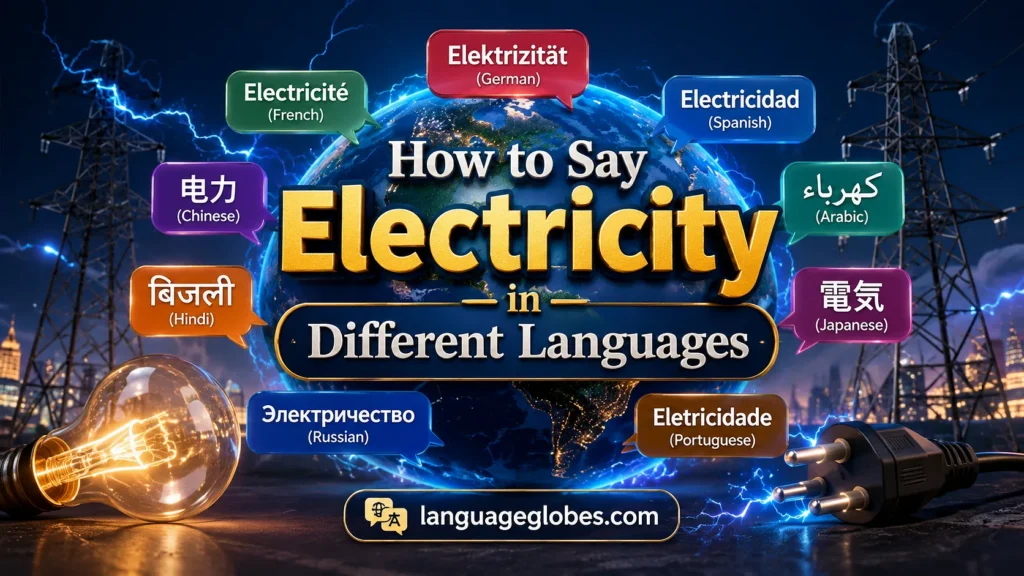
Learning how to say electricity can make language learning more practical and enjoyable. This guide explores electricity in different languages, including electricity translation, electricity translations, and electricity pronunciation for everyday use.
Understanding this common vocabulary helps learners discuss modern life, technology, and science vocabulary with confidence. As a universal concept, electricity plays a fundamental aspect in powering homes, businesses, schools, hospitals, and communication systems.
Exploring different languages also reveals linguistic diversity, unique language vocabulary, and cultural approaches to everyday communication. You will discover useful pronunciation tips, example sentences, and practical translations for stronger global communication and cross-cultural understanding.
Also Read This: How to Say Elements in Different Languages
Interesting Facts About Electricity
- Electricity comes from the Greek word “elektron,” meaning amber.
- Modern civilization depends heavily on electricity for transportation, communication, and healthcare.
- The word for electricity is often similar across many languages because of scientific and international influence.
- Many languages borrowed their electricity-related terms from Latin, Greek, French, or English.
- Learning technical words like electricity helps travelers communicate during emergencies and daily situations.
- Electricity vocabulary is commonly used in schools, universities, engineering fields, and utility services worldwide.
- The concept of electricity became widely known globally during the Industrial Revolution.
- Many countries use unique pronunciations while maintaining similar spellings for the word electricity.
How to Say Electricity in Different Languages
European Languages
Europe is home to dozens of languages belonging mainly to the Germanic, Romance, and Slavic language families. While many European languages use similar scientific terminology, each language has its own pronunciation and usage patterns. Understanding these translations can be especially useful when traveling across Europe or studying international science and technology.
| Language | Country/Region | Translation | Pronunciation | Example Sentence |
| 🇺🇸 American English | United States | Electricity | ih-lek-TRIS-uh-tee | We need electricity to power the house. |
| 🇬🇧 British English | United Kingdom | Electricity | ih-lek-TRIS-uh-tee | The electricity bill arrived today. |
| 🇦🇺 Australian English | Australia | Electricity | ih-lek-TRIS-uh-tee | The storm interrupted the electricity supply. |
| 🇫🇷 French | France | Électricité | ay-lek-tree-see-tay | L’électricité est essentielle à la vie moderne. |
| 🇪🇸 Spanish | Spain | Electricidad | eh-lek-tree-see-DAD | La electricidad alimenta la ciudad. |
| 🇵🇹 Portuguese | Portugal | Eletricidade | eh-leh-tree-see-DAH-de | A eletricidade é importante. |
| 🇮🇹 Italian | Italy | Elettricità | eh-let-tree-chee-TA | L’elettricità è necessaria. |
| 🇩🇪 German | Germany | Elektrizität | eh-lek-tree-tsee-TATE | Elektrizität ist wichtig. |
| 🇳🇱 Dutch | Netherlands | Elektriciteit | eh-lek-tree-see-TATE | Elektriciteit is noodzakelijk. |
| 🇸🇪 Swedish | Sweden | Elektricitet | eh-lek-tree-see-TET | Elektricitet driver våra hem. |
| 🇳🇴 Norwegian | Norway | Elektrisitet | eh-lek-tree-see-TET | Elektrisitet er viktig. |
| 🇩🇰 Danish | Denmark | Elektricitet | eh-lek-tree-see-TET | Elektricitet bruges hver dag. |
| 🇫🇮 Finnish | Finland | Sähkö | SAH-koh | Sähkö on tärkeää. |
| 🇮🇸 Icelandic | Iceland | Rafmagn | RAF-maghn | Rafmagn er nauðsynlegt. |
| 🇵🇱 Polish | Poland | Elektryczność | eh-lek-TRICH-noshch | Elektryczność zasila domy. |
| 🇨🇿 Czech | Czech Republic | Elektřina | eh-lek-trzhi-na | Elektřina je důležitá. |
| 🇸🇰 Slovak | Slovakia | Elektrina | eh-lek-tree-na | Elektrina je potrebná. |
| 🇭🇺 Hungarian | Hungary | Villamosság | vil-la-mo-shag | A villamosság fontos. |
| 🇷🇴 Romanian | Romania | Electricitate | eh-lek-tree-chee-TA-te | Electricitatea este esențială. |
| 🇬🇷 Greek | Greece | Ηλεκτρισμός | ee-lek-tree-SMOS | Ο ηλεκτρισμός είναι σημαντικός. |
| 🇷🇺 Russian | Russia | Электричество | eh-lek-TREE-che-stvo | Электричество необходимо. |
| 🇺🇦 Ukrainian | Ukraine | Електрика | eh-LEK-try-ka | Електрика потрібна. |
Asian Languages
Asia is the largest continent and contains thousands of languages spoken by billions of people. From East Asia to South Asia and Southeast Asia, the word for electricity varies significantly. Many Asian languages have developed unique terms based on local linguistic traditions while incorporating modern scientific concepts.
| Language | Country/Region | Translation | Pronunciation | Example Sentence |
| 🇨🇳 Chinese (Mandarin) | China | 电 | dian | 电很重要。 |
| 🇯🇵 Japanese | Japan | 電気 | den-ki | 電気は必要です。 |
| 🇰🇷 Korean | South Korea | 전기 | jeon-gi | 전기는 중요합니다. |
| 🇮🇳 Hindi | India | बिजली | bij-lee | बिजली हमारे जीवन के लिए जरूरी है। |
| 🇮🇳 Urdu | Pakistan | بجلی | bij-lee | بجلی بہت ضروری ہے۔ |
| 🇮🇳 Bengali | Bangladesh/India | বিদ্যুৎ | bid-dut | বিদ্যুৎ খুব গুরুত্বপূর্ণ। |
| 🇮🇳 Punjabi | India/Pakistan | ਬਿਜਲੀ | bij-lee | ਬਿਜਲੀ ਜ਼ਰੂਰੀ ਹੈ। |
| 🇮🇳 Gujarati | India | વીજળી | veej-lee | વીજળી મહત્વપૂર્ણ છે. |
| 🇮🇳 Marathi | India | वीज | veej | वीज आवश्यक आहे. |
| 🇮🇳 Tamil | India | மின்சாரம் | min-sa-ram | மின்சாரம் முக்கியமானது. |
| 🇮🇳 Telugu | India | విద్యుత్ | vid-yut | విద్యుత్ అవసరం. |
| 🇮🇳 Kannada | India | ವಿದ್ಯುತ್ | vid-yut | ವಿದ್ಯುತ್ ಮುಖ್ಯವಾಗಿದೆ. |
| 🇮🇳 Malayalam | India | വൈദ്യുതി | vai-dyu-ti | വൈദ്യുതി ആവശ്യമാണ്. |
| 🇳🇵 Nepali | Nepal | बिजुली | bi-ju-lee | बिजुली आवश्यक छ। |
| 🇱🇰 Sinhala | Sri Lanka | විදුලිය | vi-du-li-ya | විදුලිය වැදගත්ය. |
| 🇹🇭 Thai | Thailand | ไฟฟ้า | fai-fa | ไฟฟ้ามีความสำคัญ |
| 🇻🇳 Vietnamese | Vietnam | Điện | deen | Điện rất quan trọng. |
| 🇮🇩 Indonesian | Indonesia | Listrik | lis-trik | Listrik sangat penting. |
| 🇲🇾 Malay | Malaysia | Elektrik | eh-lek-trik | Elektrik diperlukan. |
| 🇵🇭 Filipino | Philippines | Kuryente | ku-ryen-te | Mahalaga ang kuryente. |
| 🇰🇭 Khmer | Cambodia | អគ្គិសនី | ak-kee-sa-nee | អគ្គិសនីសំខាន់ណាស់។ |
| 🇲🇳 Mongolian | Mongolia | Цахилгаан | tsa-khil-gaan | Цахилгаан хэрэгтэй. |
African Languages
Africa is one of the most linguistically diverse continents, with thousands of languages spoken across its regions. Many African languages have adapted modern scientific terms while preserving their unique cultural identity. Electricity-related vocabulary is increasingly important as technology and infrastructure continue to grow throughout the continent.
| Language | Country/Region | Translation | Pronunciation | Example Sentence |
| 🇿🇦 Swahili | East Africa | Umeme | oo-meh-meh | Umeme ni muhimu. |
| 🇿🇦 Zulu | South Africa | Ugesi | oo-ge-si | Ugesi ubalulekile. |
| 🇿🇦 Xhosa | South Africa | Umbane | oom-ba-ne | Umbane uyimfuneko. |
| 🇳🇬 Yoruba | Nigeria | Ina mọnamọna | ee-na mo-na-mo-na | Ina mọnamọna ṣe pataki. |
| 🇳🇬 Igbo | Nigeria | Ọkụ eletrik | oh-koo eh-lek-trik | Ọkụ eletrik dị mkpa. |
| 🇳🇬 Hausa | Nigeria | Wutar lantarki | woo-tar lan-tar-kee | Wutar lantarki tana da muhimmanci. |
| 🇪🇹 Amharic | Ethiopia | ኤሌክትሪክ | eh-lek-trik | ኤሌክትሪክ አስፈላጊ ነው። |
| 🇿🇦 Afrikaans | South Africa | Elektrisiteit | eh-lek-tri-si-tate | Elektrisiteit is belangrik. |
| 🇸🇴 Somali | Somalia | Koronto | ko-ron-to | Koronto waa muhiim. |
| 🇲🇬 Malagasy | Madagascar | Herinaratra | he-ri-na-ra-tra | Zava-dehibe ny herinaratra. |
Middle Eastern Languages
The Middle East has a rich linguistic heritage influenced by ancient civilizations, trade routes, and cultural exchanges. Languages from this region are spoken across several continents and have contributed significantly to science, mathematics, and technology throughout history.
| Language | Country/Region | Translation | Pronunciation | Example Sentence |
| 🇸🇦 Arabic | Middle East | كهرباء | kah-hrab-aa | الكهرباء مهمة جداً. |
| 🇮🇷 Persian (Farsi) | Iran | برق | bargh | برق ضروری است. |
| 🇹🇷 Turkish | Turkey | Elektrik | eh-lek-trik | Elektrik önemlidir. |
| 🇮🇱 Hebrew | Israel | חשמל | khash-mal | חשמל חשוב מאוד. |
| 🇰🇼 Kurdish | Kurdistan Region | Karelêk | ka-re-lek | Karelêk girîng e. |
| 🇴🇲 Pashto | Afghanistan | برېښنا | brekh-na | برېښنا مهمه ده. |
| 🇦🇲 Armenian | Armenia | Էլեկտրականություն | eh-lek-tra-ka-nu-tyun | Էլեկտրականությունը կարևոր է։ |
| 🇬🇪 Georgian | Georgia | ელექტროენერგია | eh-lek-tro-eh-ner-gi-a | ელექტროენერგია მნიშვნელოვანია. |
Additional Languages Around the World
The world contains many fascinating languages beyond the major regional groups. These languages reflect the diversity of cultures across Oceania, the Americas, and indigenous communities. Learning their words for electricity offers a broader appreciation of global communication.
| Language | Country/Region | Translation | Pronunciation | Example Sentence |
| 🇳🇿 Maori | New Zealand | Hiko | hee-ko | He mea nui te hiko. |
| 🇼🇸 Samoan | Samoa | Eletise | eh-leh-tee-se | E tāua le eletise. |
| 🇹🇴 Tongan | Tonga | ‘Uhila | oo-hee-la | ‘Oku mahu’inga ‘a e ‘uhila. |
| 🇭🇹 Haitian Creole | Haiti | Elektrisite | eh-lek-tree-see-te | Elektrisite enpòtan. |
| 🇬🇱 Greenlandic | Greenland | Innaallagiaq | in-naa-lla-gee-ak | Innaallagiaq pingaaruteqarpoq. |
| 🇨🇦 Inuktitut | Canada | ᐃᑯᒪᐅᑦ | ee-ku-ma-ut | ᐃᑯᒪᐅᑦ ᐱᑦᔪᑎᖃᖅᐳᖅ. |
| 🇺🇸 Hawaiian | Hawaii | Uila | oo-ee-la | He mea nui ka uila. |
| 🇵🇾 Guarani | Paraguay | Electricidad | eh-lek-tree-see-dad | Electricidad iñimportanteterei. |
| 🇮🇪 Irish | Ireland | Leictreachas | lek-tra-khas | Tá leictreachas tábhachtach. |
| 🏴 Welsh | Wales | Trydan | tru-dan | Mae trydan yn bwysig. |
| 🇱🇹 Lithuanian | Lithuania | Elektra | eh-lek-tra | Elektra svarbi. |
| 🇱🇻 Latvian | Latvia | Elektrība | eh-lek-tree-ba | Elektrība ir svarīga. |
| 🇪🇪 Estonian | Estonia | Elekter | eh-lek-ter | Elekter on oluline. |
| 🇧🇬 Bulgarian | Bulgaria | Електричество | eh-lek-tri-che-stvo | Електричеството е важно. |
| 🇷🇸 Serbian | Serbia | Електрицитет | eh-lek-tri-tsi-tet | Електрицитет је важан. |
| 🇭🇷 Croatian | Croatia | Električna energija | eh-lek-treech-na | Električna energija je važna. |
| 🇸🇮 Slovenian | Slovenia | Elektrika | eh-lek-tree-ka | Elektrika je pomembna. |
| 🇦🇱 Albanian | Albania | Energji elektrike | en-er-gji eh-lek-tri-ke | Energjia elektrike është e rëndësishme. |
| 🇱🇺 Luxembourgish | Luxembourg | Stroum | shtrom | Stroum ass wichteg. |
| 🇲🇹 Maltese | Malta | Elettriku | eh-let-tree-ku | L-elettriku huwa importanti. |
FAQs
How do you say electricity in different languages?
The electricity translation varies across different languages, reflecting rich linguistic diversity. Exploring electricity in different languages helps build useful language vocabulary for everyday and international communication.
What is the meaning of electricity?
Electricity meaning refers to a form of energy used for powering homes, businesses, technology, and communication systems. It is a universal concept that plays a fundamental aspect of modern life.
How do you pronounce electricity correctly?
Electricity pronunciation can be improved by listening carefully and practicing the word aloud. This electricity pronunciation guide also supports clearer language skills and confident communication.
Why learn electricity translations in different languages?
Learning electricity translations is useful for language learning, traveling, education, and international communication. It also introduces learners to common vocabulary used in science and daily conversations.
How can I learn electricity in 70 languages?
Learning electricity in 70 languages provides a broad collection of multilingual vocabulary for learners interested in world languages. Comparing translations can strengthen vocabulary building and cross-cultural understanding.
What are some common translations for electricity?
Common translations include French électricité, German Elektrizität, Italian elettricità, Afrikaans elektrisiteit, and Dutch elektriciteit. These examples show how language vocabulary differs across cultures.
How can example sentences help with electricity vocabulary?
Using example sentences shows how the electricity word works naturally in conversations. This approach makes practical language learning easier and improves vocabulary retention.
Is electricity useful vocabulary for studying science?
Yes, science vocabulary related to electricity is useful when studying science, technology, engineering, and education. Learning these terms can support clearer communication about modern technology.
What are the best ways to practice electricity pronunciation?
Useful pronunciation tips include repeating the word slowly, comparing native speech, and practicing within sentences. Regular practice helps learners read electricity terms and speak them more naturally.
Why is learning electricity vocabulary important for global communication?
Understanding electricity vocabulary supports global communication, especially when discussing technology, education, businesses, and utility services. It also strengthens cross-cultural understanding in a globally connected world.
Conclusion
Learning electricity in different languages is a simple way to expand language vocabulary, improve electricity pronunciation, and support practical language learning. Exploring electricity translations also builds cross-cultural understanding while connecting science vocabulary with modern life. With clear example sentences and useful pronunciation tips, learners can confidently use this universal concept in everyday and global communication. Keep practicing these translations to build stronger language skills and vocabulary.

James Anderson is a passionate language enthusiast and content creator at LanguageGlobes. With a keen interest in global cultures and communication, he shares insightful and engaging content to help readers explore and master new languages.