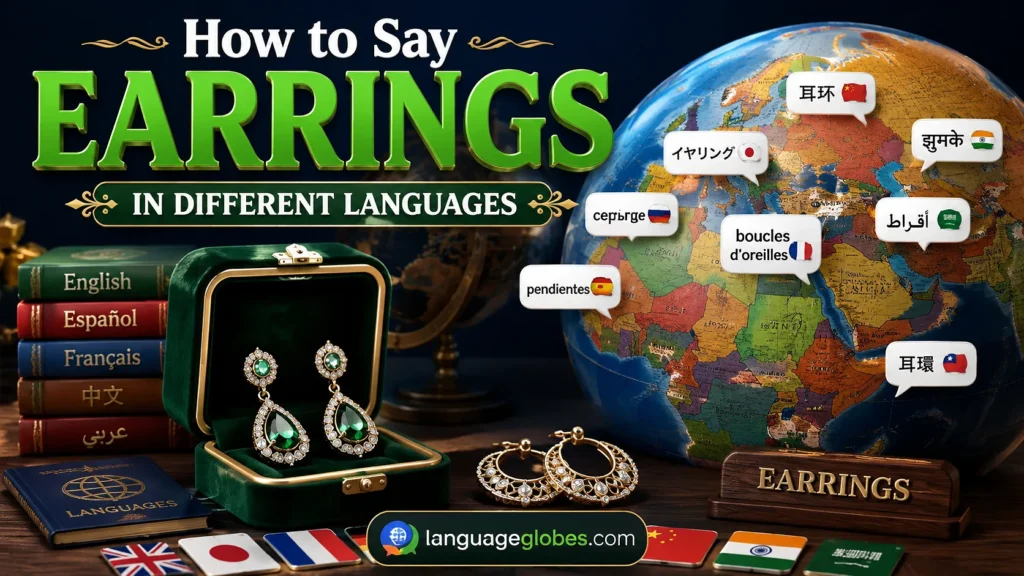
Learning how to say earrings can make language learning more practical and enjoyable. This guide explores earrings in different languages, including useful translations, pronunciation, and everyday vocabulary.
The word may change across different languages, while its meaning remains connected to a familiar accessory. From French, Spanish, Hindi, and Urdu to other regional languages, these terms reveal fascinating cultural differences.
Earrings are more than decorative items, as they can reflect fashion, cultural traditions, identity, and self-expression. Understanding earrings vocabulary can help language learners, travelers, and jewelry enthusiasts communicate naturally while exploring international cultures.
Also Read This: How to Say Earthquake in Different Languages
Interesting Facts About Earrings
- Earrings have been worn for more than 7,000 years in various civilizations.
- Ancient Egyptians used earrings as symbols of wealth and social status.
- Sailors in some cultures wore earrings as symbols of experience and good fortune.
- Earrings are popular among both women and men in many parts of the world.
- Different cultures have unique earring designs that reflect their traditions.
- Some indigenous communities use earrings during important ceremonies and celebrations.
- Modern earrings are made from materials such as gold, silver, platinum, wood, glass, and gemstones.
- The word “earrings” often translates differently depending on whether a language uses singular or plural forms.
- Traditional earrings are important elements of bridal jewelry in many countries.
- Earrings remain one of the most purchased jewelry accessories worldwide.
How to Say Earrings in Different Languages
Below are translations of the word “earrings” across major world languages. Each entry includes the language, region, translation, pronunciation, and an example sentence.
European Languages
Europe is home to hundreds of languages and rich cultural traditions. Jewelry has played an important role in European fashion for centuries, from royal treasures to modern accessories. Learning how to say earrings in European languages can be especially useful for travelers exploring different countries across the continent.
| Language | Country/Region | Translation | Pronunciation | Example Sentence |
| 🇺🇸 American English | USA | Earrings | Ear-rings | I bought new earrings yesterday. |
| 🇬🇧 British English | United Kingdom | Earrings | Ear-rings | She is wearing silver earrings. |
| 🇦🇺 Australian English | Australia | Earrings | Ear-rings | These earrings look beautiful. |
| 🇫🇷 French | France | Boucles d’oreilles | Bookl doh-ray | J’aime ces boucles d’oreilles. |
| 🇪🇸 Spanish | Spain | Pendientes | Pen-dee-en-tes | Me gustan estos pendientes. |
| 🇵🇹 Portuguese | Portugal | Brincos | Breen-kos | Ela usa brincos dourados. |
| 🇮🇹 Italian | Italy | Orecchini | O-rek-kee-nee | Mi piacciono questi orecchini. |
| 🇩🇪 German | Germany | Ohrringe | Ohr-ring-eh | Sie trägt schöne Ohrringe. |
| 🇳🇱 Dutch | Netherlands | Oorbellen | Oor-bel-len | Ik koop nieuwe oorbellen. |
| 🇸🇪 Swedish | Sweden | Örhängen | Ur-heng-en | Hon har fina örhängen. |
| 🇳🇴 Norwegian | Norway | Øredobber | Uh-reh-dob-ber | Jeg liker disse øredobbene. |
| 🇩🇰 Danish | Denmark | Øreringe | Uh-re-ring-eh | Hun har nye øreringe. |
| 🇫🇮 Finnish | Finland | Korvakorut | Kor-va-ko-rut | Nämä korvakorut ovat kauniit. |
| 🇮🇸 Icelandic | Iceland | Eyrnalokkar | Ayr-na-lok-kar | Hún er með fallega eyrnalokka. |
| 🇵🇱 Polish | Poland | Kolczyki | Kol-chee-kee | Lubię te kolczyki. |
| 🇨🇿 Czech | Czech Republic | Náušnice | Nau-shnit-se | Líbí se mi ty náušnice. |
| 🇸🇰 Slovak | Slovakia | Náušnice | Nau-shnit-se | Páčia sa mi tieto náušnice. |
| 🇭🇺 Hungarian | Hungary | Fülbevaló | Fuel-be-va-lo | Szép fülbevalója van. |
| 🇷🇴 Romanian | Romania | Cercei | Cher-chey | Îmi plac acești cercei. |
| 🇬🇷 Greek | Greece | Σκουλαρίκια | Skoo-la-ree-kya | Μου αρέσουν τα σκουλαρίκια. |
| 🇷🇺 Russian | Russia | Серьги | Ser-gee | Мне нравятся эти серьги. |
| 🇺🇦 Ukrainian | Ukraine | Сережки | Se-rezh-ky | Мені подобаються ці сережки. |
| 🇧🇬 Bulgarian | Bulgaria | Обеци | O-be-tsi | Харесвам тези обеци. |
| 🇭🇷 Croatian | Croatia | Naušnice | Nau-shnit-se | Volim ove naušnice. |
| 🇷🇸 Serbian | Serbia | Минђуше | Min-joo-she | Sviđaju mi se ove minđuše. |
Asian Languages
Asia is the largest continent and contains thousands of languages spoken by billions of people. Jewelry traditions vary greatly across Asia, from elaborate wedding ornaments in South Asia to elegant minimalist designs in East Asia. Earrings are widely used in cultural celebrations, fashion, and religious ceremonies throughout the region.
| Language | Country/Region | Translation | Pronunciation | Example Sentence |
| 🇨🇳 Chinese (Mandarin) | China | 耳环 | Er-hwan | 我喜欢这些耳环。 |
| 🇯🇵 Japanese | Japan | イヤリング | Ee-ya-rin-gu | このイヤリングが好きです。 |
| 🇰🇷 Korean | South Korea | 귀걸이 | Gwi-go-ri | 이 귀걸이가 예뻐요. |
| 🇮🇳 Hindi | India | झुमके | Jhoom-kay | मुझे ये झुमके पसंद हैं। |
| 🇵🇰 Urdu | Pakistan | بالیاں | Baa-li-yaan | مجھے یہ بالیاں پسند ہیں۔ |
| 🇧🇩 Bengali | Bangladesh | কানের দুল | Ka-ner dul | আমি এই কানের দুল পছন্দ করি। |
| 🇮🇳 Punjabi | India/Pakistan | ਵਾਲੀਆਂ | Va-lee-an | ਮੈਨੂੰ ਇਹ ਵਾਲੀਆਂ ਪਸੰਦ ਹਨ। |
| 🇮🇳 Gujarati | India | કાનના ટોપ્સ | Kaan-na tops | મને આ કાનના ટોપ્સ ગમે છે. |
| 🇮🇳 Marathi | India | कानातले | Kaa-naat-lay | मला ही कानातले आवडतात. |
| 🇮🇳 Tamil | India | காதணி | Kaa-tha-ni | எனக்கு இந்த காதணி பிடிக்கும். |
| 🇮🇳 Telugu | India | చెవిపోగులు | Che-vi-po-gu-lu | నాకు ఈ చెవిపోగులు ఇష్టం. |
| 🇮🇳 Kannada | India | ಕಿವಿಯೋಲೆ | Ki-vi-o-lay | ನನಗೆ ಈ ಕಿವಿಯೋಲೆ ಇಷ್ಟ. |
| 🇮🇳 Malayalam | India | കമ്മൽ | Kam-mal | എനിക്ക് ഈ കമ്മൽ ഇഷ്ടമാണ്. |
| 🇳🇵 Nepali | Nepal | कानका गहना | Kaan-ka ga-ha-na | मलाई यी कानका गहना मन पर्छ। |
| 🇱🇰 Sinhala | Sri Lanka | කරාබු | Ka-ra-bu | මම මේ කරාබු වලට කැමතියි. |
| 🇹🇭 Thai | Thailand | ต่างหู | Tang-hoo | ฉันชอบต่างหูคู่นี้ |
| 🇻🇳 Vietnamese | Vietnam | Khuyên tai | Khwen tai | Tôi thích khuyên tai này. |
| 🇮🇩 Indonesian | Indonesia | Anting-anting | An-ting an-ting | Saya suka anting-anting ini. |
| 🇲🇾 Malay | Malaysia | Anting-anting | An-ting an-ting | Saya suka anting-anting ini. |
| 🇵🇭 Filipino | Philippines | Hikaw | Hee-kaw | Gusto ko ang hikaw na ito. |
| 🇰🇭 Khmer | Cambodia | ក្រវិល | Kro-vil | ខ្ញុំចូលចិត្តក្រវិលនេះ។ |
| 🇱🇦 Lao | Laos | ຕຸ້ມຫູ | Toom-hoo | ຂ້ອຍມັກຕຸ້ມຫູນີ້. |
African Languages
Africa is home to extraordinary linguistic diversity, with more than 2,000 languages spoken across the continent. Jewelry and personal adornments often have deep cultural meanings in African societies. Earrings can symbolize identity, age, status, beauty, or tribal heritage depending on the region.
| Language | Country/Region | Translation | Pronunciation | Example Sentence |
| 🇿🇦 Swahili | East Africa | Pete za masikio | Pe-te za ma-see-kio | Ninapenda pete za masikio hizi. |
| 🇿🇦 Zulu | South Africa | Amacici | A-ma-see-see | Ngiyawathanda amacici. |
| 🇿🇦 Xhosa | South Africa | Amacici | A-ma-see-see | Ndiyawathanda amacici. |
| 🇳🇬 Yoruba | Nigeria | Afikọti | A-fee-ko-tee | Mo fẹ́ afikọti wọnyi. |
| 🇳🇬 Igbo | Nigeria | Ntị ọla | Ntee o-la | Ahụrụ m ntị ọla ndị a n’anya. |
| 🇳🇬 Hausa | Nigeria | ‘Yan kunne | Yan kun-ne | Ina son waɗannan ‘yan kunne. |
| 🇪🇹 Amharic | Ethiopia | የጆሮ ጌጥ | Ye-jo-ro ge-get | እነዚህን የጆሮ ጌጥ እወዳለሁ። |
| 🇰🇪 Somali | Somalia | Hilqado | Hil-ka-do | Waxaan jeclahay hilqadahan. |
| 🇧🇼 Tswana | Botswana | Masale a ditsebe | Ma-sa-le a dit-se-be | Ke rata masale a ditsebe. |
| 🇱🇸 Sesotho | Lesotho | Masale | Ma-sa-le | Ke rata masale ana. |
Middle Eastern Languages
The Middle East has a rich history of jewelry making that stretches back thousands of years. Gold and silver earrings have long been valued in the region, often appearing in traditional clothing, weddings, and cultural celebrations. Many Middle Eastern languages reflect this deep appreciation for craftsmanship and adornment.
| Language | Country/Region | Translation | Pronunciation | Example Sentence |
| 🇸🇦 Arabic | Middle East | أقراط | Aq-rat | أحب هذه الأقراط. |
| 🇮🇷 Persian (Farsi) | Iran | گوشواره | Goo-sh-va-reh | من این گوشواره را دوست دارم. |
| 🇹🇷 Turkish | Türkiye | Küpe | Kyu-peh | Bu küpeleri seviyorum. |
| 🇮🇱 Hebrew | Israel | עגילים | A-gee-leem | אני אוהב את העגילים האלה. |
| 🇰🇷 Kurdish | Kurdistan Region | Guhwar | Goo-hwar | Ez ji van guhwaran hez dikim. |
| 🇦🇲 Armenian | Armenia | Ականջօղ | A-kan-jogh | Ես սիրում եմ այս ականջօղերը։ |
| 🇬🇪 Georgian | Georgia | საყურე | Sa-ku-re | ეს საყურე მომწონს. |
Additional Languages Around the World
Languages from the Americas, Oceania, and indigenous communities contribute significantly to the world’s linguistic heritage. Learning these translations helps expand cultural awareness and appreciation for the diversity of human communication.
| Language | Country/Region | Translation | Pronunciation | Example Sentence |
| 🇭🇹 Haitian Creole | Haiti | Zanno | Zan-no | Mwen renmen zanno sa yo. |
| 🇳🇿 Māori | New Zealand | Whakakai | Fa-ka-kai | He pai ki ahau ēnei whakakai. |
| 🇼🇸 Samoan | Samoa | Tautaliga | Tau-ta-lee-ga | Ou te fiafia i nei tautaliga. |
| 🇹🇴 Tongan | Tonga | Tautalinga | Tau-ta-ling-a | Oku ou saiʻia e ngaahi tautalinga. |
| 🇭🇺 Esperanto | International | Orelringoj | O-rel-rin-goy | Mi ŝatas tiujn orelringojn. |
| 🇮🇪 Irish | Ireland | Cluaise | Kloo-a-sha | Is maith liom na cluaise seo. |
| 🏴 Welsh | Wales | Clustdlysau | Clist-dlus-eye | Rwy’n hoffi’r clustdlysau hyn. |
| 🇪🇪 Estonian | Estonia | Kõrvarõngad | Kur-va-rung-gad | Mulle meeldivad need kõrvarõngad. |
| 🇱🇻 Latvian | Latvia | Auskari | Aus-ka-ri | Man patīk šie auskari. |
| 🇱🇹 Lithuanian | Lithuania | Auskarai | Aus-ka-rai | Man patinka šie auskarai. |
| 🇸🇮 Slovenian | Slovenia | Uhani | U-ha-ni | Všeč so mi ti uhani. |
| 🇧🇦 Bosnian | Bosnia | Naušnice | Nau-shnit-se | Sviđaju mi se ove naušnice. |
| 🇦🇱 Albanian | Albania | Vathë | Va-the | Më pëlqejnë këto vathë. |
| 🇲🇰 Macedonian | North Macedonia | Обетки | O-bet-ki | Ми се допаѓаат овие обетки. |
| 🇲🇹 Maltese | Malta | Imsielet | Im-see-let | Jogħġbuni dawn l-imsielet. |
FAQs
What is the word for earrings in different languages?
The word for earrings changes across different languages and language regions. This guide provides useful earrings translation, pronunciation, and multilingual vocabulary for learners.
How do you say earrings in different languages?
You can learn how to say earrings in languages such as French, Spanish, Hindi, and Urdu. Each translation offers a useful example of global language and international cultures.
What are earrings in different languages called?
Earrings in different languages have unique terms shaped by local vocabulary and culture. Learning these words improves earrings vocabulary and supports practical language learning.
What is the earring translation in French and Spanish?
The French term is boucle d’oreille, while Spanish commonly uses pendiente or arete. These examples show how language pronunciation and vocabulary can vary between cultures.
How do you say earrings in Hindi and Urdu?
In Hindi, kaani ki baali and jhumka are commonly associated with earrings. Urdu also has familiar terms connected with traditional jewelry and everyday accessory vocabulary.
Why learn the word for earrings in other languages?
Knowing the word for earrings can help travelers, language learners, and shoppers communicate more easily. It is useful when shopping abroad or exploring local markets.
What is the difference between earring and earrings translation?
Earring refers to one item, while earrings refers to two or more pieces. Learning both forms helps build accurate everyday vocabulary and language skills.
Are earrings important in different cultures?
Yes, earrings can represent cultural significance, identity, status, and self-expression. Their designs often reflect unique cultural traditions and traditional jewelry styles.
How can I learn easy pronunciation for earrings translations?
Practice each translation slowly and compare its written form with reliable language pronunciation guidance. Repeating the word aloud can make learning vocabulary easier and more natural.
Why are earrings considered a universal accessory?
Earrings are a popular fashion accessory found across many global cultures and societies. Their designs range from simple studs and elegant hoops to traditional handcrafted designs.
Conclusion
Learning how to say earrings in different languages makes language learning more useful and engaging. Exploring earrings translation, pronunciation, and earrings vocabulary helps language learners communicate confidently across different cultures. From French, Spanish, Hindi, and Urdu to other regional languages, these words highlight cultural diversity and traditional jewelry. Understanding these terms also makes travel, shopping abroad, and discovering international cultures easier and more enjoyable.

Lucy Carter is a curious mind and language lover who writes for Language Globes. She enjoys discovering new languages and sharing simple, helpful ideas that make learning fun and accessible for everyone.