
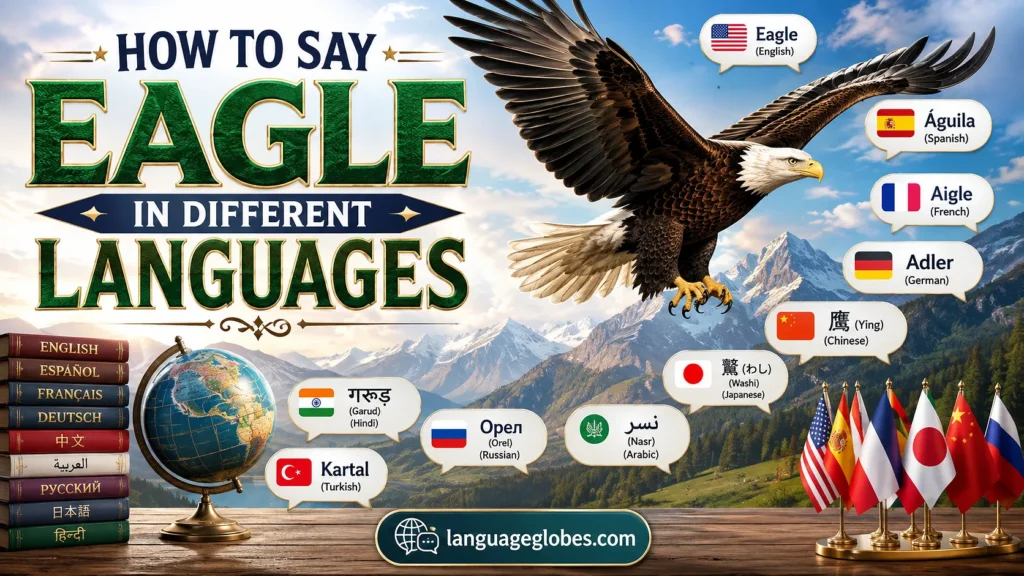
The eagle is a majestic bird often linked with strength, freedom, courage, and leadership. Across cultures and different languages, this powerful bird carries deep meanings shaped by history, traditions, myths, and national symbols.
Learning how to say eagle in multiple languages offers more than useful vocabulary because it reveals cultural diversity, linguistic diversity, and the ways people understand nature. This guide explores the translation of eagle, pronunciation, and cultural meanings across world languages.
Whether you are a traveler, language learner, student, teacher, or writer, exploring eagle translations can deepen your understanding of language diversity. From Spanish águila and French aigle to German Adler, Italian aquila, and Arabic عقاب, each language reflects unique linguistic traditions.
The Urdu word عقاب is commonly pronounced uqaab, while regional usage may vary. These translations, example sentences, and pronunciation details help readers communicate effectively while discovering the cultural significance of this respected symbol.
Also Read This: How to Say Ears in Different Languages
Interesting Facts About Eagle
- Eagles are among the strongest birds of prey in the world.
- They have exceptional eyesight and can spot prey from several kilometers away.
- Eagles are found on every continent except Antarctica.
- The bald eagle is the national bird of the United States. 🇺🇸
- Many cultures view eagles as symbols of freedom, power, and wisdom.
- Eagles can fly at very high altitudes and travel long distances.
- Some eagle species have wingspans exceeding 7 feet (2 meters).
- Ancient Roman armies used eagle symbols on their military standards.
- Eagles are often featured on national flags, coats of arms, and emblems.
- Their strong talons allow them to catch and carry heavy prey.
How to Say Eagle in Different Languages
European Languages
Europe is home to hundreds of languages belonging to several language families, including Germanic, Romance, Slavic, Celtic, and Baltic languages. Throughout European history, eagles have been symbols of kingdoms, empires, and national identity. Learning the European translations of eagle helps language learners understand the region’s rich cultural heritage.
| Language | Country/Region | Translation | Pronunciation | Example Sentence |
| American English 🇺🇸 | USA | Eagle | EE-guhl | The eagle flies high in the sky. |
| British English 🇬🇧 | United Kingdom | Eagle | EE-guhl | An eagle was seen above the mountains. |
| Australian English 🇦🇺 | Australia | Eagle | EE-guhl | We spotted an eagle during our trip. |
| French 🇫🇷 | France | Aigle | EHG-luh | L’aigle vole dans le ciel. |
| Spanish 🇪🇸 | Spain | Águila | AH-gee-la | El águila vuela alto. |
| Portuguese 🇵🇹 | Portugal | Águia | AH-ghee-ah | A águia é majestosa. |
| Italian 🇮🇹 | Italy | Aquila | AH-kwee-la | L’aquila vola in alto. |
| German 🇩🇪 | Germany | Adler | AHD-ler | Der Adler fliegt hoch. |
| Dutch 🇳🇱 | Netherlands | Adelaar | AH-duh-lar | De adelaar vliegt hoog. |
| Swedish 🇸🇪 | Sweden | Örn | UURN | Örnen flyger högt. |
| Norwegian 🇳🇴 | Norway | Ørn | UURN | Ørnen flyr høyt. |
| Danish 🇩🇰 | Denmark | Ørn | UURN | Ørnen flyver højt. |
| Finnish 🇫🇮 | Finland | Kotka | KOT-ka | Kotka lentää korkealla. |
| Icelandic 🇮🇸 | Iceland | Örn | UURN | Örninn flýgur hátt. |
| Polish 🇵🇱 | Poland | Orzeł | OR-zhel | Orzeł leci wysoko. |
| Czech 🇨🇿 | Czech Republic | Orel | OH-rel | Orel letí vysoko. |
| Slovak 🇸🇰 | Slovakia | Orol | OH-rol | Orol letí vysoko. |
| Hungarian 🇭🇺 | Hungary | Sas | SHASH | A sas magasan repül. |
| Romanian 🇷🇴 | Romania | Vultur | VOOL-toor | Vulturul zboară sus. |
| Bulgarian 🇧🇬 | Bulgaria | Орел | O-rel | Орелът лети високо. |
| Croatian 🇭🇷 | Croatia | Orao | OH-rao | Orao leti visoko. |
| Serbian 🇷🇸 | Serbia | Orao | OH-rao | Orao leti visoko. |
| Slovenian 🇸🇮 | Slovenia | Orel | OH-rel | Orel leti visoko. |
| Ukrainian 🇺🇦 | Ukraine | Орел | O-rel | Орел летить високо. |
| Russian 🇷🇺 | Russia | Орёл | A-ryol | Орёл летит высоко. |
| Greek 🇬🇷 | Greece | Αετός | Ae-TOS | Ο αετός πετά ψηλά. |
Asian Languages
Asia is the largest continent and contains thousands of languages spoken by billions of people. Eagles appear in many Asian legends, spiritual traditions, and folk stories. The translations below represent some of the most widely spoken languages across Asia.
| Language | Country/Region | Translation | Pronunciation | Example Sentence |
| Chinese (Mandarin) 🇨🇳 | China | 鹰 | Ying | 鹰在天空中飞翔。 |
| Japanese 🇯🇵 | Japan | ワシ | Wa-shi | ワシは高く飛びます。 |
| Korean 🇰🇷 | South Korea | 독수리 | Dok-su-ri | 독수리가 높이 난다. |
| Hindi 🇮🇳 | India | चील | Cheel | चील आसमान में उड़ती है। |
| Urdu 🇵🇰 | Pakistan | عقاب | Uqaab | عقاب بلند پرواز کرتا ہے۔ |
| Bengali 🇧🇩 | Bangladesh | ঈগল | Ee-gol | ঈগল আকাশে উড়ছে। |
| Punjabi | India/Pakistan | ਉਕਾਬ | U-kaab | ਉਕਾਬ ਉੱਚਾ ਉੱਡਦਾ ਹੈ। |
| Gujarati | India | ગરુડ | Ga-rud | ગરુડ ઊંચે ઉડે છે. |
| Marathi | India | गरुड | Ga-rud | गरुड उंच उडतो. |
| Tamil | India | கழுகு | Ka-zhu-gu | கழுகு உயரமாக பறக்கிறது. |
| Telugu | India | గద్ద | Gad-da | గద్ద ఎత్తుగా ఎగురుతుంది. |
| Kannada | India | ಗಿಡುಗ | Gi-du-ga | ಗಿಡುಗ ಎತ್ತರದಲ್ಲಿ ಹಾರುತ್ತದೆ. |
| Malayalam | India | കഴുകൻ | Ka-zhu-kan | കഴുകൻ ഉയരത്തിൽ പറക്കുന്നു. |
| Sinhala 🇱🇰 | Sri Lanka | රාජාලියා | Ra-ja-li-ya | රාජාලියා ඉහළට පියාසර කරයි. |
| Nepali 🇳🇵 | Nepal | चिल | Chil | चिल आकाशमा उड्छ। |
| Thai 🇹🇭 | Thailand | นกอินทรี | Nok In-see | นกอินทรีบินสูง |
| Vietnamese 🇻🇳 | Vietnam | Đại bàng | Dai Bang | Đại bàng bay cao. |
| Indonesian 🇮🇩 | Indonesia | Elang | Eh-lang | Elang terbang tinggi. |
| Malay 🇲🇾 | Malaysia | Helang | He-lang | Helang terbang tinggi. |
| Filipino 🇵🇭 | Philippines | Agila | A-gee-la | Ang agila ay lumilipad nang mataas. |
| Khmer 🇰🇭 | Cambodia | ឥន្ទ្រី | In-tri | ឥន្ទ្រីហោះខ្ពស់។ |
| Lao 🇱🇦 | Laos | ນົກອິນຊີ | Nok In-si | ນົກອິນຊີບິນສູງ. |
| Mongolian 🇲🇳 | Mongolia | Бүргэд | Bur-ged | Бүргэд өндөр нисдэг. |
| Burmese 🇲🇲 | Myanmar | လင်းယုန် | Lin-yone | လင်းယုန်မြင့်ပျံသည်။ |
African Languages
Africa is one of the most linguistically diverse continents, with thousands of languages spoken across its regions. Eagles are admired throughout Africa for their strength and hunting abilities. Many African cultures use birds of prey in folklore and traditional storytelling.
| Language | Country/Region | Translation | Pronunciation | Example Sentence |
| Swahili 🇹🇿 | East Africa | Tai | TAI | Tai anaruka juu. |
| Zulu 🇿🇦 | South Africa | Ukhozi | U-kho-zi | Ukhozi lundiza phezulu. |
| Xhosa 🇿🇦 | South Africa | Ukhozi | U-kho-zi | Ukhozi lubhabha phezulu. |
| Afrikaans 🇿🇦 | South Africa | Arend | AH-rent | Die arend vlieg hoog. |
| Yoruba 🇳🇬 | Nigeria | Idì | Ee-dee | Idì ń fò gíga. |
| Igbo 🇳🇬 | Nigeria | Ugo | U-go | Ugo na-efe elu. |
| Hausa 🇳🇬 | Nigeria | Gaggafa | Gag-ga-fa | Gaggafa tana tashi sama. |
| Amharic 🇪🇹 | Ethiopia | ንስር | Ni-sir | ንስር ከፍ ብሎ ይበራል። |
| Somali 🇸🇴 | Somalia | Gorgor | Gor-gor | Gorgorku wuu duulaa. |
| Shona 🇿🇼 | Zimbabwe | Gondo | Gon-do | Gondo rinobhururuka. |
| Kinyarwanda 🇷🇼 | Rwanda | Kagoma | Ka-go-ma | Kagoma iguruka hejuru. |
| Sesotho 🇱🇸 | Lesotho | Ntsu | N-tsu | Ntsu e fofa holimo. |
Middle Eastern Languages
The Middle East has a rich history that stretches back thousands of years. Eagles and similar birds of prey appear in ancient art, literature, and national emblems throughout the region. These languages reflect the cultural and historical significance of the eagle across Middle Eastern societies.
| Language | Country/Region | Translation | Pronunciation | Example Sentence |
| Arabic 🌍 | Middle East | نسر | Nasr | النسر يطير عالياً. |
| Persian 🇮🇷 | Iran | عقاب | O-ghab | عقاب در آسمان پرواز میکند. |
| Turkish 🇹🇷 | Turkey | Kartal | Kar-tal | Kartal yüksekte uçar. |
| Hebrew 🇮🇱 | Israel | נשר | Ne-sher | הנשר עף גבוה. |
| Kurdish | Kurdistan Region | Kartal | Kar-tal | Kartal bilind difire. |
| Azerbaijani 🇦🇿 | Azerbaijan | Qartal | Qar-tal | Qartal yüksək uçur. |
| Armenian 🇦🇲 | Armenia | Արծիվ | Art-siv | Արծիվը բարձր է թռչում։ |
| Georgian 🇬🇪 | Georgia | არწივი | Art-si-vi | არწივი მაღლა დაფრინავს. |
Additional Languages Around the World
The world contains many unique languages that do not fit neatly into a single regional category. Learning these translations helps create a broader understanding of global communication and cultural diversity.
| Language | Country/Region | Translation | Pronunciation | Example Sentence |
| Hawaiian 🌺 | Hawaii | Aeto | Ah-eh-to | Lele kiʻekiʻe ka aeto. |
| Maori 🇳🇿 | New Zealand | Aeto | Ah-eh-to | Ka rere te aeto. |
| Samoan 🇼🇸 | Samoa | Aeto | Ah-eh-to | E lele maualuga le aeto. |
| Tongan 🇹🇴 | Tonga | Aeto | Ah-eh-to | ʻOku puna māʻolunga ʻa e aeto. |
| Fijian 🇫🇯 | Fiji | Ikeli | Ee-ke-li | E vuka vakacerecere na ikeli. |
| Esperanto 🌍 | International | Aglo | AG-lo | La aglo flugas alte. |
| Latin | Historical | Aquila | AH-kwee-la | Aquila alte volat. |
| Irish 🇮🇪 | Ireland | Iolar | UL-ar | Eitlíonn an t-iolar ard. |
| Welsh 🏴 | Wales | Eryr | ER-ir | Mae’r eryr yn hedfan yn uchel. |
| Scottish Gaelic 🏴 | Scotland | Iolaire | Ee-o-la-reh | Tha an iolaire ag itealaich àrd. |
| Basque | Spain | Arrano | Ar-ra-no | Arranoa altu hegan egiten du. |
| Catalan | Spain | Àguila | AH-ghee-la | L’àguila vola alt. |
| Galician | Spain | Aguia | AH-ghee-ah | A aguia voa alto. |
FAQs
What is the word for eagle in different languages?
The word eagle changes across different languages and reflects linguistic diversity. Common translations include Spanish águila, French aigle, German Adler, and Italian aquila.
How do you say eagle in Spanish and French?
In Spanish, eagle is águila, while in French, it is aigle. These world languages offer useful vocabulary for travelers and language learners.
How do you say eagle in German and Italian?
The German word for eagle is Adler, while Italian uses aquila. Both words demonstrate interesting linguistic variation across Europe.
How do you say eagle in Arabic and Urdu?
In Arabic, eagle is عقاب, commonly pronounced uqaab. Urdu also uses عقاب, making this translation of eagle especially familiar across the Middle East and South Asia.
What does the eagle symbolize in different cultures?
The eagle is often associated with strength, freedom, courage, leadership, vision, and pride. Its cultural significance appears in traditions, myths, and national symbols.
Why is the eagle considered a powerful bird?
The powerful bird represents qualities admired by many cultures, including courage, independence, and leadership. Its image has remained important across civilizations and modern nations.
Is the bald eagle the national bird of the United States?
Yes, the bald eagle is the national bird of the United States. It is strongly connected with national identity, freedom, and the country’s national symbols.
Where can I learn eagle translations and pronunciations?
A useful guide can provide translations, pronunciation, and example sentences across multiple languages. This helps a language learner, student, or traveler understand words more naturally.
How can learning eagle in different languages improve vocabulary?
Learning animal names in multiple languages builds practical vocabulary and encourages a deeper understanding of cultural diversity. It can also help people communicate effectively while exploring world languages.
Why is learning how to say eagle useful for language learners?
Learning how to say eagle introduces useful vocabulary while highlighting cultural heritage and language diversity. Exploring the word across Europe, Asia, Africa, and the Middle East also reveals fascinating regional differences.
Conclusion
Learning how to say eagle in different languages reveals fascinating linguistic diversity and cultural significance. From Spanish, French, German, and Italian to Arabic and Urdu, each translation reflects unique traditions and meanings. Understanding these world languages can expand vocabulary, support language learners, and deepen appreciation for cultural diversity. The eagle remains a powerful symbol of strength, freedom, courage, leadership, and national identity across many cultures.

Joshua Lewis is a passionate language enthusiast and content creator at LanguageGlobes.com. He specializes in exploring global languages, cultures, and communication trends, helping readers connect with the world through words.