
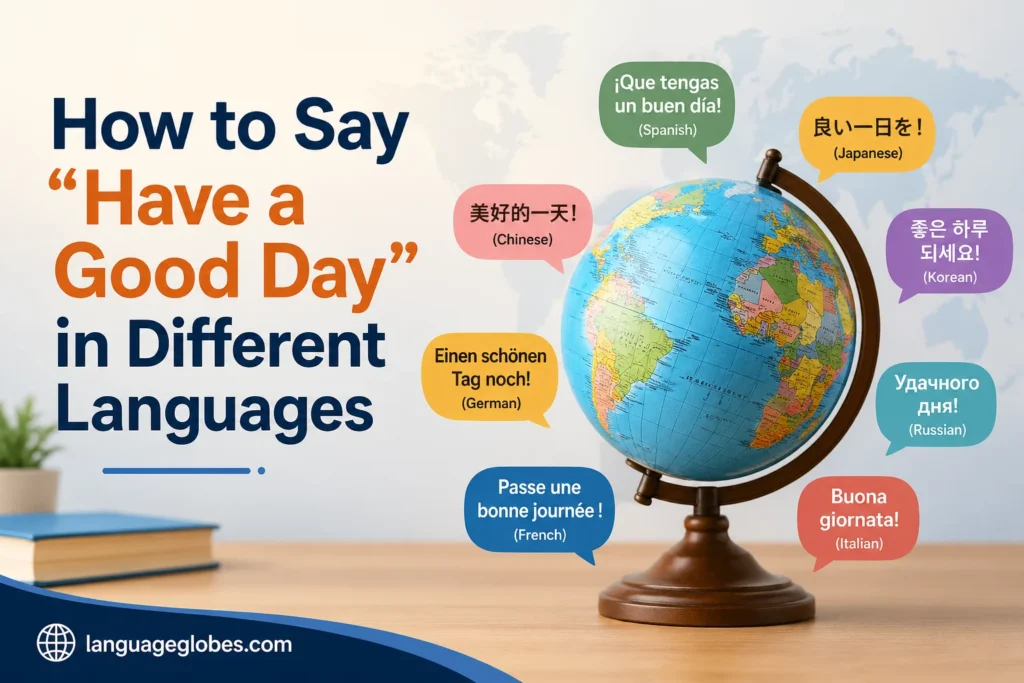
When people search for How to Say “Have a Good Day” in Different Languages, they seek a friendly way to send positive wishes across cultures worldwide.
From experience traveling and making international friends, I’ve noticed how learning a new language and knowing small phrases makes conversations feel more memorable. This phrase goes beyond saying goodbye—it’s about spreading kindness, sharing good vibes, and connecting with others. In this article, you’ll discover how to say it using translations, pronunciations, meanings, and examples, so you’re ready to brighten someone’s day, no matter where in the world you are.
Wishing someone a good day is a universal gesture of kindness and well-wishing that transcends cultural and linguistic boundaries across the globe. It is a simple yet meaningful expression that varies in phraseology but always carries the same warm intent. Even today, as we embark on a journey to explore 70 different languages, this exploration enriches vocabulary and deepens appreciation for the diverse ways people around the world share good wishes with each other.
In daily life, expressing kind wishes is one of the simplest yet most powerful ways to connect. Though it seems small, it spreads warmth, positivity, and goodwill across borders, especially when working with international clients or in everyday expression during interactions. Language reflects culture and can reveal how different societies value politeness, respect, and human connection. In some cultures, it may sound formal, while in others it feels casual. Learning this in multiple languages improves communication, shows cultural awareness, and connects regions like europe, asia, africa, and the middle east. With each translation, pronunciation, and usage style in this comprehensive guide, covering over 70 languages with complete example sentences, you’ll be helping yourself speak like a global citizen.
Interesting Facts About “How to Say Have a Good Day Languages”
- 🌎 The phrase “Have a good day” is considered a universal expression of kindness.
- 🗣️ Some languages don’t translate it directly but use similar phrases like “Go well” or “Be happy.”
- 🤝 In many cultures, such greetings are essential for polite daily interaction.
- ✨ In professional settings, using local greetings can build trust and rapport.
- 📚 Learning simple phrases like this is often the first step in language acquisition.
🌍 European Languages
Europe is home to a rich diversity of languages, many belonging to the Romance, Germanic, and Slavic families. Greetings here often vary between formal and informal contexts, reflecting social etiquette and cultural nuance.
| Language | Country/Region | Translation | Pronunciation | Example Sentence |
| American English 🇺🇸 | USA | Have a good day | hav uh gud dey | Have a good day at work! |
| British English 🇬🇧 | UK | Have a good day | hav uh gud dey | Cheers, have a good day! |
| Australian English 🇦🇺 | Australia | Have a good day | hav uh gud dey | Mate, have a good day! |
| Spanish 🇪🇸 | Spain | Que tengas un buen día | keh ten-gas oon bwen dee-ah | ¡Que tengas un buen día! |
| French 🇫🇷 | France | Bonne journée | bon zhoor-nay | Bonne journée à vous |
| German 🇩🇪 | Germany | Einen schönen Tag | eye-nen shur-nen tahk | Einen schönen Tag noch |
| Italian 🇮🇹 | Italy | Buona giornata | bwon-ah jor-nah-tah | Buona giornata! |
| Portuguese 🇵🇹 | Portugal | Tenha um bom dia | ten-ya oom bom dee-ah | Tenha um bom dia |
| Dutch 🇳🇱 | Netherlands | Fijne dag | fay-nuh dahg | Fijne dag! |
| Swedish 🇸🇪 | Sweden | Ha en bra dag | ha en bra dag | Ha en bra dag! |
| Norwegian 🇳🇴 | Norway | Ha en fin dag | ha en fin dag | Ha en fin dag! |
| Danish 🇩🇰 | Denmark | Hav en god dag | hav en goh day | Hav en god dag |
| Finnish 🇫🇮 | Finland | Hyvää päivää | hoo-vaa pie-vaa | Hyvää päivää |
| Polish 🇵🇱 | Poland | Miłego dnia | mee-weh-go dnia | Miłego dnia! |
| Czech 🇨🇿 | Czech Republic | Hezký den | hez-kee den | Hezký den |
| Slovak 🇸🇰 | Slovakia | Pekný deň | pek-nee den | Pekný deň |
| Hungarian 🇭🇺 | Hungary | Szép napot | sehp nah-pot | Szép napot kívánok |
| Romanian 🇷🇴 | Romania | O zi bună | oh zee boo-nuh | O zi bună! |
| Greek 🇬🇷 | Greece | Καλή μέρα | ka-lee meh-ra | Καλή μέρα! |
| Russian 🇷🇺 | Russia | Хорошего дня | ha-ro-she-go dnya | Хорошего дня! |
🌏 Asian Languages
Asia is linguistically diverse, with thousands of languages across regions. Many Asian cultures emphasize respect and hierarchy, which is reflected in their greetings.
| Language | Country/Region | Translation | Pronunciation | Example Sentence |
| Chinese (Mandarin) 🇨🇳 | China | 祝你有美好的一天 | zhu ni yo may-how duh ee tyen | 祝你有美好的一天 |
| Japanese 🇯🇵 | Japan | 良い一日を | yoi ichinichi o | 良い一日を! |
| Korean 🇰🇷 | Korea | 좋은 하루 되세요 | jo-eun ha-ru dwe-se-yo | 좋은 하루 되세요 |
| Hindi 🇮🇳 | India | आपका दिन शुभ हो | aap-ka din shubh ho | आपका दिन शुभ हो |
| Urdu 🇵🇰 | Pakistan | آپ کا دن اچھا گزرے | aap ka din acha guzray | آپ کا دن اچھا گزرے |
| Bengali 🇧🇩 | Bangladesh | আপনার দিনটি ভালো কাটুক | apnar din-ti bhalo katuk | আপনার দিনটি ভালো কাটুক |
| Tamil 🇮🇳 | India | நல்ல நாளாக இருக்கட்டும் | nalla naal-aaga irukkatum | நல்ல நாளாக இருக்கட்டும் |
| Telugu 🇮🇳 | India | మీ రోజు మంచిగా గడవాలి | mee roju manchiga gadavali | మీ రోజు మంచిగా గడవాలి |
| Thai 🇹🇭 | Thailand | ขอให้เป็นวันที่ดี | kor hai pen wan-tee dee | ขอให้เป็นวันที่ดี |
| Vietnamese 🇻🇳 | Vietnam | Chúc bạn một ngày tốt lành | chook ban mot ngay tot lanh | Chúc bạn một ngày tốt lành |
| Indonesian 🇮🇩 | Indonesia | Semoga harimu menyenangkan | se-mo-ga ha-ri-mu men-ye-nang-kan | Semoga harimu menyenangkan |
| Malay 🇲🇾 | Malaysia | Semoga hari anda baik | se-mo-ga ha-ri an-da baik | Semoga hari anda baik |
| Filipino 🇵🇭 | Philippines | Magandang araw | ma-gan-dang a-raw | Magandang araw |
| Sinhala 🇱🇰 | Sri Lanka | ඔබට සුභ දවසක් | oba-ta subha davasa | ඔබට සුභ දවසක් |
| Nepali 🇳🇵 | Nepal | तपाईंको दिन शुभ रहोस् | tapai ko din shubh rahos | तपाईंको दिन शुभ रहोस् |
🌍 African Languages
Africa is home to over 2,000 languages, making it one of the most linguistically diverse continents. Greetings are often warm and expressive, reflecting strong community values.
| Language | Country/Region | Translation | Pronunciation | Example Sentence |
| Swahili 🇰🇪 | East Africa | Kuwa na siku njema | koo-wa na see-koo n-je-ma | Kuwa na siku njema |
| Zulu 🇿🇦 | South Africa | Ube nosuku oluhle | oo-be no-soo-koo o-loo-hleh | Ube nosuku oluhle |
| Xhosa 🇿🇦 | South Africa | Yiba nosuku oluhle | yee-ba no-soo-koo o-loo-hleh | Yiba nosuku oluhle |
| Yoruba 🇳🇬 | Nigeria | Ní ọjọ́ rere | nee o-jo re-re | Ní ọjọ́ rere |
| Igbo 🇳🇬 | Nigeria | Nwee ụbọchị ọma | nwee ubochi oma | Nwee ụbọchị ọma |
| Hausa 🇳🇬 | Nigeria | Ka yi rana mai kyau | ka yee ra-na mai kyau | Ka yi rana mai kyau |
| Amharic 🇪🇹 | Ethiopia | መልካም ቀን | mel-kam ken | መልካም ቀን |
| Somali 🇸🇴 | Somalia | Maalin wanaagsan | maa-lin wan-aa-gan | Maalin wanaagsan |
| Shona 🇿🇼 | Zimbabwe | Iva nezuva rakanaka | ee-va ne-zu-va ra-ka-na-ka | Iva nezuva rakanaka |
| Afrikaans 🇿🇦 | South Africa | Geniet jou dag | ge-neet yo dag | Geniet jou dag |
Read More: How to Say “Good Afternoon” in Different Languages
🌍 Middle Eastern Languages
The Middle East is rich in history and culture, with languages deeply rooted in tradition. Greetings here often carry blessings and goodwill.
| Language | Country/Region | Translation | Pronunciation | Example Sentence |
| Arabic 🇸🇦 | Middle East | أتمنى لك يوماً سعيداً | atamanna laka yawman sa’eedan | أتمنى لك يوماً سعيداً |
| Persian 🇮🇷 | Iran | روز خوبی داشته باشید | rooz khoobi dashte bashid | روز خوبی داشته باشید |
| Turkish 🇹🇷 | Turkey | İyi günler | ee-yee goon-ler | İyi günler |
| Hebrew 🇮🇱 | Israel | שיהיה לך יום טוב | she-yee-yeh le-cha yom tov | שיהיה לך יום טוב |
| Kurdish 🇮🇶 | Kurdistan | Rojek baş | ro-jek bash | Rojek baş |
❓ FAQ Section
1. Is “Have a good day” used in all cultures?
Not exactly. While the sentiment exists everywhere, some cultures prefer different expressions like “Go safely” or “Stay well.”
2. What’s the difference between formal and informal versions?
Many languages (like Spanish or French) have formal and informal forms depending on the relationship between speakers.
3. Can I use English instead when traveling?
Yes, but using the local language—even just a simple phrase—shows respect and is often appreciated.
4. Is pronunciation important?
Absolutely. Even a slightly correct pronunciation can make your effort more meaningful.
5. What is the easiest language to learn this phrase in?
Languages like Spanish, French, and Italian are often easier for beginners due to their phonetic nature.
Conclusion
Learning how to say “Have a good day” in different languages is more than just a linguistic exercise—it’s a doorway into understanding cultures, building relationships, and spreading positivity worldwide. A simple phrase can brighten someone’s day, whether you’re in a local market, an international meeting, or chatting online.
By mastering these expressions, you not only enhance your communication skills but also become a more empathetic and culturally aware global citizen. So next time you part ways with someone—why not say it in their language?
Have a good day… wherever you are in the world! 🌍✨

Joshua Lewis is a passionate language enthusiast and content creator at LanguageGlobes.com. He specializes in exploring global languages, cultures, and communication trends, helping readers connect with the world through words.