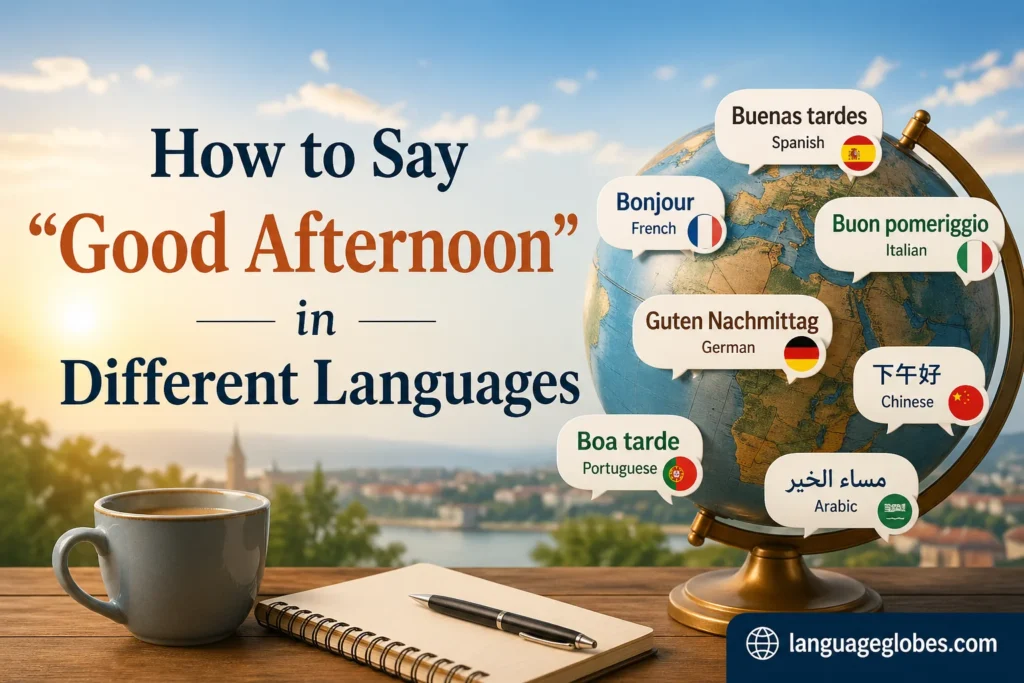
How to Say “Good Afternoon” in Different Languages helps show how language is more than just words, a bridge that connects people. From my experience, even small phrases like I, love, you are often seen as the ultimate expression of affection, yet everyday greetings such as good afternoon also play a powerful role in human connection. I’ve noticed these simple expressions convey respect, warmth, and kindness, making them essential in both personal and professional interactions across cultures, and they feel light yet carry real weight.
What truly stands out is how greetings are deeply rooted in tradition. Saying good afternoon is not just about acknowledging the time of the day—it’s about recognizing the presence of another person. In many places, this habit becomes a reflection of hospitality, politeness, and social harmony. Whether you’re traveling, learning a new language, or building global relationships, I’ve found that understanding how to greet someone properly can make a lasting impression.
Interestingly, different languages express the same idea in unique ways—some are formal, others casual, and depend on context, while many remain universal regardless of the situation. By exploring these variations, you gain real insight into cultural values, communication, and styles worldwide. In this comprehensive guide, you’ll discover how to say it in 70 forms, complete with pronunciation, example, and sentences, all helping you connect across the globe.
🌟 Interesting Facts About How to Say “Good Afternoon” in Different Languages
- 🌍 Greetings vary widely depending on culture, time, and formality.
- 🗣️ Some languages have multiple versions of “Good afternoon” based on respect and hierarchy.
- 🇯🇵 In Japanese, greetings change depending on time and social context.
- 🇪🇸 In Spanish-speaking countries, greetings often reflect warmth and friendliness.
- 🌞 In many cultures, afternoon greetings are used in both formal and casual settings.
- ✨ Learning greetings is often the first step in mastering a new language.
🌍 European Languages
European languages are among the most widely spoken in the world, with deep historical roots and strong cultural influence. Greetings in Europe often reflect politeness and social etiquette, with many languages offering both formal and informal variations. Let’s explore how “Good afternoon” is expressed across this diverse region.
Table: “Good Afternoon” in European Languages
| Language | Country/Region | Translation | Pronunciation | Example Sentence |
| English (US 🇺🇸) | USA | Good afternoon | gud af-ter-noon | Good afternoon, how are you? |
| English (UK 🇬🇧) | UK | Good afternoon | gud af-ter-noon | Good afternoon, sir. |
| English (AU 🇦🇺) | Australia | Good afternoon | gud af-ter-noon | Good afternoon, mate! |
| French 🇫🇷 | France | Bon après-midi | bon ah-pray mee-dee | Bon après-midi, comment ça va ? |
| Spanish 🇪🇸 | Spain | Buenas tardes | bwe-nas tar-des | Buenas tardes, amigo. |
| German 🇩🇪 | Germany | Guten Tag | goo-ten tahg | Guten Tag, wie geht’s? |
| Italian 🇮🇹 | Italy | Buon pomeriggio | bwon po-me-rid-jo | Buon pomeriggio! |
| Portuguese 🇵🇹 | Portugal | Boa tarde | bo-ah tar-de | Boa tarde, tudo bem? |
| Dutch 🇳🇱 | Netherlands | Goedemiddag | hoo-de-mid-dakh | Goedemiddag! |
| Swedish 🇸🇪 | Sweden | God eftermiddag | goo ef-ter-mid-dag | God eftermiddag! |
| Danish 🇩🇰 | Denmark | God eftermiddag | goo ef-ter-mid-dag | God eftermiddag! |
| Norwegian 🇳🇴 | Norway | God ettermiddag | goo et-ter-mid-dag | God ettermiddag! |
| Polish 🇵🇱 | Poland | Dzień dobry | jen doh-bri | Dzień dobry! |
| Czech 🇨🇿 | Czech Republic | Dobré odpoledne | do-breh od-po-led-ne | Dobré odpoledne! |
| Slovak 🇸🇰 | Slovakia | Dobré popoludnie | do-breh po-po-lud-nye | Dobré popoludnie! |
| Hungarian 🇭🇺 | Hungary | Jó napot | yo na-pot | Jó napot kívánok! |
| Romanian 🇷🇴 | Romania | Bună ziua | boo-nuh zee-wa | Bună ziua! |
| Greek 🇬🇷 | Greece | Καλό απόγευμα | ka-lo a-po-yev-ma | Καλό απόγευμα! |
| Finnish 🇫🇮 | Finland | Hyvää iltapäivää | hoo-vaa il-ta-pai-vaa | Hyvää iltapäivää! |
| Irish 🇮🇪 | Ireland | Tráthnóna maith | traw-no-na mah | Tráthnóna maith! |
🌏 Asian Languages
Asia is incredibly diverse, with languages shaped by ancient civilizations, philosophy, and social customs. Greetings here often depend on respect, hierarchy, and time of day. In many Asian cultures, saying “Good afternoon” properly can show politeness and cultural awareness.
Table: “Good Afternoon” in Asian Languages
| Language | Country/Region | Translation | Pronunciation | Example Sentence |
| Chinese (Mandarin) 🇨🇳 | China | 下午好 | xià wǔ hǎo | 下午好,你好吗? |
| Japanese 🇯🇵 | Japan | こんにちは | kon-ni-chi-wa | こんにちは! |
| Korean 🇰🇷 | Korea | 안녕하세요 | an-nyeong-ha-se-yo | 안녕하세요! |
| Hindi 🇮🇳 | India | नमस्कार | na-mas-kar | नमस्कार! |
| Urdu 🇵🇰 | Pakistan | دوپہر بخیر | do-pehr ba-khair | دوپہر بخیر! |
| Bengali 🇧🇩 | Bangladesh | শুভ অপরাহ্ন | shu-bho o-po-ra-hno | শুভ অপরাহ্ন! |
| Tamil 🇮🇳 | India | மதிய வணக்கம் | ma-thi-ya va-nak-kam | மதிய வணக்கம்! |
| Telugu 🇮🇳 | India | శుభ మధ్యాహ్నం | shu-bha ma-dhya-ha-nam | శుభ మధ్యాహ్నం! |
| Thai 🇹🇭 | Thailand | สวัสดีตอนบ่าย | sa-wat-dee ton bai | สวัสดีตอนบ่าย! |
| Vietnamese 🇻🇳 | Vietnam | Chào buổi chiều | chow boo-oy chieu | Chào buổi chiều! |
| Indonesian 🇮🇩 | Indonesia | Selamat siang | se-la-mat see-ang | Selamat siang! |
| Malay 🇲🇾 | Malaysia | Selamat petang | se-la-mat pe-tang | Selamat petang! |
| Filipino 🇵🇭 | Philippines | Magandang hapon | ma-gan-dang ha-pon | Magandang hapon! |
| Sinhala 🇱🇰 | Sri Lanka | සුභ මධ්යහන | su-bha ma-dhya-ha-na | සුභ මධ්යහන! |
| Nepali 🇳🇵 | Nepal | शुभ दिउँसो | shu-bha di-un-so | शुभ दिउँसो! |
| Khmer 🇰🇭 | Cambodia | សួស្តីពេលរសៀល | suor-sdei pel ro-siel | សួស្តីពេលរសៀល! |
| Lao 🇱🇦 | Laos | ສະບາຍດີຕອນບ່າຍ | sa-bai-dee ton bai | ສະບາຍດີຕອນບ່າຍ! |
| Burmese 🇲🇲 | Myanmar | မင်္ဂလာပါ | min-ga-la-ba | မင်္ဂလာပါ! |
🌍 African Languages
Africa is home to over 2,000 languages, each rich in culture and tradition. Greetings are incredibly important in African societies and are often used to show respect, friendliness, and community values. Saying “Good afternoon” can sometimes involve extended greetings and inquiries about well-being.
Table: “Good Afternoon” in African Languages
| Language | Country/Region | Translation | Pronunciation | Example Sentence |
| Swahili 🇰🇪 | East Africa | Habari za mchana | ha-ba-ri za m-cha-na | Habari za mchana! |
| Zulu 🇿🇦 | South Africa | Sawubona ntambama | sa-woo-bo-na nta-mba-ma | Sawubona ntambama! |
| Xhosa 🇿🇦 | South Africa | Molo emalanga | mo-lo e-ma-lan-ga | Molo emalanga! |
| Yoruba 🇳🇬 | Nigeria | Ẹ káàsán | eh kaa-san | Ẹ káàsán! |
| Igbo 🇳🇬 | Nigeria | Ehihie ọma | e-hi-hi-e o-ma | Ehihie ọma! |
| Hausa 🇳🇬 | Nigeria | Ina wuni | ee-na woo-nee | Ina wuni! |
| Amharic 🇪🇹 | Ethiopia | እንደምን አምሽ | en-de-min am-sh | እንደምን አምሽ! |
| Somali 🇸🇴 | Somalia | Galab wanaagsan | ga-lab wan-ag-san | Galab wanaagsan! |
| Shona 🇿🇼 | Zimbabwe | Masikati | ma-si-ka-ti | Masikati! |
| Afrikaans 🇿🇦 | South Africa | Goeie middag | hoo-ee mid-dakh | Goeie middag! |
| Malagasy 🇲🇬 | Madagascar | Manao ahoana hariva | ma-nao a-ho-a-na ha-ree-va | Manao ahoana! |
| Kinyarwanda 🇷🇼 | Rwanda | Mwiriwe | mwee-ree-weh | Mwiriwe! |
| Wolof 🇸🇳 | Senegal | Nanga def | nan-ga def | Nanga def! |
| Tigrinya 🇪🇷 | Eritrea | ከመይ ውዓልካ | ke-mey wa-al-ka | ከመይ ውዓልካ! |
Read More: How to Say “Good Evening” in Different Languages
🌍 Middle Eastern Languages
Middle Eastern languages are shaped by centuries of history, religion, and literature. Greetings are often deeply meaningful and sometimes include blessings or well-wishes. Saying “Good afternoon” can carry warmth and respect in both formal and informal interactions.
Table: “Good Afternoon” in Middle Eastern Languages
| Language | Country/Region | Translation | Pronunciation | Example Sentence |
| Arabic 🇸🇦 | Middle East | مساء الخير | ma-saa al-khair | مساء الخير! |
| Persian 🇮🇷 | Iran | عصر بخیر | asr be-kheir | عصر بخیر! |
| Turkish 🇹🇷 | Turkey | İyi öğleden sonra | ee-yi o-gle-den son-ra | İyi öğleden sonra! |
| Hebrew 🇮🇱 | Israel | אחר הצהריים טובים | a-khar ha-tso-ho-ra-yim to-vim | אחר הצהריים טובים! |
| Kurdish 🇮🇶 | Iraq | Êvar baş | e-var bash | Êvar baş! |
| Pashto 🇦🇫 | Afghanistan | مازیګر مو پخیر | ma-zee-gar mo pa-khair | مازیګر مو پخیر! |
| Armenian 🇦🇲 | Armenia | Բարի կեսօր | ba-ree ke-sor | Բարի կեսօր! |
| Azerbaijani 🇦🇿 | Azerbaijan | Günortanız xeyir | gu-nor-ta-niz khe-yir | Günortanız xeyir! |
| Georgian 🇬🇪 | Georgia | შუადღე მშვიდობისა | shu-ad-ghe mshvi-do-bi-sa | შუადღე მშვიდობისა! |
| Syriac | Middle East | ܫܠܡܐ ܒܛܒܐ | shla-ma bta-va | ܫܠܡܐ ܒܛܒܐ! |
❓ FAQ: Saying “I Love You” in Different Languages
1. Why is learning “I love you” in different languages important?
It helps express emotions across cultures and strengthens relationships globally.
2. What is “I love you” in French?
“Je t’aime.”
3. How do you say “I love you” in Spanish?
“Te quiero” or “Te amo.”
4. Is “I love you” always romantic?
Not always—it can express family love, friendship, or deep care.
5. What is the easiest language to learn love phrases in?
Languages like Spanish and Italian are often considered easier for beginners.
6. Do all cultures express love verbally?
No, some cultures show love more through actions than words.
7. What is “I love you” in Japanese?
“Aishiteru” (あいしてる).
8. Can tone change the meaning of “I love you”?
Yes, tone and context greatly affect meaning.
9. What is “I love you” in Arabic?
“أنا أحبك” (Ana uhibbuka/uhibbuki).
10. Why are love phrases popular worldwide?
Because love is a universal human emotion.
Conclusion
Learning how to say “Good afternoon” in different languages is a simple yet powerful way to connect with people around the world. These greetings go beyond words—they reflect culture, respect, and human connection. Whether you’re traveling, working internationally, or just exploring languages, mastering greetings helps you build meaningful relationships.
In a globalized world, even small efforts like greeting someone in their native language can create a big impact. It shows appreciation, openness, and cultural awareness. So next time you meet someone from another culture, try saying **“Good afternoon” in their language—you might just make their day brighter. ☀️🌍

James Anderson is a passionate language enthusiast and content creator at LanguageGlobes. With a keen interest in global cultures and communication, he shares insightful and engaging content to help readers explore and master new languages.