
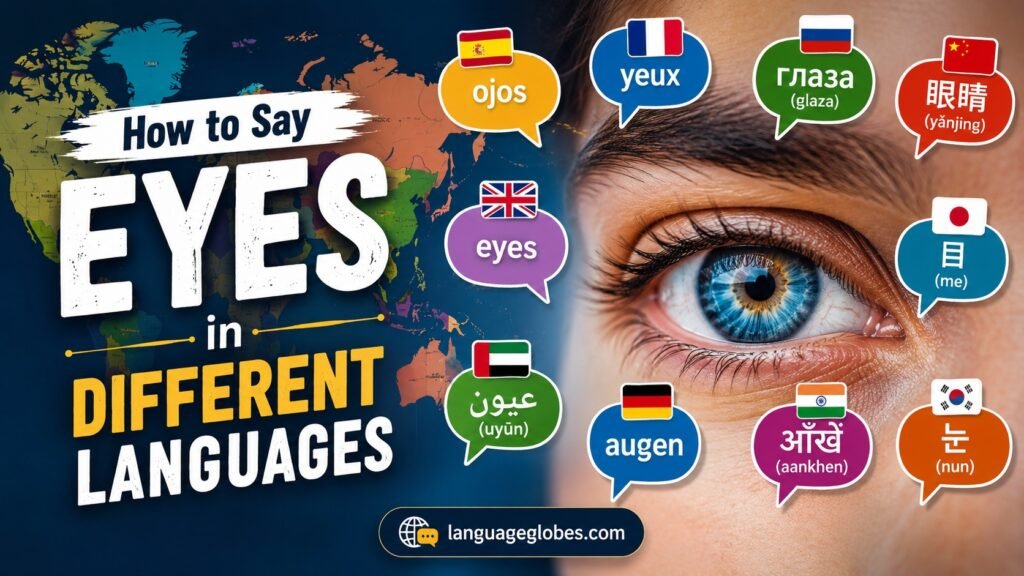
The eyes are a vital body part that shapes vision, seeing, and visual perception. Learning how to say eyes in different languages offers useful translations while exploring linguistic diversity. These language translations also reveal how world languages describe human body parts and everyday ideas.
For language learners, travelers, students, and writers, this guide makes vocabulary easier to understand and remember. Explore eyes in different languages with clear pronunciation, example sentences, and helpful translations and pronunciations.
You will discover Spanish ojos, French yeux, and German Augen, along with cultural meanings surrounding eyes, emotions, love, and beauty. This linguistic journey highlights language and culture, global communication, and the fascinating ways people express a universal human experience.
Also Read This: How to Say Error in Different Languages
Interesting Facts About Eyes
- Eyes are often called the “windows to the soul” in many cultures.
- Almost every language has special expressions related to eyes and vision.
- Human eyes can distinguish millions of colors.
- Ancient civilizations used eye symbols to represent protection and wisdom.
- Many languages have multiple words for eyes depending on context and formality.
- Eye contact carries different cultural meanings around the world.
- In literature and poetry, eyes frequently symbolize emotions and beauty.
- The word “eyes” appears in thousands of idioms across global languages.
- Learning body-part vocabulary is one of the first steps in language acquisition.
- The concept of eyes is universal, making it an excellent word for cross-cultural learning.
How to Say Eyes in Different Languages
European Languages
Europe is home to hundreds of languages belonging mainly to the Germanic, Romance, Slavic, Celtic, and Baltic language families. Although these languages evolved differently over centuries, they all have unique words and expressions related to eyes. Learning these translations offers a fascinating glimpse into European cultures and linguistic traditions.
| Language | Country/Region | Translation | Pronunciation | Example Sentence |
| 🇺🇸 American English | USA | Eyes | eyez | Her eyes are beautiful. |
| 🇬🇧 British English | UK | Eyes | eyez | His eyes are blue. |
| 🇦🇺 Australian English | Australia | Eyes | eyez | The child’s eyes sparkled. |
| Spanish | 🇪🇸 Spain | Ojos | OH-hos | Tus ojos son hermosos. |
| French | 🇫🇷 France | Yeux | yuh | Tes yeux sont beaux. |
| German | 🇩🇪 Germany | Augen | OW-gen | Deine Augen sind schön. |
| Italian | 🇮🇹 Italy | Occhi | OCK-kee | I tuoi occhi sono belli. |
| Portuguese | 🇵🇹 Portugal | Olhos | OL-yoosh | Seus olhos são lindos. |
| Dutch | 🇳🇱 Netherlands | Ogen | OH-ghen | Je ogen zijn mooi. |
| Swedish | 🇸🇪 Sweden | Ögon | UR-gon | Dina ögon är vackra. |
| Norwegian | 🇳🇴 Norway | Øyne | OY-ne | Dine øyne er vakre. |
| Danish | 🇩🇰 Denmark | Øjne | OY-nuh | Dine øjne er smukke. |
| Finnish | 🇫🇮 Finland | Silmät | SEEL-mat | Sinun silmäsi ovat kauniit. |
| Icelandic | 🇮🇸 Iceland | Augu | OY-gu | Augun þín eru falleg. |
| Polish | 🇵🇱 Poland | Oczy | O-chee | Twoje oczy są piękne. |
| Czech | 🇨🇿 Czech Republic | Oči | O-chee | Tvé oči jsou krásné. |
| Slovak | 🇸🇰 Slovakia | Oči | O-chee | Tvoje oči sú krásne. |
| Hungarian | 🇭🇺 Hungary | Szemek | SEH-mek | Gyönyörűek a szemeid. |
| Romanian | 🇷🇴 Romania | Ochi | Okee | Ochii tăi sunt frumoși. |
| Bulgarian | 🇧🇬 Bulgaria | Очи | Ochi | Очите ти са красиви. |
| Croatian | 🇭🇷 Croatia | Oči | Ochi | Tvoje oči su lijepe. |
| Serbian | 🇷🇸 Serbia | Очи | Ochi | Tvoje oči su lepe. |
| Slovenian | 🇸🇮 Slovenia | Oči | Ochi | Tvoje oči so lepe. |
| Ukrainian | 🇺🇦 Ukraine | Очі | Ochi | Твої очі красиві. |
| Russian | 🇷🇺 Russia | Глаза | Gla-ZA | Твои глаза красивые. |
| Belarusian | 🇧🇾 Belarus | Вочы | VO-chee | Твае вочы прыгожыя. |
| Greek | 🇬🇷 Greece | Μάτια | MA-tya | Τα μάτια σου είναι όμορφα. |
| Irish | 🇮🇪 Ireland | Súile | SOO-leh | Tá do shúile álainn. |
| Welsh | 🏴 Wales | Llygaid | HLUH-gaid | Mae dy lygaid yn hardd. |
| Albanian | 🇦🇱 Albania | Sytë | SUH-teh | Sytë e tu janë të bukur. |
| Latvian | 🇱🇻 Latvia | Acis | A-tsis | Tavas acis ir skaistas. |
| Lithuanian | 🇱🇹 Lithuania | Akys | A-kis | Tavo akys gražios. |
| Estonian | 🇪🇪 Estonia | Silmad | SIL-mad | Su silmad on ilusad. |
Asian Languages
Asia is the world’s largest continent and contains thousands of languages spoken by billions of people. From East Asia to South Asia and Southeast Asia, languages in this region reflect rich histories, philosophies, and cultural traditions. The word for eyes often appears in poetry, literature, and everyday conversation throughout Asia.
| Language | Country/Region | Translation | Pronunciation | Example Sentence |
| Chinese (Mandarin) | 🇨🇳 China | 眼睛 | Yan-jing | 你的眼睛很漂亮。 |
| Japanese | 🇯🇵 Japan | 目 | Meh | あなたの目はきれいです。 |
| Korean | 🇰🇷 South Korea | 눈 | Noon | 당신의 눈은 아름답습니다. |
| Hindi | 🇮🇳 India | आँखें | AAN-khen | तुम्हारी आँखें सुंदर हैं। |
| Urdu | 🇵🇰 Pakistan | آنکھیں | Aankhen | تمہاری آنکھیں خوبصورت ہیں۔ |
| Bengali | 🇧🇩 Bangladesh | চোখ | Chokh | তোমার চোখ সুন্দর। |
| Punjabi | 🇮🇳🇵🇰 Punjab | ਅੱਖਾਂ | Akkhan | ਤੇਰੀਆਂ ਅੱਖਾਂ ਸੋਹਣੀਆਂ ਹਨ। |
| Gujarati | 🇮🇳 India | આંખો | Aankho | તમારી આંખો સુંદર છે. |
| Marathi | 🇮🇳 India | डोळे | Doh-le | तुझे डोळे सुंदर आहेत. |
| Tamil | 🇮🇳 India | கண்கள் | Kan-gal | உன் கண்கள் அழகாக உள்ளன. |
| Telugu | 🇮🇳 India | కళ్ళు | Kallu | నీ కళ్ళు అందంగా ఉన్నాయి. |
| Kannada | 🇮🇳 India | ಕಣ್ಣುಗಳು | Kannugalu | ನಿನ್ನ ಕಣ್ಣುಗಳು ಸುಂದರವಾಗಿವೆ. |
| Malayalam | 🇮🇳 India | കണ്ണുകൾ | Kannukal | നിന്റെ കണ്ണുകൾ മനോഹരമാണ്. |
| Sinhala | 🇱🇰 Sri Lanka | ඇස් | Aes | ඔබේ ඇස් ලස්සනයි. |
| Nepali | 🇳🇵 Nepal | आँखा | Aankha | तिम्रा आँखा राम्रा छन्। |
| Thai | 🇹🇭 Thailand | ตา | Tah | ดวงตาของคุณสวยมาก |
| Vietnamese | 🇻🇳 Vietnam | Mắt | Mat | Đôi mắt của bạn đẹp. |
| Indonesian | 🇮🇩 Indonesia | Mata | Ma-ta | Mata kamu indah. |
| Malay | 🇲🇾 Malaysia | Mata | Ma-ta | Mata awak cantik. |
| Filipino | 🇵🇭 Philippines | Mata | Ma-ta | Maganda ang iyong mga mata. |
| Khmer | 🇰🇭 Cambodia | ភ្នែក | Phnek | ភ្នែករបស់អ្នកស្អាត។ |
| Lao | 🇱🇦 Laos | ຕາ | Ta | ຕາຂອງເຈົ້າງາມ. |
| Burmese | 🇲🇲 Myanmar | မျက်စိ | Myet-si | သင့်မျက်စိလှသည်။ |
| Mongolian | 🇲🇳 Mongolia | Нүд | Nud | Таны нүд сайхан байна. |
African Languages
Africa is one of the most linguistically diverse continents in the world, with thousands of languages spoken across its regions. African languages belong to several major language families and reflect rich cultural traditions, storytelling practices, and historical heritage. Learning these words helps appreciate the continent’s remarkable diversity.
| Language | Country/Region | Translation | Pronunciation | Example Sentence |
| Swahili | 🇹🇿🇰🇪 East Africa | Macho | MA-cho | Macho yako ni mazuri. |
| Zulu | 🇿🇦 South Africa | Amehlo | Ah-MEH-hlo | Amehlo akho mahle. |
| Xhosa | 🇿🇦 South Africa | Amehlo | Ah-MEH-hlo | Amehlo akho mahle. |
| Afrikaans | 🇿🇦 South Africa | Oë | OO-uh | Jou oë is mooi. |
| Yoruba | 🇳🇬 Nigeria | Ojú | OH-joo | Ojú rẹ lẹwa. |
| Igbo | 🇳🇬 Nigeria | Anya | AHN-ya | Anya gị mara mma. |
| Hausa | 🇳🇬 Niger/Nigeria | Ido | EE-do | Idonka suna da kyau. |
| Amharic | 🇪🇹 Ethiopia | አይኖች | Ai-noch | ዓይኖችህ ቆንጆ ናቸው። |
| Somali | 🇸🇴 Somalia | Indho | IN-dho | Indhahaagu waa qurux badan yihiin. |
| Shona | 🇿🇼 Zimbabwe | Meso | ME-so | Meso ako akanaka. |
| Kinyarwanda | 🇷🇼 Rwanda | Amaso | Ah-MA-so | Amaso yawe ni meza. |
| Malagasy | 🇲🇬 Madagascar | Maso | MA-so | Tsara ny masonao. |
Middle Eastern Languages
The Middle East has been a crossroads of civilizations for thousands of years. The languages spoken in this region have influenced religion, science, literature, and trade throughout history. Words related to eyes frequently appear in poetry, spiritual texts, and expressions of admiration and affection.
| Language | Country/Region | Translation | Pronunciation | Example Sentence |
| Arabic | 🇸🇦 Middle East | عيون | Uyoon | عيونك جميلة. |
| Persian (Farsi) | 🇮🇷 Iran | چشمها | Cheshm-ha | چشمان تو زیبا هستند. |
| Turkish | 🇹🇷 Türkiye | Gözler | Goez-ler | Gözlerin çok güzel. |
| Hebrew | 🇮🇱 Israel | עיניים | Ei-na-yim | העיניים שלך יפות. |
| Kurdish | 🌍 Kurdistan Region | Çav | Chav | Çavên te bedew in. |
| Armenian | 🇦🇲 Armenia | Աչքեր | Ach-ker | Քո աչքերը գեղեցիկ են։ |
| Azerbaijani | 🇦🇿 Azerbaijan | Gözlər | Goez-lar | Gözlərin gözəldir. |
| Pashto | 🇦🇫 Afghanistan | سترګې | Ster-gay | ستا سترګې ښکلې دي. |
Additional Languages Around the World
The world contains many additional languages spoken across islands, indigenous communities, and multicultural societies. Exploring these languages broadens cultural understanding and highlights the incredible variety of human communication.
| Language | Country/Region | Translation | Pronunciation | Example Sentence |
| Hawaiian | 🇺🇸 Hawaii | Maka | MA-ka | Nani kou maka. |
| Maori | 🇳🇿 New Zealand | Karu | KA-roo | He ataahua ō karu. |
| Samoan | 🇼🇸 Samoa | Mata | MA-ta | E matagofie ou mata. |
| Tongan | 🇹🇴 Tonga | Mata | MA-ta | Oku faka’ofo’ofa ho mata. |
| Fijian | 🇫🇯 Fiji | Mata | MA-ta | E rairai vinaka na matamu. |
| Tahitian | 🇵🇫 Tahiti | Mata | MA-ta | E nehenehe to oe mata. |
| Inuit (Inuktitut) | 🇨🇦 Arctic Canada | Ijjit | IJ-jit | Ijjitit piujuq. |
| Cherokee | 🇺🇸 USA | ᎤᎦᏙ | U-ga-do | ᎤᎦᏙ ᎤᏬᏚᎯ. |
| Navajo | 🇺🇸 USA | Nástsʼíís | NAS-tsees | Nástsʼíís yá’át’ééh. |
| Haitian Creole | 🇭🇹 Haiti | Je | Zheh | Je ou bèl. |
| Luxembourgish | 🇱🇺 Luxembourg | Aen | A-en | Deng Aen si schéin. |
| Maltese | 🇲🇹 Malta | Għajnejn | Ai-neyn | Għajnejk sbieħ. |
FAQs
What is the word for eyes in different languages?
The word for eyes changes across different languages, reflecting unique language translations and linguistic diversity. This guide provides useful translations, pronunciation, and example sentences.
How do you say eyes in different languages?
You can learn how to say eyes through clear translations and pronunciations from many world languages. These terms are useful for language learners, travelers, students, and writers.
How do you say eye in different languages?
Learning how to say eye helps build language vocabulary and improve everyday communication skills. Understanding each foreign language term also makes language learning more practical.
What are eyes called in Spanish, French, and German?
In Spanish, eyes are ojos; in French, they are yeux; and in German, they are Augen. These common terms show interesting differences among world languages.
Why are eyes important as a human body part?
The eyes are a vital body part and sensory organ responsible for vision, seeing, and visual perception. They also play an important role in expressive body language.
How can learning eyes in different languages help language learners?
Studying eyes in different languages supports vocabulary building, language practice, and language education. It also introduces learners to language and culture through everyday common words.
How do different cultures describe eyes and emotions?
Across different cultures, eyes can represent emotions, love, honesty, wisdom, beauty, and understanding. These cultural associations add depth to ordinary language.
What pronunciation help is included for eyes in different languages?
A pronunciation guide can show how to read the word and pronounce terms correctly. Example sentences and translations and pronunciations make practice easier for learners.
Why learn the word for eyes in multiple languages?
Learning the word for eyes supports global communication, language exploration, and multilingual learning. It also provides a simple way to explore linguistic diversity around the world.
What can eyes teach us about language and culture?
The meanings of eyes reveal connections between language and culture, world cultures, and shared human experiences. Exploring these terms offers a fascinating linguistic journey across languages.
Conclusion
Learning how to say eyes in different languages offers a simple way to explore world languages, language and culture, and linguistic diversity. With clear translations, pronunciation, and example sentences, learners can build useful language vocabulary for everyday communication. Exploring eyes in different languages also reveals cultural ideas connected with vision, emotions, beauty, and understanding. This guide makes language learning engaging while supporting global communication and a deeper appreciation of languages around the world.

Lucy Carter is a curious mind and language lover who writes for Language Globes. She enjoys discovering new languages and sharing simple, helpful ideas that make learning fun and accessible for everyone.