Eyeliner is a popular cosmetic and essential eye makeup product used to define the eyes and enhance facial features. Learning how this beauty product is expressed in different languages reveals fascinating beauty terms, makeup terminology, and global beauty terms shaped by culture.
This guide explores language translations, pronunciation, and example sentences for eyeliner, while highlighting cultural influences and linguistic traditions. Whether you are learning a new language, traveling, or shopping for cosmetics abroad, these translations make beauty vocabulary easier to understand across countries and cultures.
Also Read This: How to Say Eyes in Different Languages
Interesting Facts About Eyeliner
- Eyeliner has been used for over 5,000 years.
- Ancient Egyptians used kohl eyeliner to protect their eyes from sunlight and infections.
- Eyeliner is one of the most widely sold cosmetic products worldwide.
- Different cultures have developed unique eyeliner styles and techniques.
- The cat-eye look became especially popular during the 1950s and 1960s.
- Modern eyeliners come in pencil, gel, liquid, and felt-tip forms.
- Many languages borrow the English word “eyeliner” with slight pronunciation changes.
- Professional makeup artists often consider eyeliner one of the most important eye makeup products.
- Eyeliner is used in fashion, theater, television, film, and everyday makeup routines.
- Beauty terminology often varies between regions even when the same language is spoken.
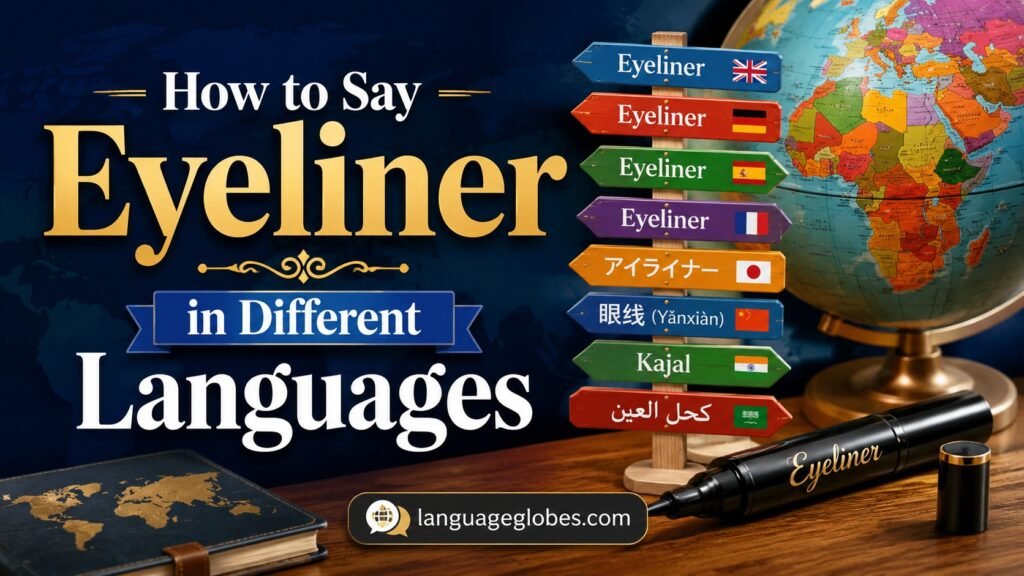
How to Say Eyeliner in Different Languages
The word “eyeliner” may be translated directly or borrowed from English depending on the language and culture. Below are translations from around the world.
European Languages
Europe is home to hundreds of languages and rich beauty traditions. Many European countries have thriving cosmetic industries, and makeup terminology is often influenced by English, French, or local linguistic traditions. Some languages use a direct translation, while others simply adapt the English term.
| Language | Country/Region | Translation | Pronunciation | Example Sentence |
| 🇺🇸 American English | United States | Eyeliner | Eye-lie-ner | I use eyeliner every day. |
| 🇬🇧 British English | United Kingdom | Eyeliner | Eye-lie-ner | She bought a new eyeliner. |
| 🇦🇺 Australian English | Australia | Eyeliner | Eye-lie-ner | This eyeliner lasts all day. |
| French | 🇫🇷 France | Eyeliner | Eye-lie-ner | J’utilise un eyeliner noir. |
| Spanish | 🇪🇸 Spain | Delineador de ojos | Deh-lee-neh-ah-dor de oh-hos | Uso delineador de ojos negro. |
| Portuguese | 🇵🇹 Portugal | Delineador | Deh-lee-neh-ah-dor | Eu uso delineador diariamente. |
| Italian | 🇮🇹 Italy | Eyeliner | Eye-lie-ner | Uso l’eyeliner ogni giorno. |
| German | 🇩🇪 Germany | Eyeliner | Eye-lie-ner | Ich benutze Eyeliner. |
| Dutch | 🇳🇱 Netherlands | Oogpotlood | Ohkh-pot-load | Ik gebruik oogpotlood. |
| Swedish | 🇸🇪 Sweden | Eyeliner | Eye-lie-ner | Jag använder eyeliner. |
| Norwegian | 🇳🇴 Norway | Eyeliner | Eye-lie-ner | Jeg bruker eyeliner. |
| Danish | 🇩🇰 Denmark | Eyeliner | Eye-lie-ner | Jeg bruger eyeliner. |
| Finnish | 🇫🇮 Finland | Silmänrajauskynä | Seel-man-ra-yous-ku-na | Käytän silmänrajauskynää. |
| Polish | 🇵🇱 Poland | Eyeliner | Eye-lie-ner | Używam eyelinera. |
| Czech | 🇨🇿 Czech Republic | Oční linka | Och-nee lin-ka | Používám oční linku. |
| Slovak | 🇸🇰 Slovakia | Očná linka | Och-na lin-ka | Používam očnú linku. |
| Hungarian | 🇭🇺 Hungary | Szemhéjtus | Sem-hay-toosh | Szemhéjtust használok. |
| Romanian | 🇷🇴 Romania | Tuș de ochi | Toosh de ohki | Folosesc tuș de ochi. |
| Greek | 🇬🇷 Greece | Eyeliner | Eye-lie-ner | Χρησιμοποιώ eyeliner. |
| Russian | 🇷🇺 Russia | Подводка для глаз | Pod-vod-ka dlya glaz | Я использую подводку для глаз. |
| Ukrainian | 🇺🇦 Ukraine | Підводка для очей | Peed-vod-ka | Я використовую підводку для очей. |
Asian Languages
Asia is the largest continent and includes some of the world’s most influential beauty markets. Countries such as South Korea, Japan, China, and India have helped shape modern cosmetic trends. Many Asian languages use native words, while others adopt the international term “eyeliner.”
| Language | Country/Region | Translation | Pronunciation | Example Sentence |
| Chinese (Mandarin) | 🇨🇳 China | 眼线笔 | Yan-shyen-bee | 我用了眼线笔。 |
| Japanese | 🇯🇵 Japan | アイライナー | Ai-rai-naa | アイライナーを使います。 |
| Korean | 🇰🇷 South Korea | 아이라이너 | Ah-ee-rai-neo | 아이라이너를 사용합니다. |
| Hindi | 🇮🇳 India | आईलाइनर | Eye-line-er | मैं आईलाइनर लगाती हूँ। |
| Urdu | 🇵🇰 Pakistan | آئی لائنر | Eye-line-er | میں آئی لائنر استعمال کرتی ہوں۔ |
| Bengali | 🇧🇩 Bangladesh | আইলাইনার | Eye-line-ar | আমি আইলাইনার ব্যবহার করি। |
| Punjabi | India/Pakistan | ਆਈਲਾਈਨਰ | Eye-line-ar | ਮੈਂ ਆਈਲਾਈਨਰ ਵਰਤਦਾ ਹਾਂ। |
| Tamil | 🇮🇳 India | ஐலைனர் | Eye-line-ar | நான் ஐலைனர் பயன்படுத்துகிறேன். |
| Telugu | 🇮🇳 India | ఐలైనర్ | Eye-line-ar | నేను ఐలైనర్ వాడుతాను. |
| Kannada | 🇮🇳 India | ಐಲೈನರ್ | Eye-line-ar | ನಾನು ಐಲೈನರ್ ಬಳಸುತ್ತೇನೆ. |
| Malayalam | 🇮🇳 India | ഐലൈനർ | Eye-line-ar | ഞാൻ ഐലൈനർ ഉപയോഗിക്കുന്നു. |
| Marathi | 🇮🇳 India | आयलाइनर | Eye-line-ar | मी आयलाइनर वापरते. |
| Gujarati | 🇮🇳 India | આઈલાઈનર | Eye-line-ar | હું આઈલાઈનર વાપરું છું. |
| Nepali | 🇳🇵 Nepal | आईलाइनर | Eye-line-ar | म आईलाइनर प्रयोग गर्छु। |
| Sinhala | 🇱🇰 Sri Lanka | අයි ලයිනර් | Eye-line-ar | මම අයි ලයිනර් භාවිතා කරමි. |
| Thai | 🇹🇭 Thailand | อายไลเนอร์ | Eye-lie-ner | ฉันใช้อายไลเนอร์ |
| Vietnamese | 🇻🇳 Vietnam | Kẻ mắt | Keh-mat | Tôi dùng kẻ mắt. |
| Indonesian | 🇮🇩 Indonesia | Eyeliner | Eye-lie-ner | Saya memakai eyeliner. |
| Malay | 🇲🇾 Malaysia | Eyeliner | Eye-lie-ner | Saya menggunakan eyeliner. |
| Filipino | 🇵🇭 Philippines | Eyeliner | Eye-lie-ner | Gumagamit ako ng eyeliner. |
African Languages
Africa is home to thousands of languages and a rich cultural heritage. Beauty and personal grooming traditions differ greatly across the continent. Many modern cosmetic terms are influenced by English, French, Arabic, Portuguese, and indigenous languages.
| Language | Country/Region | Translation | Pronunciation | Example Sentence |
| Swahili | 🇹🇿 Tanzania/Kenya | Eyeliner | Eye-lie-ner | Ninatumia eyeliner. |
| Zulu | 🇿🇦 South Africa | I-eyeliner | Eye-lie-ner | Ngisebenzisa i-eyeliner. |
| Xhosa | 🇿🇦 South Africa | I-eyeliner | Eye-lie-ner | Ndisebenzisa i-eyeliner. |
| Afrikaans | 🇿🇦 South Africa | Oogomlyner | Ogh-om-line-er | Ek gebruik oogomlyner. |
| Yoruba | 🇳🇬 Nigeria | Eyeliner | Eye-lie-ner | Mo lo eyeliner. |
| Igbo | 🇳🇬 Nigeria | Eyeliner | Eye-lie-ner | Ana m eji eyeliner. |
| Hausa | 🇳🇬 Nigeria | Eyeliner | Eye-lie-ner | Ina amfani da eyeliner. |
| Amharic | 🇪🇹 Ethiopia | አይላይነር | Eye-line-er | አይላይነር እጠቀማለሁ። |
| Somali | 🇸🇴 Somalia | Eyeliner | Eye-lie-ner | Waxaan isticmaalaa eyeliner. |
| Shona | 🇿🇼 Zimbabwe | Eyeliner | Eye-lie-ner | Ndinoshandisa eyeliner. |
Middle Eastern Languages
The Middle East has a long history of eye makeup traditions. Kohl, a predecessor of modern eyeliner, has been used in the region for centuries. Today, both traditional and contemporary eye cosmetics remain an important part of beauty culture.
| Language | Country/Region | Translation | Pronunciation | Example Sentence |
| Arabic | 🌍 Middle East | محدد العيون | Mu-had-did al-uyoon | أستخدم محدد العيون يومياً. |
| Persian | 🇮🇷 Iran | خط چشم | Khat-e-cheshm | من خط چشم استفاده میکنم. |
| Turkish | 🇹🇷 Turkey | Eyeliner | Eye-lie-ner | Eyeliner kullanıyorum. |
| Hebrew | 🇮🇱 Israel | אייליינר | Eye-line-er | אני משתמשת באייליינר. |
| Kurdish | Iraq/Turkey | Eyeliner | Eye-line-er | Ez eyeliner bikar tînim. |
| Pashto | 🇦🇫 Afghanistan | آئي لائنر | Eye-line-er | زه آئي لائنر کاروم. |
Additional Languages Around the World
The following languages represent diverse cultures from the Americas, Oceania, and other regions. Learning these translations can help travelers, language learners, and beauty professionals communicate more effectively around the globe.
| Language | Country/Region | Translation | Pronunciation | Example Sentence |
| Hawaiian | 🇺🇸 Hawaii | Eyeliner | Eye-lie-ner | I use eyeliner. |
| Maori | 🇳🇿 New Zealand | Eyeliner | Eye-lie-ner | Ka whakamahi ahau i te eyeliner. |
| Samoan | 🇼🇸 Samoa | Eyeliner | Eye-lie-ner | Ou te faaaogaina eyeliner. |
| Tongan | 🇹🇴 Tonga | Eyeliner | Eye-lie-ner | Oku ou faka’aonga’i eyeliner. |
| Haitian Creole | 🇭🇹 Haiti | Kreyon je | Kray-on jeh | Mwen itilize kreyon je. |
| Latin | Historical | Circumductor oculorum | Kir-kum-duk-tor | Circumductor oculorum utor. |
| Esperanto | International | Okullinio | Oh-kool-lin-ee-oh | Mi uzas okullinion. |
| Catalan | 🇪🇸 Spain | Delineador d’ulls | Deh-lee-neh-ah-dor | Faig servir delineador d’ulls. |
| Basque | 🇪🇸 Spain | Begi-lerroa | Beh-gee ler-ro-a | Begi-lerroa erabiltzen dut. |
| Galician | 🇪🇸 Spain | Delineador de ollos | Deh-lee-neh-ah-dor | Uso delineador de ollos. |
| Irish | 🇮🇪 Ireland | Líneáil súl | Lee-nail sool | Úsáidim líneáil súl. |
| Welsh | 🏴 Wales | Leinin llygaid | Lay-nin hluh-guid | Rwy’n defnyddio leinin llygaid. |
| Scottish Gaelic | 🏴 Scotland | Loidhne-sùla | Loyn-ya-soo-la | Bidh mi a’ cleachdadh loidhne-sùla. |
| Icelandic | 🇮🇸 Iceland | Augnlína | Oygn-lee-na | Ég nota augnlínu. |
| Latvian | 🇱🇻 Latvia | Acu laineris | At-su line-ris | Es lietoju acu laineri. |
| Lithuanian | 🇱🇹 Lithuania | Akių pravedimas | Ah-kyoo pra-ve-di-mas | Naudoju akių pravedimą. |
| Estonian | 🇪🇪 Estonia | Silmalainer | Sil-ma-line-er | Kasutan silmalainerit. |
| Slovenian | 🇸🇮 Slovenia | Črtalo za oči | Chur-ta-lo za o-chi | Uporabljam črtalo za oči. |
| Croatian | 🇭🇷 Croatia | Tuš za oči | Toosh za o-chi | Koristim tuš za oči. |
| Serbian | 🇷🇸 Serbia | Ајлајнер | Eye-line-er | Користим ајлајнер. |
| Bosnian | 🇧🇦 Bosnia | Eyeliner | Eye-lie-ner | Koristim eyeliner. |
FAQs
What is eyeliner called in different languages?
Eyeliner has different names across different languages, with translations often reflecting local beauty vocabulary and makeup terminology. Some languages use direct loanwords, while others use native descriptive terms.
How do you say eyeliner in French and Spanish?
In French, eyeliner is commonly called l’eyeliner, while Spanish uses el delineador de ojos. These language translations show how cosmetic terminology varies across cultures.
Why is eyeliner considered an important eye makeup product?
Eyeliner is a popular eye makeup and cosmetic product used to define the eyes and enhance facial features. It can create both natural makeup and dramatic makeup looks.
How can learning eyeliner translations help language learners?
Learning beauty terms can expand beauty vocabulary and improve everyday communication. It is especially useful when discussing makeup or cosmetic products while traveling.
How do cultural influences affect eyeliner terminology?
Cultural influences, linguistic traditions, and beauty culture can shape how eyeliner is described. These differences reflect human culture and cultural identity across regions.
Is eyeliner commonly used around the world?
Yes, eyeliner has worldwide usage and remains a staple cosmetic product in many cultures. Its styles and names vary with international beauty practices and local preferences.
Can I learn how to pronounce eyeliner in other languages?
Yes, studying pronunciation alongside language translations makes unfamiliar cosmetic terminology easier to use. Example sentences can also help learners understand practical usage.
How is eyeliner related to ancient civilizations?
Eye makeup has historical connections with ancient Egypt, India, and China, where cosmetics held cultural and practical importance. These traditions helped shape the history of beauty and makeup.
What should travelers know about eyeliner when shopping abroad?
Understanding beauty vocabulary can make shopping for cosmetics easier during international travel. Knowing local cosmetics terms helps travelers communicate with cosmetic retailers more confidently.
Why are eyeliner translations useful for understanding global beauty?
Translations reveal how makeup in different languages connects language with beauty culture and global cosmetics. They also provide useful insight into worldwide usage and regional cosmetic terminology.
Conclusion
Understanding how to say eyeliner in different languages makes beauty vocabulary more useful for communication, travel, and shopping for cosmetics. These language translations show how cosmetic terminology, makeup terminology, and beauty culture vary across countries and cultures. Exploring global beauty terms also reveals the cultural influences behind everyday eye makeup expressions. With clear pronunciation and practical examples, learning these translations becomes an easy way to explore international beauty and worldwide usage.

Lucy Carter is a curious mind and language lover who writes for Language Globes. She enjoys discovering new languages and sharing simple, helpful ideas that make learning fun and accessible for everyone.