
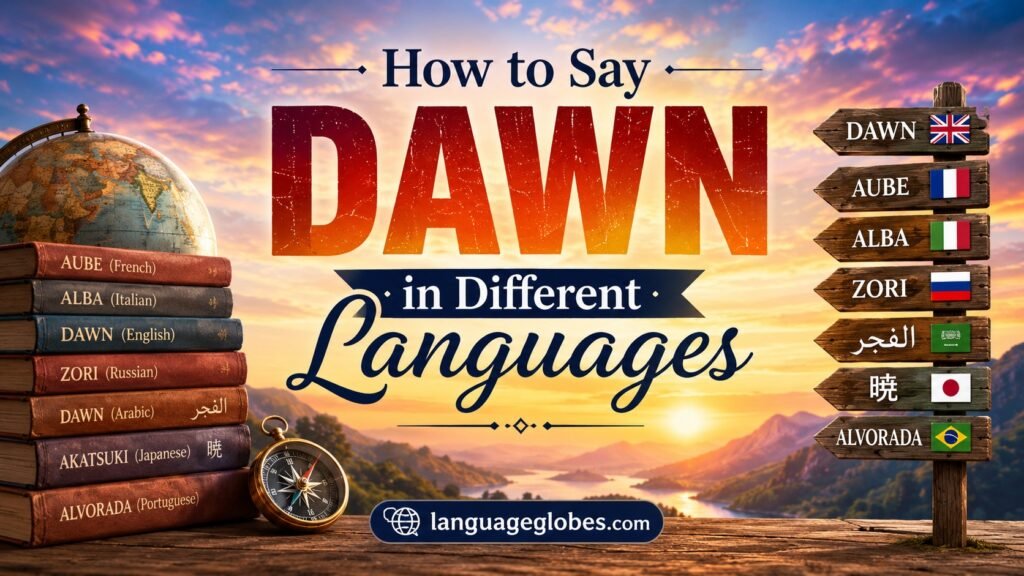
Dawn is a beautiful word that describes the first light of day before sunrise. Across world languages, it can express hope, renewal, fresh beginnings, and the beginning of a new day. This meaningful concept appears in poetry, literature, songs, and spiritual teachings across many global cultures.
Learning the dawn translation across different languages reveals fascinating language diversity and cultural diversity. This guide explores dawn in different languages, including Spanish, French, Chinese, and Arabic, with pronunciation, translations, and example sentences. Whether you are a language learner, traveler, writer, or student, these multilingual translations offer an enjoyable way to explore world culture and language history.
Also Read This: How to Say Danger in Different Languages
Interesting Facts About Dawn
- Dawn is the period of twilight that occurs before sunrise.
- In many cultures, dawn symbolizes hope, rebirth, and new beginnings.
- Ancient civilizations often associated dawn with gods and goddesses of light.
- Many poems and songs use dawn as a metaphor for opportunity and change.
- The word “dawn” comes from Old English roots related to daylight and becoming light.
- Different languages have unique words that capture the beauty of early morning light.
- Dawn has special significance in many religious and spiritual traditions.
- Photographers often prefer dawn because of its soft and beautiful natural lighting.
- The colors seen at dawn are caused by sunlight scattering through Earth’s atmosphere.
- Learning nature-related vocabulary such as dawn helps language learners expand their cultural knowledge.
How to Say Dawn in Different Languages
European Languages
Europe is home to many of the world’s most influential languages, including Romance, Germanic, and Slavic language families. These languages have rich literary traditions and often use the word “dawn” in poetry and storytelling. Learning these translations can help travelers and language enthusiasts connect with European cultures more deeply.
| Language | Country/Region | Translation | Pronunciation | Example Sentence |
| 🇺🇸 American English | USA | Dawn | Don | The dawn looked beautiful today. |
| 🇬🇧 British English | UK | Dawn | Don | We walked at dawn. |
| 🇦🇺 Australian English | Australia | Dawn | Don | The beach is peaceful at dawn. |
| French | 🇫🇷 France | Aube | Ob | L’aube est magnifique aujourd’hui. |
| Spanish | 🇪🇸 Spain | Amanecer | Ah-mah-neh-ser | El amanecer es hermoso. |
| Portuguese | 🇵🇹 Portugal | Alvorada | Al-vo-ra-da | A alvorada chegou cedo. |
| Italian | 🇮🇹 Italy | Alba | Al-ba | L’alba è splendida. |
| German | 🇩🇪 Germany | Morgendämmerung | Mor-gen-dem-me-rung | Die Morgendämmerung ist schön. |
| Dutch | 🇳🇱 Netherlands | Dageraad | Da-ger-aad | De dageraad is prachtig. |
| Swedish | 🇸🇪 Sweden | Gryning | Gree-ning | Gryningen är vacker. |
| Norwegian | 🇳🇴 Norway | Daggry | Dag-gree | Daggry er vakker. |
| Danish | 🇩🇰 Denmark | Daggry | Dag-gree | Daggry er smuk. |
| Finnish | 🇫🇮 Finland | Aamunkoitto | Aa-mun-koi-to | Aamunkoitto on kaunis. |
| Icelandic | 🇮🇸 Iceland | Dögun | Deh-gun | Dögun er falleg. |
| Irish | 🇮🇪 Ireland | Breacadh an lae | Brak-ah an lay | Tá breacadh an lae álainn. |
| Welsh | 🏴 Wales | Gwawr | Gwa-oor | Mae’r wawr yn brydferth. |
| Polish | 🇵🇱 Poland | Świt | Shveet | Świt był piękny. |
| Czech | 🇨🇿 Czech Republic | Úsvit | Oo-svit | Úsvit byl krásný. |
| Slovak | 🇸🇰 Slovakia | Úsvit | Oo-svit | Úsvit je nádherný. |
| Hungarian | 🇭🇺 Hungary | Hajnal | Hai-nal | A hajnal gyönyörű. |
| Romanian | 🇷🇴 Romania | Zori | Zo-ree | Zorile sunt frumoase. |
| Bulgarian | 🇧🇬 Bulgaria | Зора | Zo-ra | Зората е красива. |
| Croatian | 🇭🇷 Croatia | Zora | Zo-ra | Zora je prekrasna. |
| Serbian | 🇷🇸 Serbia | Zora | Zo-ra | Zora je lepa. |
| Slovenian | 🇸🇮 Slovenia | Zora | Zo-ra | Zora je čudovita. |
| Greek | 🇬🇷 Greece | Αυγή | Av-gee | Η αυγή είναι όμορφη. |
| Russian | 🇷🇺 Russia | Рассвет | Ras-svyet | Рассвет прекрасен. |
| Ukrainian | 🇺🇦 Ukraine | Світанок | Svi-ta-nok | Світанок красивий. |
| Belarusian | 🇧🇾 Belarus | Світанак | Svi-ta-nak | Світанак прыгожы. |
| Lithuanian | 🇱🇹 Lithuania | Aušra | Ow-shra | Aušra graži. |
| Latvian | 🇱🇻 Latvia | Rītausma | Ree-tows-ma | Rītausma ir skaista. |
| Estonian | 🇪🇪 Estonia | Koidik | Koi-dik | Koidik on ilus. |
Asian Languages
Asia is the largest continent and contains thousands of languages spoken by billions of people. From East Asia to South Asia and Southeast Asia, dawn is often connected with spirituality, meditation, and the beginning of daily life. Many Asian cultures celebrate the early morning hours as a time of peace and reflection.
| Language | Country/Region | Translation | Pronunciation | Example Sentence |
| Chinese (Mandarin) | 🇨🇳 China | 黎明 | Lee-ming | 黎明很美丽。 |
| Cantonese | 🇭🇰 Hong Kong | 黎明 | Lai-ming | 黎明好靚。 |
| Japanese | 🇯🇵 Japan | 夜明け | Yo-a-ke | 夜明けは美しいです。 |
| Korean | 🇰🇷 South Korea | 새벽 | Se-byeok | 새벽이 아름답습니다. |
| Hindi | 🇮🇳 India | भोर | Bhor | भोर बहुत सुंदर है। |
| Urdu | 🇵🇰 Pakistan | سحر | Sehr | سحر بہت خوبصورت ہے۔ |
| Bengali | 🇧🇩 Bangladesh | ভোর | Bhor | ভোর খুব সুন্দর। |
| Punjabi | 🇮🇳 India/Pakistan | ਸਵੇਰ | Sa-ver | ਸਵੇਰ ਸੋਹਣੀ ਹੈ। |
| Gujarati | 🇮🇳 India | પરોઢ | Pa-rodh | પરોઢ સુંદર છે. |
| Marathi | 🇮🇳 India | पहाट | Pa-haat | पहाट सुंदर आहे. |
| Tamil | 🇮🇳 India | விடியல் | Vi-di-yal | விடியல் அழகாக உள்ளது. |
| Telugu | 🇮🇳 India | ఉదయం | U-da-yam | ఉదయం అందంగా ఉంది. |
| Kannada | 🇮🇳 India | ಮುಂಜಾನೆ | Mun-ja-ne | ಮುಂಜಾನೆ ಸುಂದರವಾಗಿದೆ. |
| Malayalam | 🇮🇳 India | പ്രഭാതം | Pra-bha-tham | പ്രഭാതം മനോഹരമാണ്. |
| Sinhala | 🇱🇰 Sri Lanka | උදෑසන | U-da-sa-na | උදෑසන ලස්සනයි. |
| Nepali | 🇳🇵 Nepal | बिहानी | Bi-ha-ni | बिहानी सुन्दर छ। |
| Thai | 🇹🇭 Thailand | รุ่งอรุณ | Rung-a-run | รุ่งอรุณสวยงาม |
| Vietnamese | 🇻🇳 Vietnam | Bình minh | Binh-minh | Bình minh rất đẹp. |
| Indonesian | 🇮🇩 Indonesia | Fajar | Fa-jar | Fajar sangat indah. |
| Malay | 🇲🇾 Malaysia | Fajar | Fa-jar | Fajar sangat cantik. |
| Filipino | 🇵🇭 Philippines | Bukang-liwayway | Bu-kang li-way-way | Maganda ang bukang-liwayway. |
| Khmer | 🇰🇭 Cambodia | ព្រលឹម | Pro-lim | ព្រលឹមស្រស់ស្អាត។ |
| Lao | 🇱🇦 Laos | ຮຸ່ງອາລຸນ | Hung-a-lun | ຮຸ່ງອາລຸນງາມ. |
| Mongolian | 🇲🇳 Mongolia | Үүр | Uur | Үүр сайхан байна. |
African Languages
Africa is home to incredible linguistic diversity, with more than 2,000 languages spoken across the continent. Many African cultures have strong connections to nature and daily life, making words related to sunrise and dawn especially meaningful in storytelling, music, and traditional practices.
| Language | Country/Region | Translation | Pronunciation | Example Sentence |
| Swahili | 🇹🇿 Tanzania/Kenya | Alfajiri | Al-fa-jee-ri | Alfajiri ni nzuri. |
| Zulu | 🇿🇦 South Africa | Ukusa | Oo-koo-sa | Ukusa luhle. |
| Xhosa | 🇿🇦 South Africa | Isifingo | Ee-see-fin-go | Isifingo sihle. |
| Afrikaans | 🇿🇦 South Africa | Dagbreek | Dag-brake | Dagbreek is mooi. |
| Yoruba | 🇳🇬 Nigeria | Òwúrọ̀ | O-woo-ro | Òwúrọ̀ dára. |
| Igbo | 🇳🇬 Nigeria | Chi bọrọ | Chee bo-ro | Chi bọrọ mara mma. |
| Hausa | 🇳🇬 Nigeria | Alfijir | Al-fi-jir | Alfijir yana da kyau. |
| Amharic | 🇪🇹 Ethiopia | ጎህ | Goh | ጎህ ቆንጆ ነው። |
| Somali | 🇸🇴 Somalia | Waaberi | Waa-be-ri | Waaberi waa qurux badan. |
| Shona | 🇿🇼 Zimbabwe | Mambakwedza | Mam-ba-kwe-dza | Mambakwedza akanaka. |
| Kinyarwanda | 🇷🇼 Rwanda | Umuseke | Oo-mu-se-ke | Umuseke ni mwiza. |
| Sesotho | 🇱🇸 Lesotho | Mafube | Ma-fu-be | Mafube a matle. |
Middle Eastern Languages
The Middle East has a rich cultural and linguistic heritage stretching back thousands of years. Dawn holds special significance in many traditions and religions of the region, often symbolizing prayer, reflection, and spiritual awakening.
| Language | Country/Region | Translation | Pronunciation | Example Sentence |
| Arabic | 🌍 Middle East | فجر | Fajr | الفجر جميل اليوم. |
| Persian (Farsi) | 🇮🇷 Iran | سپیده دم | Se-pi-de dam | سپیده دم زیباست. |
| Turkish | 🇹🇷 Türkiye | Şafak | Sha-fak | Şafak çok güzel. |
| Hebrew | 🇮🇱 Israel | שחר | Sha-har | השחר יפה. |
| Kurdish | 🌍 Kurdistan Region | Beyanî | Be-ya-ni | Beyanî gelek xweşe. |
| Azerbaijani | 🇦🇿 Azerbaijan | Sübh | Subh | Sübh gözəldir. |
| Armenian | 🇦🇲 Armenia | Արշալույս | Ar-sha-luys | Արշալույսը գեղեցիկ է։ |
| Georgian | 🇬🇪 Georgia | განთიადი | Gan-thi-a-di | განთიადი ლამაზია. |
Additional Languages Around the World
The world contains many unique languages beyond the major regional groups. These languages represent indigenous cultures, island nations, and communities that contribute to the richness of global communication. Learning their words for dawn helps us appreciate humanity’s shared connection to nature.
| Language | Country/Region | Translation | Pronunciation | Example Sentence |
| Hawaiian | 🇺🇸 Hawaii | Alaula | A-la-u-la | He nani ka alaula. |
| Maori | 🇳🇿 New Zealand | Ata hāpara | A-ta haa-pa-ra | He ataahua te ata hāpara. |
| Samoan | 🇼🇸 Samoa | Tafa o ata | Ta-fa o a-ta | E matagofie le tafa o ata. |
| Tongan | 🇹🇴 Tonga | Pongipongi | Pon-gi-pon-gi | Oku faka’ofo’ofa e pongipongi. |
| Fijian | 🇫🇯 Fiji | Kida | Kee-da | E totoka na kida. |
| Tahitian | 🇵🇫 Tahiti | Poipoi | Poi-poi | E nehenehe te poipoi. |
| Greenlandic | 🇬🇱 Greenland | Ullaalerneq | Ulla-ler-neq | Ullaalerneq kusanarpoq. |
| Inuit (Inuktitut) | 🇨🇦 Arctic Canada | Ullaaq | Ul-laaq | Ullaaq kusanartuq. |
| Cherokee | 🇺🇸 USA | ᎤᎩᎶᎢ | U-gi-lo-i | ᎤᎩᎶᎢ ᎤᏣᏘ ᎤᏬᏚᎯ. |
FAQs
What does dawn mean?
Dawn means the first light of day that appears before sunrise. It represents the beginning of a new day, often connected with hope, renewal, and a fresh start.
How do you say dawn in different languages?
The translation of dawn varies across world languages and cultures. For example, Spanish uses el amanecer, French uses l’aube, Chinese uses 黎明, and Arabic uses فجر.
What is the dawn pronunciation in English?
The English pronunciation of dawn sounds like “dawn,” with a long vowel sound. You can pronounce dawn clearly by saying it smoothly without stressing the final consonant.
How do you say dawn in Spanish?
In Spanish, dawn is commonly translated as el amanecer. This expression describes the morning light and the natural transition from darkness to daylight.
How do you say dawn in French?
In French, dawn is l’aube, a word commonly associated with the first morning light. It also appears in poetry, literature, and other linguistic expressions.
How is dawn written in Chinese?
In Chinese, dawn is written as 黎明 and pronounced lí míng. It refers to the early light appearing around sunrise and is used in various cultural expressions.
How do you say dawn in Arabic?
In Arabic, dawn is written as فجر and commonly pronounced fajr. The word can describe the early morning light and has cultural significance in many contexts.
Why is dawn a symbolic word in different cultures?
As a symbolic word, dawn often represents hope, optimism, new beginnings, and opportunity. Its meaning appears across cultural traditions, songs, and spiritual teachings.
Why learn the word dawn in different languages?
Learning dawn in different languages supports language learning, vocabulary building, and cultural appreciation. It also introduces learners to unique linguistic expressions and patterns across different cultures.
Where can I learn dawn pronunciation and translations?
A pronunciation guide and translation guide can help you understand dawn pronunciation, meanings, and usage. Studying example sentences also improves communication skills and vocabulary development.
Conclusion
Learning dawn in different languages offers a simple way to explore language diversity, cultural diversity, and world culture. From el amanecer to l’aube, 黎明, and فجر, each dawn translation reflects unique cultural expressions and meanings. Understanding dawn pronunciation, different languages, and linguistic expressions can support language learning, vocabulary development, and global communication. This beautiful natural phenomenon remains a meaningful symbol of hope, renewal, and a fresh start across cultures.

James Anderson is a passionate language enthusiast and content creator at LanguageGlobes. With a keen interest in global cultures and communication, he shares insightful and engaging content to help readers explore and master new languages.