
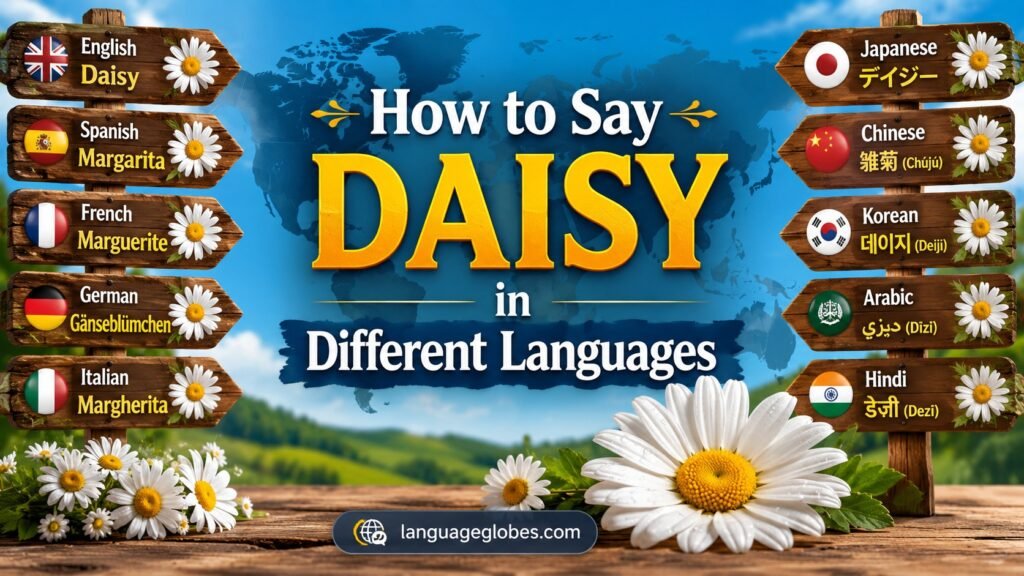
The daisy is one of the world’s beloved flowers, known for its simple beauty, white petals, and bright yellow centers. Its connection with innocence, purity, happiness, and new beginnings gives this lovely bloom meaning across different cultures. Learning how to say Daisy in different languages reveals fascinating unique sounds, unique expressions, and cultural views of the flower’s charm.
This guide explores the translation of daisy across multiple languages, with useful translations, pronunciations, and examples for people around the world. Whether you are a language learner, traveler, florist, student, or writer, these words can expand your vocabulary and deepen your appreciation of global cultures. You will discover how this cherished flower appears in everyday conversations, traditions, literature, and celebrations.
Also Read This: How to Say Dawn in Different Languages
Interesting Facts About Daisy
- Daisy is a symbol of purity, innocence, and loyal love.
- The name “daisy” comes from the Old English phrase “day’s eye.”
- Daisies close their petals at night and reopen in the morning.
- They belong to the Asteraceae family, one of the largest plant families.
- Daisies are popular flowers in gardens across Europe, Asia, Africa, and the Americas.
- Many cultures associate daisies with hope, happiness, and fresh beginnings.
- Daisy flowers attract bees, butterflies, and other pollinators.
- The flower is frequently used in poetry, art, and folklore worldwide.
- Different daisy species can be found on nearly every continent.
- Daisy-inspired names are popular for girls in many English-speaking countries.
How to Say Daisy in Different Languages
European Languages
Europe is home to dozens of languages belonging to Germanic, Romance, Slavic, Celtic, and other language families. Flowers hold special significance in many European traditions, and the daisy appears frequently in folklore, literature, and gardening culture throughout the continent.
| Language | Country/Region | Translation | Pronunciation | Example Sentence |
| 🇺🇸 American English | USA | Daisy | DAY-zee | The daisy is blooming in the garden. |
| 🇬🇧 British English | UK | Daisy | DAY-zee | I picked a daisy from the field. |
| 🇦🇺 Australian English | Australia | Daisy | DAY-zee | The daisy grows well in spring. |
| 🇫🇷 French | France | Marguerite | mar-guh-REET | La marguerite est jolie. |
| 🇪🇸 Spanish | Spain | Margarita | mar-ga-REE-ta | La margarita es hermosa. |
| 🇵🇹 Portuguese | Portugal | Margarida | mar-ga-REE-da | A margarida floresceu. |
| 🇮🇹 Italian | Italy | Margherita | mar-ghe-REE-ta | La margherita è bella. |
| 🇩🇪 German | Germany | Gänseblümchen | GEN-ze-bloom-khen | Das Gänseblümchen blüht. |
| 🇳🇱 Dutch | Netherlands | Madeliefje | ma-de-LEEF-ye | Het madeliefje is mooi. |
| 🇸🇪 Swedish | Sweden | Prästkrage | PREST-kra-ge | Prästkragen blommar. |
| 🇳🇴 Norwegian | Norway | Tusenfryd | TOO-sen-freed | Tusenfryd er vakker. |
| 🇩🇰 Danish | Denmark | Tusindfryd | TOO-sin-freed | Tusindfryd blomstrer. |
| 🇫🇮 Finnish | Finland | Päivänkakkara | PIE-van-kak-ka-ra | Päivänkakkara on kaunis. |
| 🇮🇸 Icelandic | Iceland | Fífill | FEE-fil | Fífillinn er fallegur. |
| 🇮🇪 Irish | Ireland | Nóinín | NO-neen | Tá an nóinín álainn. |
| 🏴 Welsh | Wales | Llygad y Dydd | HLU-gad uh DITH | Mae’r llygad y dydd yn brydferth. |
| 🇵🇱 Polish | Poland | Stokrotka | sto-KROT-ka | Stokrotka kwitnie. |
| 🇨🇿 Czech | Czech Republic | Sedmikráska | sed-mi-KRAS-ka | Sedmikráska je krásná. |
| 🇸🇰 Slovak | Slovakia | Sedmokráska | sed-mo-KRAS-ka | Sedmokráska kvitne. |
| 🇭🇺 Hungarian | Hungary | Százszorszép | saaz-sor-sep | A százszorszép szép. |
| 🇷🇴 Romanian | Romania | Margaretă | mar-ga-RE-ta | Margareta este frumoasă. |
| 🇧🇬 Bulgarian | Bulgaria | Маргаритка | mar-ga-RIT-ka | Маргаритката е красива. |
| 🇷🇸 Serbian | Serbia | Бела рада | BE-la RA-da | Бела рада цвета. |
| 🇭🇷 Croatian | Croatia | Tratinčica | tra-TIN-chi-tsa | Tratinčica cvjeta. |
| 🇸🇮 Slovenian | Slovenia | Marjetica | mar-YE-ti-tsa | Marjetica cveti. |
| 🇺🇦 Ukrainian | Ukraine | Ромашка | ro-MASH-ka | Ромашка гарна. |
| 🇷🇺 Russian | Russia | Ромашка | ro-MASH-ka | Ромашка красивая. |
| 🇧🇾 Belarusian | Belarus | Рамонак | ra-MO-nak | Рамонак прыгожы. |
| 🇱🇹 Lithuanian | Lithuania | Ramunė | ra-moo-NEH | Ramunė žydi. |
| 🇱🇻 Latvian | Latvia | Margrietiņa | mar-gree-E-ti-nya | Margrietiņa zied. |
| 🇪🇪 Estonian | Estonia | Karikakar | ka-ri-ka-kar | Karikakar õitseb. |
| 🇬🇷 Greek | Greece | Μαργαρίτα | mar-ga-REE-ta | Η μαργαρίτα είναι όμορφη. |
| 🇦🇱 Albanian | Albania | Margaritë | mar-ga-REET | Margarita është e bukur. |
Asian Languages
Asia is the largest continent and contains thousands of languages spoken by billions of people. From East Asia to South Asia and Southeast Asia, flowers often represent beauty, spirituality, and cultural traditions. The daisy is recognized and appreciated in many Asian countries.
| Language | Country/Region | Translation | Pronunciation | Example Sentence |
| 🇨🇳 Chinese (Mandarin) | China | 雏菊 | chu-ju | 雏菊很漂亮。 |
| 🇯🇵 Japanese | Japan | デイジー | DEI-jii | デイジーは美しいです。 |
| 🇰🇷 Korean | South Korea | 데이지 | DE-i-ji | 데이지가 예쁩니다. |
| 🇮🇳 Hindi | India | डेज़ी | DAY-zee | डेज़ी सुंदर है। |
| 🇵🇰 Urdu | Pakistan | گلِ گل بہار | gul-e-gul-bahar | گلِ گل بہار خوبصورت ہے۔ |
| 🇧🇩 Bengali | Bangladesh | ডেইজি | DAY-ji | ডেইজি সুন্দর। |
| 🇵🇰 Punjabi | Punjab | ਡੇਜ਼ੀ | DAY-zee | ਡੇਜ਼ੀ ਸੋਹਣੀ ਹੈ। |
| 🇮🇳 Gujarati | India | ડેઝી | DAY-zee | ડેઝી સુંદર છે. |
| 🇮🇳 Marathi | India | डेझी | DAY-zee | डेझी सुंदर आहे. |
| 🇳🇵 Nepali | Nepal | डेजी | DAY-zee | डेजी सुन्दर छ। |
| 🇱🇰 Sinhala | Sri Lanka | ඩේසි | DAY-see | ඩේසි ලස්සනයි. |
| 🇮🇳 Tamil | India | டெய்சி | DAY-si | டெய்சி அழகாக உள்ளது. |
| 🇮🇳 Telugu | India | డైసీ | DAI-see | డైసీ అందంగా ఉంది. |
| 🇮🇳 Kannada | India | ಡೈಸಿ | DAI-see | ಡೈಸಿ ಸುಂದರವಾಗಿದೆ. |
| 🇮🇳 Malayalam | India | ഡെയ്സി | DAY-see | ഡെയ്സി മനോഹരമാണ്. |
| 🇹🇭 Thai | Thailand | เดซี่ | DAY-see | ดอกเดซี่สวยมาก |
| 🇻🇳 Vietnamese | Vietnam | Hoa cúc trắng | hoa kook trang | Hoa cúc trắng rất đẹp. |
| 🇰🇭 Khmer | Cambodia | ដេស៊ី | DAY-see | ដេស៊ីស្រស់ស្អាត។ |
| 🇱🇦 Lao | Laos | ເດຊີ | DAY-see | ເດຊີງາມ. |
| 🇲🇲 Burmese | Myanmar | ဒေစီ | DAY-see | ဒေစီလှပသည်။ |
| 🇲🇾 Malay | Malaysia | Daisy | DAY-zee | Daisy itu cantik. |
| 🇮🇩 Indonesian | Indonesia | Daisy | DAY-zee | Daisy itu indah. |
| 🇵🇭 Filipino | Philippines | Daisy | DAY-zee | Maganda ang daisy. |
| 🇲🇳 Mongolian | Mongolia | Дэйзи | DAY-zee | Дэйзи үзэсгэлэнтэй. |
African Languages
Africa is one of the most linguistically diverse continents, with thousands of languages spoken across its regions. Flowers often symbolize celebration, community, and natural beauty. While many African languages borrow international flower names, unique local pronunciations and expressions are common.
| Language | Country/Region | Translation | Pronunciation | Example Sentence |
| 🇿🇦 Afrikaans | South Africa | Madeliefie | ma-de-LEE-fee | Die madeliefie is mooi. |
| 🇿🇦 Zulu | South Africa | Idayisi | ee-DAY-see | Idayisi lihle. |
| 🇿🇦 Xhosa | South Africa | Idayisi | ee-DAY-see | Idayisi intle. |
| 🇰🇪 Swahili | East Africa | Daisy | DAY-zee | Daisy ni zuri. |
| 🇪🇹 Amharic | Ethiopia | ዴዚ | DAY-zee | ዴዚ ቆንጆ ነው። |
| 🇳🇬 Yoruba | Nigeria | Daisy | DAY-zee | Daisy lẹwa. |
| 🇳🇬 Igbo | Nigeria | Daisy | DAY-zee | Daisy mara mma. |
| 🇳🇬 Hausa | Nigeria | Daisy | DAY-zee | Daisy tana da kyau. |
| 🇸🇴 Somali | Somalia | Daisy | DAY-zee | Daisy waa qurux badan. |
| 🇲🇬 Malagasy | Madagascar | Daisy | DAY-zee | Tsara ny Daisy. |
Middle Eastern Languages
The Middle East has a rich history of language, poetry, and floral symbolism. Flowers frequently appear in literature, art, and cultural celebrations. Many regional languages have unique names for flowers, reflecting centuries of linguistic and cultural heritage.
| Language | Country/Region | Translation | Pronunciation | Example Sentence |
| 🇸🇦 Arabic | Middle East | أقحوان | uq-hu-WAN | الأقحوان جميل. |
| 🇮🇷 Persian | Iran | گل مینا | gol mee-na | گل مینا زیباست. |
| 🇹🇷 Turkish | Türkiye | Papatya | pa-PAT-ya | Papatya çok güzel. |
| 🇮🇱 Hebrew | Israel | חיננית | khi-na-NEET | החיננית יפה. |
| 🇰🇼 Kurdish | Kurdistan Region | Papatya | pa-PAT-ya | Papatya xweşe. |
| 🇦🇲 Armenian | Armenia | Երիցուկ | ye-ri-TSUK | Երիցուկը գեղեցիկ է։ |
| 🇬🇪 Georgian | Georgia | გვირილა | gvi-ri-la | გვირილა ლამაზია. |
Additional Languages Around the World
Beyond Europe, Asia, Africa, and the Middle East, many other languages are spoken throughout the Americas and the Pacific region. These languages contribute to the incredible diversity of global communication and cultural expression.
| Language | Country/Region | Translation | Pronunciation | Example Sentence |
| 🇲🇽 Mexican Spanish | Mexico | Margarita | mar-ga-REE-ta | La margarita es bonita. |
| 🇧🇷 Brazilian Portuguese | Brazil | Margarida | mar-ga-REE-da | A margarida é linda. |
| 🇭🇹 Haitian Creole | Haiti | Daisy | DAY-zee | Daisy a bèl. |
| 🇼🇸 Samoan | Samoa | Daisy | DAY-zee | E matagofie le Daisy. |
| 🇳🇿 Maori | New Zealand | Daisy | DAY-zee | He ataahua te Daisy. |
| 🇫🇯 Fijian | Fiji | Daisy | DAY-zee | E totoka na Daisy. |
| 🇵🇬 Tok Pisin | Papua New Guinea | Daisy | DAY-zee | Daisy em i naispela. |
| 🇬🇱 Greenlandic | Greenland | Daisy | DAY-zee | Daisy kusanarpoq. |
| 🇨🇦 Inuktitut | Arctic Canada | ᑌᓯ | DAY-see | ᑌᓯ ᐱᐅᔪᖅ. |
FAQs
What does daisy mean in different languages?
The daisy often represents innocence, purity, happiness, and new beginnings across different cultures. Its universal charm makes it a cherished flower around the world.
How do you say Daisy in different languages?
To say Daisy in different languages, you can explore translations and pronunciations from multiple languages. These variations reveal unique sounds and interesting cultural expressions.
What is the Spanish word for daisy?
The Spanish word for daisy is margarita, a common term connected with this lovely bloom. It is useful vocabulary for language learners and travelers.
What is daisy called in Turkish?
In Turkish, daisy is commonly called papatya. Learning this word can improve common vocabulary while offering insight into global cultures.
What is the Italian word for daisy?
The Italian word for daisy is margherita, a familiar flower name in Italian. This translation is useful when exploring flowers and language learning.
What is daisy called in French?
In French, daisy can be called marguerite or pâquerette, depending on the specific flower. These translations highlight interesting cultural perspectives and linguistic differences.
Where can I find the translation of daisy in many languages?
A translation list can show the name of the daisy across many global languages. Comparing these words helps build linguistic knowledge and appreciation for linguistic diversity.
How can learning daisy translations help language learners?
Learning simple terms such as daisy can build a strong foundation for learning any language. It also supports daily conversations, vocabulary growth, and communication skills.
How do you pronounce daisy in different languages?
The pronunciations of daisy vary because each language has its own sounds and speaking patterns. Listening to audio pronunciation can make unfamiliar words easier to pronounce and remember.
Why is daisy important across global cultures?
The daisy has a symbol of purity and symbol of innocence in many traditions, while also representing happiness and renewal. Exploring its meanings encourages cultural appreciation and curiosity about nature.
Conclusion
Learning how to say Daisy in different languages offers a simple way to explore global cultures, different languages, and linguistic diversity. From margarita in Spanish to papatya in Turkish and margherita in Italian, each translation reflects unique cultural meaning. Exploring these translations, pronunciations, and examples can expand your vocabulary while supporting language learning. Whether you are a traveler, student, writer, or language learner, discovering the name of the daisy makes communication more meaningful and enjoyable.

James Anderson is a passionate language enthusiast and content creator at LanguageGlobes. With a keen interest in global cultures and communication, he shares insightful and engaging content to help readers explore and master new languages.