
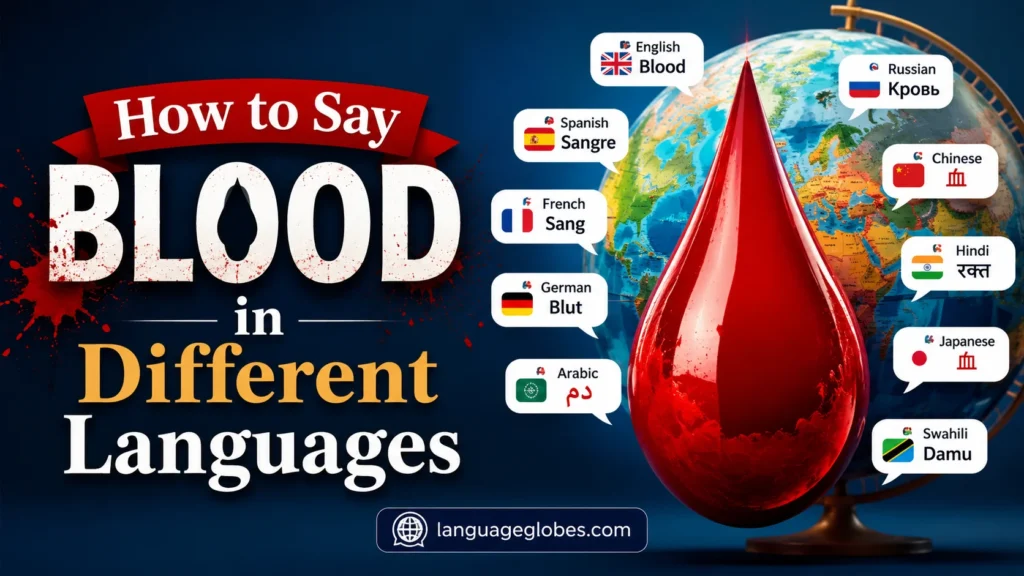
Understanding how to say blood across different languages improves communication and deepens appreciation for culture. This translation guide explains blood translation, blood meaning, pronunciation, and usage using simple examples.
Whether you are a language learner, student, traveler, writer, or language enthusiast, this language guide offers practical multilingual vocabulary. Explore world languages, foreign languages, language families, including Romance languages and Germanic languages, with confidence.
Learn to pronounce blood through clear blood pronunciation, audio pronunciation, and accurate language translation for spoken languages. Discover linguistic roots, language origins, Latin, and sanguis while understanding the blood term across history, literature, biology, medical science, medicine, healthcare, human body, life, and cultural symbolism.
This guide supports language learning, global communication, cross-cultural communication, and language comparison with reliable example sentences and useful vocabulary.
Also Read This: How to Say Bad in Different Languages
Interesting Facts About Blood
- Blood carries oxygen and nutrients throughout the body.
- The average adult has about 4.5 to 5.5 liters of blood.
- Every culture has words and expressions related to blood.
- Blood is often used symbolically to represent family, ancestry, and loyalty.
- Many languages use blood-related idioms to express emotions and relationships.
- The word blood has ancient roots in many language families.
- Medical professionals worldwide rely on blood terminology for healthcare communication.
- Blood donation saves millions of lives every year.
- Blood types are recognized internationally, regardless of language.
- Learning body-related vocabulary is one of the most practical steps in language learning.
How to Say Blood in Different Languages
The word blood may sound different across languages, but its importance remains the same. Below are translations from around the world.
European Languages
Europe is home to hundreds of languages belonging to Germanic, Romance, Slavic, Celtic, and other language families. While these languages have unique histories, many share common linguistic roots. Learning the word for blood in European languages can help travelers and language learners communicate in everyday and medical situations.
| Language | Country/Region | Translation | Pronunciation | Example Sentence |
| 🇺🇸 American English | USA | Blood | blud | The blood test was normal. |
| 🇬🇧 British English | United Kingdom | Blood | blud | The doctor checked my blood. |
| 🇦🇺 Australian English | Australia | Blood | blud | Blood donation helps many people. |
| Spanish | 🇪🇸 Spain | Sangre | SAHN-greh | La sangre es importante para la vida. |
| French | 🇫🇷 France | Sang | sahn | Le sang transporte l’oxygène. |
| German | 🇩🇪 Germany | Blut | bloot | Blut ist lebenswichtig. |
| Italian | 🇮🇹 Italy | Sangue | SAHN-gweh | Il sangue scorre nel corpo. |
| Portuguese | 🇵🇹 Portugal | Sangue | SAHN-goo | O sangue é vermelho. |
| Dutch | 🇳🇱 Netherlands | Bloed | bloot | Bloed is essentieel. |
| Swedish | 🇸🇪 Sweden | Blod | blohd | Blod transporterar syre. |
| Norwegian | 🇳🇴 Norway | Blod | bloo | Blod er viktig. |
| Danish | 🇩🇰 Denmark | Blod | blohth | Blod er nødvendigt. |
| Finnish | 🇫🇮 Finland | Veri | VEH-ree | Veri kiertää kehossa. |
| Icelandic | 🇮🇸 Iceland | Blóð | bloth | Blóð er mikilvægt. |
| Polish | 🇵🇱 Poland | Krew | krev | Krew jest ważna. |
| Czech | 🇨🇿 Czech Republic | Krev | krev | Krev je důležitá. |
| Slovak | 🇸🇰 Slovakia | Krv | kurv | Krv je život. |
| Slovenian | 🇸🇮 Slovenia | Kri | kree | Kri je pomembna. |
| Croatian | 🇭🇷 Croatia | Krv | kurv | Krv je važna. |
| Serbian | 🇷🇸 Serbia | Krv | kurv | Krv je život. |
| Bosnian | 🇧🇦 Bosnia | Krv | kurv | Krv je važna. |
| Romanian | 🇷🇴 Romania | Sânge | SUN-je | Sângele este important. |
| Hungarian | 🇭🇺 Hungary | Vér | vair | A vér fontos. |
| Greek | 🇬🇷 Greece | Αίμα | EE-ma | Το αίμα είναι σημαντικό. |
| Albanian | 🇦🇱 Albania | Gjak | gjak | Gjaku është i rëndësishëm. |
| Latvian | 🇱🇻 Latvia | Asinis | AH-si-nis | Asinis ir svarīgas. |
| Lithuanian | 🇱🇹 Lithuania | Kraujas | KROW-yas | Kraujas svarbus. |
| Estonian | 🇪🇪 Estonia | Veri | VEH-ri | Veri on tähtis. |
| Irish | 🇮🇪 Ireland | Fuil | fool | Tá fuil tábhachtach. |
| Welsh | 🏴 Wales | Gwaed | gwide | Mae gwaed yn bwysig. |
Asian Languages
Asia is the largest continent and contains thousands of languages spoken by billions of people. From East Asia to South Asia and Southeast Asia, the word blood reflects both linguistic diversity and cultural richness. These translations are useful for travelers, students, and international communication.
| Language | Country/Region | Translation | Pronunciation | Example Sentence |
| Chinese (Mandarin) | 🇨🇳 China | 血液 | shweh-yeh | 血液对生命很重要。 |
| Cantonese | 🇭🇰 Hong Kong | 血 | hyut | 血對生命很重要。 |
| Japanese | 🇯🇵 Japan | 血 | chi | 血は大切です。 |
| Korean | 🇰🇷 South Korea | 피 | pi | 피는 중요합니다. |
| Hindi | 🇮🇳 India | खून | khoon | खून जीवन के लिए आवश्यक है। |
| Urdu | 🇵🇰 Pakistan | خون | khoon | خون زندگی کے لیے ضروری ہے۔ |
| Bengali | 🇧🇩 Bangladesh | রক্ত | rokto | রক্ত জীবনের জন্য গুরুত্বপূর্ণ। |
| Punjabi | India/Pakistan | ਖੂਨ | khoon | ਖੂਨ ਜ਼ਰੂਰੀ ਹੈ। |
| Gujarati | 🇮🇳 India | લોહી | lohee | લોહી મહત્વપૂર્ણ છે. |
| Marathi | 🇮🇳 India | रक्त | rakt | रक्त महत्त्वाचे आहे. |
| Tamil | 🇮🇳 India | இரத்தம் | iratham | இரத்தம் முக்கியமானது. |
| Telugu | 🇮🇳 India | రక్తం | raktam | రక్తం ముఖ్యమైనది. |
| Kannada | 🇮🇳 India | ರಕ್ತ | rakta | ರಕ್ತ ಮುಖ್ಯವಾಗಿದೆ. |
| Malayalam | 🇮🇳 India | രക്തം | raktham | രക്തം പ്രധാനമാണ്. |
| Sinhala | 🇱🇰 Sri Lanka | ලේ | lay | ලේ වැදගත්ය. |
| Nepali | 🇳🇵 Nepal | रगत | ragat | रगत महत्वपूर्ण छ। |
| Thai | 🇹🇭 Thailand | เลือด | lueat | เลือดสำคัญมาก |
| Vietnamese | 🇻🇳 Vietnam | Máu | mao | Máu rất quan trọng. |
| Indonesian | 🇮🇩 Indonesia | Darah | da-rah | Darah sangat penting. |
| Malay | 🇲🇾 Malaysia | Darah | da-rah | Darah penting. |
| Filipino | 🇵🇭 Philippines | Dugo | doo-go | Mahalaga ang dugo. |
| Khmer | 🇰🇭 Cambodia | ឈាម | chheam | ឈាមសំខាន់ណាស់។ |
| Lao | 🇱🇦 Laos | ເລືອດ | leuat | ເລືອດສຳຄັນ. |
| Burmese | 🇲🇲 Myanmar | သွေး | thway | သွေးအရေးကြီးသည်။ |
| Mongolian | 🇲🇳 Mongolia | Цус | tsoos | Цус чухал. |
African Languages
Africa is one of the most linguistically diverse continents, with thousands of languages spoken across its regions. Many African languages belong to the Niger-Congo, Afro-Asiatic, and Nilo-Saharan language families. Learning common words such as blood helps build cross-cultural understanding.
| Language | Country/Region | Translation | Pronunciation | Example Sentence |
| Swahili | 🌍 East Africa | Damu | da-moo | Damu ni muhimu. |
| Zulu | 🇿🇦 South Africa | Igazi | ee-ga-zee | Igazi libalulekile. |
| Xhosa | 🇿🇦 South Africa | Igazi | ee-ga-zee | Igazi libalulekile. |
| Afrikaans | 🇿🇦 South Africa | Bloed | bloot | Bloed is belangrik. |
| Yoruba | 🇳🇬 Nigeria | Ẹjẹ | eh-jeh | Ẹjẹ ṣe pataki. |
| Igbo | 🇳🇬 Nigeria | Ọbara | oh-ba-ra | Ọbara dị mkpa. |
| Hausa | 🇳🇬 Nigeria | Jini | jee-nee | Jini yana da muhimmanci. |
| Amharic | 🇪🇹 Ethiopia | ደም | dem | ደም አስፈላጊ ነው። |
| Somali | 🇸🇴 Somalia | Dhiig | dheeg | Dhiig waa muhiim. |
| Shona | 🇿🇼 Zimbabwe | Ropa | ro-pa | Ropa rwakakosha. |
| Kinyarwanda | 🇷🇼 Rwanda | Amaraso | ama-ra-so | Amaraso ni ingenzi. |
| Luganda | 🇺🇬 Uganda | Omusaayi | o-mu-sa-yi | Omusaayi mukulu. |
Middle Eastern Languages
The Middle East is known for its rich cultural history and influential languages. Many languages spoken in this region belong to the Semitic family and have shaped literature, religion, science, and trade for centuries. Knowing essential vocabulary like blood can be valuable when learning these languages.
| Language | Country/Region | Translation | Pronunciation | Example Sentence |
| Arabic | 🌍 Middle East | دم | dam | الدم مهم للحياة. |
| Persian (Farsi) | 🇮🇷 Iran | خون | khoon | خون برای زندگی مهم است. |
| Turkish | 🇹🇷 Turkey | Kan | kan | Kan yaşam için önemlidir. |
| Hebrew | 🇮🇱 Israel | דם | dam | דם חשוב לחיים. |
| Kurdish | Iraq/Turkey | Xwîn | khween | Xwîn girîng e. |
| Armenian | 🇦🇲 Armenia | Արյուն | aryun | Արյունը կարևոր է։ |
| Azerbaijani | 🇦🇿 Azerbaijan | Qan | gan | Qan vacibdir. |
| Georgian | 🇬🇪 Georgia | სისხლი | sis-khli | სისხლი მნიშვნელოვანია. |
Additional Languages Around the World
Many fascinating languages are spoken throughout the Pacific Islands, indigenous communities, and other regions of the world. Learning these translations helps expand global awareness and appreciation for linguistic diversity.
| Language | Country/Region | Translation | Pronunciation | Example Sentence |
| Maori | 🇳🇿 New Zealand | Toto | toh-toh | He mea nui te toto. |
| Hawaiian | 🇺🇸 Hawaii | Koko | ko-ko | He mea nui ke koko. |
| Samoan | 🇼🇸 Samoa | Toto | toh-toh | E tāua le toto. |
| Tongan | 🇹🇴 Tonga | Toto | toh-toh | ʻOku mahuʻinga ʻa e toto. |
| Fijian | 🇫🇯 Fiji | Dra | ndra | E bibi na dra. |
| Tahitian | 🇵🇫 Tahiti | Toto | toh-toh | Mea faufaa te toto. |
| Greenlandic | 🇬🇱 Greenland | Aak | ahk | Aak pingaaruteqarpoq. |
| Inuktitut | 🇨🇦 Arctic Canada | Aupak | ow-pak | Aupak muhimu. |
FAQs
What does the blood word mean in different languages?
The blood word carries a similar universal meaning across many world languages, representing life, the human body, and living creatures. Its cultural context, history, and language expressions may vary depending on culture and regional traditions.
How can I find an accurate blood translation for multiple languages?
A reliable translation guide helps you compare blood translation, word translation, and language translation across global languages. It also explains correct usage, pronunciation, and common example sentences for everyday learning.
How do you pronounce blood correctly in foreign languages?
Learning blood pronunciation becomes easier with a language pronunciation guide and audio pronunciation resources. These help language learners confidently speak blood and understand pronunciation differences between spoken languages.
Why is blood meaning different across cultures?
Although blood meaning often relates to life and the human body, many societies connect it with heritage, family, family connections, religion, sacrifice, and emotions. These differences reflect rich cultural symbolism and world culture.
Why should language learners study the blood term?
The blood term is an essential word and fundamental term used in everyday conversations, education, and travel. Understanding it improves vocabulary, language learning, and multilingual communication.
How does the blood word relate to medical science and healthcare?
In medical science, medicine, healthcare, anatomy, and biology, blood is an essential concept for understanding the human body and human life. It is also widely used by medical professionals and healthcare professionals.
What are the linguistic origins of the blood word?
The blood word has unique linguistic roots and language origins across many language families. For example, Latin uses sanguis, while Romance languages and Germanic languages developed related forms through historical language evolution.
Who can benefit from learning blood in many languages?
Students, travelers, writers, language enthusiasts, and cultural enthusiasts all benefit from learning blood across different languages. It strengthens communication, global communication, and cross-cultural communication skills.
How many languages include translations for the blood word?
Many comprehensive language guides provide blood translation in over 70 languages, over 100 languages, or more than 40 languages. This makes it easier to discover languages, compare language diversity, and expand useful vocabulary.
Why is comparing blood across languages useful?
A language comparison highlights linguistic diversity, linguistic differences, and shared values between cultures. It also helps learn languages, improve communication skills, understand foreign languages, and build stronger international communication through richer multilingual vocabulary.
Conclusion
By learning how to say blood in different languages, you strengthen language learning, expand multilingual vocabulary, and improve global communication with confidence. Understanding blood translation, blood meaning, pronunciation, and correct usage across world languages also builds deeper appreciation for culture, language diversity, and cross-cultural communication. Whether you are a student, traveler, writer, or language enthusiast, this language guide provides valuable knowledge that makes communication more meaningful and helps you discover languages with greater understanding.

Grace Hall is a passionate language enthusiast and writer at LanguageGlobes, dedicated to making global communication simple and accessible. She shares insightful content to help readers explore new languages, cultures, and connections around the world.