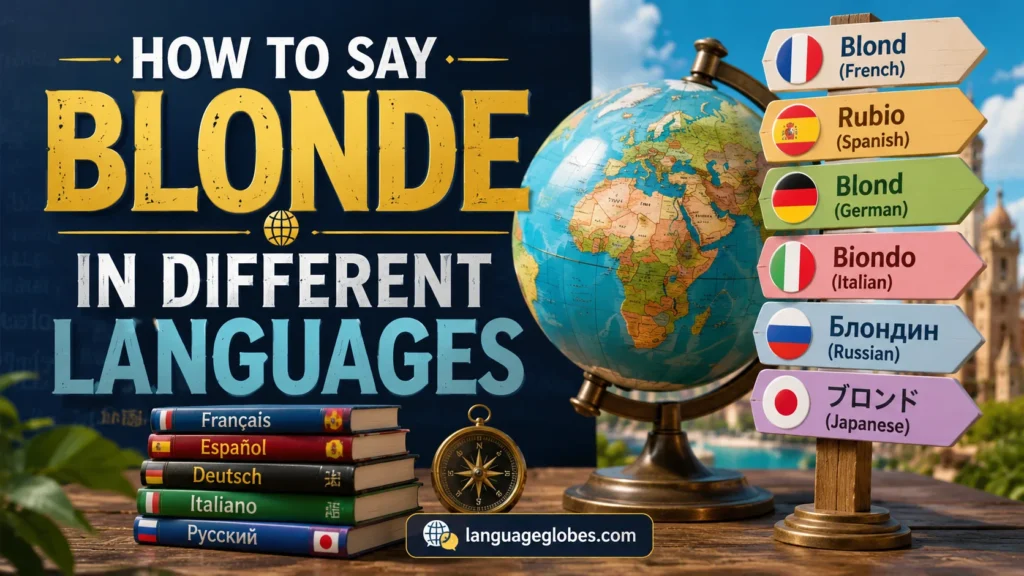
Understanding how to say blonde in different languages improves language learning and strengthens global communication across diverse cultures. This translation guide explains hair terminology, vocabulary, and pronunciation using clear example sentences and practical language expressions.
You will discover how blond, hair color, light hair, golden hair, fair hair, and pale yellow hair are described naturally. It also highlights regional variations, grammar, and linguistic differences for accurate everyday communication.
Whether you are a writer, translator, traveler, or enthusiastic language learner, this educational guide offers reliable multilingual vocabulary and practical language reference. Learn the female form, male form, grammatical gender, noun, and adjective usage across many world languages and foreign languages.
You will also explore cultural awareness, cultural diversity, historical significance, societal identity, and individual identity connected with hair description and beauty terms. This helpful language guide supports confident international communication while expanding your foreign vocabulary through meaningful language comparison.
Also Read This: How to Say Blood in Different Languages
Interesting Facts About Blonde
- The word blonde comes from the French language.
- In French, blond is traditionally masculine, while blonde is feminine.
- Many languages have gender-specific words for hair colors.
- Some Asian and African languages often borrow the English word “blonde” in modern conversation.
- Hair color descriptions can vary significantly depending on local culture and beauty standards.
- Several languages use the same word for both “blond” and “fair-haired.”
- Blonde hair naturally occurs in only a small percentage of the world’s population.
- Translators often choose context-specific words when describing blonde hair in literature.
How to Say Blonde in Different Languages
The tables below show how the word blonde is expressed in many languages around the world.
European Languages
Europe is home to some of the world’s most influential language families, including Germanic, Romance, Slavic, and Celtic languages. Many European languages have distinct words for hair colors and often distinguish between masculine and feminine forms. Understanding these translations can be particularly helpful for travel, literature, and language learning.
| Language | Country/Region | Translation | Pronunciation | Example Sentence |
| 🇺🇸 American English | USA | Blonde | Blond | She is blonde. |
| 🇬🇧 British English | UK | Blonde | Blond | She has blonde hair. |
| 🇦🇺 Australian English | Australia | Blonde | Blond | My friend is blonde. |
| 🇫🇷 French | France | Blonde | Blon-duh | Elle est blonde. |
| 🇪🇸 Spanish | Spain | Rubia | Roo-bee-ah | Ella es rubia. |
| 🇵🇹 Portuguese | Portugal | Loira | Loy-rah | Ela é loira. |
| 🇮🇹 Italian | Italy | Bionda | Bee-on-dah | Lei è bionda. |
| 🇩🇪 German | Germany | Blond | Blont | Sie ist blond. |
| 🇳🇱 Dutch | Netherlands | Blond | Blont | Zij is blond. |
| 🇸🇪 Swedish | Sweden | Blond | Blond | Hon är blond. |
| 🇳🇴 Norwegian | Norway | Blond | Blond | Hun er blond. |
| 🇩🇰 Danish | Denmark | Blond | Blond | Hun er blond. |
| 🇫🇮 Finnish | Finland | Vaalea | Vah-le-ah | Hän on vaalea. |
| 🇮🇸 Icelandic | Iceland | Ljóshærð | Lyo-hairth | Hún er ljóshærð. |
| 🇵🇱 Polish | Poland | Blondynka | Blon-din-kah | Ona jest blondynką. |
| 🇨🇿 Czech | Czech Republic | Blondýna | Blon-dee-na | Ona je blondýna. |
| 🇸🇰 Slovak | Slovakia | Blondínka | Blon-deen-kah | Ona je blondínka. |
| 🇭🇺 Hungarian | Hungary | Szőke | Suh-kay | Ő szőke. |
| 🇷🇴 Romanian | Romania | Blondă | Blon-duh | Ea este blondă. |
| 🇧🇬 Bulgarian | Bulgaria | Руса | Roo-sah | Тя е руса. |
| 🇷🇸 Serbian | Serbia | Плава | Plah-vah | Ona je plava. |
| 🇭🇷 Croatian | Croatia | Plavuša | Pla-voo-sha | Ona je plavuša. |
| 🇸🇮 Slovenian | Slovenia | Blondinka | Blon-din-kah | Ona je blondinka. |
| 🇬🇷 Greek | Greece | Ξανθιά | Ksan-thee-ah | Είναι ξανθιά. |
| 🇺🇦 Ukrainian | Ukraine | Блондинка | Blon-din-ka | Вона блондинка. |
| 🇷🇺 Russian | Russia | Блондинка | Blon-deen-ka | Она блондинка. |
| 🇱🇹 Lithuanian | Lithuania | Blondinė | Blon-di-nay | Ji blondinė. |
| 🇱🇻 Latvian | Latvia | Blondīne | Blon-dee-neh | Viņa ir blondīne. |
| 🇪🇪 Estonian | Estonia | Blondiin | Blon-deen | Ta on blondiin. |
Asian Languages
Asia contains thousands of languages and diverse cultures stretching from the Middle East to East Asia. While naturally blonde hair is less common in many Asian populations, most languages have developed specific terms to describe blonde individuals, especially through modern media, travel, and cultural exchange.
| Language | Country/Region | Translation | Pronunciation | Example Sentence |
| 🇨🇳 Chinese (Mandarin) | China | 金发女郎 | Jin-fah Nyu-lang | 她是金发女郎。 |
| 🇯🇵 Japanese | Japan | ブロンド | Bu-ron-do | 彼女はブロンドです。 |
| 🇰🇷 Korean | South Korea | 금발 | Geum-bal | 그녀는 금발이다. |
| 🇮🇳 Hindi | India | गोरी बालों वाली | Go-ri Ba-lon Va-li | वह गोरी बालों वाली है। |
| 🇵🇰 Urdu | Pakistan | سنہرے بالوں والی | Sun-hairay Balon Wali | وہ سنہرے بالوں والی ہے۔ |
| 🇧🇩 Bengali | Bangladesh | স্বর্ণকেশী | Shorno-keshi | সে স্বর্ণকেশী। |
| 🇮🇳 Punjabi | Punjab | سنہری بالاں والی | Sunheri Balan Wali | اوہ سنہری بالاں والی اے۔ |
| 🇮🇳 Gujarati | India | સોનેરી વાળવાળી | So-ne-ri Val-va-li | તે સોનેરી વાળવાળી છે. |
| 🇮🇳 Marathi | India | सोनेरी केसांची | So-ne-ri Ke-san-chi | ती सोनेरी केसांची आहे. |
| 🇳🇵 Nepali | Nepal | गोरो कपाल भएकी | Go-ro Ka-pal | उनी गोरो कपाल भएकी हुन्। |
| 🇱🇰 Sinhala | Sri Lanka | දුඹුරු කෙස් ඇති | Dum-bu-ru Kes Athi | ඇය දුඹුරු කෙස් ඇති. |
| 🇹🇭 Thai | Thailand | ผมบลอนด์ | Pom Blond | เธอผมบลอนด์ |
| 🇻🇳 Vietnamese | Vietnam | Tóc vàng | Tok Vang | Cô ấy có tóc vàng. |
| 🇮🇩 Indonesian | Indonesia | Pirang | Pee-rang | Dia pirang. |
| 🇲🇾 Malay | Malaysia | Berambut Perang | Beh-ram-boot Pe-rang | Dia berambut perang. |
| 🇵🇭 Filipino | Philippines | Kulay ginto ang buhok | Ku-lay Gin-to | Siya ay kulay ginto ang buhok. |
| 🇰🇭 Khmer | Cambodia | សក់ពណ៌មាស | Sok Puo Mas | នាងមានសក់ពណ៌មាស។ |
| 🇱🇦 Lao | Laos | ຜົມສີທອງ | Pom See Thong | ນາງມີຜົມສີທອງ |
| 🇲🇳 Mongolian | Mongolia | Шар үстэй | Shar Us-tei | Тэр шар үстэй. |
| 🇹🇷 Turkish | Turkey | Sarışın | Sa-rush-un | O sarışın. |
African Languages
Africa is home to more than two thousand languages and incredible cultural diversity. Many African languages describe blonde hair through phrases meaning “golden-haired” or “light-haired.” In multilingual countries, English, French, Portuguese, and Arabic influences also shape local vocabulary.
| Language | Country/Region | Translation | Pronunciation | Example Sentence |
| 🇿🇦 Afrikaans | South Africa | Blond | Blont | Sy is blond. |
| 🇸🇿 Swati | Eswatini | Omhloshana | Om-hlo-sha-na | Ungumhloshana. |
| 🇿🇦 Zulu | South Africa | Onezinwele ezimhlophe | O-ne-zin-we-le | Ungowezinwele ezimhlophe. |
| 🇰🇪 Swahili | East Africa | Mwenye nywele za dhahabu | Mwe-nye Nye-we-le | Ana nywele za dhahabu. |
| 🇪🇹 Amharic | Ethiopia | ወርቃማ ፀጉር | Wer-ka-ma Tse-gur | እሷ ወርቃማ ፀጉር አላት። |
| 🇳🇬 Yoruba | Nigeria | Olori irun ofeefee | O-lo-ri Ee-run | O ni irun ofeefee. |
| 🇳🇬 Igbo | Nigeria | Ntutu odo | Ntoo-too O-do | O nwere ntutu odo. |
| 🇳🇬 Hausa | Nigeria | Mai gashi mai rawaya | Mai Ga-shi | Ita mai gashi mai rawaya ce. |
| 🇧🇼 Tswana | Botswana | Mosweu wa moriri | Mo-swe-u | Ke mosweu wa moriri. |
| 🇲🇬 Malagasy | Madagascar | Volom-bolamena | Vo-lom-bo-la-me-na | Blonde izy. |
Middle Eastern Languages
The Middle East has a rich linguistic heritage that includes Semitic, Turkic, and Indo-Iranian languages. Descriptions of physical appearance, including hair color, often carry poetic and historical significance in the region’s literature and traditions.
| Language | Country/Region | Translation | Pronunciation | Example Sentence |
| 🇸🇦 Arabic | Middle East | شقراء | Shaq-ra | هي شقراء. |
| 🇮🇷 Persian (Farsi) | Iran | بلوند | Be-lond | او بلوند است. |
| 🇮🇱 Hebrew | Israel | בלונדינית | Blon-di-neet | היא בלונדינית. |
| 🇰🇷 Kurdish | Kurdistan Region | Zerînpor | Ze-reen-por | Ew zerînpor e. |
| 🇦🇲 Armenian | Armenia | Շիկահեր | Shi-ka-her | Նա շիկահեր է։ |
| 🇦🇿 Azerbaijani | Azerbaijan | Sarışın | Sa-rish-in | O sarışındır. |
| 🇬🇪 Georgian | Georgia | ქერა | Ke-ra | ის ქერაა. |
| 🇹🇯 Tajik | Tajikistan | Малламуй | Mal-la-mooy | Ӯ малламуй аст. |
| 🇵🇸 Palestinian Arabic | Palestine | شقراء | Shaq-ra | هي شقراء. |
| 🇴🇲 Omani Arabic | Oman | شقراء | Shaq-ra | هي شقراء. |
Additional Languages Around the World
Many languages outside Europe, Asia, Africa, and the Middle East also have unique ways of describing blonde hair. These translations highlight the incredible diversity of human language and expression across different regions of the world.
| Language | Country/Region | Translation | Pronunciation | Example Sentence |
| 🇳🇿 Maori | New Zealand | Makawe kōwhai | Ma-ka-we Ko-whai | He makawe kōwhai tōna. |
| 🇼🇸 Samoan | Samoa | Lauulu samasama | Lau-u-lu Sa-ma-sa-ma | E lauulu samasama o ia. |
| 🇹🇴 Tongan | Tonga | Lau’ulu lanu koula | Lau-ulu La-nu Kou-la | Ko e lau’ulu lanu koula ia. |
| 🇫🇯 Fijian | Fiji | Drauniulu vulavula | Drau-ni-u-lu | E drauniulu vulavula o koya. |
| 🇭🇹 Haitian Creole | Haiti | Blond | Blond | Li blond. |
| 🇬🇱 Greenlandic | Greenland | Qernertuunngitsoq | Ker-ner-tung-it-sok | Arnaq taanna qernertuunngitsoq. |
| 🇵🇬 Tok Pisin | Papua New Guinea | Yelo gras | Ye-lo Gras | Em i gat yelo gras. |
| 🇮🇪 Irish | Ireland | Fionn | Fyun | Tá sí fionn. |
| 🏴 Welsh | Wales | Melynwallt | Mel-in-walth | Mae hi’n felynwallt. |
| 🏴 Scottish Gaelic | Scotland | Fionn | Fyoon | Tha i fionn. |
FAQs
What does blonde mean in different languages?
The meaning of blonde changes across world languages because each language follows unique grammar, vocabulary, and hair terminology. Some languages use separate words for a woman and a man, while others use one form for every person.
What is the difference between blonde and blond?
In many foreign languages, blonde is the female form, while blond is the male form. This difference depends on grammatical gender, where the word functions as a noun or adjective according to the language.
Why do translations for blonde vary between languages?
Every translation reflects local cultures, regional variations, and linguistic differences. These changes help preserve natural language expressions and improve accurate international communication.
How do I pronounce blonde correctly in different languages?
Learning pronunciation, following an audio pronunciation resource, and using a pronunciation guide improve speaking confidence. Regular reading pronunciation, listening practice, and pronunciation practice also help learners sound more natural.
Is this a useful language guide for language learners?
Yes, this language guide serves as an educational guide and valuable educational resource for language learners. It supports vocabulary expansion, foreign vocabulary, and stronger communication skills through practical examples.
How is hair color described in different languages?
Many languages use descriptive terms such as light hair, golden hair, fair hair, pale yellow hair, light brown hair, golden shades, and other hair shade expressions. These descriptive words vary according to local language and dialect.
Why is grammatical gender important when translating blonde?
Understanding grammatical gender ensures the correct translation for the female form and male form. Correct use of adjectives, nouns, and grammar makes communication more accurate and natural.
Can writers and translators benefit from learning these terms?
Absolutely, writers, translators, and travelers can improve multilingual content, language translation, and global communication. A reliable translation guide also strengthens professional and personal communication.
What cultural meaning does blonde have around the world?
The idea of blonde often reflects cultural awareness, cultural diversity, cultural identity, historical significance, societal identity, and individual identity. Views may differ across Europe, Asia, Africa, the Middle East, and other global cultures.
How many languages are included in a comprehensive language reference?
A detailed language reference may cover over 100 languages or 70 languages, depending on the resource. It usually includes multilingual, multilingual vocabulary, language comparison, foreign languages, regional language, native language, language resource, audio learning, example sentences, fascinating facts, and practical beauty terms for better hair appearance understanding.
Conclusion
By understanding how blonde is expressed in different languages, you build stronger language learning skills while expanding your vocabulary and improving translation accuracy. This language guide helps you understand hair terminology, grammar, pronunciation, regional variations, and linguistic differences with confidence. Whether you are a language learner, writer, translator, or traveler, this educational guide supports better global communication, deeper cultural awareness, and meaningful connections across world languages and global cultures through accurate and natural language expressions.

James Anderson is a passionate language enthusiast and content creator at LanguageGlobes. With a keen interest in global cultures and communication, he shares insightful and engaging content to help readers explore and master new languages.