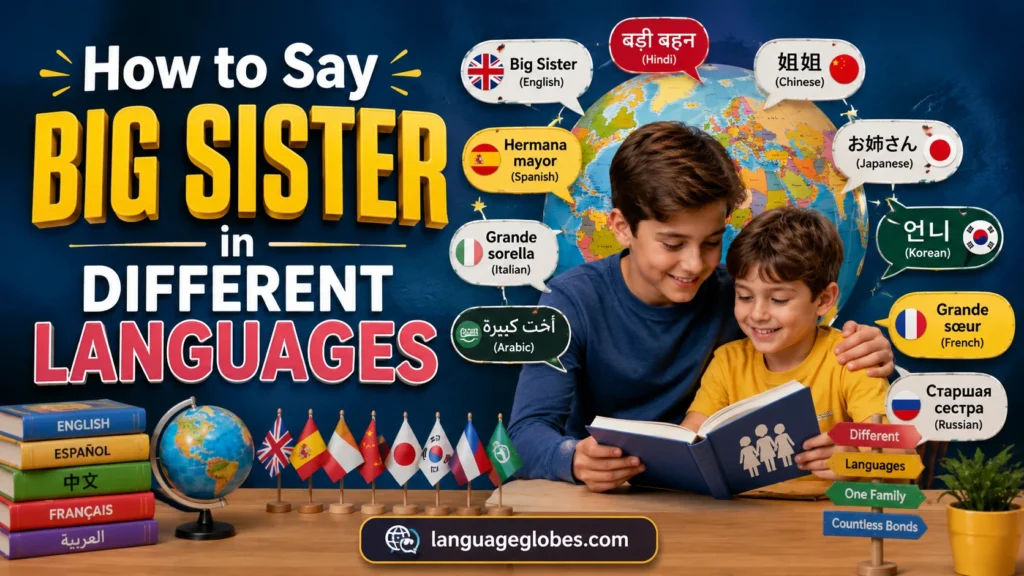
Learning how to say big sister in different languages strengthens communication across diverse cultures with confidence. This language guide explores big sister translation, big sister pronunciation, and meaningful translations for everyday use.
Discover the correct word, phrase, and term through clear language examples and simple pronunciation guide support. Whether improving language learning or satisfying curiosity, this translation resource makes every family relationship easier to understand.
A big sister is often an older sister, elder sister, trusted friend, guide, teacher, protector, and inspiring role model within every family. Many languages reflect family values, respect, affection, family bond, kinship, family hierarchy, and cultural traditions through unique expressions.
This translation list compares world languages, European languages, Asian languages, African languages, and global languages, helping readers learn languages naturally. You will also find example sentence, audio pronunciation, listen to pronunciation, native speakers, regional variations, and practical everyday conversation tips for multilingual communication.
Also Read This: How to Say Big Brother in Different Languages
Interesting Facts About Big Sister
- Many Asian languages have separate words specifically for older and younger sisters.
- In several cultures, older sisters are treated with special respect and responsibility.
- The concept of a big sister often symbolizes guidance, protection, and family leadership.
- Some languages use honorific titles instead of direct names when speaking to an older sister.
- In Chinese, Korean, and Japanese, the word for big sister changes depending on who is speaking.
- African languages often use family terms that emphasize community and extended family relationships.
- Many European languages derive their word for sister from ancient Indo-European roots.
- Learning family vocabulary is one of the easiest ways to start communicating in a new language.
- Big sister terms are commonly used as affectionate nicknames among friends in some cultures.
- Family-related words are among the oldest and most frequently used words in every language.
How to Say Big Sister in Different Languages
The following tables show translations of “big sister” from around the world. Pronunciations are simplified for English speakers and may vary slightly by region.
European Languages
Europe is home to hundreds of languages and dialects with rich cultural histories. Family plays an important role throughout European societies, and many languages have affectionate terms for older siblings. While some languages use a direct translation of “older sister,” others rely on descriptive phrases that emphasize age and family relationships.
| Language | Country/Region | Translation | Pronunciation | Example Sentence |
| 🇺🇸 American English | United States | Big Sister | Big Sis-ter | My big sister helps me with homework. |
| 🇬🇧 British English | United Kingdom | Big Sister | Big Sis-ter | My big sister lives in London. |
| 🇦🇺 Australian English | Australia | Big Sister | Big Sis-ter | My big sister loves surfing. |
| Spanish | 🇪🇸 Spain | Hermana Mayor | Er-ma-na Ma-yor | Mi hermana mayor me ayuda. |
| French | 🇫🇷 France | Grande Sœur | Grahn-d Sur | Ma grande sœur est gentille. |
| German | 🇩🇪 Germany | Große Schwester | Gro-suh Shves-ter | Meine große Schwester hilft mir. |
| Italian | 🇮🇹 Italy | Sorella Maggiore | So-rel-la Mad-jor-e | Mia sorella maggiore è simpatica. |
| Portuguese | 🇵🇹 Portugal | Irmã Mais Velha | Ir-ma Mais Vel-ya | Minha irmã mais velha é médica. |
| Dutch | 🇳🇱 Netherlands | Oudere Zus | Ow-de-re Zus | Mijn oudere zus woont hier. |
| Swedish | 🇸🇪 Sweden | Storasyster | Sto-ra-sis-ter | Min storasyster är snäll. |
| Norwegian | 🇳🇴 Norway | Storesøster | Sto-re-sos-ter | Min storesøster hjelper meg. |
| Danish | 🇩🇰 Denmark | Storesøster | Sto-re-sos-ter | Min storesøster er sød. |
| Finnish | 🇫🇮 Finland | Isosisko | Ee-so-sis-ko | Isosiskoni auttaa minua. |
| Icelandic | 🇮🇸 Iceland | Stóra Systir | Sto-ra Sis-tir | Stóra systir mín er góð. |
| Polish | 🇵🇱 Poland | Starsza Siostra | Star-sha Shos-tra | Moja starsza siostra jest miła. |
| Czech | 🇨🇿 Czech Republic | Starší Sestra | Star-shee Ses-tra | Moje starší sestra pomáhá. |
| Slovak | 🇸🇰 Slovakia | Staršia Sestra | Star-shee-a Ses-tra | Moja staršia sestra je učiteľka. |
| Hungarian | 🇭🇺 Hungary | Nővér | Nu-ver | A nővérem kedves. |
| Romanian | 🇷🇴 Romania | Soră Mai Mare | So-ra Mai Ma-re | Sora mea mai mare este aici. |
| Greek | 🇬🇷 Greece | Μεγάλη Αδελφή | Me-ga-li A-del-fi | Η μεγάλη αδελφή μου βοηθά. |
| Russian | 🇷🇺 Russia | Старшая Сестра | Star-sha-ya Ses-tra | Моя старшая сестра добрая. |
Asian Languages
Asia is the largest continent and contains incredible linguistic diversity. Many Asian cultures place a strong emphasis on family hierarchy and respect for elders. As a result, several Asian languages have unique and culturally significant words specifically for older sisters.
| Language | Country/Region | Translation | Pronunciation | Example Sentence |
| Mandarin Chinese | 🇨🇳 China | 姐姐 | Jie Jie | 我的姐姐很好。 |
| Cantonese | 🇭🇰 Hong Kong | 家姐 | Ga Je | 家姐對我很好。 |
| Japanese | 🇯🇵 Japan | お姉さん | O-nee-san | お姉さんは優しいです。 |
| Korean | 🇰🇷 South Korea | 언니 | Un-ni | 언니가 도와줘요. |
| Hindi | 🇮🇳 India | बड़ी बहन | Ba-di Be-hen | मेरी बड़ी बहन अच्छी है। |
| Urdu | 🇵🇰 Pakistan | بڑی بہن | Bari Behan | میری بڑی بہن بہت اچھی ہے۔ |
| Bengali | 🇧🇩 Bangladesh | বড় বোন | Boro Bon | আমার বড় বোন শিক্ষক। |
| Punjabi | India/Pakistan | ਵੱਡੀ ਭੈਣ | Vad-di Bhain | ਮੇਰੀ ਵੱਡੀ ਭੈਣ ਚੰਗੀ ਹੈ। |
| Gujarati | 🇮🇳 India | મોટી બહેન | Mo-ti Be-hen | મારી મોટી બહેન મદદ કરે છે. |
| Marathi | 🇮🇳 India | मोठी बहीण | Mo-thi Ba-hin | माझी मोठी बहीण छान आहे. |
| Tamil | 🇮🇳 India | அக்கா | Ak-ka | என் அக்கா நல்லவர். |
| Telugu | 🇮🇳 India | అక్క | Ak-ka | నా అక్క చాలా మంచిది. |
| Kannada | 🇮🇳 India | ಅಕ್ಕ | Ak-ka | ನನ್ನ ಅಕ್ಕ ಒಳ್ಳೆಯವಳು. |
| Malayalam | 🇮🇳 India | ചേച്ചി | Che-chi | എന്റെ ചേച്ചി നല്ലവളാണ്. |
| Sinhala | 🇱🇰 Sri Lanka | අක්කා | Ak-ka | මගේ අක්කා හොඳයි. |
| Nepali | 🇳🇵 Nepal | दिदी | Dee-Dee | मेरी दिदी राम्री छिन्। |
| Thai | 🇹🇭 Thailand | พี่สาว | Pee Sao | พี่สาวของฉันใจดี |
| Vietnamese | 🇻🇳 Vietnam | Chị Gái | Chi Gai | Chị gái tôi rất tốt. |
| Indonesian | 🇮🇩 Indonesia | Kakak Perempuan | Ka-kak Pe-rem-puan | Kakak perempuan saya baik. |
| Malay | 🇲🇾 Malaysia | Kakak | Ka-kak | Kakak saya sangat baik. |
| Filipino | 🇵🇭 Philippines | Ate | A-te | Ate ko ay mabait. |
| Khmer | 🇰🇭 Cambodia | បងស្រី | Bong Srey | បងស្រីរបស់ខ្ញុំល្អណាស់។ |
| Lao | 🇱🇦 Laos | ເອື້ອຍ | Eu-ay | ເອື້ອຍຂອງຂ້ອຍໃຈດີ. |
| Burmese | 🇲🇲 Myanmar | အစ်မ | Ait-ma | အစ်မက ကြင်နာတယ်။ |
| Mongolian | 🇲🇳 Mongolia | Эгч | Egch | Эгч минь сайн хүн. |
African Languages
Africa is one of the most linguistically diverse continents, with thousands of languages spoken across its regions. Family and community connections are central to many African cultures, making sibling terms important parts of daily communication.
| Language | Country/Region | Translation | Pronunciation | Example Sentence |
| Swahili | 🇹🇿 Tanzania/Kenya | Dada Mkubwa | Da-da Mku-ba | Dada mkubwa ananisaidia. |
| Zulu | 🇿🇦 South Africa | Udadewethu Omkhulu | U-da-de-we-thu Om-ku-lu | Udadewethu omkhulu muhle. |
| Xhosa | 🇿🇦 South Africa | Udade Omkhulu | U-da-de Om-ku-lu | Udade omkhulu uyandinceda. |
| Afrikaans | 🇿🇦 South Africa | Ouer Suster | Ow-er Sus-ter | My ouer suster is vriendelik. |
| Yoruba | 🇳🇬 Nigeria | Ẹgbọn Obinrin | Eg-bon O-bi-nrin | Ẹgbọn obinrin mi dara. |
| Igbo | 🇳🇬 Nigeria | Nwanne Nwanyị Okenye | Nwan-ne Nwa-nyi O-ke-nye | Nwanne m nwanyị okenye dị mma. |
| Hausa | 🇳🇬 Nigeria | Yayar Tawa | Ya-yar Ta-wa | Yayar tawa tana da kirki. |
| Amharic | 🇪🇹 Ethiopia | ታላቅ እህት | Ta-lak E-hit | ታላቅ እህቴ ጥሩ ናት። |
| Somali | 🇸🇴 Somalia | Walaal Weyn | Wa-laal Weyn | Walaashay weyn waa fiican. |
| Shona | 🇿🇼 Zimbabwe | Hanzvadzi Huru | Han-zva-dzi Hu-ru | Hanzvadzi huru inobatsira. |
| Kinyarwanda | 🇷🇼 Rwanda | Mushikiwabo Mukuru | Mu-shi-ki-wa-bo Mu-ku-ru | Mushikiwabo mukuru ni mwiza. |
| Luganda | 🇺🇬 Uganda | Mwannyina Omukulu | Mwan-nyi-na O-mu-ku-lu | Mwannyina omukulu mulungi. |
Middle Eastern Languages
The Middle East has a rich linguistic heritage shaped by ancient civilizations, trade routes, and cultural traditions. Respect for family members is deeply rooted throughout the region, and many languages have special expressions for older sisters.
| Language | Country/Region | Translation | Pronunciation | Example Sentence |
| Arabic | 🌍 Middle East | أخت كبيرة | Ukht Ka-bi-ra | أختي الكبيرة تساعدني. |
| Persian (Farsi) | 🇮🇷 Iran | خواهر بزرگ | Kha-har Bo-zorg | خواهر بزرگم مهربان است. |
| Turkish | 🇹🇷 Turkey | Abla | Ab-la | Ablam bana yardım ediyor. |
| Hebrew | 🇮🇱 Israel | אחות גדולה | A-hot Gdo-la | אחות גדולה שלי נחמדה. |
| Kurdish | Iraq/Turkey | Xwişka Mezin | Khwish-ka Me-zin | Xwişka mezin min başe. |
| Pashto | 🇦🇫 Afghanistan | مشره خور | Mash-ra Khor | زما مشره خور ښه ده. |
| Dari | 🇦🇫 Afghanistan | خواهر کلان | Kha-har Ka-lan | خواهر کلان من مهربان است. |
| Armenian | 🇦🇲 Armenia | Մեծ Քույր | Mets Kuyr | Մեծ քույրս բարի է։ |
| Azerbaijani | 🇦🇿 Azerbaijan | Böyük Bacı | Bo-yuk Ba-ji | Böyük bacım mənə kömək edir. |
| Georgian | 🇬🇪 Georgia | უფროსი და | Uf-ro-si Da | უფროსი და კეთილია. |
Additional Languages Around the World
Languages from Oceania, indigenous communities, and other regions contribute to the rich tapestry of global communication. Learning these terms helps us appreciate the diversity of human cultures and family traditions.
| Language | Country/Region | Translation | Pronunciation | Example Sentence |
| Hawaiian | 🇺🇸 Hawaii | Kaikuahine Nui | Kai-koo-a-hi-ne Nu-i | He aloha koʻu kaikuahine nui. |
| Maori | 🇳🇿 New Zealand | Tuakana | Too-a-ka-na | He pai taku tuakana. |
| Samoan | 🇼🇸 Samoa | Tuafafine Matua | Too-a-fa-fi-ne Ma-tu-a | E alofa lo’u tuafafine matua. |
| Tongan | 🇹🇴 Tonga | Tuofefine Lahi | Too-o-fe-fi-ne La-hi | Ko hoku tuofefine lahi lelei. |
| Fijian | 🇫🇯 Fiji | Tuakana | Too-a-ka-na | E vinaka na tuakana. |
| Tahitian | 🇵🇫 Tahiti | Tuahine Paari | Too-a-hi-ne Paa-ri | E maitai te tuahine paari. |
| Inuit (Inuktitut) | 🇨🇦 Arctic Canada | Angajuqqaaq | An-ga-juk-kaak | Angajuqqaaq ikajuqtara. |
| Cherokee | 🇺🇸 United States | Agidoda | A-gi-do-da | Agidoda is kind. |
| Navajo | 🇺🇸 United States | Shimá Sání | Shi-ma Sa-ni | Shimá sání helps me. |
| Esperanto | International | Fratino Pli Aĝa | Fra-ti-no Plee A-ja | Mia fratino pli aĝa estas afabla. |
FAQs
How to say big sister in different languages?
You can learn how to say big sister in different languages by exploring translations, language guide, and world languages. This helps improve communication, vocabulary, and understanding of cultural diversity.
What is the meaning of big sister in family relationships?
A big sister or older sister is an elder sibling within a family. She often plays a role of guide, protector, and trusted friend in the family bond.
Why is elder sister an important kinship term?
The term elder sister is an important kinship word showing respect, affection, and family values. It reflects strong familial bond and family relationships across cultures.
How is big sister translated in global languages?
The phrase big sister translation varies across European languages, Asian languages, and African languages. These translations reflect linguistic diversity and regional language differences.
How do you pronounce big sister correctly?
You can learn big sister pronunciation using an audio pronunciation and pronunciation guide. This improves spoken languages, learn pronunciation, and language practice skills.
What are affectionate terms for big sister?
Many cultures use an affectionate nickname or honorific titles for big sister. These terms show respect, affection, and family heritage in daily communication.
How is big sister used in everyday conversation?
The term big sister is common in everyday conversation and spoken languages. It helps learners improve language learning, communication, and multilingual communication.
What role does big sister play in culture and traditions?
A big sister represents cultural traditions, family heritage, and linguistic heritage. She is often seen as a role model, teacher, and guide in many societies.
How does language learning help understand big sister terms?
Language learning helps you explore different languages, translation list, and language examples. It strengthens language skills, vocabulary, and cross cultural communication.
Why is multilingual communication important for family terms?
Multilingual communication helps understand family hierarchy, older sibling, and sibling relationship terms. It improves global communication, language education, and cultural understanding.
Conclusion
In conclusion, learning how to say big sister in different languages strengthens communication and deepens understanding of world languages and linguistic diversity. It highlights the importance of family, family bond, and kinship, where an older sister or elder sister often acts as a guide, protector, and role model. Through translations, pronunciation guide, and language learning, people can explore cultural traditions and improve multilingual communication. This knowledge enriches family relationships, supports language skills, and connects global cultures in meaningful ways.

Joshua Lewis is a passionate language enthusiast and content creator at LanguageGlobes.com. He specializes in exploring global languages, cultures, and communication trends, helping readers connect with the world through words.