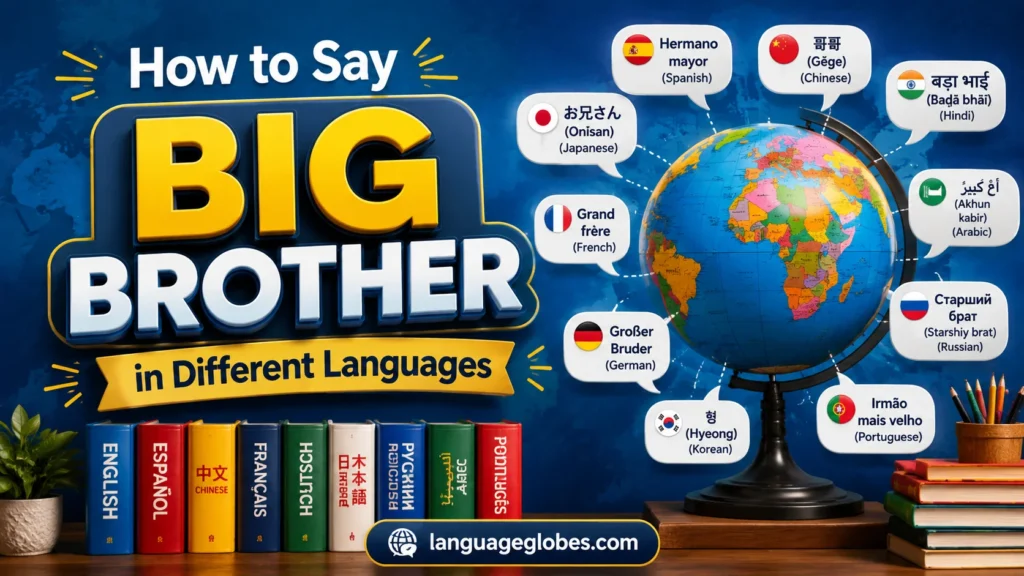
Learning how to say big brother in different languages helps strengthen family communication across global cultures naturally. This language guide explains big brother in different languages using accurate language translation and clear pronunciation.
You will discover meaningful family terms, kinship terms, and respectful terms used in many world languages. Whether you are language learners, students, or travelers, this translation guide makes language learning simple and enjoyable.
Understanding elder brother, older brother, and brother expressions reflects family relationships, cultural values, and family traditions worldwide. Explore elder brother in different languages, brother in different languages, example sentences, and a practical pronunciation guide for confident communication.
This multilingual dictionary also highlights affectionate terms, formal language, informal language, speaker gender, and addressing elder brother across international languages. Expand your vocabulary, appreciate language diversity, and build stronger human connections through every phrase translation.
Also Read This: How to Say Birth in Different Languages
Interesting Facts About Big Brother
- Many Asian languages have different words for older and younger siblings.
- In Korean, Japanese, and Chinese, the word for big brother often reflects respect and hierarchy within the family.
- Some cultures use the term for big brother even when speaking to close friends or mentors.
- In Arabic-speaking countries, the phrase for big brother is often used as a respectful form of address.
- Several African languages use family terms beyond biological relationships to show community bonds.
- The meaning of big brother can symbolize protection, leadership, and responsibility across cultures.
- Some languages have gender-specific sibling terms while others use a single word for all siblings.
- Learning family vocabulary is one of the easiest ways to start understanding a new language.
How to Say Big Brother in Different Languages
Below are translations of the phrase big brother from around the world.
European Languages
Europe is home to hundreds of languages belonging to Germanic, Romance, Slavic, Celtic, and other language families. Family relationships are highly valued throughout the continent, and many European languages have distinct terms for older siblings. Learning these expressions provides insight into regional cultures and traditions.
| Language | Country/Region | Translation | Pronunciation | Example Sentence |
| 🇺🇸 American English | USA | Big Brother | Big Bruh-thur | My big brother helps me every day. |
| 🇬🇧 British English | United Kingdom | Big Brother | Big Bruh-thuh | My big brother lives in London. |
| 🇦🇺 Australian English | Australia | Big Brother | Big Bruh-thuh | My big brother taught me cricket. |
| 🇫🇷 French | France | Grand Frère | Grahn Frehr | Mon grand frère est gentil. |
| 🇪🇸 Spanish | Spain | Hermano Mayor | Er-ma-no Ma-yor | Mi hermano mayor me ayuda. |
| 🇵🇹 Portuguese | Portugal | Irmão Mais Velho | Eer-mowh Mais Vel-yo | Meu irmão mais velho é médico. |
| 🇮🇹 Italian | Italy | Fratello Maggiore | Fra-tel-lo Mad-jo-re | Mio fratello maggiore è simpatico. |
| 🇩🇪 German | Germany | Großer Bruder | Gro-ser Broo-der | Mein großer Bruder arbeitet hier. |
| 🇳🇱 Dutch | Netherlands | Grote Broer | Gro-te Broor | Mijn grote broer woont daar. |
| 🇸🇪 Swedish | Sweden | Storebror | Sto-re-bror | Min storebror är stark. |
| 🇳🇴 Norwegian | Norway | Storebror | Sto-re-bror | Min storebror spiller fotball. |
| 🇩🇰 Danish | Denmark | Storebror | Sto-re-bror | Min storebror er lærer. |
| 🇫🇮 Finnish | Finland | Isoveli | Ee-so-ve-li | Isoveli auttaa minua. |
| 🇵🇱 Polish | Poland | Starszy Brat | Star-shi Brat | Mój starszy brat jest miły. |
| 🇨🇿 Czech | Czech Republic | Starší Bratr | Star-shee Bra-tr | Můj starší bratr studuje. |
| 🇸🇰 Slovak | Slovakia | Starší Brat | Star-shee Brat | Môj starší brat pracuje. |
| 🇭🇺 Hungarian | Hungary | Báty | Baa-ty | A bátyom kedves. |
| 🇷🇴 Romanian | Romania | Frate Mai Mare | Fra-te Mai Ma-re | Fratele meu mai mare este doctor. |
| 🇬🇷 Greek | Greece | Μεγάλος Αδελφός | Me-ga-los A-del-fos | Ο μεγάλος αδελφός μου βοηθά. |
| 🇷🇺 Russian | Russia | Старший Брат | Star-shee Brat | Мой старший брат дома. |
| 🇺🇦 Ukrainian | Ukraine | Старший Брат | Star-shyi Brat | Мій старший брат хороший. |
Asian Languages
Asia is the world’s largest continent and contains thousands of languages and dialects. Respect for elders is deeply rooted in many Asian cultures, which is reflected in special terms for older siblings. In several Asian societies, addressing a big brother correctly is an important sign of courtesy and family respect.
| Language | Country/Region | Translation | Pronunciation | Example Sentence |
| 🇨🇳 Chinese (Mandarin) | China | 哥哥 | Gē Ge | 我的哥哥很聪明。 |
| 🇯🇵 Japanese | Japan | 兄 | Ani | 兄は優しいです。 |
| 🇰🇷 Korean | South Korea | 형 | Hyung | 형은 친절해요. |
| 🇮🇳 Hindi | India | बड़ा भाई | Bada Bhai | मेरा बड़ा भाई शिक्षक है। |
| 🇵🇰 Urdu | Pakistan | بڑا بھائی | Bara Bhai | میرا بڑا بھائی اچھا ہے۔ |
| 🇧🇩 Bengali | Bangladesh | বড় ভাই | Boro Bhai | আমার বড় ভাই ডাক্তার। |
| 🇵🇰 Punjabi | Punjab | وڈا پرا | Vadda Pra | میرا وڈا پرا بہت اچھا ہے۔ |
| 🇮🇳 Gujarati | India | મોટો ભાઈ | Moto Bhai | મારો મોટો ભાઈ અહીં છે. |
| 🇮🇳 Marathi | India | मोठा भाऊ | Motha Bhau | माझा मोठा भाऊ मदत करतो. |
| 🇮🇳 Tamil | India | அண்ணன் | Annan | என் அண்ணன் நல்லவர். |
| 🇮🇳 Telugu | India | అన్న | Anna | నా అన్న చాలా మంచివాడు. |
| 🇮🇳 Kannada | India | ಅಣ್ಣ | Anna | ನನ್ನ ಅಣ್ಣ ಶಿಕ್ಷಕ. |
| 🇮🇳 Malayalam | India | ചേട്ടൻ | Chettan | എന്റെ ചേട്ടൻ നല്ലവൻ ആണ്. |
| 🇳🇵 Nepali | Nepal | दाइ | Dai | मेरो दाइ राम्रो छ। |
| 🇱🇰 Sinhala | Sri Lanka | අයියා | Ayya | මගේ අයියා හොඳයි. |
| 🇹🇭 Thai | Thailand | พี่ชาย | Phee Chai | พี่ชายของฉันใจดี |
| 🇻🇳 Vietnamese | Vietnam | Anh Trai | Anh Try | Anh trai tôi rất tốt. |
| 🇰🇭 Khmer | Cambodia | បងប្រុស | Bong Pros | បងប្រុសខ្ញុំល្អណាស់។ |
| 🇱🇦 Lao | Laos | ອ້າຍ | Ai | ອ້າຍຂອງຂ້ອຍໃຈດີ. |
| 🇮🇩 Indonesian | Indonesia | Kakak Laki-laki | Ka-kak La-ki La-ki | Kakak laki-laki saya baik. |
| 🇲🇾 Malay | Malaysia | Abang | A-bang | Abang saya sangat baik. |
| 🇵🇭 Filipino | Philippines | Kuya | Koo-ya | Mabait ang kuya ko. |
African Languages
Africa is known for its incredible linguistic diversity, with more than 2,000 languages spoken across the continent. Family and community relationships are central to many African cultures. Terms for older brothers often carry meanings of respect, leadership, and responsibility.
| Language | Country/Region | Translation | Pronunciation | Example Sentence |
| 🇿🇦 Zulu | South Africa | Umfowethu Omdala | Um-fo-we-thu Om-da-la | Umfowethu omdala uyasiza. |
| 🇿🇦 Xhosa | South Africa | Umkhuluwa | Um-khlu-wa | Umkhuluwa wam ulungile. |
| 🇰🇪 Swahili | East Africa | Kaka Mkubwa | Ka-ka Mku-bwa | Kaka mkubwa wangu ni mwalimu. |
| 🇪🇹 Amharic | Ethiopia | ታላቅ ወንድም | Ta-lak Wen-dim | ታላቅ ወንድሜ ጥሩ ነው። |
| 🇳🇬 Yoruba | Nigeria | Ẹgbọn | Eg-bon | Ẹgbọn mi dara pupọ. |
| 🇳🇬 Igbo | Nigeria | Nwanne Nwoke Okenye | Nwa-ne Nwo-ke O-ke-nye | Nwanne nwoke okenye m dị mma. |
| 🇳🇬 Hausa | Nigeria | Yaya | Ya-ya | Yayana yana da kirki. |
| 🇰🇪 Somali | Somalia | Walaal Weyn | Wa-laal Wayne | Walaal weyn waa wanaagsan yahay. |
| 🇲🇬 Malagasy | Madagascar | Rahalahy Lehibe | Ra-ha-la-hi Le-hi-be | Rahalahy lehibe dia tsara. |
| 🇷🇼 Kinyarwanda | Rwanda | Musaza | Mu-sa-za | Musaza wanjye ni mwiza. |
Middle Eastern Languages
The Middle East has a rich history of culture, trade, literature, and family traditions. Respect for older family members is deeply embedded in many Middle Eastern societies. The term for big brother is often used not only within families but also as a respectful way to address friends and community members.
| Language | Country/Region | Translation | Pronunciation | Example Sentence |
| 🇸🇦 Arabic | Middle East | أخ كبير | Akh Kabeer | أخي الكبير يساعدني دائماً. |
| 🇮🇷 Persian | Iran | برادر بزرگ | Baradar Bozorg | برادر بزرگ من مهربان است. |
| 🇹🇷 Turkish | Turkey | Ağabey | Aa-bey | Ağabeyim bana yardım ediyor. |
| 🇮🇱 Hebrew | Israel | אח גדול | Ach Gadol | אח גדול שלי נחמד. |
| 🇰🇼 Kurdish | Kurdistan Region | Birayê Mezin | Bee-ra-ye Me-zin | Birayê mezin min başe. |
| 🇴🇲 Pashto | Afghanistan/Pakistan | مشر ورور | Mashar Woror | زما مشر ورور ښه دی. |
| 🇦🇲 Armenian | Armenia | Ավագ Եղբայր | A-vag Yegh-bair | Ավագ եղբայրս բարի է։ |
| 🇬🇪 Georgian | Georgia | უფროსი ძმა | Uprosi Dzma | უფროსი ძმა კარგი ადამიანია. |
Additional Languages Around the World
Languages from other regions further demonstrate how universal family relationships are. Despite cultural differences, nearly every society recognizes the importance of older siblings and has a special word to express that bond.
| Language | Country/Region | Translation | Pronunciation | Example Sentence |
| 🇭🇹 Haitian Creole | Haiti | Gran Frè | Gran Fray | Gran frè mwen bon anpil. |
| 🇧🇷 Brazilian Portuguese | Brazil | Irmão Mais Velho | Eer-mowh Mais Vel-yo | Meu irmão mais velho é gentil. |
| 🇮🇸 Icelandic | Iceland | Stóri Bróðir | Sto-ri Bro-thir | Stóri bróðir minn hjálpar mér. |
| 🇮🇪 Irish | Ireland | Deartháir Mór | Jar-hair More | Tá mo dheartháir mór cineálta. |
| 🏴 Welsh | Wales | Brawd Hŷn | Browd Heen | Mae fy mrawd hŷn yn garedig. |
| 🇲🇹 Maltese | Malta | Ħu l-Kbir | Hoo Il Kbeer | Ħija għandu ħu l-kbir tajjeb. |
| 🇪🇪 Estonian | Estonia | Vanem Vend | Va-nem Vend | Minu vanem vend on tore. |
| 🇱🇻 Latvian | Latvia | Vecākais Brālis | Ve-tsa-kais Bra-lis | Mans vecākais brālis palīdz man. |
| 🇱🇹 Lithuanian | Lithuania | Vyresnysis Brolis | Vee-res-nee-sis Bro-lis | Mano vyresnysis brolis geras. |
| 🇦🇱 Albanian | Albania | Vëllai i Madh | Ve-llai Ee Madh | Vëllai i madh më ndihmon. |
| 🇧🇦 Bosnian | Bosnia | Stariji Brat | Sta-ri-yi Brat | Moj stariji brat radi ovdje. |
| 🇭🇷 Croatian | Croatia | Stariji Brat | Sta-ri-yi Brat | Moj stariji brat je ljubazan. |
| 🇷🇸 Serbian | Serbia | Старији Брат | Sta-ri-yi Brat | Мој старији брат је добар. |
| 🇸🇮 Slovenian | Slovenia | Starejši Brat | Sta-rey-shi Brat | Moj starejši brat pomaga. |
| 🇲🇳 Mongolian | Mongolia | Ах | Akh | Ах маань сайн хүн. |
| 🇲🇲 Burmese | Myanmar | အစ်ကို | Ah Ko | အစ်ကိုက ကြင်နာတယ်။ |
| 🇹🇼 Taiwanese Hokkien | Taiwan | 哥哥 | Ge Ge | 哥哥很好。 |
FAQs
What does big brother mean in different languages?
The meaning of big brother is generally an elder brother or older brother who is respected within the family. While words differ across world languages, they often reflect family relationships, cultural values, and local traditions.
How do you translate big brother into different languages?
To translate big brother, you should consider the cultural context, speaker gender, and the level of formality. A reliable translation guide helps provide accurate phrase translation across many international languages.
Why do family terms vary between global cultures?
Different global cultures have unique family terms and kinship terms because of their heritage, family culture, and social customs. These differences highlight the richness of language diversity and world cultures.
Why is learning big brother in different languages useful?
Learning big brother in different languages improves language learning, strengthens communication, and supports better cross-cultural communication. It also helps students, travelers, and language learners interact respectfully with native speakers.
How can I improve the pronunciation of brother in different languages?
Using a clear pronunciation guide, listening to audio pronunciation, and practicing with example sentences can improve your language pronunciation. Regular reading and speaking also build confidence.
What is the difference between formal language and informal language for addressing elder brother?
Some languages use formal language to show respect, while others use informal language among close siblings. Choosing the correct form depends on family culture, speaker gender, and local customs.
Who can benefit from learning family vocabulary in foreign languages?
Students, travelers, and language learners benefit greatly from learning family vocabulary in foreign languages. It expands vocabulary, improves communication, and makes conversations feel more natural.
Why are kinship terms important in language translation?
Accurate language translation requires understanding kinship terms because they often carry emotional significance and cultural significance. Correct usage also reflects family relationships and local traditions.
Can a multilingual dictionary help with brother in different languages?
Yes, a multilingual dictionary is an excellent educational resource for finding brother in different languages. It often includes new expressions, example sentences, and helpful pronunciation information.
How does learning different languages strengthen human connections?
Learning different languages encourages cultural awareness, builds stronger human connections, and promotes understanding between people worldwide. It also creates appreciation for family traditions, affectionate terms, and diverse family vocabulary.
Conclusion
Learning how to say big brother in different languages helps you understand family relationships, cultural values, and language diversity while expanding your vocabulary. This language guide makes language learning easier through accurate language translation, clear pronunciation, and practical example sentences for everyday communication. Whether you are a language learner, student, or traveler, exploring big brother in different languages and brother in different languages strengthens cross-cultural communication and builds meaningful human connections across world cultures.

Joshua Lewis is a passionate language enthusiast and content creator at LanguageGlobes.com. He specializes in exploring global languages, cultures, and communication trends, helping readers connect with the world through words.