
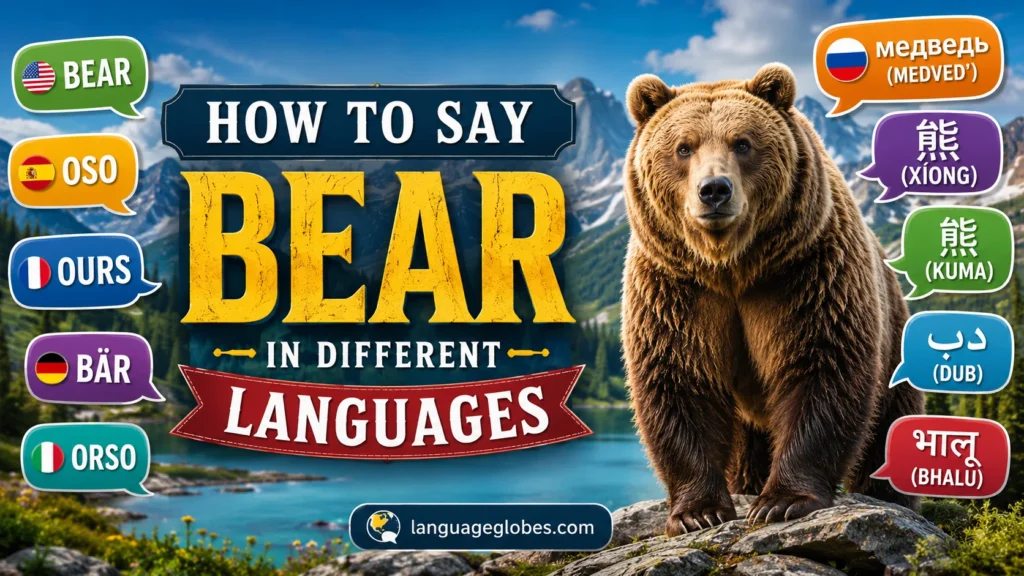
Bear is one of the most recognizable animals found across our planet and diverse ecosystems. These majestic creatures roam forests, tundra, and mountains, representing the spirit of the wild. Across many cultures, the bear often symbolises strength, courage, wisdom, and protection. From awe-inspiring grizzlies to black bears, polar bears, and brown bears, these formidable animals inspire fascination. Their presence in folklore, art, religion, and stories reflects a lasting connection between humans and nature.
Understanding the words used for bear in different languages offers valuable insight into global cultures and traditions. Whether you are a student, traveler, language enthusiast, or teacher, this guide supports learning through meaningful translations. Exploring animal names across languages worldwide helps expand vocabulary and strengthen cultural knowledge.
You will discover how to describe bear in 70 languages, learn audio pronunciation, and understand linguistic diversity. This knowledge can improve everyday conversations, enrich travel experiences, and support studying languages effectively. By examining language families such as Romance languages and Slavic languages, readers gain deeper insight into linguistic patterns and shared roots. Join this fascinating linguistic journey and connect with people from different backgrounds through language.
Also read this: How to Say By in Different Languages
Interesting Facts About Bear
- Bears belong to the family Ursidae and are found on several continents.
- There are eight recognized bear species worldwide.
- Bears have excellent senses of smell, often far stronger than humans.
- Many cultures feature bears in legends, stories, and folklore.
- The word “bear” has ancient origins in many Indo-European languages.
- Some languages use words derived from meanings such as “brown one” or “honey eater.”
- Bears symbolize strength, courage, protection, and endurance in many traditions.
- The teddy bear, a popular children’s toy, was named after U.S. President Theodore Roosevelt.
- Bears appear in national symbols, sports mascots, and cultural artwork around the world.
- Learning animal names like bear is a fun way to begin studying a new language.
How to Say Bear in Different Languages
European Languages
Europe is home to hundreds of languages belonging to several major language families. Bears have long been part of European folklore, appearing in fairy tales, legends, and traditional stories. The translations below show how different European cultures refer to this powerful animal.
| Language | Country/Region | Translation | Pronunciation | Example Sentence |
| 🇺🇸 American English | USA | Bear | Bair | The bear is walking through the forest. |
| 🇬🇧 British English | UK | Bear | Bair | We saw a bear at the wildlife park. |
| 🇦🇺 Australian English | Australia | Bear | Bair | A bear can be very strong. |
| Spanish | Spain 🇪🇸 | Oso | OH-so | El oso vive en el bosque. |
| French | France 🇫🇷 | Ours | Oor | L’ours est grand. |
| German | Germany 🇩🇪 | Bär | Bear | Der Bär ist stark. |
| Italian | Italy 🇮🇹 | Orso | OR-so | L’orso vive in montagna. |
| Portuguese | Portugal 🇵🇹 | Urso | OOR-so | O urso é forte. |
| Dutch | Netherlands 🇳🇱 | Beer | Bayr | De beer loopt in het bos. |
| Swedish | Sweden 🇸🇪 | Björn | Byurn | Björnen är stor. |
| Norwegian | Norway 🇳🇴 | Bjørn | Byurn | Bjørnen bor i skogen. |
| Danish | Denmark 🇩🇰 | Bjørn | Byurn | Bjørnen er stærk. |
| Finnish | Finland 🇫🇮 | Karhu | KAR-hoo | Karhu elää metsässä. |
| Icelandic | Iceland 🇮🇸 | Björn | Byurn | Björninn er stór. |
| Polish | Poland 🇵🇱 | Niedźwiedź | Nyej-vyedj | Niedźwiedź jest silny. |
| Czech | Czech Republic 🇨🇿 | Medvěd | Med-vyet | Medvěd je velký. |
| Slovak | Slovakia 🇸🇰 | Medveď | Med-ved | Medveď žije v lese. |
| Hungarian | Hungary 🇭🇺 | Medve | Med-veh | A medve erős. |
| Romanian | Romania 🇷🇴 | Urs | Oors | Ursul este mare. |
| Greek | Greece 🇬🇷 | Αρκούδα | Ar-KOO-tha | Η αρκούδα είναι μεγάλη. |
| Russian | Russia 🇷🇺 | Медведь | Med-vyed | Медведь живет в лесу. |
| Ukrainian | Ukraine 🇺🇦 | Ведмідь | Ved-mid | Ведмідь великий. |
| Belarusian | Belarus 🇧🇾 | Мядзведзь | Myadz-vedz | Мядзведзь моцны. |
| Bulgarian | Bulgaria 🇧🇬 | Мечка | Mech-ka | Мечката е голяма. |
| Serbian | Serbia 🇷🇸 | Медвед | Med-ved | Медвед је јак. |
| Croatian | Croatia 🇭🇷 | Medvjed | Med-vyed | Medvjed živi u šumi. |
Asian Languages
Asia is the largest continent and contains some of the world’s oldest civilizations and language traditions. Bears are found in several Asian regions and appear in local folklore, religious stories, and wildlife conservation efforts.
| Language | Country/Region | Translation | Pronunciation | Example Sentence |
| Chinese (Mandarin) | China 🇨🇳 | 熊 | Shyong | 熊住在森林里。 |
| Japanese | Japan 🇯🇵 | 熊 | Koo-ma | 熊は森にいます。 |
| Korean | South Korea 🇰🇷 | 곰 | Gom | 곰은 강합니다. |
| Hindi | India 🇮🇳 | भालू | Bha-loo | भालू जंगल में रहता है। |
| Urdu | Pakistan 🇵🇰 | ریچھ | Reech | ریچھ جنگل میں رہتا ہے۔ |
| Bengali | Bangladesh 🇧🇩 | ভালুক | Bha-luk | ভালুক বনে থাকে। |
| Punjabi | Punjab | ਰਿੱਛ | Richh | ਰਿੱਛ ਜੰਗਲ ਵਿੱਚ ਰਹਿੰਦਾ ਹੈ। |
| Gujarati | India 🇮🇳 | રીંછ | Reench | રીંછ જંગલમાં રહે છે. |
| Marathi | India 🇮🇳 | अस्वल | As-val | अस्वल जंगलात राहते. |
| Tamil | India 🇮🇳 | கரடி | Ka-ra-di | கரடி காட்டில் வாழ்கிறது. |
| Telugu | India 🇮🇳 | ఎలుగుబంటి | Elugu-banti | ఎలుగుబంటి అడవిలో ఉంటుంది. |
| Kannada | India 🇮🇳 | ಕರಡಿ | Ka-ra-di | ಕರಡಿ ಕಾಡಿನಲ್ಲಿ ವಾಸಿಸುತ್ತದೆ. |
| Malayalam | India 🇮🇳 | കരടി | Ka-ra-di | കരടി കാട്ടിൽ ജീവിക്കുന്നു. |
| Sinhala | Sri Lanka 🇱🇰 | වලහා | Va-la-ha | වලහා ශක්තිමත්ය. |
| Nepali | Nepal 🇳🇵 | भालु | Bha-lu | भालु जंगलमा बस्छ। |
| Thai | Thailand 🇹🇭 | หมี | Mee | หมีอยู่ในป่า |
| Vietnamese | Vietnam 🇻🇳 | Gấu | Gow | Gấu sống trong rừng. |
| Indonesian | Indonesia 🇮🇩 | Beruang | Beh-roo-ang | Beruang hidup di hutan. |
| Malay | Malaysia 🇲🇾 | Beruang | Beh-roo-ang | Beruang tinggal di hutan. |
| Filipino | Philippines 🇵🇭 | Oso | OH-so | Ang oso ay malakas. |
| Mongolian | Mongolia 🇲🇳 | Баавгай | Baav-gai | Баавгай том амьтан. |
| Khmer | Cambodia 🇰🇭 | ខ្លាឃ្មុំ | Kla-khmom | ខ្លាឃ្មុំរស់នៅព្រៃ។ |
| Lao | Laos 🇱🇦 | ໝີ | Mee | ໝີຢູ່ໃນປ່າ. |
African Languages
Africa is one of the most linguistically diverse continents in the world, with thousands of languages spoken across its regions. While bears are not native to most African countries, the word exists in local languages through education, literature, wildlife studies, and global communication.
| Language | Country/Region | Translation | Pronunciation | Example Sentence |
| Swahili | East Africa 🌍 | Dubu | Doo-boo | Dubu anaishi msituni. |
| Zulu | South Africa 🇿🇦 | Ibhere | Ee-bhe-re | Ibhere linamandla. |
| Xhosa | South Africa 🇿🇦 | Ibhere | Ee-bhe-re | Ibhere likhulu. |
| Afrikaans | South Africa 🇿🇦 | Beer | Bayr | Die beer is sterk. |
| Somali | Somalia 🇸🇴 | Orso | Or-so | Orsadu waa weyn tahay. |
| Amharic | Ethiopia 🇪🇹 | ድብ | Dib | ድብ በዱር ይኖራል። |
| Yoruba | Nigeria 🇳🇬 | Béà | Beh-ah | Béà náà lágbára. |
| Igbo | Nigeria 🇳🇬 | Bea | Beh-ah | Bea bi n’ime ọhịa. |
| Hausa | Nigeria 🇳🇬 | Bera | Beh-ra | Bera tana da ƙarfi. |
| Shona | Zimbabwe 🇿🇼 | Bere | Beh-reh | Bere rinogara musango. |
| Kinyarwanda | Rwanda 🇷🇼 | Idubu | Ee-doo-boo | Idubu iba mu ishyamba. |
Middle Eastern Languages
The Middle East has a rich linguistic heritage shaped by ancient civilizations, trade routes, and cultural exchange. Several bear species historically lived in parts of this region, making the animal familiar in local traditions and languages.
| Language | Country/Region | Translation | Pronunciation | Example Sentence |
| Arabic | Middle East 🌍 | دب | Dubb | الدب يعيش في الغابة. |
| Persian (Farsi) | Iran 🇮🇷 | خرس | Khers | خرس حیوان بزرگی است. |
| Turkish | Türkiye 🇹🇷 | Ayı | A-yuh | Ayı çok güçlüdür. |
| Hebrew | Israel 🇮🇱 | דוב | Dov | הדוב גדול. |
| Kurdish | Kurdistan 🌍 | Hirç | Heerch | Hirç di daristanê de dijî. |
| Armenian | Armenia 🇦🇲 | Արջ | Arch | Արջը մեծ է։ |
| Azerbaijani | Azerbaijan 🇦🇿 | Ayı | A-yuh | Ayı meşədə yaşayır. |
| Georgian | Georgia 🇬🇪 | დათვი | Datvi | დათვი ძლიერია. |
Additional Languages Around the World
Beyond Europe, Asia, Africa, and the Middle East, many other languages across Oceania, the Americas, and indigenous communities have their own words for bear. These languages enrich our understanding of global linguistic diversity.
| Language | Country/Region | Translation | Pronunciation | Example Sentence |
| Maori | New Zealand 🇳🇿 | Pea | Peh-ah | He kararehe nui te pea. |
| Hawaiian | Hawaii 🌺 | Bea | Bay-ah | He holoholona nui ka bea. |
| Samoan | Samoa 🇼🇸 | Pea | Peh-ah | O le pea e malosi. |
| Tongan | Tonga 🇹🇴 | Pea | Peh-ah | Ko e pea ko ha manu lahi. |
| Haitian Creole | Haiti 🇭🇹 | Lous | Loos | Lous la fò anpil. |
| Esperanto | International 🌍 | Urso | OOR-so | La urso estas granda. |
| Latin | Historical Europe | Ursus | OOR-soos | Ursus magnus est. |
| Irish | Ireland 🇮🇪 | Béar | Bayr | Tá an béar sa choill. |
| Welsh | Wales 🏴 | Arth | Arth | Mae’r arth yn gryf. |
| Scottish Gaelic | Scotland 🏴 | Mathan | Ma-han | Tha am mathan mòr. |
| Basque | Basque Region | Hartz | Harts | Hartza handia da. |
| Albanian | Albania 🇦🇱 | Ari | Ah-ree | Ariu është i fortë. |
| Slovenian | Slovenia 🇸🇮 | Medved | Med-ved | Medved živi v gozdu. |
| Latvian | Latvia 🇱🇻 | Lācis | Laa-tsis | Lācis ir liels. |
| Lithuanian | Lithuania 🇱🇹 | Lokys | Lo-kis | Lokys gyvena miške. |
FAQs
What does bear mean in different languages?
The word bear has many translations across global languages, reflecting rich linguistic diversity. In most cultures, bear represents strength and survival in the wild. These meanings show how humans connect nature through shared language understanding.
How do you translate bear in global languages?
Translating bear across languages worldwide reveals unique words shaped by cultures. Each translation carries local expression and historical meaning. This helps learners expand vocabulary and cultural awareness.
Why is bear important in cultures and folklore?
In many cultures, bear appears in folklore, myths, and traditional stories. It is often linked with strength, wisdom, and protection. These stories highlight deep human connection with nature and animals.
How do language learners use animal names like bear?
Language learners study animal names like bear to build practical vocabulary. It improves memory and helps in everyday conversations. This approach supports natural understanding of languages.
What is the word bear in Romance languages?
In Romance languages, the word for bear comes from shared Latin roots. These translations reflect historical language development and linguistic patterns. It shows how languages are connected through time.
What is bear in Slavic languages?
In Slavic languages, bear has distinct but related translations. These forms preserve ancient language structure and cultural meaning. They highlight deep linguistic diversity across regions.
How do pronunciation guides help say bear?
Audio pronunciation helps learners correctly pronounce bear in different languages. It improves clarity in spoken language practice. This makes learning more effective and engaging.
How does linguistic diversity affect animal names like bear?
Linguistic diversity creates unique words for bear across languages worldwide. Each name reflects local cultures and perception of nature. This diversity enriches global language understanding.
Why do bears symbolize strength and wisdom?
Bears are seen as symbols of strength, courage, and wisdom in many cultures. Their behavior in the wild inspires respect in human storytelling. This symbolism appears widely in folklore and traditions.
How many languages include translations of bear?
Over many languages worldwide, the word bear has countless translations. Each reflects unique language history and cultural identity. This shows the richness of global linguistic diversity.
Conclusion
In conclusion, exploring bear across global languages reveals the richness of linguistic diversity and shared human connection. From translations shaped by cultures to meaningful words used in languages worldwide, each term reflects history and identity. This journey through language helps learners understand animal names, expand vocabulary, and appreciate global communication. The bear continues to symbolize strength, wisdom, and unity in nature and storytelling. Ultimately, this linguistic journey deepens awareness of how people across backgrounds connect through expression and meaning.

James Anderson is a passionate language enthusiast and content creator at LanguageGlobes. With a keen interest in global cultures and communication, he shares insightful and engaging content to help readers explore and master new languages.