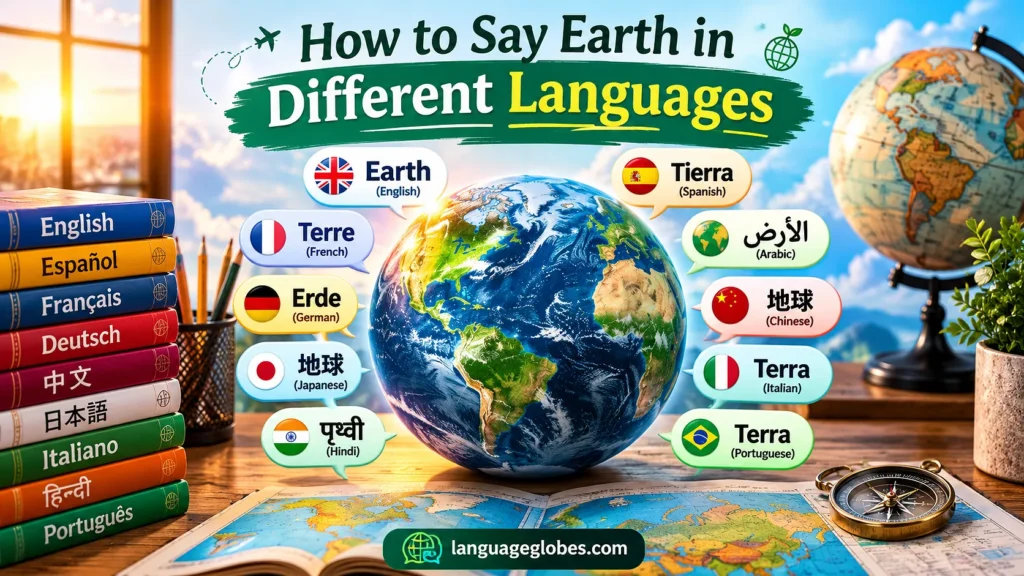
Earth is our home planet, giving us life, nature, and the ground beneath our feet. Learning how to say Earth in different languages reveals how languages and cultures express this shared idea across the world.
These Earth translations also show the cultural significance, spiritual significance, and scientific significance of this important word Earth. For language learners, travelers, students, teachers, and writers, exploring multilingual vocabulary can build cultural awareness and stronger communication skills.
In this guide, you will discover Earth in different languages, including Spanish, French, Mandarin Chinese, and Arabic. Each translation helps explain the meaning of Earth, its pronunciation in different languages, and its place in everyday conversations.
Exploring these world languages makes language learning more engaging while highlighting linguistic diversity and our relationship with nature. You will also explore soil in different languages, ground in different languages, and the wider concept of Earth across world cultures.
Also Read This: How to Say Eat in Different Languages
Interesting Facts About Earth
- Earth is the only known planet that supports life.
- The word “Earth” comes from Old English and Germanic roots meaning “ground” or “soil.”
- More than 7,000 languages are spoken around the world, and nearly every language has a unique word for Earth.
- Many cultures personify Earth as a mother figure who nurtures life.
- Earth is approximately 4.5 billion years old.
- The planet is covered by about 71% water.
- Ancient civilizations often associated Earth with fertility, stability, and creation.
- Environmental movements worldwide frequently use the local translation of Earth to promote conservation.
- The concept of Earth appears in mythology, science, religion, and literature across all continents.
- Learning words like Earth in different languages helps promote global understanding and cultural appreciation.
How to Say Earth in Different Languages
Below are translations of the word Earth in more than 70 languages from around the world.
European Languages
Europe is home to many of the world’s most widely spoken languages. These languages belong to several language families, including Romance, Germanic, Slavic, Celtic, and Baltic languages. The word for Earth often reflects centuries of cultural and historical development and provides insight into how different societies view the planet and nature.
| Language | Country/Region | Translation | Pronunciation | Example Sentence |
| 🇺🇸 American English | United States | Earth | Urth | Earth is our home. |
| 🇬🇧 British English | United Kingdom | Earth | Urth | Earth supports all life. |
| 🇦🇺 Australian English | Australia | Earth | Urth | We must protect Earth. |
| French | 🇫🇷 France | Terre | Tehr | La Terre est notre maison. |
| Spanish | 🇪🇸 Spain | Tierra | Tee-eh-rra | La Tierra es hermosa. |
| Portuguese | 🇵🇹 Portugal | Terra | Teh-rra | A Terra é incrível. |
| Italian | 🇮🇹 Italy | Terra | Tehr-ra | La Terra è viva. |
| German | 🇩🇪 Germany | Erde | Air-duh | Die Erde ist unser Planet. |
| Dutch | 🇳🇱 Netherlands | Aarde | Aar-duh | De aarde is prachtig. |
| Swedish | 🇸🇪 Sweden | Jorden | Yor-den | Jorden är vårt hem. |
| Norwegian | 🇳🇴 Norway | Jorden | Yor-den | Jorden behöver skydd. |
| Danish | 🇩🇰 Denmark | Jorden | Yor-den | Jorden er vigtig. |
| Finnish | 🇫🇮 Finland | Maa | Mah | Maa on kaunis. |
| Icelandic | 🇮🇸 Iceland | Jörð | Yorth | Jörð er heimili okkar. |
| Polish | 🇵🇱 Poland | Ziemia | Zhe-mya | Ziemia jest piękna. |
| Czech | 🇨🇿 Czech Republic | Země | Zeh-mnye | Země je náš domov. |
| Slovak | 🇸🇰 Slovakia | Zem | Zem | Zem je krásna. |
| Hungarian | 🇭🇺 Hungary | Föld | Furld | A Föld az otthonunk. |
| Romanian | 🇷🇴 Romania | Pământ | Puh-munt | Pământul este frumos. |
| Bulgarian | 🇧🇬 Bulgaria | Земя | Ze-mya | Земята е наш дом. |
| Croatian | 🇭🇷 Croatia | Zemlja | Zem-lya | Zemlja je prekrasna. |
| Serbian | 🇷🇸 Serbia | Земља | Zem-lya | Земља је лепа. |
| Slovenian | 🇸🇮 Slovenia | Zemlja | Zem-lya | Zemlja je naš dom. |
| Ukrainian | 🇺🇦 Ukraine | Земля | Zem-lya | Земля прекрасна. |
| Russian | 🇷🇺 Russia | Земля | Zem-lya | Земля наш дом. |
| Belarusian | 🇧🇾 Belarus | Зямля | Zyam-lya | Зямля прыгожая. |
| Lithuanian | 🇱🇹 Lithuania | Žemė | Zhe-meh | Žemė yra mūsų namai. |
| Latvian | 🇱🇻 Latvia | Zeme | Ze-me | Zeme ir skaista. |
| Irish | 🇮🇪 Ireland | Domhan | Dov-an | Is ár mbaile an Domhan. |
| Welsh | 🏴 Wales | Daear | Dye-ar | Mae’r Ddaear yn brydferth. |
| Scottish Gaelic | 🏴 Scotland | Talamh | Tal-av | Tha an talamh cudromach. |
| Albanian | 🇦🇱 Albania | Tokë | To-kuh | Toka është e bukur. |
Asian Languages
Asia is the largest and most populous continent, containing thousands of languages and rich cultural traditions. The concept of Earth often appears in philosophy, religion, science, and folklore throughout Asian societies. These translations demonstrate the remarkable diversity of the continent’s linguistic heritage.
| Language | Country/Region | Translation | Pronunciation | Example Sentence |
| Mandarin Chinese | 🇨🇳 China | 地球 | Dee-chyo | 地球是我们的家园。 |
| Cantonese | 🇭🇰 Hong Kong | 地球 | Dei-kau | 地球係我哋嘅家。 |
| Japanese | 🇯🇵 Japan | 地球 | Chi-kyuu | 地球は私たちの家です。 |
| Korean | 🇰🇷 South Korea | 지구 | Ji-gu | 지구는 우리의 집입니다. |
| Hindi | 🇮🇳 India | पृथ्वी | Prithvi | पृथ्वी हमारा घर है। |
| Urdu | 🇵🇰 Pakistan | زمین | Zameen | زمین ہمارا گھر ہے۔ |
| Bengali | 🇧🇩 Bangladesh | পৃথিবী | Pri-thi-bi | পৃথিবী আমাদের ঘর। |
| Punjabi | 🇮🇳🇵🇰 Punjab | ਧਰਤੀ | Dhar-tee | ਧਰਤੀ ਸਾਡਾ ਘਰ ਹੈ। |
| Gujarati | 🇮🇳 India | પૃથ્વી | Pruthvi | પૃથ્વી આપણું ઘર છે. |
| Marathi | 🇮🇳 India | पृथ्वी | Prithvi | पृथ्वी आपले घर आहे. |
| Tamil | 🇮🇳 Sri Lanka | பூமி | Boo-mi | பூமி நமது வீடு. |
| Telugu | 🇮🇳 India | భూమి | Bhoomi | భూమి మన ఇల్లు. |
| Kannada | 🇮🇳 India | ಭೂಮಿ | Bhoomi | ಭೂಮಿ ನಮ್ಮ ಮನೆ. |
| Malayalam | 🇮🇳 India | ഭൂമി | Bhoomi | ഭൂമി നമ്മുടെ വീടാണ്. |
| Sinhala | 🇱🇰 Sri Lanka | පෘථිවිය | Pruthiviya | පෘථිවිය අපේ නිවසයි. |
| Nepali | 🇳🇵 Nepal | पृथ्वी | Prithvi | पृथ्वी हाम्रो घर हो। |
| Thai | 🇹🇭 Thailand | โลก | Lok | โลกคือบ้านของเรา. |
| Vietnamese | 🇻🇳 Vietnam | Trái Đất | Chai Dat | Trái Đất là ngôi nhà của chúng ta. |
| Indonesian | 🇮🇩 Indonesia | Bumi | Boo-mee | Bumi adalah rumah kita. |
| Malay | 🇲🇾 Malaysia | Bumi | Boo-mee | Bumi ialah rumah kita. |
| Filipino | 🇵🇭 Philippines | Daigdig | Daig-dig | Ang daigdig ay tahanan natin. |
| Khmer | 🇰🇭 Cambodia | ផែនដី | Phen-dey | ផែនដីជាផ្ទះរបស់យើង។ |
| Lao | 🇱🇦 Laos | ໂລກ | Lok | ໂລກແມ່ນບ້ານຂອງພວກເຮົາ. |
| Mongolian | 🇲🇳 Mongolia | Дэлхий | Del-khee | Дэлхий бол бидний гэр. |
| Burmese | 🇲🇲 Myanmar | ကမ္ဘာမြေ | Kam-ba-myay | ကမ္ဘာမြေသည် ကျွန်ုပ်တို့၏အိမ်ဖြစ်သည်။ |
African Languages
Africa is home to incredible linguistic diversity, with thousands of languages spoken across the continent. Many African languages have strong connections to nature, land, and community. The word Earth often carries cultural meanings related to ancestry, agriculture, and environmental stewardship.
| Language | Country/Region | Translation | Pronunciation | Example Sentence |
| Swahili | 🇹🇿 🇰🇪 East Africa | Dunia | Doon-ya | Dunia ni nyumba yetu. |
| Zulu | 🇿🇦 South Africa | Umhlaba | Oom-hla-ba | Umhlaba uyikhaya lethu. |
| Xhosa | 🇿🇦 South Africa | Umhlaba | Oom-hla-ba | Umhlaba likhaya lethu. |
| Afrikaans | 🇿🇦 South Africa | Aarde | Aar-duh | Die aarde is mooi. |
| Yoruba | 🇳🇬 Nigeria | Ayé | Ah-yeh | Ayé jẹ́ ilé wa. |
| Igbo | 🇳🇬 Nigeria | Ụwa | Oo-wa | Ụwa bụ ụlọ anyị. |
| Hausa | 🇳🇬 Niger | Duniya | Doon-ya | Duniya gidanmu ce. |
| Amharic | 🇪🇹 Ethiopia | ምድር | Midir | ምድር ቤታችን ናት። |
| Somali | 🇸🇴 Somalia | Dhul | Dhul | Dhulku waa gurigeena. |
| Shona | 🇿🇼 Zimbabwe | Nyika | Nyi-ka | Nyika ndiyo imba yedu. |
| Kinyarwanda | 🇷🇼 Rwanda | Isi | Ee-see | Isi ni iwacu. |
| Malagasy | 🇲🇬 Madagascar | Tany | Tan-ee | Tany no tranontsika. |
Middle Eastern Languages
The Middle East has a rich history of civilization, scholarship, and cultural exchange. Languages from this region have influenced science, literature, religion, and trade for centuries. Many words for Earth are deeply rooted in ancient traditions and continue to be widely used today.
| Language | Country/Region | Translation | Pronunciation | Example Sentence |
| Arabic | 🌍 Middle East | الأرض | Al-Ard | الأرض بيتنا. |
| Persian | 🇮🇷 Iran | زمین | Zamin | زمین خانه ماست. |
| Turkish | 🇹🇷 Türkiye | Dünya | Dunya | Dünya bizim evimizdir. |
| Hebrew | 🇮🇱 Israel | כדור הארץ | Ka-dor Ha-aretz | כדור הארץ הוא הבית שלנו. |
| Kurdish | 🌍 Kurdistan Region | Erd | Erd | Erd mala me ye. |
| Azerbaijani | 🇦🇿 Azerbaijan | Yer | Yer | Yer bizim evimizdir. |
| Armenian | 🇦🇲 Armenia | Երկիր | Yer-kir | Երկիրը մեր տունն է։ |
| Georgian | 🇬🇪 Georgia | დედამიწა | De-da-mi-tsa | დედამიწა ჩვენი სახლია. |
Additional Languages Around the World
Languages from Oceania, indigenous communities, and other regions add even more richness to our understanding of human communication. Learning these words helps preserve cultural heritage and promotes global respect for linguistic diversity.
| Language | Country/Region | Translation | Pronunciation | Example Sentence |
| Māori | 🇳🇿 New Zealand | Whenua | Feh-noo-ah | Ko te whenua tō tātou kāinga. |
| Hawaiian | 🇺🇸 Hawaii | Honua | Ho-noo-ah | ʻO ka honua ko mākou home. |
| Samoan | 🇼🇸 Samoa | Lalolagi | La-lo-lan-gi | O le lalolagi o lo tatou fale. |
| Tongan | 🇹🇴 Tonga | Māmani | Maa-ma-ni | Ko e māmani ko hotau ʻapi. |
| Fijian | 🇫🇯 Fiji | Vuravura | Voo-ra-voo-ra | Na vuravura na noda vale. |
| Tahitian | 🇵🇫 Tahiti | Fenua | Feh-noo-ah | Te fenua to matou fare. |
| Greenlandic | 🇬🇱 Greenland | Nuna | Noo-na | Nuna tassaavoq angerlarsimaffipput. |
| Inuktitut | 🇨🇦 Arctic Canada | Nuna | Noo-na | Nuna uvattinnut igluuvoq. |
| Cherokee | 🇺🇸 North America | ᎡᎶᎯ | Eh-lo-hee | ᎡᎶᎯ ᎣᏍᏛ ᎢᎩ. |
| Navajo | 🇺🇸 North America | Nahasdzáán | Na-has-dzan | Nahasdzáán nihí shikéí. |
FAQs
What does the word Earth mean?
The word Earth refers to our home planet, where life, nature, and people exist. The meaning of Earth can also describe the ground or soil beneath us.
How do you say Earth in different languages?
To say Earth in different languages, you can explore translations across many world languages. These Earth translations reveal interesting differences between languages and cultures.
How is Earth translated in Spanish?
In Spanish, Earth is commonly translated as “la Tierra.” This translation is widely used when discussing the planet Earth, land, or the natural world.
How is Earth translated in French?
In French, Earth is commonly translated as “la terre.” The word can describe the home planet, land, ground, or soil, depending on context.
How do you say Earth in Mandarin Chinese?
In Mandarin Chinese, Earth is commonly written as “Dìqiú.” Learning this Earth translation can help language learners understand useful common vocabulary.
How do you say Earth in Arabic?
In Arabic, Earth is commonly translated as “Al-Ard.” This word can refer to Earth as a planet or the land and ground around us.
Why learn Earth in different languages?
Learning Earth in different languages supports language learning, cultural awareness, and communication skills. It also offers insight into linguistic diversity across global cultures.
How can Earth translations help language learners?
Earth translations provide useful multilingual vocabulary that can strengthen vocabulary building and everyday communication. Simple words like Earth create a helpful language foundation for learning a new language.
What is the connection between Earth and different cultures?
Earth has cultural significance, spiritual significance, and scientific significance across many cultures and civilizations. Its meaning often reflects a community’s relationship with nature and shared home.
Where can I use Earth translations in everyday life?
You can use Earth translations in everyday conversations, literature, education, travel, and environmental discussions. They are also useful for exploring world cultures and improving communication skills.
Conclusion
Exploring Earth in different languages reveals how languages, cultures, and world cultures describe our home planet and shared home. Learning Earth translations can expand multilingual vocabulary, improve communication skills, and build cultural awareness through linguistic diversity. Understanding the meaning of Earth also deepens our relationship with nature and makes language learning more meaningful. Whether you are a student, traveler, teacher, or writer, these translations offer a simple way to explore our wider world.

James Anderson is a passionate language enthusiast and content creator at LanguageGlobes. With a keen interest in global cultures and communication, he shares insightful and engaging content to help readers explore and master new languages.