
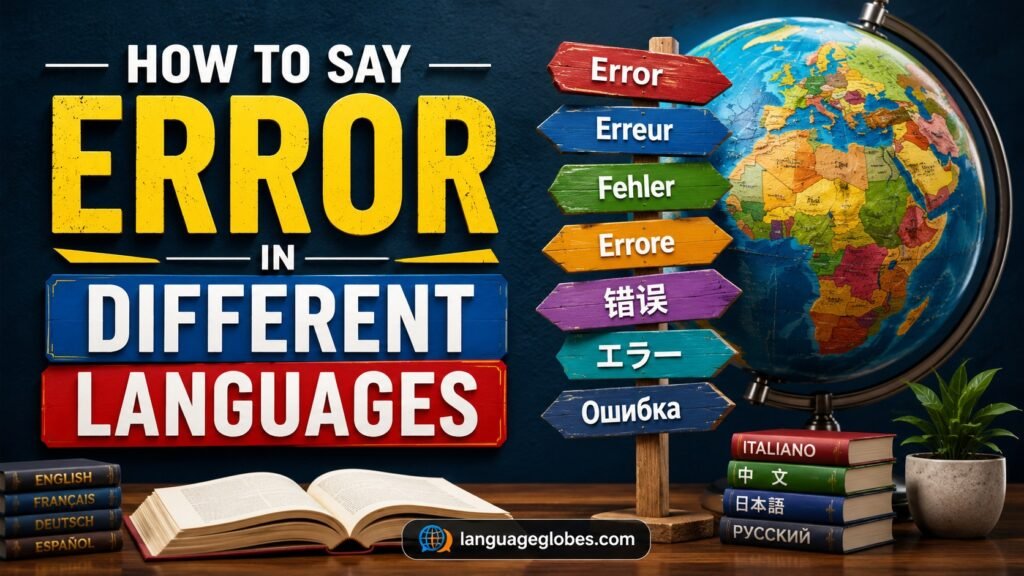
An error or mistake can happen in everyday life, computing, studying, or working. Learning how to say error in different languages helps explain an incorrect action, fault, or miscalculation clearly.
Understanding error translation also supports communication during international interactions and daily conversations. This guide makes learning a new language easier through useful translations and cultural context.
You will discover error in different languages, with translations, pronunciations, example sentences, and regional information. These terms can help language learners, travelers, students, and professionals handle technical issues and human misunderstandings.
Understanding words like French erreur, German Fehler, Russian ошибка, and Chinese 错误 reveals fascinating language diversity. Such cultural knowledge can make multilingual communication more natural and accurate worldwide.
Also Read This: How to Say Era in Different Languages
Interesting Facts About Error
- The word “error” comes from the Latin word error, meaning “to wander” or “to stray.”
- In computer science, error messages help users identify and fix problems in software or hardware.
- Different cultures may use words meaning “mistake,” “fault,” or “wrong action” interchangeably with “error.”
- The concept of error is important in mathematics, statistics, engineering, and language learning.
- Many languages have separate words for human mistakes and technical errors.
- Error detection and correction systems are essential in modern communication technology.
- Learning error-related vocabulary helps travelers understand warnings and instructions abroad.
- The word “error” appears frequently in educational, technical, and professional settings worldwide.
How to Say Error in Different Languages
Below are translations of the word “error” across major language families and regions around the world.
European Languages
Europe is home to hundreds of languages belonging mainly to the Germanic, Romance, Slavic, Celtic, and Baltic language families. While these languages differ significantly, many share historical influences from Latin, Greek, and neighboring cultures. Learning the word “error” in European languages can be particularly useful for travel, education, and international business.
| Language | Country/Region | Translation | Pronunciation | Example Sentence |
| 🇺🇸 American English | USA | Error | Air-er | There is an error in the report. |
| 🇬🇧 British English | United Kingdom | Error | Eh-ruh | The system detected an error. |
| 🇦🇺 Australian English | Australia | Error | Air-er | An error occurred during the process. |
| French | 🇫🇷 France | Erreur | eh-rur | Cette erreur doit être corrigée. |
| Spanish | 🇪🇸 Spain | Error | eh-ror | Hay un error en el documento. |
| Portuguese | 🇵🇹 Portugal | Erro | eh-hoo | Existe um erro no sistema. |
| Italian | 🇮🇹 Italy | Errore | er-ro-reh | C’è un errore nel file. |
| German | 🇩🇪 Germany | Fehler | fay-ler | Das ist ein Fehler. |
| Dutch | 🇳🇱 Netherlands | Fout | fout | Er zit een fout in het rapport. |
| Swedish | 🇸🇪 Sweden | Fel | fell | Det finns ett fel här. |
| Norwegian | 🇳🇴 Norway | Feil | file | Det er en feil i programmet. |
| Danish | 🇩🇰 Denmark | Fejl | file | Der er en fejl i systemet. |
| Finnish | 🇫🇮 Finland | Virhe | veer-heh | Tässä on virhe. |
| Icelandic | 🇮🇸 Iceland | Villa | vit-la | Þetta er villa. |
| Polish | 🇵🇱 Poland | Błąd | bwond | To jest błąd. |
| Czech | 🇨🇿 Czech Republic | Chyba | khi-ba | Je to chyba. |
| Slovak | 🇸🇰 Slovakia | Chyba | khi-ba | Toto je chyba. |
| Hungarian | 🇭🇺 Hungary | Hiba | hee-ba | Ez egy hiba. |
| Romanian | 🇷🇴 Romania | Eroare | eh-ro-ah-reh | Există o eroare. |
| Bulgarian | 🇧🇬 Bulgaria | Грешка | gresh-ka | Това е грешка. |
| Croatian | 🇭🇷 Croatia | Pogreška | po-gresh-ka | Ovo je pogreška. |
| Serbian | 🇷🇸 Serbia | Грешка | gresh-ka | Ovo je greška. |
| Slovenian | 🇸🇮 Slovenia | Napaka | na-pa-ka | To je napaka. |
| Ukrainian | 🇺🇦 Ukraine | Помилка | po-myl-ka | Це помилка. |
| Russian | 🇷🇺 Russia | Ошибка | o-shib-ka | Это ошибка. |
| Belarusian | 🇧🇾 Belarus | Памылка | pa-myl-ka | Гэта памылка. |
| Lithuanian | 🇱🇹 Lithuania | Klaida | klai-da | Tai klaida. |
| Latvian | 🇱🇻 Latvia | Kļūda | klu-da | Tā ir kļūda. |
| Irish | 🇮🇪 Ireland | Earráid | ar-aid | Is earráid é seo. |
| Welsh | 🏴 Wales | Gwall | gwall | Mae hwn yn wall. |
Asian Languages
Asia is the largest and most linguistically diverse continent in the world. It includes languages from the Indo-European, Sino-Tibetan, Dravidian, Turkic, Austronesian, and many other language families. The word for “error” often reflects cultural approaches to mistakes, learning, and responsibility.
| Language | Country/Region | Translation | Pronunciation | Example Sentence |
| Chinese (Mandarin) | 🇨🇳 China | 错误 | tswo-oh | 这是一个错误。 |
| Japanese | 🇯🇵 Japan | エラー | eh-raa | エラーが発生しました。 |
| Korean | 🇰🇷 South Korea | 오류 | o-ryu | 오류가 발생했습니다. |
| Hindi | 🇮🇳 India | त्रुटि | tru-ti | यह एक त्रुटि है। |
| Urdu | 🇵🇰 Pakistan | غلطی | ghal-ti | یہ ایک غلطی ہے۔ |
| Bengali | 🇧🇩 Bangladesh | ত্রুটি | troo-ti | এটি একটি ত্রুটি। |
| Punjabi | 🇮🇳 India/Pakistan | ਗਲਤੀ | gal-ti | ਇਹ ਇੱਕ ਗਲਤੀ ਹੈ। |
| Gujarati | 🇮🇳 India | ભૂલ | bhool | આ એક ભૂલ છે. |
| Marathi | 🇮🇳 India | चूक | chook | ही एक चूक आहे. |
| Tamil | 🇮🇳 India | பிழை | pi-lai | இது ஒரு பிழை. |
| Telugu | 🇮🇳 India | లోపం | lo-pam | ఇది లోపం. |
| Kannada | 🇮🇳 India | ದೋಷ | do-sha | ಇದು ದೋಷವಾಗಿದೆ. |
| Malayalam | 🇮🇳 India | പിശക് | pi-shak | ഇത് ഒരു പിശകാണ്. |
| Sinhala | 🇱🇰 Sri Lanka | දෝෂය | do-sha-ya | මෙය දෝෂයකි. |
| Nepali | 🇳🇵 Nepal | त्रुटि | tru-ti | यो त्रुटि हो। |
| Thai | 🇹🇭 Thailand | ข้อผิดพลาด | kor-pit-plat | นี่คือข้อผิดพลาด |
| Vietnamese | 🇻🇳 Vietnam | Lỗi | loy | Đây là một lỗi. |
| Indonesian | 🇮🇩 Indonesia | Kesalahan | ke-sa-la-han | Ada kesalahan di sini. |
| Malay | 🇲🇾 Malaysia | Ralat | ra-lat | Terdapat ralat. |
| Filipino | 🇵🇭 Philippines | Kamalian | ka-ma-li-an | Ito ay kamalian. |
| Mongolian | 🇲🇳 Mongolia | Алдаа | al-daa | Энэ бол алдаа. |
| Khmer | 🇰🇭 Cambodia | កំហុស | kom-hoh | នេះជាកំហុស។ |
| Lao | 🇱🇦 Laos | ຂໍ້ຜິດພາດ | kor-pit-phat | ນີ້ແມ່ນຂໍ້ຜິດພາດ. |
| Burmese | 🇲🇲 Myanmar | အမှား | ah-myar | ဒါက အမှားပါ။ |
African Languages
Africa is home to more than 2,000 languages and incredible cultural diversity. The continent includes major language families such as Niger-Congo, Afro-Asiatic, Nilo-Saharan, and Khoisan. Understanding words like “error” in African languages helps build stronger cultural appreciation and communication skills.
| Language | Country/Region | Translation | Pronunciation | Example Sentence |
| Swahili | 🇹🇿 Tanzania/Kenya | Hitilafu | hee-tee-la-foo | Hii ni hitilafu. |
| Zulu | 🇿🇦 South Africa | Iphutha | ee-poo-tha | Lokhu iphutha. |
| Xhosa | 🇿🇦 South Africa | Impazamo | im-pa-za-mo | Le yimpazamo. |
| Afrikaans | 🇿🇦 South Africa | Fout | fout | Dit is ‘n fout. |
| Yoruba | 🇳🇬 Nigeria | Aṣiṣe | ah-shee-she | Eyi jẹ aṣiṣe. |
| Igbo | 🇳🇬 Nigeria | Njehie | n-jeh-he | Nke a bụ njehie. |
| Hausa | 🇳🇬 Nigeria | Kuskure | koos-koo-reh | Wannan kuskure ne. |
| Amharic | 🇪🇹 Ethiopia | ስህተት | sih-tet | ይህ ስህተት ነው። |
| Somali | 🇸🇴 Somalia | Khalad | kha-lad | Tani waa khalad. |
| Shona | 🇿🇼 Zimbabwe | Chikanganiso | chi-kan-ga-ni-so | Ichi chikanganiso. |
| Kinyarwanda | 🇷🇼 Rwanda | Ikosa | ee-ko-sa | Iri ni ikosa. |
| Sesotho | 🇱🇸 Lesotho | Phoso | pho-so | Ena ke phoso. |
Middle Eastern Languages
The Middle East has a rich linguistic history shaped by ancient civilizations, trade routes, and cultural exchanges. Languages from this region often belong to the Semitic, Turkic, and Indo-Iranian families. Understanding common words such as “error” can be useful when communicating across the region.
| Language | Country/Region | Translation | Pronunciation | Example Sentence |
| Arabic | 🌍 Middle East | خطأ | kha-ta | هذا خطأ. |
| Persian (Farsi) | 🇮🇷 Iran | خطا | kha-ta | این یک خطاست. |
| Turkish | 🇹🇷 Türkiye | Hata | ha-ta | Bu bir hata. |
| Hebrew | 🇮🇱 Israel | שגיאה | she-gee-ah | זו שגיאה. |
| Kurdish | 🌍 Kurdistan Region | Xeletî | khe-le-ti | Ev xeletî ye. |
| Pashto | 🇦🇫 Afghanistan | تېروتنه | tay-ro-ta-na | دا تېروتنه ده. |
| Dari | 🇦🇫 Afghanistan | خطا | kha-ta | این خطا است. |
| Azerbaijani | 🇦🇿 Azerbaijan | Səhv | sahv | Bu səhvdir. |
| Armenian | 🇦🇲 Armenia | Սխալ | skhal | Սա սխալ է։ |
| Georgian | 🇬🇪 Georgia | შეცდომა | shet-do-ma | ეს შეცდომაა. |
Additional Languages Around the World
The world contains thousands of languages spoken across North America, South America, Oceania, and island nations. These languages reflect unique histories and cultural identities. Learning even one word from another language can help build bridges between people from different backgrounds.
| Language | Country/Region | Translation | Pronunciation | Example Sentence |
| Hawaiian | 🇺🇸 Hawaii | Hewa | heh-va | He hewa kēia. |
| Maori | 🇳🇿 New Zealand | Hapa | ha-pa | He hapa tēnei. |
| Samoan | 🇼🇸 Samoa | Mea sese | meh-ah seh-seh | O se mea sese lea. |
| Tongan | 🇹🇴 Tonga | Fehalaaki | fe-ha-la-ki | Ko e fehalaaki eni. |
| Fijian | 🇫🇯 Fiji | Cala | tha-la | Oqo e cala. |
| Tahitian | 🇵🇫 Tahiti | Hapa | ha-pa | E hapa teie. |
| Quechua | 🇵🇪 Peru | Pantay | pan-tai | Kayqa pantaymi. |
| Guarani | 🇵🇾 Paraguay | Javy | ja-vee | Kóva peteĩ javy. |
| Aymara | 🇧🇴 Bolivia | Pantja | pan-cha | Aka pantjawa. |
| Nahuatl | 🇲🇽 Mexico | Tlacualiztli | tla-kwa-liz-tli | Nopa tlacualiztli. |
| Inuit (Inuktitut) | 🇨🇦 Canada | Kukkuniaq | kook-koo-ni-ak | Una kukkuniaq. |
| Esperanto | International | Eraro | eh-ra-ro | Tio estas eraro. |
FAQs
How do you say error in different languages?
The word error has different translations across different languages, including French erreur, German Fehler, Russian ошибка, and Chinese 错误. Each term may vary slightly by context.
What is the translation of error in French?
In French, error translation is erreur. It is commonly used for a mistake, fault, or incorrect result in daily conversations.
How do you pronounce error in different languages?
To pronounce error correctly, learners should study native pronunciation alongside translations and example sentences. Audio pronunciation can also help improve accuracy.
What is error called in German?
The German word for error is Fehler. It can describe a mistake, fault, or incorrect action in everyday and professional environments.
How do you say error in Spanish, Portuguese, and Italian?
The word error is commonly translated as error in Spanish, erro in Portuguese, and errore in Italian. These forms are useful for language learners and travelers.
What is error called in Russian and Chinese?
In Russian, error is ошибка, while Chinese commonly uses 错误. These translations are helpful for multilingual communication and understanding worldwide languages.
Why is learning error translations useful?
Knowing error in different languages supports communication, cultural knowledge, and international interactions. It can help when traveling, studying, or working with people from other regions.
How is error used in computing and technology?
In computing and technology, an error usually describes a technical problem, incorrect process, or system failure. Understanding this vocabulary is useful for software development and engineering.
What is the difference between an error and a mistake?
An error often refers to an incorrect result or technical problem, while a mistake can describe a human action. Both are a natural part of life and learning.
Can I learn error translations in many languages?
Yes, studying multiple languages can reveal how cultures describe mistakes, problems, and solutions. Comparing pronunciations, example sentences, and regional information makes language learning more practical.
Conclusion
Learning how to say error in different languages makes multilingual communication easier for language learners, travelers, students, and professionals. Understanding error translation, pronunciations, and example sentences builds useful cultural knowledge for international interactions. Whether discussing computing, technical issues, or an everyday mistake, knowing the right word improves clear communication. Exploring worldwide languages also makes learning a new language more practical, engaging, and rewarding.

Lucy Carter is a curious mind and language lover who writes for Language Globes. She enjoys discovering new languages and sharing simple, helpful ideas that make learning fun and accessible for everyone.