
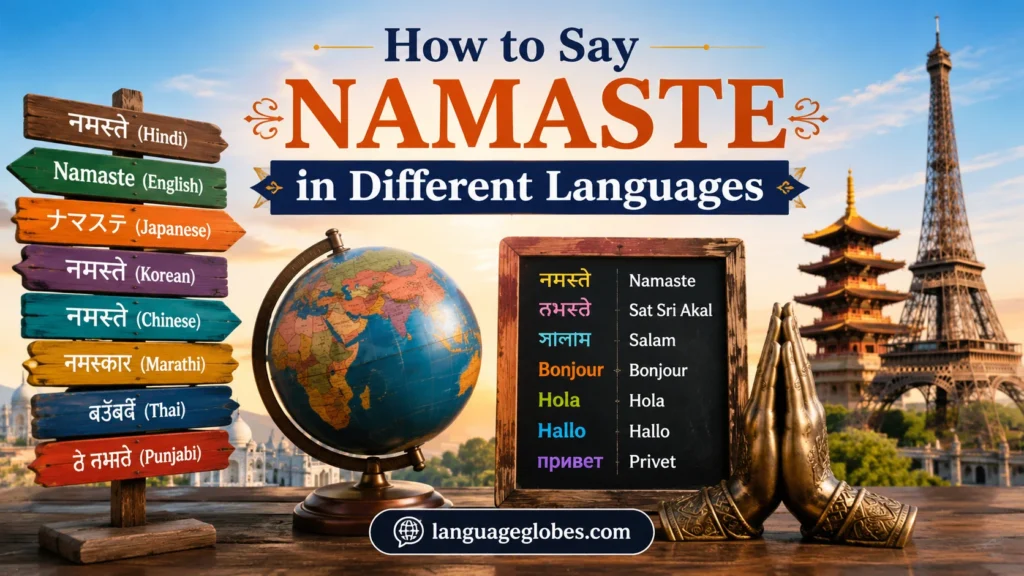
Namaste is a respectful greeting rooted in South Asian cultures like India and Nepal. Namaste carries deep spiritual significance from Sanskrit language and ancient cultural traditions. The meaning of Namaste reflects I bow to you and inner respect.
This greeting uses Anjali Mudra, a yoga gesture with palms pressed together. It represents a cultural expression of respect, kindness, humility, and human connection. A universal greeting concept appears across global cultures and greeting traditions worldwide.
Across many world languages, Namaste adapts into multilingual greetings and polite salutations. Travelers and students use it in global communication, travel communication, and language learning. It improves cross cultural communication, cultural understanding, and strong social etiquette and first impressions.
Such greetings encourage respectful communication, global etiquette, hospitality culture, peace and harmony. Learning includes pronunciation tips, example sentences, and diverse greeting variations and practices. These multilingual expression forms reflect world greeting styles and cultural diversity globally.
Also read this: How to Say Night in Different Languages
Interesting Facts About Namaste
- Namaste comes from the Sanskrit words “namah” (bow) and “te” (to you).
- It is commonly used in India, Nepal, and among Hindu, Buddhist, and Jain communities.
- Namaste is often accompanied by placing both palms together near the chest.
- The gesture associated with Namaste is called Anjali Mudra.
- Namaste symbolizes respect, gratitude, and spiritual connection.
- Yoga practitioners around the world frequently use Namaste at the beginning or end of classes.
- The greeting does not depend on age, social status, or profession.
- Namaste has become a globally recognized symbol of peaceful interaction.
- During periods when physical contact is discouraged, Namaste is often recommended as a respectful alternative to handshakes.
- Many cultures have greetings that share similar meanings of respect and goodwill.
How to Say Namaste in Different Languages
Greetings vary greatly across the world, but most cultures have a respectful expression similar to Namaste. Below are translations and commonly used greetings from different language families and regions.
European Languages
Europe is home to hundreds of languages and diverse cultural traditions. Greetings often emphasize politeness, friendliness, and social respect. While the exact meaning may differ from Namaste, these expressions serve a similar purpose when meeting someone.
| Language | Country/Region | Translation | Pronunciation | Example Sentence |
| 🇺🇸 American English | USA | Hello | Heh-loh | Hello, nice to meet you. |
| 🇬🇧 British English | UK | Hello | Heh-loh | Hello, how are you today? |
| 🇦🇺 Australian English | Australia | G’day | Guh-day | G’day mate, how are you? |
| French | 🇫🇷 France | Bonjour | Bon-zhoor | Bonjour, comment allez-vous ? |
| Spanish | 🇪🇸 Spain | Hola | Oh-la | Hola, ¿cómo estás? |
| Portuguese | 🇵🇹 Portugal | Olá | Oh-lah | Olá, tudo bem? |
| Italian | 🇮🇹 Italy | Ciao | Chow | Ciao, come stai? |
| German | 🇩🇪 Germany | Hallo | Hah-lo | Hallo, wie geht’s? |
| Dutch | 🇳🇱 Netherlands | Hallo | Hah-lo | Hallo, hoe gaat het? |
| Swedish | 🇸🇪 Sweden | Hej | Hey | Hej, hur mår du? |
| Norwegian | 🇳🇴 Norway | Hei | Hay | Hei, hvordan har du det? |
| Danish | 🇩🇰 Denmark | Hej | Hi | Hej, hvordan går det? |
| Finnish | 🇫🇮 Finland | Hei | Hay | Hei, mitä kuuluu? |
| Polish | 🇵🇱 Poland | Cześć | Cheshch | Cześć, jak się masz? |
| Czech | 🇨🇿 Czech Republic | Ahoj | Ah-hoy | Ahoj, jak se máš? |
| Slovak | 🇸🇰 Slovakia | Ahoj | Ah-hoy | Ahoj, ako sa máš? |
| Hungarian | 🇭🇺 Hungary | Szia | See-ya | Szia, hogy vagy? |
| Romanian | 🇷🇴 Romania | Salut | Sah-loot | Salut, ce faci? |
| Greek | 🇬🇷 Greece | Geia Sas | Yah-sas | Geia sas, ti kanete? |
| Russian | 🇷🇺 Russia | Zdravstvuyte | Zdrast-vooy-tye | Zdravstvuyte, kak dela? |
Asian Languages
Asia is the birthplace of many ancient civilizations and languages. Respectful greetings are deeply rooted in social customs throughout the continent. Many Asian greetings, like Namaste, reflect values of honor, humility, and respect.
| Language | Country/Region | Translation | Pronunciation | Example Sentence |
| Hindi | 🇮🇳 India | Namaste | Nah-mas-tay | Namaste, aap kaise hain? |
| Nepali | 🇳🇵 Nepal | Namaste | Nah-mas-tay | Namaste, tapailai kasto cha? |
| Bengali | 🇧🇩 Bangladesh | Nomoshkar | No-mosh-kar | Nomoshkar, kemon achhen? |
| Urdu | 🇵🇰 Pakistan | Assalamualaikum | As-sa-la-mu-a-lai-kum | Assalamualaikum, aap kaise hain? |
| Punjabi | India/Pakistan | Sat Sri Akal | Sut Sri Akaal | Sat Sri Akal ji. |
| Gujarati | 🇮🇳 India | Namaste | Nah-mas-tay | Namaste, kem cho? |
| Marathi | 🇮🇳 India | Namaskar | Nah-mus-kar | Namaskar, tumhi kase aahat? |
| Tamil | 🇮🇳 India | Vanakkam | Vaa-na-kam | Vanakkam, eppadi irukkeenga? |
| Telugu | 🇮🇳 India | Namaskaram | Na-mas-ka-ram | Namaskaram, ela unnaru? |
| Kannada | 🇮🇳 India | Namaskara | Na-mas-ka-ra | Namaskara, hegiddira? |
| Malayalam | 🇮🇳 India | Namaskaram | Na-mas-ka-ram | Namaskaram, sukhamano? |
| Sinhala | 🇱🇰 Sri Lanka | Ayubowan | Ayu-bo-wan | Ayubowan, kohomada? |
| Thai | 🇹🇭 Thailand | Sawasdee | Sa-wat-dee | Sawasdee krub. |
| Vietnamese | 🇻🇳 Vietnam | Xin Chào | Sin Chow | Xin chào, bạn khỏe không? |
| Indonesian | 🇮🇩 Indonesia | Halo | Ha-lo | Halo, apa kabar? |
| Malay | 🇲🇾 Malaysia | Selamat | Seh-la-mat | Selamat datang. |
| Chinese (Mandarin) | 🇨🇳 China | Nǐ Hǎo | Nee How | Nǐ hǎo, nǐ zěnme yàng? |
| Japanese | 🇯🇵 Japan | Konnichiwa | Kon-nee-chee-wa | Konnichiwa, ogenki desu ka? |
| Korean | 🇰🇷 South Korea | Annyeonghaseyo | An-nyong-ha-se-yo | Annyeonghaseyo. |
| Mongolian | 🇲🇳 Mongolia | Sain Bainaa | Sign Bai-na | Sain bainaa uu? |
African Languages
Africa is home to more than 2,000 languages and a rich variety of traditions. Greetings are highly valued across African societies and often reflect community, hospitality, and respect for others.
| Language | Country/Region | Translation | Pronunciation | Example Sentence |
| Swahili | 🌍 East Africa | Jambo | Jam-bo | Jambo, habari gani? |
| Zulu | 🇿🇦 South Africa | Sawubona | Sa-woo-bo-na | Sawubona, unjani? |
| Xhosa | 🇿🇦 South Africa | Molo | Mo-lo | Molo, unjani? |
| Afrikaans | 🇿🇦 South Africa | Hallo | Hah-lo | Hallo, hoe gaan dit? |
| Amharic | 🇪🇹 Ethiopia | Selam | Seh-lam | Selam, dehna neh? |
| Somali | 🇸🇴 Somalia | Salaan | Sa-laan | Salaan, sidee tahay? |
| Yoruba | 🇳🇬 Nigeria | Bawo | Bah-wo | Bawo ni? |
| Igbo | 🇳🇬 Nigeria | Ndewo | N-deh-wo | Ndewo, kedu? |
| Hausa | 🇳🇬 Nigeria | Sannu | San-noo | Sannu da zuwa. |
| Shona | 🇿🇼 Zimbabwe | Mhoro | Mho-ro | Mhoro, wakadini? |
| Kinyarwanda | 🇷🇼 Rwanda | Muraho | Moo-ra-ho | Muraho neza? |
| Luganda | 🇺🇬 Uganda | Gyebale Ko | Je-ba-le-ko | Gyebale ko. |
| Sesotho | 🇱🇸 Lesotho | Dumela | Doo-me-la | Dumela, o kae? |
| Tswana | 🇧🇼 Botswana | Dumela | Doo-me-la | Dumela rra. |
| Oromo | 🇪🇹 Ethiopia | Akkam | Ah-kam | Akkam jirta? |
Middle Eastern Languages
The Middle East has a long history of cultural exchange, trade, and civilization. Greetings are often warm, respectful, and sometimes include blessings for peace and well-being.
| Language | Country/Region | Translation | Pronunciation | Example Sentence |
| Arabic | 🌍 Middle East | Assalamu Alaikum | As-sa-la-mu a-lai-kum | Assalamu Alaikum wa rahmatullah. |
| Persian | 🇮🇷 Iran | Salam | Sa-lam | Salam, chetori? |
| Turkish | 🇹🇷 Turkey | Merhaba | Mer-ha-ba | Merhaba, nasılsın? |
| Hebrew | 🇮🇱 Israel | Shalom | Sha-lom | Shalom, ma shlomcha? |
| Kurdish | Iraq/Turkey | Silav | See-lav | Silav heval. |
| Pashto | 🇦🇫 Afghanistan | Salam | Sa-lam | Salam, tsenga ye? |
| Dari | 🇦🇫 Afghanistan | Salam | Sa-lam | Salam, chetor hasti? |
| Armenian | 🇦🇲 Armenia | Barev | Ba-rev | Barev dzez. |
| Azerbaijani | 🇦🇿 Azerbaijan | Salam | Sa-lam | Salam, necesen? |
| Georgian | 🇬🇪 Georgia | Gamarjoba | Ga-mar-jo-ba | Gamarjoba megobaro. |
Additional Languages Around the World
Many other languages around the world have beautiful greetings that reflect local customs and traditions. Learning these expressions can make travel experiences richer and help create stronger cross-cultural connections.
| Language | Country/Region | Translation | Pronunciation | Example Sentence |
| Hawaiian | 🌺 Hawaii | Aloha | Ah-lo-ha | Aloha, how are you? |
| Maori | 🇳🇿 New Zealand | Kia Ora | Kee-ah Ora | Kia Ora, e hoa. |
| Samoan | 🇼🇸 Samoa | Talofa | Ta-lo-fa | Talofa lava. |
| Tongan | 🇹🇴 Tonga | Malo e Lelei | Ma-lo eh Le-lay | Malo e lelei. |
| Fijian | 🇫🇯 Fiji | Bula | Boo-la | Bula vinaka. |
| Tahitian | 🇵🇫 Tahiti | Ia Orana | Ee-ah Orana | Ia Orana. |
| Irish | 🇮🇪 Ireland | Dia Duit | Dee-a Gwitch | Dia Duit, conas atá tú? |
| Welsh | 🏴 Wales | Helo | Hel-lo | Helo, sut wyt ti? |
| Scottish Gaelic | 🏴 Scotland | Halò | Ha-lo | Halò, ciamar a tha thu? |
| Icelandic | 🇮🇸 Iceland | Halló | Hat-lo | Halló, hvernig hefurðu það? |
| Latvian | 🇱🇻 Latvia | Sveiki | Svey-kee | Sveiki, kā jums klājas? |
| Lithuanian | 🇱🇹 Lithuania | Labas | Lah-bas | Labas, kaip sekasi? |
| Estonian | 🇪🇪 Estonia | Tere | Te-re | Tere, kuidas läheb? |
| Croatian | 🇭🇷 Croatia | Bok | Boke | Bok, kako si? |
| Serbian | 🇷🇸 Serbia | Zdravo | Zdra-vo | Zdravo, kako ste? |
FAQs
What is the meaning of Namaste in India and Nepal?
Namaste is a respectful greeting commonly used in India and Nepal with deep roots in Sanskrit language. The meaning of Namaste expresses “I bow to you,” showing honor and humility. It reflects a spiritual feeling of recognizing respect and connection between people.
How is Namaste connected to Anjali Mudra and yoga tradition?
Anjali Mudra is a yoga gesture where palms pressed together or hands together are placed at the chest level. This sacred gesture is often paired with a slight bow, symbolizing respect and calmness. It is widely used in yoga tradition and spiritual significance practices.
Why is Namaste considered a cultural expression of respect?
Namaste is a powerful cultural expression that reflects humility, kindness, and human connection. It is deeply rooted in South Asian cultures and encourages peaceful interaction. This greeting builds respectful greeting habits and strengthens emotional understanding between people.
Is Namaste a universal greeting concept across global cultures?
The universal greeting concept of Namaste is understood across global cultures as a symbol of respect. It connects greeting traditions and multilingual greetings used in many world languages. This shared expression promotes harmony and mutual respect worldwide.
How do people use Namaste in multilingual and travel communication?
In travel communication, Namaste is used as part of multilingual greetings to show respect. It supports language learning and improves cross cultural communication in real-life situations. Travelers often use it for positive first impressions and polite interaction.
What are pronunciation tips for saying Namaste correctly?
Pronunciation tips for Namaste help learners use it correctly in Hindi greeting and Nepali greeting contexts. It is softly spoken with respectful tone to show sincerity. Practicing improves confidence in global etiquette and communication skills.
Can Namaste be used as a hello alternative or greeting?
Yes, Namaste is often used as a hello alternative in respectful situations. It works as a respectful salutation, peace greeting, and goodwill expression. It creates a calm and polite start to conversations in many cultures.
Where is Namaste commonly used in cultural traditions?
Namaste is widely used in Indian culture, Nepal culture, and other South Asian greeting traditions. It appears in daily life, ceremonies, and respectful interactions. This makes it a strong part of traditional cultural expression practices.
How does Namaste vary across multilingual expressions and greetings?
Greeting variations of Namaste appear in multilingual expression and cultural greeting equivalents worldwide. Different regions adapt it into unique world greeting styles while keeping its respectful meaning. It supports understanding of global communication habits.
What etiquette should be followed when using Namaste?
Using Namaste follows respectful communication, social etiquette, and proper interpersonal respect. A gentle slight bow with palms together shows sincerity. It improves communication skills and creates positive human interaction in social settings.
Conclusion
Namaste remains a respectful greeting across South Asian cultures like India and Nepal, carrying deep spiritual significance from Sanskrit language and the meaning of Namaste as I bow to you. Through Anjali Mudra and a gentle yoga gesture, it reflects a universal greeting concept shared across global cultures and multilingual greetings. This timeless cultural expression strengthens cross cultural communication, promotes respectful communication, and supports harmony in global etiquette.

Joshua Lewis is a passionate language enthusiast and content creator at LanguageGlobes.com. He specializes in exploring global languages, cultures, and communication trends, helping readers connect with the world through words.