
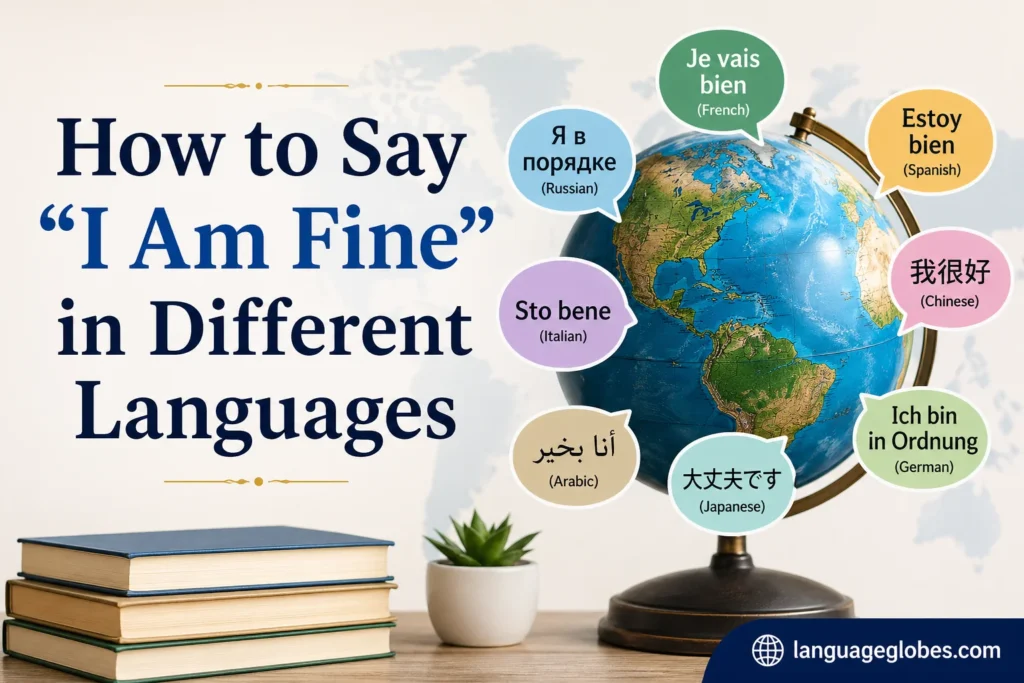
Learning How to Say “I Am Fine” in Different Languages builds ability to express onesself in different languages and connect globally with ease. In my experience, this simple skill becomes a gateway to understanding and appreciating diverse cultures around the world. Even simple phrases like yes, no, and I am fine feel universal, but their meaning and tone varies widely across regions. During my own exploration, I started to delve into how to say it in 70 languages spanning continents, noticing the beauty of melodic tones in Romance speech and intricate characters in Asian scripts. Each expression offers a glimpse into linguistic richness, where every interaction can feel like we embark on a shared journey together to discover how people convey well-being, from Albanian to Zulu.
Today, many people search for I am fine in different languages because they want to learn how to respond politely in real-life conversations. This saying is among the most common replies to the question How are you, and it naturally reflects positivity, good health, and politeness. By learning each phrase, you can confidently greet others, connect in a friendly and respectful way, and handle social moments with ease. From what I’ve found in casual chats, this small detail plays a big part in shaping your tone and intention in conversation.
On a deeper level, expressing emotions and well-being is a human need. Whether you are greeting a friend, answering about your health, or making small talk, this phrase has a key role in daily communication. It helps build connections, maintain relationships, and show love in a subtle, powerful, and important way. It can reflect your emotional states, social norms, and cultural values, where a polite default response may not always mean everything is perfect, but can invite a meaningful conversation. Over time, this practice improves your skills, helps you understand different parts of the world, fosters awareness, strengthens bonds, and enhances travel experiences.
Interesting Facts About “How to Say I Am Fine” in Different Languages
- 🌍 Over 7,000 languages exist worldwide, and most have multiple ways to express “I am fine.”
- 🗣️ In many cultures, the phrase can vary depending on formality, gender, or age.
- 😊 Some languages use expressions that translate more closely to “I am good” or “I am okay” instead of “fine.”
- 🤝 In countries like Japan and Korea, responses often reflect social harmony rather than personal truth.
- 💬 English dialects such as American, British, and Australian English have subtle differences in tone and usage.
🌍 European Languages
Europe is home to a rich tapestry of languages, many of which share historical roots in Latin, Germanic, and Slavic families. Communication styles here vary widely—from the expressive nature of Southern Europe to the more reserved tone in Northern regions. Saying “I am fine” can range from casual to formal depending on the situation.
Table: “I Am Fine” in European Languages
| Language | Country 🇺🇳 | Translation | Pronunciation | Example Sentence |
| American English | USA 🇺🇸 | I am fine | eye am fine | I am fine, thank you. |
| British English | UK 🇬🇧 | I am fine | eye am fayn | I am fine, cheers. |
| Australian English | Australia 🇦🇺 | I’m good | aim good | I’m good, mate! |
| Spanish | Spain 🇪🇸 | Estoy bien | es-toy bee-en | Estoy bien, gracias. |
| French | France 🇫🇷 | Je vais bien | zhuh vay bee-ahn | Je vais bien aujourd’hui. |
| German | Germany 🇩🇪 | Ich bin gut | ikh bin goot | Ich bin gut, danke. |
| Italian | Italy 🇮🇹 | Sto bene | sto beh-neh | Sto bene oggi. |
| Portuguese | Portugal 🇵🇹 | Estou bem | es-toh baym | Estou bem, obrigado. |
| Dutch | Netherlands 🇳🇱 | Ik ben goed | ik ben khoot | Ik ben goed vandaag. |
| Swedish | Sweden 🇸🇪 | Jag mår bra | yag mor bra | Jag mår bra idag. |
| Norwegian | Norway 🇳🇴 | Jeg har det bra | yai har de bra | Jeg har det bra nå. |
| Danish | Denmark 🇩🇰 | Jeg har det godt | yai har de got | Jeg har det godt. |
| Finnish | Finland 🇫🇮 | Olen kunnossa | oh-len kun-no-sa | Olen kunnossa nyt. |
| Polish | Poland 🇵🇱 | Mam się dobrze | mam shay dob-zhe | Mam się dobrze dziś. |
| Czech | Czech Republic 🇨🇿 | Mám se dobře | maam seh dob-zhe | Mám se dobře. |
| Hungarian | Hungary 🇭🇺 | Jól vagyok | yol vad-yok | Jól vagyok, köszönöm. |
| Greek | Greece 🇬🇷 | Είμαι καλά | ee-meh ka-la | Είμαι καλά σήμερα. |
| Romanian | Romania 🇷🇴 | Sunt bine | sunt bee-neh | Sunt bine azi. |
| Ukrainian | Ukraine 🇺🇦 | Я в порядку | ya v po-ryad-ku | Я в порядку сьогодні. |
| Russian | Russia 🇷🇺 | Я в порядке | ya v po-ryad-ke | Я в порядке, спасибо. |
🌏 Asian Languages
Asia is the largest and most culturally diverse continent, with languages influenced by ancient traditions, philosophies, and social hierarchies. In many Asian cultures, responses like “I am fine” reflect respect, politeness, and group harmony rather than individual feelings.
Table: “I Am Fine” in Asian Languages
| Language | Country 🇺🇳 | Translation | Pronunciation | Example Sentence |
| Chinese (Mandarin) | China 🇨🇳 | 我很好 | wo hen hao | 我很好,谢谢。 |
| Japanese | Japan 🇯🇵 | 元気です | genki desu | 元気です、ありがとう。 |
| Korean | South Korea 🇰🇷 | 괜찮아요 | gwaen-cha-na-yo | 괜찮아요, 감사합니다. |
| Hindi | India 🇮🇳 | मैं ठीक हूँ | main theek hoon | मैं ठीक हूँ। |
| Urdu | Pakistan 🇵🇰 | میں ٹھیک ہوں | main theek hoon | میں ٹھیک ہوں، شکریہ۔ |
| Bengali | Bangladesh 🇧🇩 | আমি ভালো আছি | ami bhalo achi | আমি ভালো আছি। |
| Tamil | India 🇮🇳 | நான் நலமாக இருக்கிறேன் | naan nala-maaga irukkiren | நான் நலமாக இருக்கிறேன். |
| Telugu | India 🇮🇳 | నేను బాగున్నాను | nenu baagunnanu | నేను బాగున్నాను. |
| Thai | Thailand 🇹🇭 | ฉันสบายดี | chan sa-bai dee | ฉันสบายดีค่ะ |
| Vietnamese | Vietnam 🇻🇳 | Tôi ổn | toy on | Tôi ổn, cảm ơn. |
| Indonesian | Indonesia 🇮🇩 | Saya baik | saya baik | Saya baik hari ini. |
| Malay | Malaysia 🇲🇾 | Saya sihat | saya see-hat | Saya sihat. |
| Filipino | Philippines 🇵🇭 | Ayos lang ako | ayos lang ako | Ayos lang ako ngayon. |
| Nepali | Nepal 🇳🇵 | म ठिक छु | ma thik chu | म ठिक छु। |
| Sinhala | Sri Lanka 🇱🇰 | මම හොඳින් | mama hondin | මම හොඳින් ඉන්නවා. |
| Khmer | Cambodia 🇰🇭 | ខ្ញុំសុខសប្បាយ | khnom sok sabay | ខ្ញុំសុខសប្បាយ។ |
| Lao | Laos 🇱🇦 | ຂ້ອຍສະບາຍດີ | khoy sabaidee | ຂ້ອຍສະບາຍດີ |
| Mongolian | Mongolia 🇲🇳 | Би сайн байна | bi sain baina | Би сайн байна. |
| Burmese | Myanmar 🇲🇲 | နေကောင်းပါတယ် | nay kaung par tal | နေကောင်းပါတယ်။ |
| Kazakh | Kazakhstan 🇰🇿 | Мен жақсымын | men zhaksymyn | Мен жақсымын. |
Read More: How to Say “I Love You” in Different Languages
🌍 African Languages
Africa is home to incredible linguistic diversity, with over 2,000 languages spoken across the continent. Many African languages emphasize community, respect, and well-being, making expressions like “I am fine” deeply connected to social interactions.
Table: “I Am Fine” in African Languages
| Language | Country 🇺🇳 | Translation | Pronunciation | Example Sentence |
| Swahili | Kenya 🇰🇪 | Niko sawa | nee-ko sa-wa | Niko sawa, asante. |
| Zulu | South Africa 🇿🇦 | Ngikhona | ngi-kho-na | Ngikhona namhlanje. |
| Xhosa | South Africa 🇿🇦 | Ndilungile | ndi-loon-gee-le | Ndilungile. |
| Yoruba | Nigeria 🇳🇬 | Mo wa daadaa | mo wa da-da | Mo wa daadaa loni. |
| Igbo | Nigeria 🇳🇬 | Adị m mma | a-di m ma | Adị m mma taa. |
| Hausa | Nigeria 🇳🇬 | Ina lafiya | ee-na la-fee-ya | Ina lafiya. |
| Amharic | Ethiopia 🇪🇹 | እኔ ደህና ነኝ | ene dehna negn | እኔ ደህና ነኝ |
| Somali | Somalia 🇸🇴 | Waan fiicanahay | waan fee-an-a-hay | Waan fiicanahay. |
| Shona | Zimbabwe 🇿🇼 | Ndiri bhoo | ndzi-ri bho | Ndiri bhoo. |
| Afrikaans | South Africa 🇿🇦 | Ek is goed | ek is goot | Ek is goed vandag. |
| Malagasy | Madagascar 🇲🇬 | Tsara aho | tsa-ra aho | Tsara aho androany. |
| Oromo | Ethiopia 🇪🇹 | Ani gaarii dha | ani gaa-ree dha | Ani gaarii dha. |
| Tigrinya | Eritrea 🇪🇷 | ኣነ ጽቡቕ እየ | ane tsbuk eye | ኣነ ጽቡቕ እየ |
| Wolof | Senegal 🇸🇳 | Maa ngi fi rek | maa ngi fi rek | Maa ngi fi rek. |
| Lingala | Congo 🇨🇩 | Nazali malamu | na-za-li ma-la-mu | Nazali malamu. |
| Kinyarwanda | Rwanda 🇷🇼 | Meze neza | me-ze ne-za | Meze neza. |
| Sesotho | Lesotho 🇱🇸 | Ke phetse hantle | ke phet-se han-tle | Ke phetse hantle. |
| Twi | Ghana 🇬🇭 | Me ho ye | me ho ye | Me ho ye. |
| Bambara | Mali 🇲🇱 | N bɛ se | n bay say | N bɛ se. |
| Fula | West Africa 🌍 | Mi yidi | mi yi-di | Mi yidi. |
🌍 Middle Eastern Languages
Middle Eastern languages are deeply rooted in history, religion, and tradition. Many belong to the Semitic language family and are rich in expression. Saying “I am fine” often reflects politeness and respect in social conversations.
Table: “I Am Fine” in Middle Eastern Languages
| Language | Country 🇺🇳 | Translation | Pronunciation | Example Sentence |
| Arabic | Saudi Arabia 🇸🇦 | أنا بخير | ana بخير | أنا بخير، شكراً |
| Persian (Farsi) | Iran 🇮🇷 | من خوبم | man khoobam | من خوبم. |
| Turkish | Turkey 🇹🇷 | İyiyim | ee-yee-yeem | İyiyim, teşekkürler. |
| Hebrew | Israel 🇮🇱 | אני בסדר | ani beseder | אני בסדר היום |
| Kurdish | Iraq 🇮🇶 | Ez baş im | ez bash im | Ez baş im. |
| Pashto | Afghanistan 🇦🇫 | زه ښه یم | za kha yam | زه ښه یم |
| Dari | Afghanistan 🇦🇫 | من خوب هستم | man khoob hastam | من خوب هستم |
| Armenian | Armenia 🇦🇲 | Ես լավ եմ | yes lav em | Ես լավ եմ |
| Azerbaijani | Azerbaijan 🇦🇿 | Mən yaxşıyam | men yakhshiyam | Mən yaxşıyam |
| Georgian | Georgia 🇬🇪 | მე კარგად ვარ | me kargad var | მე კარგად ვარ |
| Syriac | Middle East 🌍 | ܐܢܐ ܛܒܐ ܐܢܐ | ana taba ana | ܐܢܐ ܛܒܐ ܐܢܐ |
| Maltese | Malta 🇲🇹 | Jien tajjeb | jee-en tie-yeb | Jien tajjeb illum |
| Tajik | Tajikistan 🇹🇯 | Ман хубам | man khubam | Ман хубам |
| Uzbek | Uzbekistan 🇺🇿 | Men yaxshiman | men yakh-shi-man | Men yaxshiman |
| Turkmen | Turkmenistan 🇹🇲 | Men gowy | men go-wy | Men gowy |
| Kazakh | Kazakhstan 🇰🇿 | Мен жақсымын | men zhaksymyn | Мен жақсымын |
| Uyghur | China 🇨🇳 | مەن ياخشى | men yakhshi | مەن ياخشى |
| Arabic (Levantine) | Lebanon 🇱🇧 | أنا منيح | ana mni7 | أنا منيح |
| Arabic (Egyptian) | Egypt 🇪🇬 | أنا كويس | ana kwayyis | أنا كويس |
| Hebrew (casual) | Israel 🇮🇱 | אני טוב | ani tov | אני טוב |
❓ FAQ: Saying “I Am Fine” in Different Languages
1. Is “I am fine” the same in every culture?
No, the meaning can vary. In some cultures, it’s a polite response even if someone isn’t actually fine.
2. Are there formal and informal versions of “I am fine”?
Yes. Many languages like Japanese, Korean, and Arabic have different forms depending on respect and context.
3. What is the most common alternative to “I am fine”?
Many people say “I am good” or “I’m okay” instead.
4. Why should I learn phrases like “I am fine” in other languages?
It helps with travel, builds connections, and shows respect for other cultures.
5. Is pronunciation important when learning these phrases?
Absolutely. Correct pronunciation ensures better understanding and avoids confusion.
Conclusion
Learning how to say “I am fine” in different languages is more than just memorizing phrases—it’s about understanding cultures, traditions, and human connection. From Europe to Asia, Africa to the Middle East, each language offers a unique way of expressing well-being.
Whether you’re traveling, studying languages, or simply expanding your global knowledge, these expressions help you connect with people on a deeper level. Even small phrases can open doors to meaningful conversations and cultural appreciation.
So next time someone asks how you are—in any language—you’ll be ready to პასუხ confidently and connect globally. 🌍

Lucy Carter is a curious mind and language lover who writes for Language Globes. She enjoys discovering new languages and sharing simple, helpful ideas that make learning fun and accessible for everyone.