
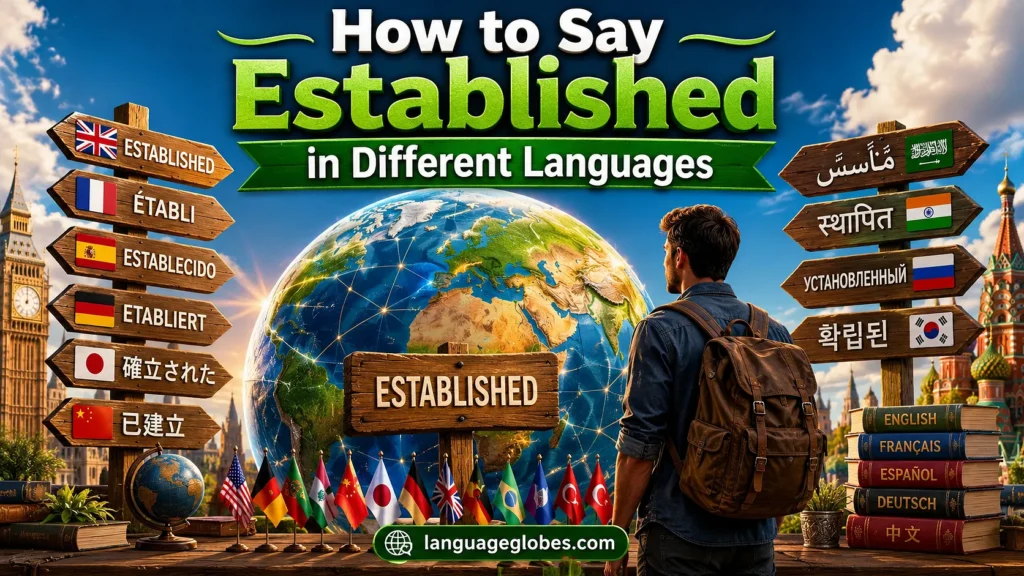
The word established describes something firmly rooted, officially recognized, or existing for a long time. Its meaning can relate to a business, tradition, organization, or person’s reputation. Learning how to express this idea in different languages helps language learners, travelers, and business professionals communicate effectively.
This guide explores established in different languages, with practical translations that connect language and culture. Understanding these expressions can help with global communication, international business documents, and studying a foreign language. You will discover useful terms in English, French, German, and Spanish, while exploring how cultures express ideas of stability, foundation, success, and recognition.
Also Read This: How to Say Espresso in Different Languages
Interesting Facts About Established
- The word established comes from the Latin word stabilire, meaning “to make stable.”
- It is commonly used in business, law, education, government, and everyday conversation.
- Many languages use different words depending on whether something is established as a company, rule, tradition, or fact.
- In some cultures, the equivalent word emphasizes stability, while others focus on recognition or official approval.
- Established organizations are often viewed as more trustworthy and reliable.
- The concept of being established is important in economic, social, and cultural contexts worldwide.
- Some languages use the same word for “established” and “founded” when referring to organizations.
How to Say Established in Different Languages
European Languages
Europe is home to hundreds of languages belonging to several language families, including Romance, Germanic, Slavic, Celtic, and Baltic languages. The idea of something being established is commonly associated with stability, tradition, and official recognition. The following translations show how various European cultures express this concept in everyday communication.
| Language | Country/Region | Translation | Pronunciation | Example Sentence |
| 🇺🇸 American English | United States | Established | ih-STAB-lisht | The company is well established. |
| 🇬🇧 British English | United Kingdom | Established | ih-STAB-lisht | The institution is well established. |
| 🇦🇺 Australian English | Australia | Established | ih-STAB-lisht | The brand is firmly established. |
| 🇫🇷 French | France | Établi | ay-ta-blee | L’entreprise est établie depuis longtemps. |
| 🇪🇸 Spanish | Spain | Establecido | es-ta-ble-SEE-do | La empresa está establecida. |
| 🇵🇹 Portuguese | Portugal/Brazil | Estabelecido | es-ta-be-le-SEE-do | A empresa está estabelecida. |
| 🇮🇹 Italian | Italy | Stabilito | sta-bee-LEE-to | L’azienda è stabilita. |
| 🇩🇪 German | Germany | Etabliert | eh-ta-BLEE-ert | Das Unternehmen ist etabliert. |
| 🇳🇱 Dutch | Netherlands | Gevestigd | khe-VES-tikht | Het bedrijf is gevestigd. |
| 🇸🇪 Swedish | Sweden | Etablerad | eh-ta-ble-RAD | Företaget är etablerat. |
| 🇳🇴 Norwegian | Norway | Etablert | eh-ta-BLERT | Selskapet er etablert. |
| 🇩🇰 Danish | Denmark | Etableret | eh-ta-ble-RET | Virksomheden er etableret. |
| 🇫🇮 Finnish | Finland | Vakiintunut | va-kee-in-tu-nut | Yritys on vakiintunut. |
| 🇵🇱 Polish | Poland | Ustanowiony | oo-sta-no-VYO-nee | Firma jest ustanowiona. |
| 🇨🇿 Czech | Czech Republic | Zavedený | za-ve-de-nee | Firma je zavedená. |
| 🇸🇰 Slovak | Slovakia | Zavedený | za-ve-de-nee | Spoločnosť je zavedená. |
| 🇭🇺 Hungarian | Hungary | Megalapított | meg-a-la-pee-tott | A cég megalapított. |
| 🇷🇴 Romanian | Romania | Stabilit | sta-bi-LIT | Compania este stabilită. |
| 🇧🇬 Bulgarian | Bulgaria | Установен | oo-sta-no-VEN | Компанията е установена. |
| 🇬🇷 Greek | Greece | Καθιερωμένος | ka-thie-ro-ME-nos | Η εταιρεία είναι καθιερωμένη. |
| 🇷🇺 Russian | Russia | Установленный | oo-sta-nov-LEN-ny | Компания установлена. |
| 🇺🇦 Ukrainian | Ukraine | Встановлений | vsta-nov-LEN-yi | Компанія встановлена. |
| 🇭🇷 Croatian | Croatia | Uspostavljen | us-po-STA-vlyen | Tvrtka je uspostavljena. |
| 🇷🇸 Serbian | Serbia | Успостављен | us-po-STA-vlyen | Компанија је успостављена. |
| 🇸🇮 Slovenian | Slovenia | Uveljavljen | oo-vel-YAV-len | Podjetje je uveljavljeno. |
| 🇱🇹 Lithuanian | Lithuania | Įsteigtas | ees-TEIG-tas | Įmonė yra įsteigta. |
| 🇱🇻 Latvian | Latvia | Izveidots | iz-VEI-dots | Uzņēmums ir izveidots. |
| 🇪🇪 Estonian | Estonia | Asutatud | a-su-TA-tud | Ettevõte on asutatud. |
| 🇮🇸 Icelandic | Iceland | Stofnað | STOF-nath | Fyrirtækið er stofnað. |
| 🇮🇪 Irish | Ireland | Bunaithe | bun-ah-ha | Tá an comhlacht bunaithe. |
| 🏴 Welsh | Wales | Sefydledig | sev-id-LEG-ig | Mae’r cwmni wedi’i sefydlu. |
Asian Languages
Asia contains the world’s largest population and an incredible variety of languages. From East Asia to South Asia and Southeast Asia, the concept of being established often relates to founding, creating, or firmly setting up an organization, tradition, or institution. These translations demonstrate the linguistic diversity of the continent.
| Language | Country/Region | Translation | Pronunciation | Example Sentence |
| 🇨🇳 Chinese (Mandarin) | China | 已建立 | yee jian-lee | 这家公司已建立多年。 |
| 🇯🇵 Japanese | Japan | 確立された | ka-ku-rit-su sa-re-ta | その会社は確立された。 |
| 🇰🇷 Korean | South Korea | 확립된 | hwang-nip-dwen | 그 회사는 확립된 기업이다. |
| 🇮🇳 Hindi | India | स्थापित | stha-pit | कंपनी स्थापित है। |
| 🇮🇳 Bengali | Bangladesh/India | প্রতিষ্ঠিত | pro-tish-thi-to | প্রতিষ্ঠানটি প্রতিষ্ঠিত। |
| 🇮🇳 Punjabi | India/Pakistan | ਸਥਾਪਿਤ | stha-pit | ਕੰਪਨੀ ਸਥਾਪਿਤ ਹੈ। |
| 🇮🇳 Gujarati | India | સ્થાપિત | stha-pit | કંપની સ્થાપિત છે. |
| 🇮🇳 Marathi | India | स्थापित | stha-pit | कंपनी स्थापित आहे. |
| 🇮🇳 Tamil | India/Sri Lanka | நிறுவப்பட்ட | ni-ru-va-pa-ta | நிறுவனம் நிறுவப்பட்டுள்ளது. |
| 🇮🇳 Telugu | India | స్థాపించబడిన | stha-pin-cha-ba-din | సంస్థ స్థాపించబడింది. |
| 🇮🇳 Kannada | India | ಸ್ಥಾಪಿತ | stha-pi-ta | ಸಂಸ್ಥೆ ಸ್ಥಾಪಿತವಾಗಿದೆ. |
| 🇮🇳 Malayalam | India | സ്ഥാപിതമായ | stha-pi-tha-ma-ya | കമ്പനി സ്ഥാപിതമാണ്. |
| 🇵🇰 Urdu | Pakistan | قائم شدہ | qa-im sha-da | کمپنی قائم شدہ ہے۔ |
| 🇳🇵 Nepali | Nepal | स्थापित | stha-pit | कम्पनी स्थापित छ। |
| 🇱🇰 Sinhala | Sri Lanka | ස්ථාපිත | stha-pi-ta | සමාගම ස්ථාපිතය. |
| 🇹🇭 Thai | Thailand | ที่จัดตั้งขึ้น | tee-jad-tang-khun | บริษัทได้รับการจัดตั้งขึ้นแล้ว |
| 🇻🇳 Vietnamese | Vietnam | Được thành lập | duoc thanh lap | Công ty được thành lập. |
| 🇰🇭 Khmer | Cambodia | បានបង្កើត | ban bong-koet | ក្រុមហ៊ុនបានបង្កើត។ |
| 🇱🇦 Lao | Laos | ສ້າງຕັ້ງ | sang-tang | ບໍລິສັດສ້າງຕັ້ງແລ້ວ |
| 🇲🇲 Burmese | Myanmar | တည်ထောင်ထားသော | ti-daung-tha-do | ကုမ္ပဏီတည်ထောင်ထားသည်။ |
| 🇮🇩 Indonesian | Indonesia | Didirikan | di-dee-ree-kan | Perusahaan itu didirikan. |
| 🇲🇾 Malay | Malaysia | Ditubuhkan | di-too-buh-kan | Syarikat itu ditubuhkan. |
| 🇵🇭 Filipino | Philippines | Itinatag | i-ti-na-tag | Ang kumpanya ay itinatag. |
| 🇲🇳 Mongolian | Mongolia | Байгуулагдсан | bai-gu-lag-san | Компани байгуулагдсан. |
| 🇰🇿 Kazakh | Kazakhstan | Құрылған | ku-ril-gan | Компания құрылған. |
| 🇺🇿 Uzbek | Uzbekistan | Tashkil etilgan | tash-kil et-il-gan | Kompaniya tashkil etilgan. |
African Languages
Africa is one of the most linguistically diverse continents in the world, with thousands of languages spoken across its regions. Many African languages have unique ways of expressing ideas related to establishment, foundation, and stability. These translations reflect the continent’s rich cultural and linguistic heritage.
| Language | Country/Region | Translation | Pronunciation | Example Sentence |
| 🇿🇦 Swahili | East Africa | Imaraishwa | ee-ma-ra-ish-wa | Kampuni imeimarishwa. |
| 🇿🇦 Zulu | South Africa | Kusunguliwe | ku-sun-gu-LEE-we | Inkampani isunguliwe. |
| 🇿🇦 Xhosa | South Africa | Isekwe | ee-sek-we | Inkampani isekwe kakuhle. |
| 🇿🇦 Afrikaans | South Africa | Gevestig | khe-ves-tikh | Die maatskappy is gevestig. |
| 🇳🇬 Yoruba | Nigeria | Ti dá sílẹ̀ | tee da see-leh | Ile-iṣẹ náà ti dá sílẹ̀. |
| 🇳🇬 Igbo | Nigeria | Guzobere | goo-zo-be-re | A guzobere ụlọ ọrụ ahụ. |
| 🇳🇬 Hausa | Nigeria | Kafa | ka-fa | An kafa kamfanin. |
| 🇪🇹 Amharic | Ethiopia | የተመሠረተ | ye-te-me-se-re-te | ድርጅቱ የተመሠረተ ነው። |
| 🇷🇼 Kinyarwanda | Rwanda | Yashyizweho | ya-shyi-zwe-ho | Isosiyete yashyizweho. |
| 🇸🇴 Somali | Somalia | La aasaasay | la aa-sa-say | Shirkaddu waa la aasaasay. |
Middle Eastern Languages
The Middle East has a long history of civilization, trade, education, and governance. Languages from this region often carry deep historical significance. The concept of being established may refer to institutions, traditions, governments, or businesses that have gained stability and recognition over time.
| Language | Country/Region | Translation | Pronunciation | Example Sentence |
| 🇸🇦 Arabic | Middle East | مُؤَسَّس | moo-as-sas | الشركة مؤسسة جيداً. |
| 🇮🇷 Persian (Farsi) | Iran | تأسیسشده | ta-see-s sho-deh | شرکت تأسیسشده است. |
| 🇹🇷 Turkish | Türkiye | Kurulmuş | koo-rul-mush | Şirket kurulmuş durumda. |
| 🇮🇱 Hebrew | Israel | מבוסס | me-vo-sas | החברה מבוססת היטב. |
| 🇰🇼 Kurdish | Kurdistan Region | دامەزراو | da-ma-zra-w | کۆمپانیاکە دامەزراوە. |
| 🇴🇲 Pashto | Afghanistan/Pakistan | تاسیس شوی | ta-sees shwe | شرکت تاسیس شوی دی. |
| 🇦🇫 Dari | Afghanistan | تأسیسشده | ta-sees sho-da | شرکت تأسیسشده است. |
Additional Languages Around the World
Beyond Europe, Asia, Africa, and the Middle East, many other languages are spoken across the Americas and the Pacific. Learning these translations provides a broader understanding of global communication and helps language enthusiasts appreciate linguistic diversity.
| Language | Country/Region | Translation | Pronunciation | Example Sentence |
| 🇳🇿 Maori | New Zealand | Whakatūria | fa-ka-too-ree-a | Kua whakatūria te kamupene. |
| 🇼🇸 Samoan | Samoa | Faavaeina | fa-a-va-ei-na | Ua faavaeina le kamupani. |
| 🇹🇴 Tongan | Tonga | Fakatu’u | fa-ka-too-u | Kuo fakatu’u e kautaha. |
| 🇭🇹 Haitian Creole | Haiti | Etabli | eh-ta-blee | Konpayi an etabli. |
| 🇬🇱 Greenlandic | Greenland | Pilersinneqartoq | pi-ler-sin-ne-kar-toq | Suliffeqarfik pilersinneqartoq. |
| 🇨🇦 Inuktitut | Canada | ᐱᔪᖅᑐᖅ | pi-yuk-tuk | ᑲᒻᐸᓂ ᐱᔪᖅᑐᖅ. |
| 🇵🇾 Guarani | Paraguay | Oñemopyenda | o-nye-mo-pyen-da | Empresa oñemopyenda. |
| 🇵🇪 Quechua | Peru | Sayarichisqa | sa-ya-ri-chis-ka | Hatun wasi sayarichisqa. |
FAQs
What Does Established Mean in Different Languages?
Established means something that is firmly rooted, officially recognized, or existing for a long time. Its exact translation can change depending on the language and cultural context.
How Do You Say Established in English?
In English, established describes something successfully created, accepted, or recognized. It can refer to a business, tradition, organization, or person’s reputation.
How Do You Say Established in French?
In French, établi is commonly used for established. It can describe something firmly created, recognized, or accepted within a particular context.
How Do You Say Established in German?
In German, etabliert commonly expresses the idea of established. It often describes a recognized business, method, institution, or practice.
How Do You Say Established in Spanish?
In Spanish, establecido is a common translation for established. It can describe something officially created, recognized, or firmly accepted.
What Are the Ways to Say Established in Different Languages?
There are many ways to say established across multiple languages, depending on the intended meaning. These expressions can describe stability, success, recognition, or something existing for a long time.
Why Learn Established in Different Languages?
Learning established in different languages helps language learners understand how cultures express similar ideas. It can also support global communication and help people communicate effectively across borders.
How Is Established Used in Business and International Communication?
In international business, established can describe a company with a strong foundation, reputation, and history. These terms are useful in international business documents and professional communication.
What Is the Difference Between Established and Set Up Successfully?
Set up successfully focuses on the successful creation of an institution or founding of a company. Established often suggests continued stability, recognition, or a broad reach over time.
How Can Learning Established Expand Your Vocabulary?
Learning established in more than 40 languages can help with expanding vocabulary and understanding similar ideas across cultures. It is especially practical for translators, travelers, and people learning a foreign language.
Conclusion
Learning established in different languages makes it easier to understand how cultures express stability, success, and recognition. From English to French, German, and Spanish, each translation offers a useful way to communicate this idea. These expressions can help language learners, travelers, and business professionals communicate effectively across cultures and borders. Understanding established in multiple languages also builds vocabulary while making global communication more practical and meaningful.

James Anderson is a passionate language enthusiast and content creator at LanguageGlobes. With a keen interest in global cultures and communication, he shares insightful and engaging content to help readers explore and master new languages.