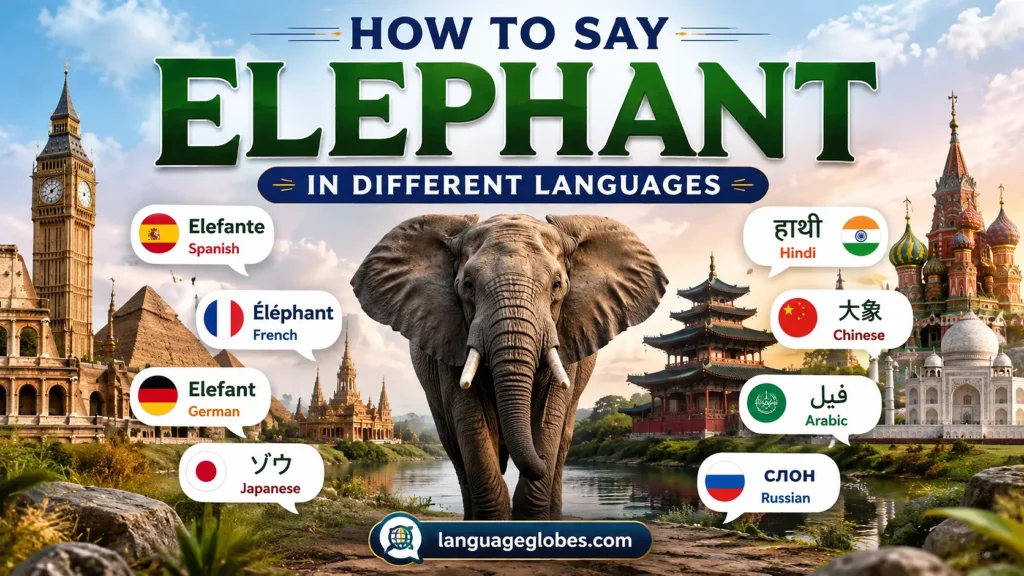
The Elephant is a universally recognized animal and one of the most culturally significant animals across world cultures. From ancient myths and stories to symbols, elephants reflect wisdom, strength, loyalty, and prosperity in many traditions and religions.
Learning elephant in different languages offers a fun way to explore linguistic diversity, global languages, and cultural connections. This guide shares useful elephant translations and elephant pronunciations for language learners, travelers, and wildlife lovers.
Discovering how to pronounce elephant and read elephant in another language can strengthen vocabulary building and communication skills. You can explore different languages, understand animal vocabulary, and discover how communities describe these majestic creatures.
Whether you are students, language enthusiasts, travelers, or content creators, these translations provide an engaging way to explore language, history, wildlife, and nature.
Also Read This: How to Say Elegant in Different Languages
Interesting Facts About Elephant
- Elephants are the largest land animals on Earth.
- They can recognize themselves in mirrors, showing high intelligence.
- Elephant trunks contain over 40,000 muscles.
- African elephants have larger ears than Asian elephants.
- Elephants communicate through sounds, touch, and vibrations.
- A baby elephant is called a calf.
- Elephants can remember locations and individuals for many years.
- They show emotions such as happiness, grief, and empathy.
- In many cultures, elephants symbolize wisdom and good fortune.
- Elephants play an important role in maintaining healthy ecosystems.
How to Say Elephant in Different Languages
The word “elephant” varies across languages, but its importance remains universal. Below are translations from more than 70 languages around the world, including pronunciation guides and example sentences.
European Languages
Europe is home to hundreds of languages belonging to several language families. From Romance and Germanic languages to Slavic and Celtic languages, the continent offers incredible linguistic diversity. Learning the word “elephant” in European languages helps reveal how different cultures describe one of the world’s most recognizable animals.
| Language | Country/Region | Translation | Pronunciation | Example Sentence |
| 🇺🇸 American English | USA | Elephant | EL-uh-funt | The elephant is very large. |
| 🇬🇧 British English | UK | Elephant | EL-uh-fuhnt | I saw an elephant at the zoo. |
| 🇦🇺 Australian English | Australia | Elephant | EL-uh-funt | The elephant was eating leaves. |
| French | 🇫🇷 France | Éléphant | ay-lay-fahn | L’éléphant est énorme. |
| Spanish | 🇪🇸 Spain | Elefante | eh-leh-FAN-teh | El elefante es grande. |
| Portuguese | 🇵🇹 Portugal | Elefante | eh-leh-FAN-te | O elefante é grande. |
| Italian | 🇮🇹 Italy | Elefante | eh-leh-FAN-teh | L’elefante è grande. |
| German | 🇩🇪 Germany | Elefant | eh-leh-FANT | Der Elefant ist groß. |
| Dutch | 🇳🇱 Netherlands | Olifant | OH-lee-fant | De olifant is groot. |
| Swedish | 🇸🇪 Sweden | Elefant | eh-leh-FANT | Elefanten är stor. |
| Norwegian | 🇳🇴 Norway | Elefant | eh-leh-FANT | Elefanten er stor. |
| Danish | 🇩🇰 Denmark | Elefant | eh-leh-FANT | Elefanten er stor. |
| Finnish | 🇫🇮 Finland | Norsu | NOR-soo | Norsu on suuri. |
| Icelandic | 🇮🇸 Iceland | Fíll | FEETL | Fíllinn er stór. |
| Polish | 🇵🇱 Poland | Słoń | SWONY | Słoń jest duży. |
| Czech | 🇨🇿 Czech Republic | Slon | SLON | Slon je velký. |
| Slovak | 🇸🇰 Slovakia | Slon | SLON | Slon je veľký. |
| Hungarian | 🇭🇺 Hungary | Elefánt | eh-leh-faant | Az elefánt nagy. |
| Romanian | 🇷🇴 Romania | Elefant | eh-leh-FANT | Elefantul este mare. |
| Bulgarian | 🇧🇬 Bulgaria | Слон | SLON | Слонът е голям. |
| Serbian | 🇷🇸 Serbia | Slon | SLON | Slon je velik. |
| Croatian | 🇭🇷 Croatia | Slon | SLON | Slon je velik. |
| Slovenian | 🇸🇮 Slovenia | Slon | SLON | Slon je velik. |
| Greek | 🇬🇷 Greece | Ελέφαντας | eh-LE-fan-tas | Ο ελέφαντας είναι μεγάλος. |
| Russian | 🇷🇺 Russia | Слон | SLON | Слон большой. |
| Ukrainian | 🇺🇦 Ukraine | Слон | SLON | Слон великий. |
| Belarusian | 🇧🇾 Belarus | Слон | SLON | Слон вялікі. |
| Irish | 🇮🇪 Ireland | Eilifint | EL-i-fint | Tá an eilifint mór. |
| Welsh | 🏴 Wales | Eliffant | eh-LIFF-ant | Mae’r eliffant yn fawr. |
Asian Languages
Asia is the largest continent and contains thousands of languages spoken by billions of people. Many Asian cultures have a deep historical connection with elephants, especially in South and Southeast Asia where elephants have been used in ceremonies, transportation, and religious traditions for centuries.
| Language | Country/Region | Translation | Pronunciation | Example Sentence |
| Chinese (Mandarin) | 🇨🇳 China | 大象 | dah-shee-ang | 大象很大。 |
| Japanese | 🇯🇵 Japan | 象 | zoh | 象は大きいです。 |
| Korean | 🇰🇷 South Korea | 코끼리 | ko-kki-ri | 코끼리는 큽니다. |
| Hindi | 🇮🇳 India | हाथी | HAA-thee | हाथी बहुत बड़ा है। |
| Urdu | 🇵🇰 Pakistan | ہاتھی | HAA-thee | ہاتھی بہت بڑا ہے۔ |
| Bengali | 🇧🇩 Bangladesh | হাতি | HAA-ti | হাতি বড়। |
| Punjabi | India/Pakistan | ਹਾਥੀ | HAA-thee | ਹਾਥੀ ਵੱਡਾ ਹੈ। |
| Gujarati | 🇮🇳 India | હાથી | HAA-thee | હાથી મોટો છે. |
| Marathi | 🇮🇳 India | हत्ती | HUT-tee | हत्ती मोठा आहे. |
| Tamil | 🇮🇳 India | யானை | YAA-nai | யானை பெரியது. |
| Telugu | 🇮🇳 India | ఏనుగు | AY-noo-goo | ఏనుగు పెద్దది. |
| Kannada | 🇮🇳 India | ಆನೆ | AA-nay | ಆನೆ ದೊಡ್ಡದು. |
| Malayalam | 🇮🇳 India | ആന | AA-na | ആന വലുതാണ്. |
| Sinhala | 🇱🇰 Sri Lanka | අලියා | a-LEE-ya | අලියා ලොකුයි. |
| Nepali | 🇳🇵 Nepal | हाती | HAA-thee | हाती ठूलो छ। |
| Thai | 🇹🇭 Thailand | ช้าง | CHANG | ช้างตัวใหญ่. |
| Lao | 🇱🇦 Laos | ຊ້າງ | CHANG | ຊ້າງໃຫຍ່. |
| Khmer | 🇰🇭 Cambodia | ដំរី | dom-REE | ដំរីធំ. |
| Vietnamese | 🇻🇳 Vietnam | Voi | VOY | Con voi rất lớn. |
| Indonesian | 🇮🇩 Indonesia | Gajah | GAH-jah | Gajah itu besar. |
| Malay | 🇲🇾 Malaysia | Gajah | GAH-jah | Gajah itu besar. |
| Filipino | 🇵🇭 Philippines | Elepante | eh-leh-PAN-te | Malaki ang elepante. |
| Mongolian | 🇲🇳 Mongolia | Заан | ZAHN | Заан том. |
| Burmese | 🇲🇲 Myanmar | ဆင် | SIN | ဆင်ကြီးတယ်။ |
African Languages
Africa is home to more than 2,000 languages and incredible cultural diversity. Since elephants are native to many African regions, numerous African languages have unique words for these magnificent animals. Elephants often appear in folklore, traditional stories, and cultural symbolism throughout the continent.
| Language | Country/Region | Translation | Pronunciation | Example Sentence |
| Swahili | 🌍 East Africa | Tembo | TEM-bo | Tembo ni mkubwa. |
| Zulu | 🇿🇦 South Africa | Indlovu | in-DLO-vu | Indlovu inkulu. |
| Xhosa | 🇿🇦 South Africa | Indlovu | in-DLO-vu | Indlovu inkulu. |
| Afrikaans | 🇿🇦 South Africa | Olifant | OH-li-fant | Die olifant is groot. |
| Yoruba | 🇳🇬 Nigeria | Erin | EH-rin | Erin tobi ni. |
| Igbo | 🇳🇬 Nigeria | Enyi | EN-yee | Enyi buru ibu. |
| Hausa | 🇳🇬 Nigeria | Giwa | GEE-wa | Giwa tana da girma. |
| Amharic | 🇪🇹 Ethiopia | ዝሆን | zi-HON | ዝሆን ትልቅ ነው። |
| Somali | 🇸🇴 Somalia | Maroodi | ma-ROO-di | Maroodigu weyn yahay. |
| Shona | 🇿🇼 Zimbabwe | Nzou | N-zoh | Nzou hombe. |
| Kinyarwanda | 🇷🇼 Rwanda | Inzovu | in-ZO-vu | Inzovu nini. |
| Malagasy | 🇲🇬 Madagascar | Elefanta | eh-leh-FAN-ta | Lehibe ny elefanta. |
Middle Eastern Languages
The Middle East has a rich linguistic history shaped by ancient civilizations, trade routes, and cultural exchange. Languages from this region have influenced many other languages around the world. Learning the word elephant in Middle Eastern languages provides insight into one of humanity’s oldest cultural crossroads.
| Language | Country/Region | Translation | Pronunciation | Example Sentence |
| Arabic | 🌍 Middle East | فيل | FEEL | الفيل كبير. |
| Persian | 🇮🇷 Iran | فیل | FEEL | فیل بزرگ است. |
| Turkish | 🇹🇷 Turkey | Fil | FEEL | Fil çok büyük. |
| Hebrew | 🇮🇱 Israel | פיל | PEEL | הפיל גדול. |
| Kurdish | Iraq/Turkey | Fîl | FEEL | Fîl mezin e. |
| Pashto | 🇦🇫 Afghanistan | فیل | FEEL | فیل لوی دی. |
Additional Languages Around the World
Beyond Europe, Asia, Africa, and the Middle East, many other languages contribute to the rich tapestry of global communication. These languages are spoken across the Americas, Oceania, and indigenous communities worldwide. Exploring these translations highlights the remarkable diversity of human language.
| Language | Country/Region | Translation | Pronunciation | Example Sentence |
| Hawaiian | 🇺🇸 Hawaii | Elepani | eh-leh-PAH-nee | Nui ka elepani. |
| Maori | 🇳🇿 New Zealand | Arewhana | ah-reh-WHA-na | He nui te arewhana. |
| Samoan | 🇼🇸 Samoa | Elefane | eh-leh-FA-ne | E tele le elefane. |
| Tongan | 🇹🇴 Tonga | Elefani | eh-leh-FA-ni | Oku lahi e elefani. |
| Fijian | 🇫🇯 Fiji | Elefani | eh-leh-FA-ni | E levu na elefani. |
| Haitian Creole | 🇭🇹 Haiti | Elefan | eh-leh-FAN | Elefan an gwo. |
| Esperanto | 🌍 International | Elefanto | eh-leh-FAN-to | La elefanto estas granda. |
| Latin | Ancient Rome | Elephantus | eh-leh-FAN-toos | Elephantus magnus est. |
| Greenlandic | 🇬🇱 Greenland | Elefanti | eh-leh-FAN-ti | Elefanti angivoq. |
| Navajo | 🇺🇸 USA | Béégashii | bay-ga-SHEE | Béégashii níłchí. |
FAQs
What is the word for Elephant in different languages?
The word Elephant has different forms across global languages. These elephant translations help learners explore linguistic diversity, animal vocabulary, and cultural expressions.
How do you say elephant in Spanish?
In Spanish, elephant is elefante, a common word used in everyday language. Learning elephant pronunciations can make language learning more practical and enjoyable.
How do you say elephant in French?
In French, elephant is éléphant, which refers to these majestic creatures. It is useful vocabulary for travelers, students, and language enthusiasts exploring different languages.
How do you say elephant in Russian?
In Russian, elephant is слон, pronounced approximately slon. This simple translation adds useful common vocabulary for multilingual learning and vocabulary building.
How do you say elephant in Hindi?
In Hindi, elephant is हाथी, pronounced hathi. This word appears frequently in discussions about wildlife, nature, and cultural traditions.
How do you say elephant in Mandarin Chinese?
In Mandarin Chinese, elephant is 大象, pronounced dàxiàng. Learning this term provides an interesting example of animal vocabulary in global languages.
Why are elephants important in different cultures?
Elephants are culturally significant animals connected with wisdom, strength, good luck, loyalty, and prosperity. Their presence in myths, religions, art, and stories spans thousands of years.
How can learning elephant translations improve language skills?
Learning elephant translations expands language vocabulary, supports communication, and strengthens a strong language foundation. It also creates a fun way to explore cultures through everyday words.
How many languages can I learn the word elephant in?
You can discover how to say elephant in dozens of languages, including over 100 languages in broader multilingual resources. Comparing translations makes linguistic diversity easier and more interesting to understand.
Where can I use elephant vocabulary for learning?
These words can support language learners, classroom resources, teaching resources, and picture dictionaries. They are also useful for vocabulary building, cultural exploration, and understanding animal symbolism.
Conclusion
Learning elephant in different languages is a simple way to discover linguistic diversity, global languages, and cultural traditions. Exploring elephant translations, elephant pronunciations, and animal vocabulary can strengthen language learning while revealing how world cultures connect elephants with wisdom, strength, loyalty, and prosperity. Whether you are a traveler, student, or language enthusiast, these words make multilingual learning more engaging. Continue exploring different languages to build vocabulary and deepen your connection with cultures around the world.

Lucy Carter is a curious mind and language lover who writes for Language Globes. She enjoys discovering new languages and sharing simple, helpful ideas that make learning fun and accessible for everyone.