
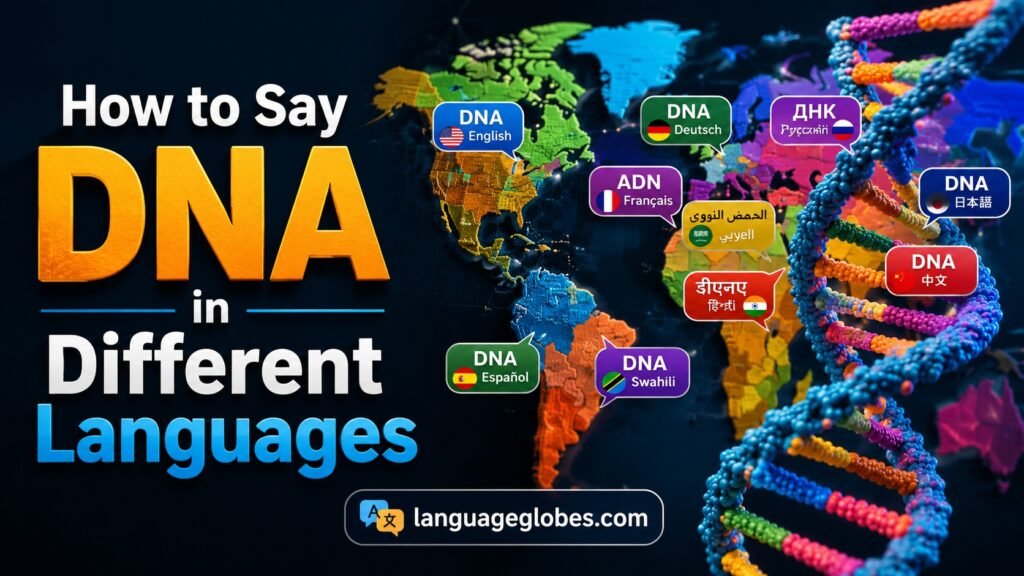
DNA is a fundamental concept in genetics, carrying genetic information inside the cells of living organisms. Its full name, Deoxyribonucleic Acid, describes the genetic material responsible for heredity and evolution.
Learning DNA in different languages reveals how scientific terminology adapts across cultures and languages. These language variations create useful connections between scientific knowledge, communication, and global science.
This guide explores how to say DNA using language translations, pronunciation, and translated terms from around the world. It also explains DNA meaning, DNA abbreviation, and DNA terminology in simple language for learners.
These translations can support students, researchers, healthcare professionals, and language enthusiasts studying molecular biology. Understanding these differences encourages international communication, cross-cultural understanding, and better sharing of scientific ideas.
Also Read This: How to Say Dance in Different Languages
Interesting Facts About DNA
- DNA stands for Deoxyribonucleic Acid.
- DNA contains the genetic instructions used by living organisms.
- Nearly every cell in the human body contains DNA.
- Human DNA is approximately 99.9% identical from person to person.
- DNA was first identified by Swiss scientist Friedrich Miescher in 1869.
- The famous double-helix structure was described by James Watson and Francis Crick in 1953.
- DNA can help identify family relationships and ancestry.
- Forensic scientists use DNA evidence to solve criminal cases.
- DNA research contributes to medical breakthroughs and disease treatment.
- The term “DNA” is recognized internationally and is often used unchanged across many languages.
How to Say DNA in Different Languages
Around the world, languages reflect unique histories, cultures, and scientific traditions. Many countries have adopted the international abbreviation “DNA,” while others use translated forms of “Deoxyribonucleic Acid.” The following sections explore how DNA is expressed across different regions and languages.
European Languages
Europe is home to hundreds of languages belonging to Germanic, Romance, Slavic, Celtic, and other language families. Scientific terminology is often shared across European countries, making DNA recognizable in many languages while still having local pronunciations.
| Language | Country/Region | Translation | Pronunciation | Example Sentence |
| 🇺🇸 American English | USA | DNA | Dee-En-Ay | DNA contains genetic information. |
| 🇬🇧 British English | UK | DNA | Dee-En-Ay | DNA is studied in biology classes. |
| 🇦🇺 Australian English | Australia | DNA | Dee-En-Ay | Scientists analyze DNA samples. |
| Spanish | Spain 🇪🇸 | ADN | Ah-Day-Eh-Neh | El ADN contiene información genética. |
| French | France 🇫🇷 | ADN | Ah-Day-En | L’ADN porte l’information génétique. |
| German | Germany 🇩🇪 | DNA | Dee-En-Ah | DNA enthält genetische Informationen. |
| Italian | Italy 🇮🇹 | DNA | Dee-En-Ah | Il DNA contiene informazioni genetiche. |
| Portuguese | Portugal 🇵🇹 | ADN | Ah-Day-Eh-Ne | O ADN contém informação genética. |
| Dutch | Netherlands 🇳🇱 | DNA | Day-En-Ah | DNA bevat genetische informatie. |
| Swedish | Sweden 🇸🇪 | DNA | De-En-A | DNA innehåller genetisk information. |
| Norwegian | Norway 🇳🇴 | DNA | De-En-A | DNA inneholder genetisk informasjon. |
| Danish | Denmark 🇩🇰 | DNA | De-En-A | DNA indeholder genetisk information. |
| Finnish | Finland 🇫🇮 | DNA | Dee-En-Aa | DNA sisältää geneettistä tietoa. |
| Icelandic | Iceland 🇮🇸 | DNA | Dee-En-Ah | DNA geymir erfðaupplýsingar. |
| Polish | Poland 🇵🇱 | DNA | De-En-A | DNA zawiera informacje genetyczne. |
| Czech | Czech Republic 🇨🇿 | DNA | De-En-A | DNA obsahuje genetické informace. |
| Slovak | Slovakia 🇸🇰 | DNA | De-En-A | DNA obsahuje genetické informácie. |
| Hungarian | Hungary 🇭🇺 | DNS | De-En-Esh | A DNS genetikai információt hordoz. |
| Romanian | Romania 🇷🇴 | ADN | Ah-De-En | ADN conține informații genetice. |
| Bulgarian | Bulgaria 🇧🇬 | ДНК | De-En-Ka | ДНК съдържа генетична информация. |
| Serbian | Serbia 🇷🇸 | ДНК | De-En-Ka | ДНК носи генетске информације. |
| Croatian | Croatia 🇭🇷 | DNK | De-En-Ka | DNK sadrži genetske informacije. |
| Slovenian | Slovenia 🇸🇮 | DNK | De-En-Ka | DNK vsebuje genetske informacije. |
| Greek | Greece 🇬🇷 | DNA | Dee-En-Ah | Το DNA περιέχει γενετικές πληροφορίες. |
| Ukrainian | Ukraine 🇺🇦 | ДНК | De-En-Ka | ДНК містить генетичну інформацію. |
| Russian | Russia 🇷🇺 | ДНК | De-En-Ka | ДНК содержит генетическую информацию. |
| Belarusian | Belarus 🇧🇾 | ДНК | De-En-Ka | ДНК змяшчае генетычную інфармацыю. |
| Irish | Ireland 🇮🇪 | DNA | Dee-En-Ay | Tá DNA i ngach cill. |
| Welsh | Wales 🏴 | DNA | Dee-En-A | Mae DNA yn cynnwys gwybodaeth enetig. |
Asian Languages
Asia is the largest continent and contains an incredible variety of languages. Many Asian languages have adapted scientific terms from English, while others created localized versions that fit their writing systems and pronunciation patterns.
| Language | Country/Region | Translation | Pronunciation | Example Sentence |
| Chinese (Simplified) | China 🇨🇳 | 脱氧核糖核酸 | Tuo Yang He Tang He Suan | DNA carries genetic information. |
| Chinese (Traditional) | Taiwan 🇹🇼 | 去氧核糖核酸 | Chu Yang He Tang He Suan | DNA stores hereditary information. |
| Japanese | Japan 🇯🇵 | DNA | Dee-En-Eh | DNAは遺伝情報を持っています。 |
| Korean | South Korea 🇰🇷 | DNA | Dee-En-Ei | DNA는 유전 정보를 담고 있습니다. |
| Hindi | India 🇮🇳 | डीएनए | Dee-En-A | डीएनए आनुवंशिक जानकारी रखता है। |
| Urdu | Pakistan 🇵🇰 | ڈی این اے | Dee-En-A | ڈی این اے جینیاتی معلومات رکھتا ہے۔ |
| Bengali | Bangladesh 🇧🇩 | ডিএনএ | Dee-En-A | ডিএনএ জিনগত তথ্য বহন করে। |
| Punjabi | India/Pakistan | ਡੀਐਨਏ | Dee-En-A | ਡੀਐਨਏ ਜੈਨੇਟਿਕ ਜਾਣਕਾਰੀ ਰੱਖਦਾ ਹੈ। |
| Tamil | India 🇮🇳 | டிஎன்ஏ | Di-En-A | டிஎன்ஏ மரபணு தகவலை கொண்டுள்ளது. |
| Telugu | India 🇮🇳 | డిఎన్ఏ | Dee-En-A | DNA జన్యు సమాచారాన్ని కలిగి ఉంటుంది. |
| Kannada | India 🇮🇳 | ಡಿಎನ್ಎ | Dee-En-A | DNA ಆನುವಂಶಿಕ ಮಾಹಿತಿಯನ್ನು ಹೊಂದಿದೆ. |
| Malayalam | India 🇮🇳 | ഡിഎൻഎ | Dee-En-A | DNA ജനിതക വിവരങ്ങൾ വഹിക്കുന്നു. |
| Marathi | India 🇮🇳 | डीएनए | Dee-En-A | डीएनए आनुवंशिक माहिती ठेवतो. |
| Gujarati | India 🇮🇳 | ડીએનએ | Dee-En-A | ડીએનએ આનુવંશિક માહિતી ધરાવે છે. |
| Nepali | Nepal 🇳🇵 | डीएनए | Dee-En-A | डीएनएले आनुवंशिक जानकारी दिन्छ। |
| Sinhala | Sri Lanka 🇱🇰 | ඩීඑන්ඒ | Dee-En-A | DNA ජානමය තොරතුරු රඳවා තබයි. |
| Thai | Thailand 🇹🇭 | ดีเอ็นเอ | Dee-En-A | ดีเอ็นเอเก็บข้อมูลทางพันธุกรรม |
| Vietnamese | Vietnam 🇻🇳 | ADN | Ah-De-En | ADN chứa thông tin di truyền. |
| Indonesian | Indonesia 🇮🇩 | DNA | Dee-En-A | DNA menyimpan informasi genetik. |
| Malay | Malaysia 🇲🇾 | DNA | Dee-En-A | DNA membawa maklumat genetik. |
| Filipino | Philippines 🇵🇭 | DNA | Dee-En-A | Ang DNA ay naglalaman ng impormasyon genetiko. |
| Khmer | Cambodia 🇰🇭 | DNA | Dee-En-A | DNA មានព័ត៌មានហ្សែន។ |
| Lao | Laos 🇱🇦 | DNA | Dee-En-A | DNA ມີຂໍ້ມູນພັນທຸກຳ. |
| Burmese | Myanmar 🇲🇲 | DNA | Dee-En-A | DNA သည် မျိုးရိုးဗီဇအချက်အလက်များ ပါဝင်သည်။ |
| Mongolian | Mongolia 🇲🇳 | ДНХ | De-En-Kha | ДНХ нь генетикийн мэдээлэл агуулдаг. |
African Languages
Africa has extraordinary linguistic diversity, with more than 2,000 languages spoken across the continent. Many African languages incorporate international scientific terms while adapting them to local pronunciation and writing systems.
| Language | Country/Region | Translation | Pronunciation | Example Sentence |
| Swahili | Kenya/Tanzania 🇰🇪🇹🇿 | DNA | Dee-En-A | DNA hubeba taarifa za urithi. |
| Afrikaans | South Africa 🇿🇦 | DNA | Dee-En-A | DNA bevat genetiese inligting. |
| Zulu | South Africa 🇿🇦 | DNA | Dee-En-A | I-DNA iqukethe ulwazi lofuzo. |
| Xhosa | South Africa 🇿🇦 | DNA | Dee-En-A | I-DNA iqulethe ulwazi lwezofuzo. |
| Yoruba | Nigeria 🇳🇬 | DNA | Dee-En-A | DNA ni alaye jiini. |
| Igbo | Nigeria 🇳🇬 | DNA | Dee-En-A | DNA nwere ozi mkpụrụ ndụ ihe nketa. |
| Hausa | Nigeria 🇳🇬 | DNA | Dee-En-A | DNA yana dauke da bayanan gado. |
| Amharic | Ethiopia 🇪🇹 | ዲኤንኤ | Dee-En-A | ዲኤንኤ የዘር መረጃ ይይዛል። |
| Somali | Somalia 🇸🇴 | DNA | Dee-En-A | DNA wuxuu xambaarsan yahay xog hidde-side. |
| Shona | Zimbabwe 🇿🇼 | DNA | Dee-En-A | DNA ine ruzivo rwemajini. |
| Kinyarwanda | Rwanda 🇷🇼 | ADN | Ah-De-En | ADN ibika amakuru y’irage. |
| Malagasy | Madagascar 🇲🇬 | ADN | Ah-De-En | ADN mitahiry vaovao ara-pirazanana. |
Middle Eastern Languages
The Middle East has a rich history of scholarship, science, and cultural exchange. Languages from this region often use transliterated forms of DNA while maintaining their unique scripts and pronunciation traditions.
| Language | Country/Region | Translation | Pronunciation | Example Sentence |
| Arabic | Middle East 🌍 | الحمض النووي | Al-Hamid Al-Nawawi | الحمض النووي يحمل المعلومات الوراثية. |
| Persian (Farsi) | Iran 🇮🇷 | دیانای | Dee-En-A | دیانای اطلاعات ژنتیکی را حمل میکند. |
| Turkish | Türkiye 🇹🇷 | DNA | Dee-En-A | DNA genetik bilgi taşır. |
| Hebrew | Israel 🇮🇱 | דנ״א | Dee-En-A | דנ״א מכיל מידע גנטי. |
| Kurdish | Kurdistan Region | DNA | Dee-En-A | DNA زانیاری جینی هەڵدەگرێت. |
| Azerbaijani | Azerbaijan 🇦🇿 | DNT | De-En-Te | DNT genetik məlumat daşıyır. |
| Armenian | Armenia 🇦🇲 | ԴՆԹ | De-En-Teh | ԴՆԹ-ն պարունակում է գենետիկ տեղեկություն։ |
| Georgian | Georgia 🇬🇪 | დნმ | De-En-Em | დნმ შეიცავს გენეტიკურ ინფორმაციას. |
Additional Languages Around the World
Many other languages from Oceania, the Americas, and indigenous communities also use adapted forms of DNA. These languages demonstrate the global reach of modern science and education.
| Language | Country/Region | Translation | Pronunciation | Example Sentence |
| Maori | New Zealand 🇳🇿 | DNA | Dee-En-A | DNA carries genetic information. |
| Hawaiian | Hawaii 🌺 | DNA | Dee-En-A | DNA stores hereditary information. |
| Samoan | Samoa 🇼🇸 | DNA | Dee-En-A | DNA e teu ai faamatalaga tupuaga. |
| Tongan | Tonga 🇹🇴 | DNA | Dee-En-A | DNA contains genetic information. |
| Tahitian | French Polynesia 🇵🇫 | DNA | Dee-En-A | DNA stores genetic data. |
| Greenlandic | Greenland 🇬🇱 | DNA | Dee-En-A | DNA carries hereditary information. |
| Quechua | Peru 🇵🇪 | ADN | Ah-De-En | ADN contiene información genética. |
| Guarani | Paraguay 🇵🇾 | ADN | Ah-De-En | ADN oguereko marandu genética. |
| Aymara | Bolivia 🇧🇴 | ADN | Ah-De-En | ADN ukax genética yatiyawi apnaqasi. |
| Nahuatl | Mexico 🇲🇽 | ADN | Ah-De-En | ADN quipiya información genética. |
FAQs
What is DNA and what does it mean?
DNA means Deoxyribonucleic Acid, a molecule that carries genetic information in living organisms. It stores genetic material that helps control heredity, growth, and development.
How do you say DNA in different languages?
DNA in different languages may use unique terms, local translations, or equivalent scientific abbreviations. The exact wording can vary according to scientific language and local usage.
What is the full scientific name of DNA?
The full DNA scientific name is Deoxyribonucleic Acid, also written as deoxyribonucleic acid. This scientific terminology describes the molecule that carries hereditary information.
Is DNA translated differently across languages?
Yes, DNA translations can differ because languages use different scientific terms and language variations. However, the DNA abbreviation often remains recognizable in international scientific communication.
How do you pronounce DNA in different languages?
DNA pronunciation varies between languages, especially when letters follow different pronunciation rules. Pronunciation guides can help learners understand each local form more accurately.
Why is DNA important in genetics and medicine?
DNA is central to genetic studies, genetics education, medical research, and understanding genetic information. It also supports research into heredity, evolution studies, and human health.
How is DNA used in forensic science and biotechnology?
DNA has important forensic science applications because genetic material can help identify individuals. It also supports biotechnology applications, genetic research, and modern scientific discoveries.
Why learn DNA vocabulary in multiple languages?
Learning DNA vocabulary across global languages supports multilingual communication and scientific knowledge sharing. It can also help students, researchers, and language enthusiasts understand scientific concepts across cultures.
What are DNA translations useful for?
DNA translations are useful for international communication, language learning, and scientific communication across countries. They can reduce scientific communication gaps during research, education, and healthcare discussions.
Can DNA terminology vary between cultures?
Yes, DNA terminology may show translation variations, cultural adaptation, and different local scientific terms. Comparing these forms provides valuable cultural language insights and highlights scientific diversity.
Conclusion
Understanding DNA in different languages shows how scientific terminology and genetic information connect people across cultures. Learning DNA translations, DNA pronunciation, and local scientific terms makes complex scientific concepts easier to understand worldwide. This knowledge supports international communication, scientific knowledge sharing, genetic studies, medical research, and forensic science applications. Exploring DNA vocabulary across global languages also encourages cross-cultural understanding and stronger global scientific collaboration.

Joshua Lewis is a passionate language enthusiast and content creator at LanguageGlobes.com. He specializes in exploring global languages, cultures, and communication trends, helping readers connect with the world through words.