
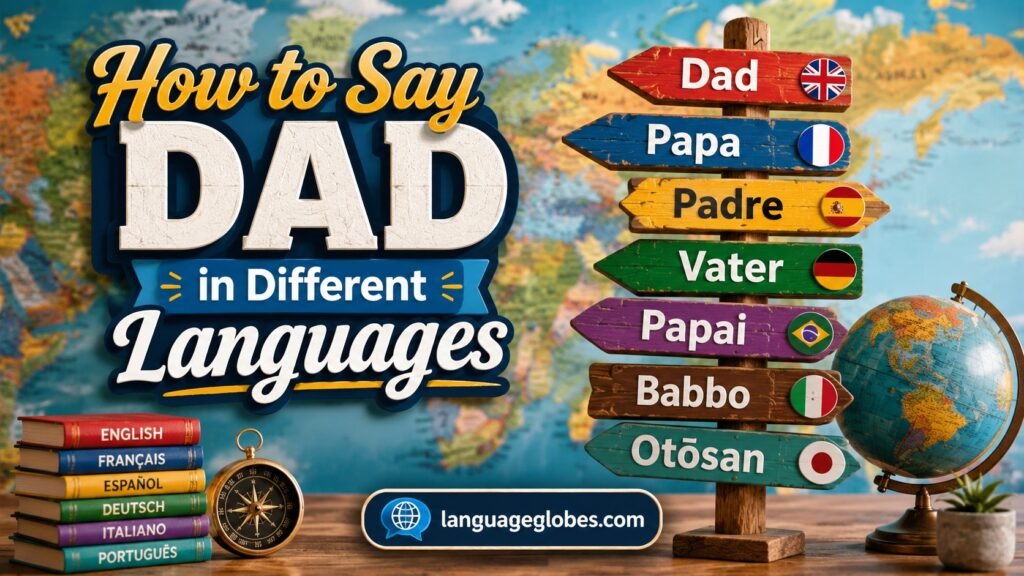
The word dad is a warm term of endearment expressing love, care, and respect. Across cultures and languages, families use meaningful words to show affection toward fathers.
From Papa and Baba to Papi and Abba, these words reflect family values. Learning their pronunciation also helps language learners understand traditions and cultural identity.
This guide explores diverse ways to say dad across different cultures and around the world. You will discover affectionate terms used by children, father figures, and families with multicultural roots.
Understanding these family-related words can help travelers communicate better while studying a new language. It also reveals how family bonds, social customs, and relationships shape everyday language.
Also Read This: How to Say Doodle in Different Languages
Interesting Facts About Dad
- The word “dad” is one of the earliest words many children learn to speak.
- Similar father-related words such as Papa, Baba, and Dada appear in many unrelated languages.
- Linguists believe simple sounds like “pa” and “ba” are common because they are easy for babies to pronounce.
- Many cultures use multiple words for father depending on formality and affection.
- Some languages have separate terms for father and dad, similar to “father” and “dad” in English.
- Family-related words are often among the most stable words in a language.
- The terms used for fathers often reflect cultural traditions and family values.
- Learning family vocabulary helps language learners communicate in everyday situations.
How to Say Dad in Different Languages
European Languages
Europe is home to hundreds of languages and dialects that reflect centuries of history and cultural diversity. While many European languages belong to the Indo-European family, each has developed unique ways of expressing family relationships. The word for dad often carries warmth, affection, and respect.
| Language | Country/Region | Translation | Pronunciation | Example Sentence |
| 🇺🇸 American English | USA | Dad | Dad | My dad is very kind. |
| 🇬🇧 British English | United Kingdom | Dad | Dad | My dad works in London. |
| 🇦🇺 Australian English | Australia | Dad | Dad | My dad loves cricket. |
| 🇫🇷 French | France | Papa | Pah-pah | Mon papa est gentil. |
| 🇪🇸 Spanish | Spain | Papá | Pah-pah | Mi papá es amable. |
| 🇵🇹 Portuguese | Portugal | Pai | Pie | Meu pai é forte. |
| 🇮🇹 Italian | Italy | Papà | Pah-pah | Mio papà è simpatico. |
| 🇩🇪 German | Germany | Papa | Pah-pah | Mein Papa ist nett. |
| 🇳🇱 Dutch | Netherlands | Papa | Pah-pah | Mijn papa is aardig. |
| 🇸🇪 Swedish | Sweden | Pappa | Pah-pah | Min pappa är snäll. |
| 🇳🇴 Norwegian | Norway | Pappa | Pah-pah | Min pappa er snill. |
| 🇩🇰 Danish | Denmark | Far | Far | Min far er venlig. |
| 🇫🇮 Finnish | Finland | Isä | Ee-sah | Isäni on mukava. |
| 🇮🇸 Icelandic | Iceland | Pabbi | Pahb-bee | Pabbi minn er góður. |
| 🇵🇱 Polish | Poland | Tata | Tah-tah | Mój tata jest miły. |
| 🇨🇿 Czech | Czech Republic | Táta | Tah-tah | Můj táta je hodný. |
| 🇸🇰 Slovak | Slovakia | Otec | Oh-tets | Môj otec je dobrý. |
| 🇭🇺 Hungarian | Hungary | Apa | Ah-pah | Az apám kedves. |
| 🇷🇴 Romanian | Romania | Tată | Tah-tuh | Tatăl meu este bun. |
| 🇬🇷 Greek | Greece | Μπαμπάς | Bahm-bas | Ο μπαμπάς μου είναι καλός. |
| 🇷🇺 Russian | Russia | Папа | Pah-pah | Мой папа добрый. |
| 🇺🇦 Ukrainian | Ukraine | Тато | Tah-to | Мій тато хороший. |
| 🇧🇬 Bulgarian | Bulgaria | Татко | Taht-ko | Моят татко е добър. |
| 🇷🇸 Serbian | Serbia | Tata | Tah-tah | Moj tata je dobar. |
| 🇭🇷 Croatian | Croatia | Tata | Tah-tah | Moj tata je dobar. |
| 🇸🇮 Slovenian | Slovenia | Očka | Och-ka | Moj očka je prijazen. |
Asian Languages
Asia is the world’s largest continent and contains thousands of languages spoken by billions of people. From East Asia to South Asia and Southeast Asia, family relationships hold great cultural importance. Words for dad often express deep respect and affection.
| Language | Country/Region | Translation | Pronunciation | Example Sentence |
| 🇨🇳 Chinese (Mandarin) | China | 爸爸 | Bah-bah | 我的爸爸很好。 |
| 🇯🇵 Japanese | Japan | お父さん | Oh-toh-san | 私のお父さんは優しいです。 |
| 🇰🇷 Korean | South Korea | 아빠 | Ah-ppa | 우리 아빠는 친절해요. |
| 🇮🇳 Hindi | India | पापा | Pah-pah | मेरे पापा अच्छे हैं। |
| 🇵🇰 Urdu | Pakistan | ابو | Abbu | میرے ابو بہت اچھے ہیں۔ |
| 🇧🇩 Bengali | Bangladesh | বাবা | Bah-bah | আমার বাবা ভালো। |
| 🇵🇰 Punjabi | Pakistan/India | پاپا | Pah-pah | میرے پاپا اچھے ہیں۔ |
| 🇮🇳 Gujarati | India | પપ્પા | Pahp-pah | મારા પપ્પા સારા છે. |
| 🇮🇳 Marathi | India | बाबा | Bah-bah | माझे बाबा चांगले आहेत. |
| 🇮🇳 Tamil | India | அப்பா | Ahp-pah | என் அப்பா நல்லவர். |
| 🇮🇳 Telugu | India | నాన్న | Nahn-nah | మా నాన్న మంచివారు. |
| 🇮🇳 Kannada | India | ಅಪ್ಪ | Ahp-pah | ನನ್ನ ಅಪ್ಪ ಒಳ್ಳೆಯವರು. |
| 🇮🇳 Malayalam | India | അച്ഛൻ | Ah-chan | എന്റെ അച്ഛൻ നല്ലവൻ ആണ്. |
| 🇳🇵 Nepali | Nepal | बुबा | Boo-bah | मेरा बुबा राम्रो हुनुहुन्छ। |
| 🇱🇰 Sinhala | Sri Lanka | තාත්තා | Thaath-tha | මගේ තාත්තා හොඳයි. |
| 🇹🇭 Thai | Thailand | พ่อ | Phor | พ่อของฉันใจดี |
| 🇻🇳 Vietnamese | Vietnam | Bố | Boh | Bố tôi rất tốt. |
| 🇰🇭 Khmer | Cambodia | ឪពុក | Ov-puk | ឪពុកខ្ញុំល្អណាស់។ |
| 🇱🇦 Lao | Laos | ພໍ່ | Por | ພໍ່ຂອງຂ້ອຍໃຈດີ. |
| 🇲🇲 Burmese | Myanmar | အဖေ | Ah-phay | အဖေက ကြင်နာတယ်။ |
| 🇲🇳 Mongolian | Mongolia | Аав | Aav | Миний аав сайн хүн. |
African Languages
Africa is home to extraordinary linguistic diversity, with more than 2,000 languages spoken across the continent. Family plays a central role in many African societies, and words for dad often reflect respect, community, and tradition.
| Language | Country/Region | Translation | Pronunciation | Example Sentence |
| 🇿🇦 Zulu | South Africa | Ubaba | Oo-bah-bah | Ubaba wami muhle. |
| 🇿🇦 Xhosa | South Africa | Tata | Tah-tah | Tata wam ulungile. |
| 🇰🇪 Swahili | East Africa | Baba | Bah-bah | Baba yangu ni mzuri. |
| 🇳🇬 Yoruba | Nigeria | Baba | Bah-bah | Baba mi dara. |
| 🇳🇬 Igbo | Nigeria | Nna | Nnah | Nna m dị mma. |
| 🇪🇹 Amharic | Ethiopia | አባት | Ah-baht | አባቴ ጥሩ ነው። |
| 🇸🇴 Somali | Somalia | Aabe | Ah-beh | Aabahay waa fiican yahay. |
| 🇷🇼 Kinyarwanda | Rwanda | Papa | Pah-pah | Papa wanjye ni mwiza. |
| 🇧🇼 Tswana | Botswana | Rra | Rrah | Rra o molemo. |
| 🇲🇼 Chichewa | Malawi | Bambo | Bahm-bo | Bambo anga ndi abwino. |
| 🇬🇭 Akan | Ghana | Agya | Ah-jah | Agya me ye pa. |
| 🇰🇪 Luo | Kenya | Wuon | Woo-on | Wuonwa ber. |
Middle Eastern Languages
The Middle East has a rich linguistic heritage shaped by ancient civilizations, religion, trade, and culture. Family values are deeply rooted throughout the region, and many languages have affectionate and respectful terms for dad.
| Language | Country/Region | Translation | Pronunciation | Example Sentence |
| 🇸🇦 Arabic | Middle East | أب / بابا | Ab / Baba | أبي رجل طيب. |
| 🇮🇷 Persian | Iran | بابا | Bah-bah | بابای من مهربان است. |
| 🇹🇷 Turkish | Turkey | Baba | Bah-bah | Babam çok iyi. |
| 🇮🇱 Hebrew | Israel | אבא | Ah-bah | אבא שלי נחמד. |
| 🇰🇼 Kurdish | Kurdistan Region | Bav | Bahv | Bavê min baş e. |
| 🇦🇲 Armenian | Armenia | Հայրիկ | Hay-rik | Հայրիկս բարի է։ |
| 🇬🇪 Georgian | Georgia | მამა | Mah-mah | მამაჩემი კარგია. |
| 🇦🇿 Azerbaijani | Azerbaijan | Ata | Ah-tah | Atam yaxşıdır. |
| 🇦🇫 Pashto | Afghanistan | پلار | Plar | زما پلار ښه دی. |
| 🇦🇫 Dari | Afghanistan | پدر | Pedar | پدرم مهربان است. |
Additional Languages Around the World
Languages from different regions demonstrate how universal the concept of fatherhood truly is. Although pronunciation and spelling vary, the love and respect associated with fathers remain similar everywhere.
| Language | Country/Region | Translation | Pronunciation | Example Sentence |
| 🇭🇹 Haitian Creole | Haiti | Papa | Pah-pah | Papa mwen bon anpil. |
| 🇵🇭 Filipino | Philippines | Tatay | Tah-tie | Mabait ang tatay ko. |
| 🇮🇩 Indonesian | Indonesia | Ayah | Ah-yah | Ayah saya baik. |
| 🇲🇾 Malay | Malaysia | Ayah | Ah-yah | Ayah saya baik. |
| 🇳🇿 Maori | New Zealand | Pāpā | Paa-paa | He tangata pai taku pāpā. |
| 🇼🇸 Samoan | Samoa | Tama | Tah-ma | E lelei lo’u tama. |
| 🇹🇴 Tongan | Tonga | Tamai | Tah-my | Ko hoku tamai lelei. |
| 🇫🇯 Fijian | Fiji | Tamaqu | Tah-ma-ngoo | E vinaka na tamaqu. |
| 🇬🇺 Chamorro | Guam | Tata | Tah-tah | Maolek i tata-hu. |
| 🇵🇬 Tok Pisin | Papua New Guinea | Papa | Pah-pah | Papa bilong mi em gutpela. |
| 🇮🇪 Irish | Ireland | Daidí | Dah-dee | Tá mo dhaidí cineálta. |
| 🏴 Welsh | Wales | Tad | Tad | Mae fy nhad yn garedig. |
FAQs
How do you say dad in different languages?
The word dad has many forms across languages and cultures. Common examples include Papa, Baba, Abba, and Papi, each reflecting family traditions and affection.
What are common words for dad around the world?
Common words for dad include Papa, Baba, Papi, Appa, and Otousan. These meaningful words often express love, care, and respect within families.
Why are words for dad different across cultures?
Different cultures develop unique family-related words based on traditions and social customs. These terms often reflect family values, relationships, and cultural identity.
What is the difference between Papa, Baba, Abba, and Papi?
Papa, Baba, Abba, and Papi are affectionate terms used in different languages. Their exact use and pronunciation vary according to regional traditions and family preferences.
How can I learn the pronunciation of dad in other languages?
Learning pronunciation is easier when you listen carefully and practice each word repeatedly. Language learners can also compare sounds while studying a new language.
How do children learn affectionate names for their fathers?
Children often learn affectionate terms naturally through family conversations and infant sounds. These familiar words become part of early vocabulary and emotional connections.
What does calling someone dad show about family bonds?
Calling someone dad can express love, care, protection, guidance, and strong family bonds. It can also show deep affection between children and their father figures.
How can learning dad in other languages help travelers?
Learning family-related words can help travelers communicate better when meeting people from different cultures. It also offers insight into local traditions and relationships.
Are there different ways to address your dad affectionately?
Yes, families often use sweet nicknames and terms of endearment when speaking to fathers. Words such as Daddy, Pops, and Pa can sound warm, casual, or playful.
Why is learning dad in different languages interesting?
Exploring diverse ways to say dad reveals how families express love across the worldwide community. It can also inspire curiosity about multicultural roots, traditions, and language.
Conclusion
Learning how to say dad in different languages reveals how cultures express love, care, and respect. Exploring Papa, Baba, Abba, and Papi shows the diverse ways families celebrate strong family bonds. These meaningful words also reflect traditions, family values, and cultural identity around the world. Whether studying languages or traveling, learning these terms can deepen appreciation for family and communication.

Lucy Carter is a curious mind and language lover who writes for Language Globes. She enjoys discovering new languages and sharing simple, helpful ideas that make learning fun and accessible for everyone.