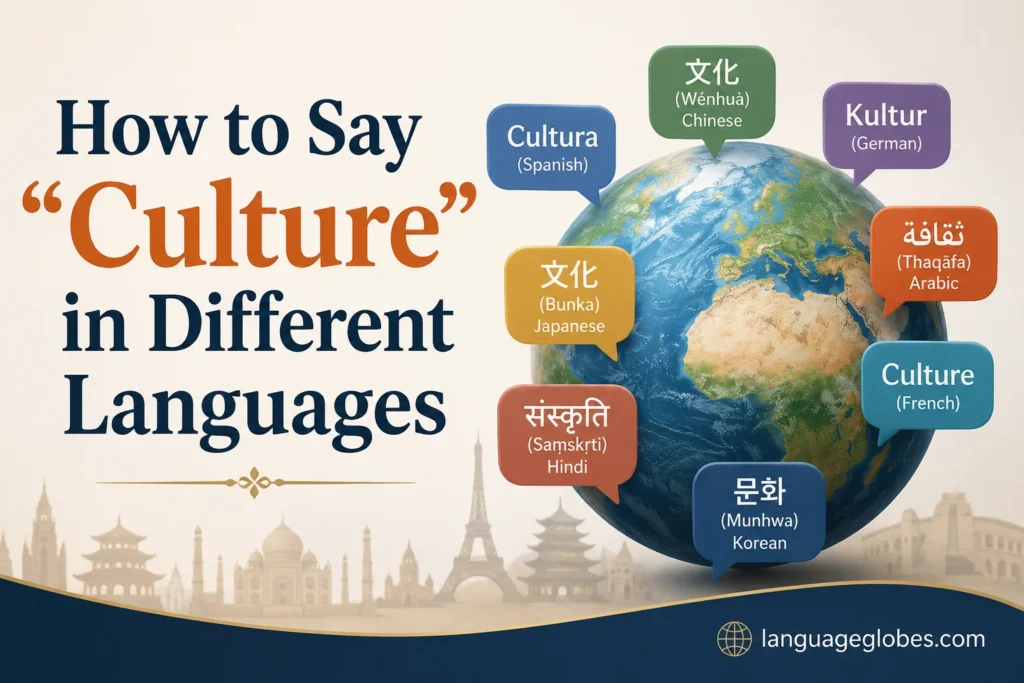
How to Say “Culture” in Different Languages helps people understand traditions, beliefs, arts, and global ways of life.
During my travels and daily conversations, I learned that culture is not just a simple term. It reflects customs, unique lifestyles, and values that define many communities and nations. Every society has its own identity, and learning different languages improves understanding between people. Many students, travelers, and language learners search for accurate translations and correct pronunciation because language is a powerful tool for connecting with the soul of another culture.
This topic is now widely searched worldwide as readers want to explore cultural identity in a more personal way. This guide shares 70 translations with practical examples that make learning more engaging. Culture encompasses many aspects of human life, including history, human values, and shared concepts that shape societies globally. By expressing ideas through language, people can appreciate diversity, develop empathy, and build bridges through better intercultural communication, creating richer and more meaningful experiences.
In my experience, studying languages is more valuable than simply memorizing vocabulary. It opens doors to stronger relationships, deeper respect, and understanding the beautiful yet complex nature of humanity. Whether someone enjoys global communication or discovering real-life experiences, these translations offer a natural and practical way to connect with the world.
Interesting Facts About “The Culture”
- The concept of “culture” varies greatly around the world, from Western emphasis on arts and literature to Eastern focus on traditions and family values.
- Languages often have unique words for culture that carry meanings not directly translatable to English.
- Expressing “culture” in different languages can reveal societal priorities, such as communal harmony, history, or innovation.
- Some cultures have multiple words for culture depending on context: art, lifestyle, traditions, or heritage.
European Languages
European languages are diverse, spanning Germanic, Romance, Slavic, and Celtic groups. Europe has been the birthplace of many philosophical, artistic, and political movements, which makes its cultural vocabulary rich and nuanced. Below is a guide to saying “the culture” in several European languages.
| Language | Country/Region | Translation | Pronunciation | Example Sentence |
| English (American) | 🇺🇸 United States | The culture | /ðə ˈkʌltʃər/ | Understanding the culture helps us appreciate traditions. |
| English (British) | 🇬🇧 United Kingdom | The culture | /ðə ˈkʌltʃər/ | Learning about the culture can enhance travel experiences. |
| English (Australian) | 🇦🇺 Australia | The culture | /ðə ˈkʌltʃər/ | The culture of Aboriginal communities is fascinating. |
| French | 🇫🇷 France | La culture | /la kyl.tyʁ/ | La culture française est riche en histoire et en art. |
| German | 🇩🇪 Germany | Die Kultur | /diː kʊlˈtuːɐ̯/ | Die Kultur Deutschlands umfasst Musik, Kunst und Traditionen. |
| Spanish | 🇪🇸 Spain | La cultura | /la kulˈtuɾa/ | La cultura española incluye fiestas y gastronomía. |
| Italian | 🇮🇹 Italy | La cultura | /la kulˈtuːra/ | La cultura italiana è famosa per la moda e l’arte. |
| Portuguese | 🇵🇹 Portugal | A cultura | /a kuɫˈtuɾɐ/ | A cultura portuguesa é conhecida pelo fado e arquitetura. |
| Dutch | 🇳🇱 Netherlands | De cultuur | /də kʏlˈtyːr/ | De cultuur in Nederland is sterk beïnvloed door handel. |
| Russian | 🇷🇺 Russia | Культура (Kultura) | /kulʲˈturə/ | Культура России имеет богатое литературное наследие. |
| Swedish | 🇸🇪 Sweden | Kulturen | /ˈkɵlːtʉːrɛn/ | Kulturen i Sverige betonar jämlikhet och traditioner. |
| Polish | 🇵🇱 Poland | Kultura | /kulˈtura/ | Kultura Polski jest bogata w muzykę i folklor. |
| Greek | 🇬🇷 Greece | Ο πολιτισμός (O politismós) | /o po.li.tiˈzmos/ | Ο πολιτισμός της Ελλάδας είναι αρχαίος και πλούσιος. |
| Irish | 🇮🇪 Ireland | An cultúr | /ən kulˈtuːr/ | An cultúr Éireannach tá saibhir i seanchas agus ceol. |
Asian Languages
Asia is the largest continent with incredibly diverse languages and traditions. From Chinese calligraphy to Indian classical music, the concept of culture in Asia carries deep historical and philosophical roots.
| Language | Country/Region | Translation | Pronunciation | Example Sentence |
| Chinese (Mandarin) | 🇨🇳 China | 文化 (Wénhuà) | /wən˧˥xwa˥˩/ | 中国的文化源远流长。 (China’s culture is long-standing.) |
| Japanese | 🇯🇵 Japan | 文化 (Bunka) | /bunka/ | 日本の文化は独自で美しいです。 (Japanese culture is unique and beautiful.) |
| Korean | 🇰🇷 South Korea | 문화 (Munhwa) | /munhwa/ | 한국의 문화는 전통과 현대가 조화를 이룹니다. (Korean culture blends tradition and modernity.) |
| Hindi | 🇮🇳 India | संस्कृति (Sanskriti) | /sʌnsˈkriti/ | भारतीय संस्कृति विविध और रंगीन है। (Indian culture is diverse and colorful.) |
| Arabic (Gulf) | 🇸🇦 Saudi Arabia | الثقافة (Al-Thaqafah) | /al-θaqaːfah/ | الثقافة العربية غنية بالتاريخ والفن. (Arab culture is rich in history and art.) |
| Thai | 🇹🇭 Thailand | วัฒนธรรม (Watthanatham) | /wát-tá-ná-tʰam/ | วัฒนธรรมไทยมีความหลากหลายและงดงาม. (Thai culture is diverse and beautiful.) |
| Vietnamese | 🇻🇳 Vietnam | Văn hóa | /van hwa/ | Văn hóa Việt Nam phong phú và đặc sắc. (Vietnamese culture is rich and unique.) |
| Bengali | 🇧🇩 Bangladesh | সংস্কৃতি (Shôngskriti) | /ʃɔŋskriti/ | বাংলাদেশে সংস্কৃতি বৈচিত্র্যপূর্ণ। (Bangladeshi culture is diverse.) |
| Indonesian | 🇮🇩 Indonesia | Budaya | /buˈda.ja/ | Budaya Indonesia mencakup tarian dan musik tradisional. (Indonesian culture includes traditional dance and music.) |
| Filipino | 🇵🇭 Philippines | Kultura | /kulˈtu.ra/ | Ang kultura ng Pilipinas ay masigla at makulay. (Filipino culture is vibrant and colorful.) |
Read More: How to Say “Celery” in Different Languages
African Languages
Africa is home to thousands of languages and rich cultural traditions, from storytelling to music and dance. Each language provides a unique lens to view the continent’s heritage.
| Language | Country/Region | Translation | Pronunciation | Example Sentence |
| Swahili | 🇰🇪 Kenya | Utamaduni | /uta-ma-du-ni/ | Utamaduni wa Kenya unajumuisha michezo na muziki. (Kenyan culture includes games and music.) |
| Zulu | 🇿🇦 South Africa | Isiko | /iˈsiːko/ | Isiko lamaZulu lihlonipha amasiko nezinsizwa. (Zulu culture respects traditions and youths.) |
| Hausa | 🇳🇬 Nigeria | Al’adu | /alˈadu/ | Al’adu na Hausawa suna da tarihi mai tsawo. (Hausa culture has a long history.) |
| Amharic | 🇪🇹 Ethiopia | ባህላዊ (Bahilawi) | /baˈhɨlawi/ | ባህላዊ ትምህርቶች ኢትዮጵያን ይወክላሉ. (Traditional practices reflect Ethiopian culture.) |
| Yoruba | 🇳🇬 Nigeria | Asa | /ˈa.sa/ | Asa Yoruba jẹ ọlọrọ pẹlu orin ati ijó. (Yoruba culture is rich with music and dance.) |
| Arabic (North Africa) | 🇪🇬 Egypt | الثقافة (Al-Thaqafah) | /al-θaqaːfah/ | الثقافة المصرية غنية بالتاريخ والفن. (Egyptian culture is rich in history and art.) |
Middle Eastern Languages
The Middle East has a rich tapestry of languages and cultures shaped by history, religion, and trade. Expressions of culture in these languages often reflect deep historical roots.
| Language | Country/Region | Translation | Pronunciation | Example Sentence |
| Arabic (Levant) | 🇱🇧 Lebanon | الثقافة (Al-Thaqafah) | /al-θaqaːfah/ | الثقافة اللبنانية متنوعة وثرية. (Lebanese culture is diverse and rich.) |
| Hebrew | 🇮🇱 Israel | תרבות (Tarbut) | /tarˈbut/ | התרבות הישראלית כוללת מסורות וחדשנות. (Israeli culture includes traditions and innovation.) |
| Persian (Farsi) | 🇮🇷 Iran | فرهنگ (Farhang) | /farˈhɑːŋ/ | فرهنگ ایرانی شامل شعر و هنر است. (Iranian culture includes poetry and art.) |
| Turkish | 🇹🇷 Turkey | Kültür | /kylˈtyr/ | Türkiye’nin kültürü tarih ve sanatı birleştirir. (Turkey’s culture combines history and art.) |
| Kurdish | 🇹🇯 Iraq/Iran | Çanda | /ʧan.da/ | Çanda Kurdîya di huner û muzîkê de xweş e. (Kurdish culture is rich in art and music.) |
FAQs
1. What does the word “culture” mean?
Culture refers to the traditions, beliefs, arts, customs, and lifestyles shared by a group of people or society.
2. Why should I learn how to say “culture” in different languages?
Learning the word in different languages improves communication, cultural understanding, and global awareness.
3. How many translations of “culture” are included in this guide?
This guide includes 70 translations of the word “culture” from languages around the world.
4. Who can benefit from learning cultural vocabulary?
Students, travelers, researchers, and language learners can all benefit from learning cultural terms.
5. Why is pronunciation important when learning new words?
Correct pronunciation helps people speak clearly and communicate more confidently with native speakers.
6. How does language help connect different societies?
Language creates understanding, builds empathy, and helps people appreciate different traditions and ways of life.
7. Can learning cultural words improve travel experiences?
Yes, knowing local cultural terms can make travel more meaningful and help create better connections with local communities.
8. What role does culture play in human life?
Culture shapes identity, values, history, behavior, and the daily lives of people across the globe.
9. Is culture the same in every country?
No, every nation and community has unique customs, beliefs, arts, and traditions that make its culture different.
10. How can I practice culture-related words in different languages?
You can practice through conversations, language apps, pronunciation guides, and real-life examples from native speakers.
Conclusion
Exploring how to say “the culture” in different languages is more than a linguistic exercise—it’s a journey into the heart of humanity. By understanding these words and their contexts, we gain insight into the values, traditions, and creativity of diverse societies. Learning and respecting different cultural expressions fosters empathy, enriches personal growth, and strengthens global connections.
Embrace the beauty of languages and let culture guide your journey toward a more in

Joshua Lewis is a passionate language enthusiast and content creator at LanguageGlobes.com. He specializes in exploring global languages, cultures, and communication trends, helping readers connect with the world through words.