
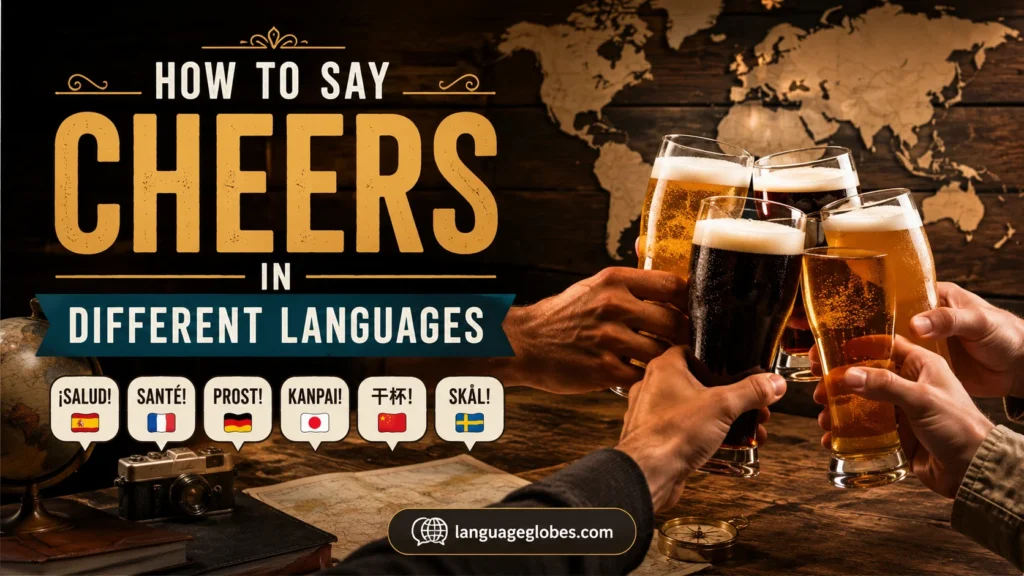
Whether you are traveling abroad or joining international celebrations, learning cheers in different languages adds meaning to every celebration. A simple way to say cheers can create lasting cultural connections and encourage genuine friendship. These multilingual expressions reflect unique traditions, social customs, and values shared across world cultures.
From raising a glass during a Champagne toast to offering good wishes at community gatherings, every phrase carries significance. Understanding a toast in different languages helps travelers, students, language learners, and culture enthusiasts communicate with greater confidence. It also promotes cultural appreciation, cultural understanding, and meaningful social interaction during memorable moments.
Across global languages, a cheers translation often expresses good health, happiness, togetherness, and unity, making it a powerful universal gesture. This guide explores world languages, authentic local expressions, accurate pronunciations, and practical example sentences for various celebratory phrases. You will discover toast traditions, celebration customs, and drinking customs used in European dinners, Asian celebrations, and diverse African cultures.
Whether sharing a New Year toast, raising a toast among friends and loved ones, or participating in a celebratory event, these phrases enrich shared experiences. Learning the local version of cheers supports worldwide hospitality, encourages cultural exchange, and strengthens social bonding through a spirit of global togetherness. Every native language toast highlights cultural heritage, spreads positivity, and contributes to a memorable universal celebration filled with shared joy.
Also read this: How to Say Creative in Different Languages
Interesting Facts About Cheers
- The English word “Cheers” originally meant “face” or “expression of joy.”
- In many countries, it is considered polite to make eye contact during a toast.
- Some cultures believe failing to toast properly brings bad luck.
- In Germany, people often say “Prost!” while clinking glasses firmly.
- In Japan, saying “Kanpai!” is an essential part of social dining culture.
- In Spain and Latin America, “Salud!” literally means “health.”
- French speakers commonly say “Santé!” which also means “health.”
- In several Slavic cultures, toasts are often long and emotional speeches.
- Australians frequently use “Cheers” casually as a way to say “thanks.”
- In many African cultures, communal drinking traditions symbolize unity and friendship.
European Languages
Europe is home to hundreds of languages and rich cultural traditions. Celebratory expressions are deeply rooted in European social customs, especially during meals, weddings, and festivals. Many European toast expressions focus on health, happiness, and friendship.
| Language | Country/Region | Translation | Pronunciation | Example Sentence |
| 🇺🇸 American English | USA | Cheers | Cheerz | Cheers to our success! |
| 🇬🇧 British English | United Kingdom | Cheers | Cheerz | Cheers, mate! |
| 🇦🇺 Australian English | Australia | Cheers | Cheerz | Cheers for helping me. |
| 🇫🇷 French | France | Santé | Sahn-tay | Santé à tous! |
| 🇪🇸 Spanish | Spain | Salud | Sah-lud | ¡Salud amigos! |
| 🇮🇹 Italian | Italy | Cin cin | Chin chin | Cin cin a tutti! |
| 🇩🇪 German | Germany | Prost | Prohst | Prost, meine Freunde! |
| 🇵🇹 Portuguese | Portugal | Saúde | Sah-oo-jee | Saúde para todos! |
| 🇳🇱 Dutch | Netherlands | Proost | Prohst | Proost iedereen! |
| 🇸🇪 Swedish | Sweden | Skål | Skoal | Skål för vänskap! |
| 🇳🇴 Norwegian | Norway | Skål | Skoal | Skål alle sammen! |
| 🇩🇰 Danish | Denmark | Skål | Skoal | Skål venner! |
| 🇫🇮 Finnish | Finland | Kippis | Kip-pis | Kippis ystävät! |
| 🇵🇱 Polish | Poland | Na zdrowie | Nah zdroh-vyeh | Na zdrowie wszystkim! |
| 🇨🇿 Czech | Czech Republic | Na zdraví | Nah zdrah-vee | Na zdraví přátelé! |
| 🇸🇰 Slovak | Slovakia | Na zdravie | Nah zdrah-vyeh | Na zdravie! |
| 🇭🇺 Hungarian | Hungary | Egészségedre | Eh-gay-sheg-ed-reh | Egészségedre barátom! |
| 🇷🇴 Romanian | Romania | Noroc | No-rock | Noroc tuturor! |
| 🇬🇷 Greek | Greece | Yamas | Yah-mahs | Yamas φίλοι! |
| 🇷🇺 Russian | Russia | Za zdorovye | Zah zda-rohv-yeh | За здоровье! |
| 🇺🇦 Ukrainian | Ukraine | Budmo | Bood-mo | Будьмо друзі! |
| 🇧🇬 Bulgarian | Bulgaria | Nazdrave | Naz-drah-veh | Наздраве приятели! |
| 🇷🇸 Serbian | Serbia | Živeli | Zhee-veh-lee | Živeli svima! |
| 🇭🇷 Croatian | Croatia | Živjeli | Zheev-yeh-lee | Živjeli prijatelji! |
| 🇸🇮 Slovenian | Slovenia | Na zdravje | Nah zdrah-vyeh | Na zdravje! |
| 🇱🇹 Lithuanian | Lithuania | Į sveikatą | Ee sveh-kata | Į sveikatą draugai! |
| 🇱🇻 Latvian | Latvia | Priekā | Pree-eh-kah | Priekā visiem! |
| 🇪🇪 Estonian | Estonia | Terviseks | Ter-vi-seks | Terviseks sõbrad! |
| 🇮🇸 Icelandic | Iceland | Skál | Skaul | Skál allir! |
| 🇮🇪 Irish | Ireland | Sláinte | Slawn-cha | Sláinte! |
| 🇦🇱 Albanian | Albania | Gëzuar | Geh-zoo-ar | Gëzuar miq! |
Asian Languages
Asia contains an extraordinary diversity of languages, cultures, and traditions. Toasting customs vary widely across the continent, from formal ceremonial drinking traditions in East Asia to warm communal celebrations in South Asia and Southeast Asia.
| Language | Country/Region | Translation | Pronunciation | Example Sentence |
| 🇨🇳 Chinese (Mandarin) | China | 干杯 | Gan-bay | 干杯朋友们! |
| 🇯🇵 Japanese | Japan | 乾杯 | Kan-pie | 乾杯しましょう! |
| 🇰🇷 Korean | South Korea | 건배 | Gun-bae | 건배 합시다! |
| 🇮🇳 Hindi | India | चीयर्स | Cheers | चीयर्स दोस्तों! |
| 🇧🇩 Bengali | Bangladesh | চিয়ার্স | Cheers | চিয়ার্স বন্ধুরা! |
| 🇵🇰 Urdu | Pakistan | چیئرز | Cheers | چیئرز دوستو! |
| 🇹🇷 Turkish | Turkey | Şerefe | Sheh-reh-feh | Şerefe arkadaşlar! |
| 🇹🇭 Thai | Thailand | ชนแก้ว | Chon gaew | ชนแก้วครับ! |
| 🇻🇳 Vietnamese | Vietnam | Chúc mừng | Chook mung | Chúc mừng mọi người! |
| 🇮🇩 Indonesian | Indonesia | Bersulang | Ber-soo-lang | Bersulang bersama! |
| 🇲🇾 Malay | Malaysia | Sorak | So-rak | Sorak semua! |
| 🇵🇭 Filipino | Philippines | Tagay | Tah-guy | Tagay tayo! |
| 🇳🇵 Nepali | Nepal | चियर्स | Cheers | चियर्स साथीहरू! |
| 🇱🇰 Sinhala | Sri Lanka | චියර්ස් | Cheers | චියර්ස් යාළුවෝ! |
| 🇲🇳 Mongolian | Mongolia | Төлөө | Tuh-loh | Төлөө найзууд аа! |
| 🇰🇭 Khmer | Cambodia | ជល់មួយ | Joul muoy | ជល់មួយ! |
| 🇱🇦 Lao | Laos | ຊົນແກ້ວ | Son gaew | ຊົນແກ້ວ! |
| 🇲🇲 Burmese | Myanmar | Cheers | Cheerz | Cheers ပါ! |
| 🇬🇪 Georgian | Georgia | გაუმარჯოს | Gah-oo-mar-jos | გაუმარჯოს მეგობრებს! |
| 🇦🇲 Armenian | Armenia | Կենաց | Keh-nats | Կենաց բոլորին! |
African Languages
Africa is linguistically one of the richest continents in the world, with thousands of languages spoken across diverse communities. Celebrations often emphasize family, hospitality, and togetherness, making toast expressions an important part of social gatherings.
| Language | Country/Region | Translation | Pronunciation | Example Sentence |
| 🇿🇦 Zulu | South Africa | Impilo | Im-pee-lo | Impilo bangani! |
| 🇿🇦 Xhosa | South Africa | Impilo | Im-pee-lo | Impilo kuni! |
| 🇰🇪 Swahili | East Africa | Maisha | My-ee-sha | Maisha marafiki! |
| 🇪🇹 Amharic | Ethiopia | ጤና ይስጥልኝ | Tehna yistilign | ጤና ይስጥልኝ! |
| 🇳🇬 Yoruba | Nigeria | Yọ̀ò | Yoh-oh | Yọ̀ò ọrẹ mi! |
| 🇳🇬 Igbo | Nigeria | Ndu | N-doo | Ndu diri unu! |
| 🇸🇴 Somali | Somalia | Farxad | Far-had | Farxad saaxiibayaal! |
| 🇲🇦 Berber | North Africa | Tanemmirt | Ta-neh-mirt | Tanemmirt! |
| 🇲🇬 Malagasy | Madagascar | Arahaba | Ah-ra-ha-ba | Arahaba ry namana! |
| 🇷🇼 Kinyarwanda | Rwanda | Ubuzima | Oo-boo-zee-ma | Ubuzima bwiza! |
| 🇧🇼 Tswana | Botswana | Botshelo | Bot-sheh-lo | Botshelo! |
| 🇿🇼 Shona | Zimbabwe | Makorokoto | Mah-koh-roh-koh-toh | Makorokoto shamwari! |
| 🇲🇼 Chichewa | Malawi | Moyo | Moy-oh | Moyo wabwino! |
| 🇸🇩 Sudanese Arabic | Sudan | في صحتك | Fi sihtak | في صحتك يا صديقي! |
| 🇪🇷 Tigrinya | Eritrea | ንጥዕና | Nti-ena | ንጥዕና! |
Middle Eastern Languages
The Middle East has a long history of hospitality, poetry, and ceremonial gatherings. Toasting traditions may differ depending on religious and cultural practices, but expressions wishing health, peace, and happiness are common across the region.
| Language | Country/Region | Translation | Pronunciation | Example Sentence |
| 🇸🇦 Arabic | Middle East | في صحتك | Fi sih-ha-tak | في صحتك يا صديقي! |
| 🇮🇷 Persian (Farsi) | Iran | به سلامتی | Beh sa-la-ma-ti | به سلامتی دوستان! |
| 🇮🇱 Hebrew | Israel | לחיים | Le-chaim | לחיים חברים! |
| 🇰🇷 Kurdish | Kurdistan Region | Serkeftin | Ser-kef-tin | Serkeftin hevalno! |
| 🇦🇫 Pashto | Afghanistan | په صحت مو | Pa sehat mo | په صحت مو دوستانو! |
| 🇦🇫 Dari | Afghanistan | به سلامتی | Beh salamati | به سلامتی! |
| 🇴🇲 Omani Arabic | Oman | بصحتك | Be-seh-ha-tek | بصحتك! |
| 🇶🇦 Qatari Arabic | Qatar | في صحتكم | Fi sihtkum | في صحتكم جميعاً! |
| 🇦🇪 Emirati Arabic | UAE | بالعافية | Bil-afiyah | بالعافية يا شباب! |
| 🇱🇧 Lebanese Arabic | Lebanon | كاسك | Kassak | كاسك يا صديقي! |
More Languages Around the World
To make this guide even more comprehensive, here are additional languages and regional variations used across the globe.
| Language | Country/Region | Translation | Pronunciation | Example Sentence |
| 🇧🇷 Brazilian Portuguese | Brazil | Saúde | Sah-oo-jee | Saúde amigos! |
| 🇲🇽 Mexican Spanish | Mexico | Salud | Sah-lud | ¡Salud amigos! |
| 🇨🇦 French Canadian | Canada | Santé | Sahn-tay | Santé tout le monde! |
| 🇨🇭 Swiss German | Switzerland | Prost | Prohst | Prost miteinander! |
| 🇧🇪 Flemish | Belgium | Schol | Skhol | Schol iedereen! |
| 🇱🇺 Luxembourgish | Luxembourg | Prost | Prohst | Prost alleguer! |
| 🇲🇹 Maltese | Malta | Saħħa | Sah-ha | Saħħa lil kulħadd! |
| 🇮🇳 Tamil | India | வாழ்த்துகள் | Vaal-thu-kal | வாழ்த்துகள் நண்பர்களே! |
| 🇮🇳 Telugu | India | చీర్స్ | Cheers | చీర్స్ స్నేహితులారా! |
| 🇮🇳 Punjabi | India/Pakistan | ਚੀਅਰਜ਼ | Cheers | ਚੀਅਰਜ਼ ਦੋਸਤੋ! |
| 🇮🇳 Gujarati | India | ચીયર્સ | Cheers | ચીયર્સ મિત્રો! |
| 🇮🇳 Marathi | India | चीयर्स | Cheers | चीयर्स मित्रांनो! |
| 🇮🇳 Kannada | India | ಚಿಯರ್ಸ್ | Cheers | ಚಿಯರ್ಸ್ ಸ್ನೇಹಿತರೇ! |
| 🇮🇳 Malayalam | India | ചിയേഴ്സ് | Cheers | ചിയേഴ്സ് സുഹൃത്തുക്കളേ! |
| 🇳🇿 Māori | New Zealand | Kia ora | Kee-ah or-ah | Kia ora koutou! |
| 🇭🇹 Haitian Creole | Haiti | Santé | Sahn-tay | Santé zanmi yo! |
| 🇬🇭 Akan | Ghana | Nkwa | N-kwah | Nkwa pa! |
| 🇨🇲 Hausa | West Africa | Lafiya | Lah-fee-ya | Lafiya abokai! |
| 🇵🇬 Tok Pisin | Papua New Guinea | Cheers | Cheerz | Cheers olgeta! |
| 🇫🇯 Fijian | Fiji | Bula | Boo-lah | Bula everyone! |
Cultural Etiquette When Saying Cheers
Make Eye Contact
In countries like Germany, Austria, and France, making eye contact during a toast is considered respectful and sincere.
Wait for Everyone
In Japan and Korea, it is polite to wait until everyone has a drink before saying the toast.
Use the Right Hand
In some Middle Eastern and African cultures, offering drinks with the right hand is a sign of respect.
Respect Local Customs
Certain cultures may avoid alcohol due to religious traditions, but celebratory phrases can still be used with tea, juice, or other beverages.
Learn Proper Pronunciation
Native speakers appreciate when visitors try to pronounce local phrases correctly, even if imperfectly.
Why Learning “Cheers” in Different Languages Matters
Learning expressions from different languages helps improve communication and cultural understanding. Even a small phrase like “Cheers” can:
- Build friendships while traveling
- Show cultural respect
- Improve language-learning confidence
- Create memorable social experiences
- Help people connect during celebrations
- Encourage appreciation for global diversity
Simple words often carry deep cultural significance and emotional warmth.
FAQs
What does saying cheers in different languages mean?
Cheers in different languages represents a universal gesture of good health, happiness, and togetherness. These multilingual expressions are commonly used during celebration, social gatherings, and community gatherings to share good wishes and strengthen friendship.
Why should travelers learn how to say cheers in different languages?
Learning how to say cheers helps travelers, students, and language learners build meaningful cultural connections. It encourages cultural appreciation, improves social interaction, and creates memorable experiences through authentic local expressions and regional greetings.
How do toast traditions vary across world cultures?
Different toast traditions reflect unique cultural traditions, beliefs and customs, and drinking customs across world cultures. From European dinners and Asian celebrations to diverse African cultures, each native language toast highlights local values and cultural heritage.
What is the purpose of a celebratory toast?
A celebratory toast is a joyful expression used while raising a glass or raising a toast during a celebratory event. It conveys health wishes, wishing happiness, and wishing good health for friends, loved ones, and everyone sharing the occasion.
How can learning cheers translations improve cultural understanding?
Understanding a cheers translation provides valuable cultural insights into global languages and worldwide customs. It promotes cultural exchange, supports global togetherness, and helps people connect with others through shared experiences, shared joy, and worldwide hospitality.
Conclusion
Whether you want to say cheers while traveling or understand cheers in different languages, these multilingual expressions help create stronger cultural connections and meaningful social interaction. Learning a toast in different languages promotes cultural appreciation, cultural understanding, and respect for diverse world cultures and cultural traditions. From raising a glass during celebration to sharing good wishes, good health, and happiness, every native language toast reflects a unique cultural heritage. By embracing these local expressions and toast traditions, you can enjoy richer shared experiences, encourage global togetherness, and celebrate the spirit of unity, friendship, and worldwide hospitality.

Joshua Lewis is a passionate language enthusiast and content creator at LanguageGlobes.com. He specializes in exploring global languages, cultures, and communication trends, helping readers connect with the world through words.