
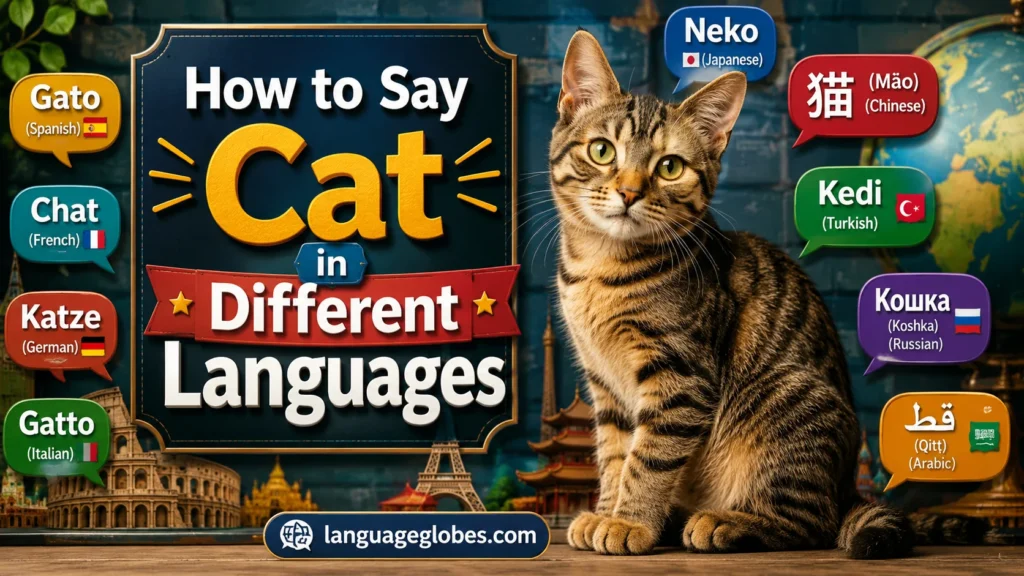
Cats have captured human hearts for millennia with their mysterious allure and playful demeanor. From ancient Egypt, where they were revered as divine creatures, to the internet age of viral sensations, they remain a universal favorite. Learning the word cat in different languages offers a fascinating linguistic journey through cultures, traditions, and everyday expressions.
Whether you enjoy language learning, travel internationally, or simply adore feline friends, this topic is both fun and educational. These enigmatic creatures appear throughout history, folklore, religion, and everyday life across the world. Their independence, intelligence, and playful behavior have created a strong bond with humans everywhere.
This comprehensive guide explores how to say cat in 70 languages while highlighting global adoration for these beloved pets. Designed for language learners, travelers, students, and animal lovers, it supports better communication when interacting across the globe. You will discover useful translation examples, pronunciations, example sentences, and interesting facts from Europe, Asia, Africa, and the Middle East.
Understanding animal names in another language can strengthen cultural understanding and expand your vocabulary naturally. The article also connects ancient civilizations with modern societies, showing how a pet cat remains recognized worldwide. Whether your English first language is English or you hope to learn languages, this resource provides a simple and useful reference.
Also read this: How to Say Dog in Different Languages
Interesting Facts About Cat
- Cats have been companions to humans for thousands of years.
- Ancient Egyptians considered cats sacred animals.
- A group of kittens is called a kindle.
- Cats can make over 100 different vocal sounds.
- Domestic cats are found on every continent except Antarctica.
- Many cultures associate cats with good luck and protection.
- Cats are among the most popular household pets worldwide.
- The scientific name for the domestic cat is Felis catus.
- Different languages often have unique words and sounds for cats.
- Cats appear in folklore, literature, art, and mythology across many cultures.
How to Say Cat in Different Languages
The word “cat” changes from one language to another, but its importance remains the same. Below, you’ll find translations organized by language regions to make learning easier and more enjoyable.
European Languages
Europe is home to hundreds of languages and rich cultural traditions. Many European languages belong to the Indo-European language family, although there are unique exceptions such as Finnish and Hungarian. Cats have long been part of European homes, stories, and folklore, making their names familiar and widely used.
| Language | Country/Region | Translation | Pronunciation | Example Sentence |
| 🇺🇸 American English | USA | Cat | Kat | The cat is sleeping. |
| 🇬🇧 British English | UK | Cat | Kat | The cat is sleeping in the garden. |
| 🇦🇺 Australian English | Australia | Cat | Kat | My cat loves sunny afternoons. |
| Spanish | 🇪🇸 Spain | Gato | GAH-toh | El gato duerme. |
| Portuguese | 🇵🇹 Portugal | Gato | GAH-too | O gato é bonito. |
| French | 🇫🇷 France | Chat | Shah | Le chat dort. |
| Italian | 🇮🇹 Italy | Gatto | GAHT-toh | Il gatto è nero. |
| German | 🇩🇪 Germany | Katze | KAT-suh | Die Katze schläft. |
| Dutch | 🇳🇱 Netherlands | Kat | Kaht | De kat slaapt. |
| Swedish | 🇸🇪 Sweden | Katt | Kaht | Katten sover. |
| Norwegian | 🇳🇴 Norway | Katt | Kaht | Katten sover. |
| Danish | 🇩🇰 Denmark | Kat | Kaht | Katten sover. |
| Finnish | 🇫🇮 Finland | Kissa | KEE-sah | Kissa nukkuu. |
| Icelandic | 🇮🇸 Iceland | Köttur | KET-tur | Kötturinn sefur. |
| Polish | 🇵🇱 Poland | Kot | Kot | Kot śpi. |
| Czech | 🇨🇿 Czech Republic | Kočka | KOCH-kah | Kočka spí. |
| Slovak | 🇸🇰 Slovakia | Mačka | MACH-kah | Mačka spí. |
| Hungarian | 🇭🇺 Hungary | Macska | MOCH-kah | A macska alszik. |
| Romanian | 🇷🇴 Romania | Pisică | Pee-SEE-kuh | Pisica doarme. |
| Bulgarian | 🇧🇬 Bulgaria | Котка | KOT-kah | Котката спи. |
| Serbian | 🇷🇸 Serbia | Mačka | MACH-kah | Mačka spava. |
| Croatian | 🇭🇷 Croatia | Mačka | MACH-kah | Mačka spava. |
| Slovenian | 🇸🇮 Slovenia | Mačka | MACH-kah | Mačka spi. |
| Greek | 🇬🇷 Greece | Γάτα | GHA-ta | Η γάτα κοιμάται. |
| Russian | 🇷🇺 Russia | Кошка | KOSH-kah | Кошка спит. |
| Ukrainian | 🇺🇦 Ukraine | Кіт | Keet | Кіт спить. |
| Belarusian | 🇧🇾 Belarus | Кот | Kot | Кот спіць. |
| Lithuanian | 🇱🇹 Lithuania | Katė | KAH-teh | Katė miega. |
| Latvian | 🇱🇻 Latvia | Kaķis | KAH-chis | Kaķis guļ. |
| Estonian | 🇪🇪 Estonia | Kass | Kahss | Kass magab. |
| Irish | 🇮🇪 Ireland | Cat | Kat | Tá an cat ina chodladh. |
| Welsh | 🏴 Wales | Cath | Kath | Mae’r gath yn cysgu. |
Asian Languages
Asia is the largest continent and contains thousands of languages spoken by billions of people. From East Asia to South Asia and Southeast Asia, cats are common companions and cultural symbols. Learning these translations provides insight into some of the world’s most widely spoken languages.
| Language | Country/Region | Translation | Pronunciation | Example Sentence |
| Chinese (Mandarin) | 🇨🇳 China | 猫 | Mao | 猫在睡觉。 |
| Japanese | 🇯🇵 Japan | 猫 | Ne-ko | 猫が寝ています。 |
| Korean | 🇰🇷 South Korea | 고양이 | Go-yang-ee | 고양이가 자고 있어요. |
| Hindi | 🇮🇳 India | बिल्ली | Bil-lee | बिल्ली सो रही है। |
| Urdu | 🇵🇰 Pakistan | بلی | Bil-li | بلی سو رہی ہے۔ |
| Bengali | 🇧🇩 Bangladesh | বিড়াল | Bee-ral | বিড়াল ঘুমাচ্ছে। |
| Punjabi | 🇮🇳🇵🇰 Punjab | ਬਿੱਲੀ | Bil-lee | ਬਿੱਲੀ ਸੌ ਰਹੀ ਹੈ। |
| Gujarati | 🇮🇳 India | બિલાડી | Bih-la-dee | બિલાડી સૂઈ રહી છે. |
| Marathi | 🇮🇳 India | मांजर | Man-jar | मांजर झोपले आहे. |
| Tamil | 🇮🇳 Sri Lanka/India | பூனை | Poo-nai | பூனை தூங்குகிறது. |
| Telugu | 🇮🇳 India | పిల్లి | Pil-lee | పిల్లి నిద్రపోతోంది. |
| Kannada | 🇮🇳 India | ಬೆಕ್ಕು | Bek-ku | ಬೆಕ್ಕು ಮಲಗಿದೆ. |
| Malayalam | 🇮🇳 India | പൂച്ച | Poo-cha | പൂച്ച ഉറങ്ങുന്നു. |
| Sinhala | 🇱🇰 Sri Lanka | පූසා | Poo-saa | පූසා නිදාගෙන සිටී. |
| Nepali | 🇳🇵 Nepal | बिरालो | Bee-raa-lo | बिरालो सुतिरहेको छ। |
| Thai | 🇹🇭 Thailand | แมว | Maew | แมวกำลังนอน. |
| Vietnamese | 🇻🇳 Vietnam | Mèo | Meow | Con mèo đang ngủ. |
| Indonesian | 🇮🇩 Indonesia | Kucing | Koo-ching | Kucing sedang tidur. |
| Malay | 🇲🇾 Malaysia | Kucing | Koo-ching | Kucing itu tidur. |
| Filipino | 🇵🇭 Philippines | Pusa | Poo-sah | Natutulog ang pusa. |
| Khmer | 🇰🇭 Cambodia | ឆ្មា | Chma | ឆ្មាកំពុងដេក។ |
| Lao | 🇱🇦 Laos | ແມວ | Maew | ແມວນອນຢູ່. |
| Burmese | 🇲🇲 Myanmar | ကြောင် | Kyoun | ကြောင်အိပ်နေသည်။ |
| Mongolian | 🇲🇳 Mongolia | Муур | Moor | Муур унтаж байна. |
African Languages
Africa is home to incredible linguistic diversity, with more than 2,000 languages spoken across the continent. Cats are familiar animals in many African communities and cities. The translations below represent several major African languages from different regions.
| Language | Country/Region | Translation | Pronunciation | Example Sentence |
| Swahili | 🇹🇿 🇰🇪 East Africa | Paka | PAH-kah | Paka amelala. |
| Zulu | 🇿🇦 South Africa | Ikati | Ee-KAH-tee | Ikati lilele. |
| Xhosa | 🇿🇦 South Africa | Ikati | Ee-KAH-tee | Ikati lilele. |
| Afrikaans | 🇿🇦 South Africa | Kat | Kaht | Die kat slaap. |
| Somali | 🇸🇴 Somalia | Bisad | Bee-sad | Bisaddu way seexataa. |
| Amharic | 🇪🇹 Ethiopia | ድመት | Dee-met | ድመት ተኝታለች። |
| Yoruba | 🇳🇬 Nigeria | Ologbo | Oh-log-bo | Ologbo naa sun. |
| Igbo | 🇳🇬 Nigeria | Nwamba | Nwam-bah | Nwamba na-arahụ ụra. |
| Hausa | 🇳🇬 Niger | Mage | MAH-geh | Mage tana barci. |
| Shona | 🇿🇼 Zimbabwe | Katsi | KAT-see | Katsi yakarara. |
| Kinyarwanda | 🇷🇼 Rwanda | Injangwe | In-jang-weh | Injangwe irasinziriye. |
| Luganda | 🇺🇬 Uganda | Kkapa | KAH-pah | Kkapa yebase. |
Middle Eastern Languages
The Middle East is known for its rich history, ancient civilizations, and influential languages. Cats have special cultural significance in many Middle Eastern societies and are often respected for their cleanliness and companionship.
| Language | Country/Region | Translation | Pronunciation | Example Sentence |
| Arabic | 🌍 Middle East | قط | Qitt | القط نائم. |
| Persian (Farsi) | 🇮🇷 Iran | گربه | Gor-beh | گربه خواب است. |
| Turkish | 🇹🇷 Türkiye | Kedi | Keh-dee | Kedi uyuyor. |
| Hebrew | 🇮🇱 Israel | חתול | Kha-tool | החתול ישן. |
| Kurdish | 🌍 Kurdistan Region | Pisîk | Pee-seek | Pisîk radizê. |
| Azerbaijani | 🇦🇿 Azerbaijan | Pişik | Pee-sheek | Pişik yatır. |
| Armenian | 🇦🇲 Armenia | Կատու | Kah-too | Կատուն քնած է։ |
| Georgian | 🇬🇪 Georgia | კატა | Kah-tah | კატა სძინავს. |
Additional Languages Around the World
The world contains thousands of languages beyond the major regional groups. These languages represent unique cultures, histories, and communities. Learning even a single word from another language helps build appreciation for global diversity.
| Language | Country/Region | Translation | Pronunciation | Example Sentence |
| Maori | 🇳🇿 New Zealand | Ngeru | Ngeh-roo | Kei te moe te ngeru. |
| Hawaiian | 🇺🇸 Hawaii | Pōpoki | Poh-poh-kee | Ke hiamoe nei ka pōpoki. |
| Samoan | 🇼🇸 Samoa | Pusi | Poo-see | Ua moe le pusi. |
| Tongan | 🇹🇴 Tonga | Pusi | Poo-see | Oku mohe ae pusi. |
| Fijian | 🇫🇯 Fiji | Pusi | Poo-see | Sa moce tiko na pusi. |
| Tahitian | 🇵🇫 Tahiti | Poti | Poh-tee | Te moe ra te poti. |
| Greenlandic | 🇬🇱 Greenland | Qimmeq | Kim-mek | Qimmeq sinippoq. |
| Basque | 🇪🇸 Spain | Katu | Kah-too | Katua lo dago. |
| Maltese | 🇲🇹 Malta | Qattus | KAT-toos | Il-qattus rieqed. |
| Luxembourgish | 🇱🇺 Luxembourg | Kaz | Kahz | D’Kaz schléift. |
FAQs
How is the word cat expressed in different languages?
The word cat changes across different languages, reflecting unique cultures and speech patterns. This linguistic journey helps learners understand how animal names shift across the globe while staying meaningful everywhere.
How do you say cat in Spanish?
In Spanish, cat is called gato, a simple and widely recognized term in language learning. This makes it easier for travelers and language learners to connect while exploring new cultures.
Why are cats considered a universal favorite?
Cats are often seen as a universal favorite because they create a strong bond with human hearts. Their playful charm and independence make them loved across many societies.
What is the linguistic journey of cat translations?
The linguistic journey of translating the word cat shows how language learning connects people through shared meanings. It highlights how cultures and traditions shape everyday vocabulary worldwide.
How were cats viewed in ancient Egypt?
In ancient Egypt, cats were revered as divine creatures linked to protection and spirituality. This deep respect reflects their strong place in history and early civilizations.
Why are cats so popular in the internet age?
In the internet age, cats became viral sensations due to their playful behavior and charm. Their funny moments spread quickly across the world, entertaining millions daily.
How many languages are covered in cat translations?
This guide explores the word cat in 70 languages, with references expanding to over 100 languages. It supports language learning and improves understanding of global communication.
How can language learners benefit from cat translations?
Language learners gain useful translation, pronunciation learning, and expanded vocabulary from studying cats in multiple different languages. It also helps with listening, read, and audio pronunciation practice.
What is the cultural significance of cats worldwide?
Across cultures, cats represent global adoration, shaped by traditions, customs, and everyday societies. Their presence reflects shared human appreciation across the world.
Which famous media feature popular cat characters?
Famous characters like Shrek and Puss in Boots showcase the popularity of cats in storytelling. These feline friends highlight their charm in modern entertainment and foreign-language films.
Conclusion
The journey of cats and the word cat across different languages reflects a rich linguistic journey connecting people worldwide. This exploration strengthens language learning, cultures, traditions, and everyday communication through shared vocabulary. It highlights global adoration for feline friends across the world, especially for those who travel internationally. Overall, understanding these terms enhances connection, appreciation, and meaningful communication everywhere.

Lucy Carter is a curious mind and language lover who writes for Language Globes. She enjoys discovering new languages and sharing simple, helpful ideas that make learning fun and accessible for everyone.