
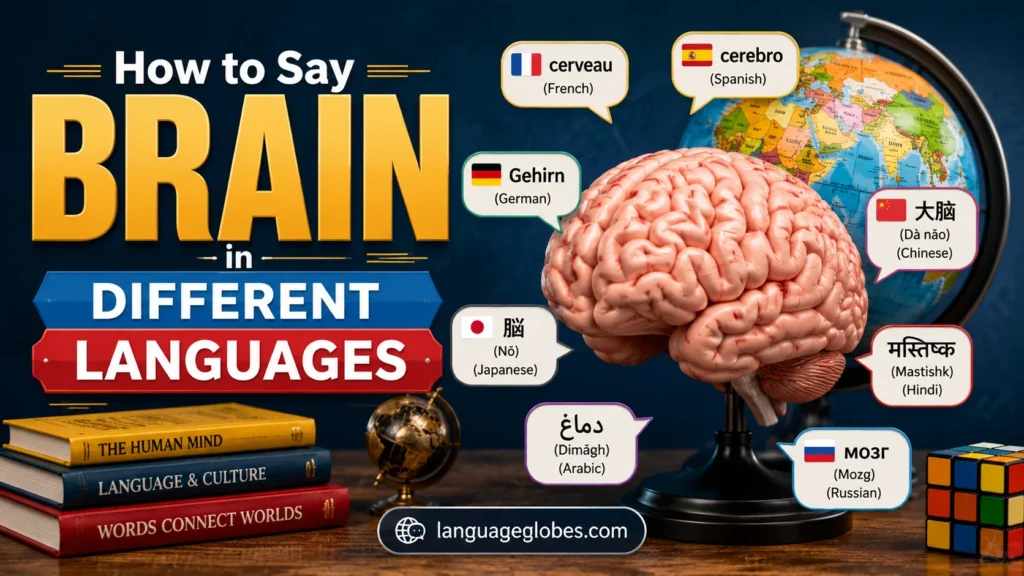
Understanding how to say brain in different languages improves language learning and broadens multilingual vocabulary naturally. This guide explains brain translation, brain meaning, brain pronunciation, and every important brain word clearly.
You will discover how the human brain, mind, thinking, memory, and emotion connect through different languages. Learning these common words strengthens communication, cultural understanding, and everyday vocabulary with confidence.
Explore brain in different languages through accurate translations, practical example sentences, and a simple pronunciation guide for easier understanding. Compare world languages, language families, and fascinating linguistic differences across diverse cultures and regional languages.
Whether you are students, researchers, travelers, healthcare professionals, or language enthusiasts, this translation guide offers valuable language reference and vocabulary expansion. Discover how brain across languages reflects global communication, linguistic diversity, and a shared universal concept worldwide.
Also Read This: How to Say Breakfast in Different Languages
Interesting Facts About Brain
- The human brain contains approximately 86 billion neurons.
- The brain controls memory, emotions, movement, and sensory perception.
- Although it represents only about 2% of body weight, it uses roughly 20% of the body’s energy.
- Many cultures consider the brain a symbol of intelligence and wisdom.
- Medical and scientific terminology related to the brain often comes from Greek and Latin origins.
- Every language has a unique word for brain, reflecting its linguistic history.
- Learning anatomy terms in different languages is useful for students, travelers, and healthcare professionals.
- The brain continues developing into a person’s mid-twenties.
- Understanding brain-related vocabulary helps in international education and medical communication.
- The concept of the brain appears in literature, philosophy, psychology, and science worldwide.
How to Say Brain in Different Languages
European Languages
Europe is home to hundreds of languages belonging to several language families, including Germanic, Romance, Slavic, Celtic, and Baltic languages. Many European languages share historical roots, yet their vocabulary often differs significantly. Learning how to say brain in European languages can help travelers, students, and language enthusiasts communicate more effectively across the continent.
| Language | Country/Region | Translation | Pronunciation | Example Sentence |
| 🇺🇸 American English | USA | Brain | Brayn | The brain controls the body. |
| 🇬🇧 British English | United Kingdom | Brain | Brayn | The brain processes information. |
| 🇦🇺 Australian English | Australia | Brain | Brayn | The brain helps us think. |
| 🇫🇷 French | France | Cerveau | Ser-voh | Le cerveau est important. |
| 🇪🇸 Spanish | Spain | Cerebro | Seh-reh-bro | El cerebro controla el cuerpo. |
| 🇵🇹 Portuguese | Portugal | Cérebro | Seh-reh-broo | O cérebro é complexo. |
| 🇮🇹 Italian | Italy | Cervello | Cher-vel-lo | Il cervello è potente. |
| 🇩🇪 German | Germany | Gehirn | Geh-heern | Das Gehirn arbeitet ständig. |
| 🇳🇱 Dutch | Netherlands | Hersenen | Her-seh-nen | De hersenen zijn belangrijk. |
| 🇸🇪 Swedish | Sweden | Hjärna | Yerna | Hjärnan styr kroppen. |
| 🇳🇴 Norwegian | Norway | Hjerne | Yer-ne | Hjernen er viktig. |
| 🇩🇰 Danish | Denmark | Hjerne | Yer-ne | Hjernen fungerer godt. |
| 🇫🇮 Finnish | Finland | Aivot | Eye-vot | Aivot ohjaavat kehoa. |
| 🇮🇸 Icelandic | Iceland | Heili | Hay-li | Heilinn stjórnar líkamanum. |
| 🇵🇱 Polish | Poland | Mózg | Moozg | Mózg jest ważny. |
| 🇨🇿 Czech | Czech Republic | Mozek | Mo-zek | Mozek řídí tělo. |
| 🇸🇰 Slovak | Slovakia | Mozog | Mo-zog | Mozog je dôležitý. |
| 🇭🇺 Hungarian | Hungary | Agy | Odj | Az agy irányítja a testet. |
| 🇷🇴 Romanian | Romania | Creier | Kreh-yer | Creierul este complex. |
| 🇬🇷 Greek | Greece | Εγκέφαλος | En-ke-fa-los | Ο εγκέφαλος είναι σημαντικός. |
| 🇷🇺 Russian | Russia | Мозг | Mozg | Мозг контролирует тело. |
| 🇺🇦 Ukrainian | Ukraine | Мозок | Mo-zok | Мозок важливий. |
| 🇧🇬 Bulgarian | Bulgaria | Мозък | Mo-zak | Мозъкът е важен. |
| 🇷🇸 Serbian | Serbia | Мозак | Mo-zak | Мозак контролише тело. |
| 🇭🇷 Croatian | Croatia | Mozak | Mo-zak | Mozak je važan. |
Asian Languages
Asia is the largest and most linguistically diverse continent in the world. It includes languages from major families such as Indo-European, Sino-Tibetan, Dravidian, Altaic, Austronesian, and Tai-Kadai. Understanding the word brain in Asian languages is particularly useful because the continent is home to billions of people and some of the world’s oldest civilizations.
| Language | Country/Region | Translation | Pronunciation | Example Sentence |
| 🇨🇳 Chinese (Mandarin) | China | 脑 | Nao | 大脑很重要。 |
| 🇯🇵 Japanese | Japan | 脳 | Noh | 脳は重要です。 |
| 🇰🇷 Korean | South Korea | 뇌 | Nwe | 뇌는 중요합니다. |
| 🇮🇳 Hindi | India | मस्तिष्क | Mas-tishk | मस्तिष्क शरीर को नियंत्रित करता है। |
| 🇮🇳 Urdu | Pakistan | دماغ | Dimaagh | دماغ جسم کو کنٹرول کرتا ہے۔ |
| 🇮🇳 Bengali | Bangladesh | মস্তিষ্ক | Mos-tish-ko | মস্তিষ্ক গুরুত্বপূর্ণ। |
| 🇮🇳 Punjabi | Punjab | ਦਿਮਾਗ | Di-maag | ਦਿਮਾਗ ਮਹੱਤਵਪੂਰਨ ਹੈ। |
| 🇮🇳 Gujarati | India | મગજ | Ma-gaj | મગજ મહત્વનું છે. |
| 🇮🇳 Marathi | India | मेंदू | Men-doo | मेंदू शरीर नियंत्रित करतो. |
| 🇮🇳 Tamil | India | மூளை | Moo-lai | மூளை முக்கியமானது. |
| 🇮🇳 Telugu | India | మెదడు | Me-da-du | మెదడు చాలా ముఖ్యం. |
| 🇮🇳 Kannada | India | ಮೆದುಳು | Me-du-lu | ಮೆದುಳು ಮುಖ್ಯವಾಗಿದೆ. |
| 🇮🇳 Malayalam | India | മസ്തിഷ്കം | Mas-thish-kam | മസ്തിഷ്കം പ്രധാനമാണ്. |
| 🇳🇵 Nepali | Nepal | मस्तिष्क | Mas-tishk | मस्तिष्क महत्वपूर्ण छ। |
| 🇱🇰 Sinhala | Sri Lanka | මොළය | Mo-la-ya | මොළය වැදගත්ය. |
| 🇹🇭 Thai | Thailand | สมอง | Sa-mong | สมองสำคัญมาก |
| 🇻🇳 Vietnamese | Vietnam | Não | Now | Não rất quan trọng. |
| 🇮🇩 Indonesian | Indonesia | Otak | O-tak | Otak mengendalikan tubuh. |
| 🇲🇾 Malay | Malaysia | Otak | O-tak | Otak sangat penting. |
| 🇵🇭 Filipino | Philippines | Utak | Oo-tak | Ang utak ay mahalaga. |
| 🇲🇳 Mongolian | Mongolia | Тархи | Tar-khi | Тархи чухал. |
| 🇰🇭 Khmer | Cambodia | ខួរក្បាល | Kuo Kbal | ខួរក្បាលសំខាន់។ |
| 🇱🇦 Lao | Laos | ສະໝອງ | Sa-mong | ສະໝອງສຳຄັນ. |
| 🇲🇲 Burmese | Myanmar | ဦးနှောက် | Oo-nauk | ဦးနှောက်အရေးကြီးသည်။ |
African Languages
Africa is one of the most linguistically rich continents, with more than 2,000 languages spoken across its nations. African languages belong to several language families, including Afroasiatic, Niger-Congo, Nilo-Saharan, and Khoisan. Learning anatomy-related words in African languages offers insight into the continent’s incredible cultural diversity.
| Language | Country/Region | Translation | Pronunciation | Example Sentence |
| 🇿🇦 Swahili | East Africa | Ubongo | Oo-bon-go | Ubongo ni muhimu. |
| 🇿🇦 Zulu | South Africa | Ubuchopho | Oo-bo-cho-po | Ubuchopho bubalulekile. |
| 🇿🇦 Xhosa | South Africa | Ingqondo | In-gon-do | Ingqondo ibalulekile. |
| 🇳🇬 Yoruba | Nigeria | Ọpọlọ | O-po-lo | Ọpọlọ ṣe pataki. |
| 🇳🇬 Igbo | Nigeria | Ụbụrụ | Oo-boo-roo | Ụbụrụ dị mkpa. |
| 🇳🇬 Hausa | Nigeria | Kwakwalwa | Kwa-kwa-lwa | Kwakwalwa tana da muhimmanci. |
| 🇪🇹 Amharic | Ethiopia | አእምሮ | A-im-ro | አእምሮ አስፈላጊ ነው። |
| 🇸🇴 Somali | Somalia | Maskax | Mas-kax | Maskaxdu waa muhiim. |
| 🇿🇦 Afrikaans | South Africa | Brein | Brayn | Die brein is belangrik. |
| 🇷🇼 Kinyarwanda | Rwanda | Ubwonko | Oo-bwon-ko | Ubwonko ni ingenzi. |
Middle Eastern Languages
The Middle East is known for its rich history, ancient civilizations, and influential languages. Many of these languages have contributed significantly to science, medicine, literature, and philosophy. Learning the word brain in Middle Eastern languages can help bridge communication across a culturally significant region.
| Language | Country/Region | Translation | Pronunciation | Example Sentence |
| 🇸🇦 Arabic | Middle East | دماغ | Di-maagh | الدماغ مهم جداً. |
| 🇮🇷 Persian (Farsi) | Iran | مغز | Maghz | مغز بسیار مهم است. |
| 🇹🇷 Turkish | Türkiye | Beyin | Bay-in | Beyin vücudu kontrol eder. |
| 🇮🇱 Hebrew | Israel | מוח | Mo-akh | המוח חשוב מאוד. |
| 🇰🇼 Kurdish | Kurdistan Region | Mêjû | May-joo | Mêjû girîng e. |
| 🇦🇲 Armenian | Armenia | Ուղեղ | Oo-ghegh | Ուղեղը կարևոր է։ |
| 🇬🇪 Georgian | Georgia | ტვინი | Tvi-ni | ტვინი მნიშვნელოვანია. |
Additional Languages Around the World
The world contains thousands of languages beyond the major regional groups. These languages reflect unique cultures, traditions, and histories. Exploring them helps us appreciate humanity’s linguistic diversity and broadens our understanding of global communication.
| Language | Country/Region | Translation | Pronunciation | Example Sentence |
| 🇮🇪 Irish | Ireland | Inchinn | In-khin | Tá an inchinn tábhachtach. |
| 🏴 Welsh | Wales | Ymennydd | Uh-men-ith | Mae’r ymennydd yn bwysig. |
| 🇲🇹 Maltese | Malta | Moħħ | Mokh | Il-moħħ huwa importanti. |
| 🇱🇻 Latvian | Latvia | Smadzenes | Sma-dze-nes | Smadzenes ir svarīgas. |
| 🇱🇹 Lithuanian | Lithuania | Smegenys | Smeh-geh-nis | Smegenys svarbios. |
| 🇪🇪 Estonian | Estonia | Aju | A-yu | Aju on tähtis. |
| 🇦🇱 Albanian | Albania | Tru | Troo | Truri është i rëndësishëm. |
| 🇸🇮 Slovenian | Slovenia | Možgani | Mozh-ga-ni | Možgani so pomembni. |
| 🇲🇰 Macedonian | North Macedonia | Мозок | Mo-zok | Мозокот е важен. |
| 🇧🇦 Bosnian | Bosnia | Mozak | Mo-zak | Mozak je važan. |
| 🇱🇺 Luxembourgish | Luxembourg | Gehir | Geh-heer | D’Gehir ass wichteg. |
| 🇧🇾 Belarusian | Belarus | Мозг | Mozg | Мозг вельмі важны. |
| 🇺🇿 Uzbek | Uzbekistan | Miya | Mi-ya | Miya muhimdir. |
| 🇰🇿 Kazakh | Ми | Mi | Mi mańyzdy. | |
| 🇰🇬 Kyrgyz | Мээ | Mee | Мээ маанилүү. | |
| 🇹🇯 Tajik | Майна | Mai-na | Майна муҳим аст. | |
| 🇹🇲 Turkmen | Beýni | Bay-ni | Beýni möhümdir. | |
| 🇵🇬 Tok Pisin | Papua New Guinea | Brin | Brin | Brin i bikpela samting. |
FAQs
What is the brain meaning in different languages?
The brain meaning stays largely consistent across different languages, referring to the human brain, the body’s central organ responsible for thinking, memory, emotion, and decision making. However, meanings may slightly vary because of culture, language expressions, and linguistic differences.
How do you say brain in different languages?
Learning how to say brain in different languages helps improve language learning, multilingual vocabulary, and cross cultural communication. This translation guide introduces accurate translations, pronunciation, and usage across many world languages.
Why is brain translation important for language learning?
Accurate brain translation helps learners understand brain terminology, build stronger vocabulary, and communicate confidently. It also supports language study, education, and better global communication through reliable language reference materials.
How can I improve brain pronunciation in foreign languages?
Practicing brain pronunciation with a clear pronunciation guide and pronunciation examples improves speaking confidence. Listening to native speakers and repeating brain word pronunciations also strengthens communication skills.
What does the brain do in the human body?
The human brain is a vital organ inside the skull that controls the nervous system, cognitive functions, learning, memory, emotion, creativity, and mental power. It also manages everyday actions and complex thought processes.
How does the brain relate to human anatomy and medicine?
In human anatomy, the brain anatomy includes structures like the cerebrum, which supports higher thinking and intelligence. Understanding these terms benefits medicine, medical terminology, healthcare, and healthcare professionals.
Which language families have unique words for brain?
Many language families, including Germanic languages, Romance languages, and languages derived from Latin, use distinct brain word forms. Examples include Hirn and Brein, reflecting rich linguistic diversity and language variations.
Who can benefit from learning brain in different languages?
Learning brain in different languages is useful for students, researchers, travelers, and language enthusiasts. It also supports international communication, regional information, and better cultural understanding in an interconnected world.
How does comparing brain across languages improve communication?
Studying brain across languages highlights language comparison, linguistic culture, and shared ideas across global languages. This strengthens global understanding, communication, and appreciation for global diversity.
Where can I find reliable language resources for brain translation?
Reliable language resources provide accurate language translation, translation guide, example sentences, vocabulary building, and multilingual knowledge for brain translation. These references also help expand essential vocabulary and understand this universal concept worldwide.
Conclusion
By learning how to say brain in different languages, you expand your multilingual vocabulary, strengthen language learning, and gain a deeper understanding of brain translation, brain meaning, and brain pronunciation. Exploring brain in different languages improves communication, supports cultural understanding, and builds confidence across world languages and language families. Whether you are a student, researcher, traveler, or language enthusiast, this translation guide offers valuable language reference, practical example sentences, and lasting vocabulary expansion for better global communication and meaningful connections across cultures.

James Anderson is a passionate language enthusiast and content creator at LanguageGlobes. With a keen interest in global cultures and communication, he shares insightful and engaging content to help readers explore and master new languages.