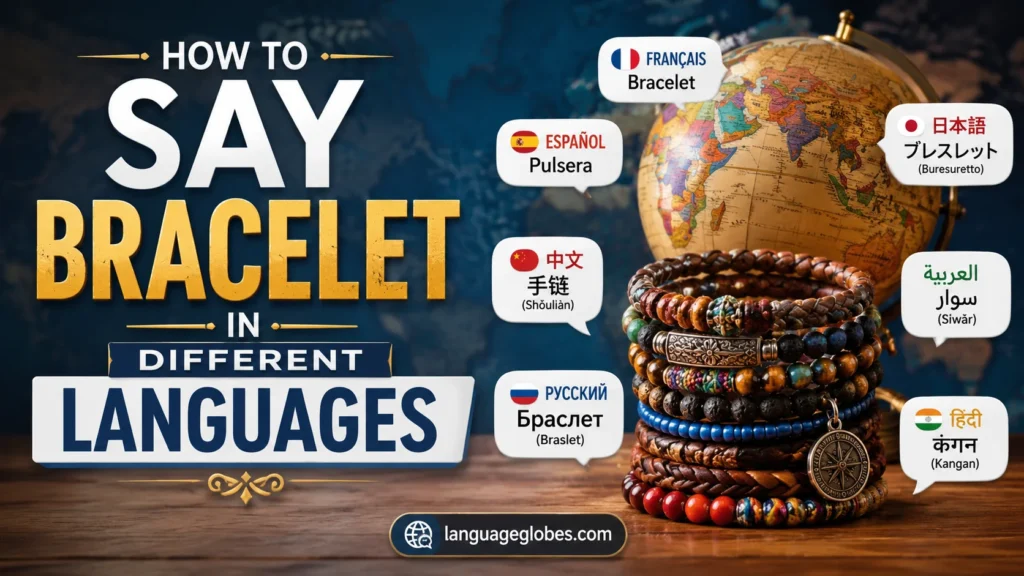
Bracelet is a popular accessory and beautiful wrist jewelry enjoyed across global cultures every day. Learning its translation in different languages improves communication during travel, shopping, and meaningful cultural exchange.
This comprehensive guide helps language learners, travelers, online sellers, and jewelry enthusiasts understand multilingual vocabulary confidently. You will discover the correct translated word, word meaning, pronunciation, and example sentences with practical explanations.
From French, Spanish, and German to many worldwide languages, every local word reflects unique culture and history. Explore language translation, translation guide, and language guide resources for better international communication and everyday conversations.
This linguistic journey makes language learning easier while expanding vocabulary through a familiar common object. Read, learn, and express ideas naturally using accurate bracelet translation across world languages with confidence.
Also Read This: How to Say Bro in Different Languages
Interesting Facts About Bracelet
- The word “bracelet” comes from the French word “bracelet,” meaning an ornament for the arm.
- Ancient Egyptians wore bracelets thousands of years ago as symbols of wealth and protection.
- Friendship bracelets became popular worldwide as symbols of friendship and connection.
- Many cultures use bracelets in religious ceremonies and traditional celebrations.
- Bracelets are among the oldest forms of jewelry known to humanity.
- Modern bracelets are made from materials such as gold, silver, platinum, leather, wood, and silicone.
- Charm bracelets allow people to personalize jewelry with meaningful symbols.
- In some countries, bracelets are worn to indicate marital status, social rank, or cultural identity.
- Smart bracelets and fitness bands have become popular wearable technology devices.
- Handmade bracelets remain important cultural crafts in many regions of the world.
How to Say Bracelet in Different Languages
Below are translations of the word “bracelet” in languages spoken around the globe.
European Languages
Europe is home to many of the world’s most influential languages, each with unique histories and traditions. Jewelry has played an important role in European fashion for centuries. From luxury French designs to traditional Eastern European ornaments, bracelets remain a common accessory throughout the continent.
| Language | Country/Region | Translation | Pronunciation | Example Sentence |
| 🇺🇸 American English | USA | Bracelet | brays-let | I bought a beautiful bracelet yesterday. |
| 🇬🇧 British English | United Kingdom | Bracelet | brays-let | She wears a silver bracelet every day. |
| 🇦🇺 Australian English | Australia | Bracelet | brays-let | My friend gave me a bracelet. |
| French | 🇫🇷 France | Bracelet | brah-slay | J’ai acheté un bracelet en or. |
| Spanish | 🇪🇸 Spain | Pulsera | pool-seh-rah | Compré una pulsera nueva. |
| Portuguese | 🇵🇹 Portugal | Pulseira | pool-say-rah | Ela usa uma pulseira bonita. |
| Italian | 🇮🇹 Italy | Braccialetto | brah-cha-let-to | Ho comprato un braccialetto. |
| German | 🇩🇪 Germany | Armband | arm-bant | Ich habe ein Armband gekauft. |
| Dutch | 🇳🇱 Netherlands | Armband | arm-bant | Zij draagt een armband. |
| Swedish | 🇸🇪 Sweden | Armband | arm-band | Jag köpte ett armband. |
| Norwegian | 🇳🇴 Norway | Armbånd | arm-bon | Hun har et armbånd. |
| Danish | 🇩🇰 Denmark | Armbånd | arm-bon | Jeg købte et armbånd. |
| Finnish | 🇫🇮 Finland | Rannekoru | ran-ne-ko-roo | Ostin uuden rannekorun. |
| Icelandic | 🇮🇸 Iceland | Armband | arm-band | Ég keypti armband. |
| Polish | 🇵🇱 Poland | Bransoletka | bran-so-let-ka | Kupiłem bransoletkę. |
| Czech | 🇨🇿 Czech Republic | Náramek | naa-ra-mek | Koupil jsem náramek. |
| Slovak | 🇸🇰 Slovakia | Náramok | naa-ra-mok | Kúpil som náramok. |
| Hungarian | 🇭🇺 Hungary | Karkötő | kar-ko-to | Vettem egy karkötőt. |
| Romanian | 🇷🇴 Romania | Brățară | bra-tsa-ra | Am cumpărat o brățară. |
| Greek | 🇬🇷 Greece | Βραχιόλι | vra-hyo-lee | Αγόρασα ένα βραχιόλι. |
| Russian | 🇷🇺 Russia | Браслет | bras-let | Я купил браслет. |
| Ukrainian | 🇺🇦 Ukraine | Браслет | bras-let | Я купив браслет. |
| Belarusian | 🇧🇾 Belarus | Бранзалет | bran-za-let | Я купіў бранзалет. |
| Croatian | 🇭🇷 Croatia | Narukvica | na-rook-vee-tsa | Kupio sam narukvicu. |
| Serbian | 🇷🇸 Serbia | Наруквица | na-rook-vee-tsa | Купио сам наруквицу. |
| Slovenian | 🇸🇮 Slovenia | Zapestnica | za-pest-ni-tsa | Kupil sem zapestnico. |
| Bulgarian | 🇧🇬 Bulgaria | Гривна | griv-na | Купих гривна. |
| Latvian | 🇱🇻 Latvia | Aproce | a-pro-tse | Es nopirku aproci. |
| Lithuanian | 🇱🇹 Lithuania | Apyrankė | a-pi-ran-ke | Nusipirkau apyrankę. |
| Estonian | 🇪🇪 Estonia | Käevõru | kae-vo-roo | Ostsin käevõru. |
| Albanian | 🇦🇱 Albania | Byzylyk | bu-zu-lik | Bleva një byzylyk. |
Asian Languages
Asia contains thousands of languages and diverse cultural traditions. Jewelry is deeply connected to celebrations, weddings, religion, and fashion throughout the continent. Bracelets are commonly worn in countries across East Asia, South Asia, Southeast Asia, and Central Asia.
| Language | Country/Region | Translation | Pronunciation | Example Sentence |
| Chinese (Mandarin) | 🇨🇳 China | 手镯 | show-jwo | 我买了一个手镯。 |
| Cantonese | 🇭🇰 Hong Kong | 手鐲 | sau-jok | 我買咗一個手鐲。 |
| Japanese | 🇯🇵 Japan | ブレスレット | boo-re-su-ret-to | ブレスレットを買いました。 |
| Korean | 🇰🇷 South Korea | 팔찌 | pal-jji | 팔찌를 샀어요. |
| Hindi | 🇮🇳 India | कंगन | kun-gun | मैंने कंगन खरीदा। |
| Urdu | 🇵🇰 Pakistan | کنگن | kun-gun | میں نے کنگن خریدا۔ |
| Bengali | 🇧🇩 Bangladesh | ব্রেসলেট | bre-slet | আমি একটি ব্রেসলেট কিনেছি। |
| Punjabi | India/Pakistan | ਕੜਾ | ka-ra | ਮੈਂ ਕੜਾ ਖਰੀਦਿਆ। |
| Gujarati | 🇮🇳 India | કંગણ | kun-gun | મેં કંગણ ખરીદ્યું. |
| Marathi | 🇮🇳 India | कंगन | kun-gun | मी कंगन विकत घेतले. |
| Tamil | 🇮🇳 India | வளையல் | va-lai-yal | நான் வளையல் வாங்கினேன். |
| Telugu | 🇮🇳 India | కంకణం | kan-ka-nam | నేను కంకణం కొనుగోలు చేశాను. |
| Kannada | 🇮🇳 India | ಕಂಕಣ | kan-ka-na | ನಾನು ಕಂಕಣ ಖರೀದಿಸಿದೆ. |
| Malayalam | 🇮🇳 India | വള | va-la | ഞാൻ വള വാങ്ങി. |
| Sinhala | 🇱🇰 Sri Lanka | වළල්ල | wa-lal-la | මම වළල්ලක් මිලදී ගත්තා. |
| Thai | 🇹🇭 Thailand | สร้อยข้อมือ | sa-roy-kor-mue | ฉันซื้อสร้อยข้อมือ. |
| Vietnamese | 🇻🇳 Vietnam | Vòng tay | vong-tai | Tôi mua một vòng tay. |
| Indonesian | 🇮🇩 Indonesia | Gelang | ge-lang | Saya membeli gelang. |
| Malay | 🇲🇾 Malaysia | Gelang | ge-lang | Saya membeli gelang. |
| Filipino | 🇵🇭 Philippines | Pulseras | pool-se-ras | Bumili ako ng pulseras. |
| Khmer | 🇰🇭 Cambodia | ខ្សែដៃ | ksae-dai | ខ្ញុំបានទិញខ្សែដៃ។ |
| Lao | 🇱🇦 Laos | ສາຍແຂນ | sai-khen | ຂ້ອຍຊື້ສາຍແຂນ. |
| Mongolian | 🇲🇳 Mongolia | Бугуйвч | boo-goi-vich | Би бугуйвч авсан. |
| Nepali | 🇳🇵 Nepal | कंगन | kun-gun | मैले कंगन किनें। |
| Kazakh | 🇰🇿 Kazakhstan | Білезік | bi-le-zik | Мен білезік сатып алдым. |
African Languages
Africa is one of the most linguistically diverse continents, with thousands of languages spoken across its regions. Traditional jewelry, including bracelets, often carries cultural, spiritual, and artistic significance. Many African communities use bracelets in ceremonies, celebrations, and everyday fashion.
| Language | Country/Region | Translation | Pronunciation | Example Sentence |
| Swahili | 🌍 East Africa | Bangili | ban-gee-lee | Nimenunua bangili mpya. |
| Zulu | 🇿🇦 South Africa | Isongo | ee-son-go | Ngithenge isongo. |
| Xhosa | 🇿🇦 South Africa | Isongo | ee-son-go | Ndithenge isongo. |
| Afrikaans | 🇿🇦 South Africa | Armband | arm-bant | Ek het ‘n armband gekoop. |
| Yoruba | 🇳🇬 Nigeria | Ẹgba ọwọ | eg-ba o-wo | Mo ra ẹgba ọwọ. |
| Igbo | 🇳🇬 Nigeria | Mgbaaka | m-ba-ka | Azụrụ m mgbaaka. |
| Hausa | 🇳🇪 Niger/Nigeria | Munduwa | moon-doo-wa | Na sayi munduwa. |
| Amharic | 🇪🇹 Ethiopia | የእጅ ጌጥ | ye-ej-geget | የእጅ ጌጥ ገዛሁ። |
| Somali | 🇸🇴 Somalia | Jijin | ji-jin | Waxaan iibsaday jijin. |
| Shona | 🇿🇼 Zimbabwe | Bhangiri | ban-gee-ree | Ndakatenga bhangiri. |
Middle Eastern Languages
The Middle East has a rich history of jewelry craftsmanship dating back thousands of years. Bracelets made from precious metals and gemstones have long been associated with beauty, wealth, and tradition. Many Middle Eastern languages have unique words reflecting these cultural influences.
| Language | Country/Region | Translation | Pronunciation | Example Sentence |
| Arabic | 🌍 Middle East | سوار | si-war | اشتريت سواراً جديداً. |
| Persian (Farsi) | 🇮🇷 Iran | دستبند | dast-band | من یک دستبند خریدم. |
| Turkish | 🇹🇷 Türkiye | Bileklik | bi-lek-lik | Bir bileklik aldım. |
| Hebrew | 🇮🇱 Israel | צמיד | tsa-meed | קניתי צמיד חדש. |
| Kurdish | Iraq/Türkiye | Bazin | ba-zin | Min bazin kirî. |
| Armenian | 🇦🇲 Armenia | Ապարանջան | a-pa-ran-jan | Ես ապարանջան գնեցի։ |
| Azerbaijani | 🇦🇿 Azerbaijan | Bilərzik | bi-lar-zik | Mən bilərzik aldım. |
Additional Languages Around the World
Many languages outside the major regional groups also have unique words for bracelet. Learning these translations helps broaden cultural understanding and improves communication with people from diverse backgrounds.
| Language | Country/Region | Translation | Pronunciation | Example Sentence |
| Maori | 🇳🇿 New Zealand | Poroporo | po-ro-po-ro | I hoko ahau i te poroporo. |
| Hawaiian | 🇺🇸 Hawaii | Kupee | koo-peh-eh | Ua kūʻai au i kupee. |
| Samoan | 🇼🇸 Samoa | Taulima | tau-lee-ma | Na ou faatauina se taulima. |
| Tongan | 🇹🇴 Tonga | Taulima | tau-lee-ma | Na’a ku fakatau ha taulima. |
| Fijian | 🇫🇯 Fiji | Taulima | tau-lee-ma | Au volia e dua na taulima. |
| Tahitian | 🇵🇫 Tahiti | Pae | pa-eh | Ua hoo mai au i te pae. |
| Greenlandic | 🇬🇱 Greenland | Arsaq | ar-sak | Arsaq pisiaraara. |
| Luxembourgish | 🇱🇺 Luxembourg | Bracelet | brah-slay | Ech hunn e Bracelet kaaft. |
| Maltese | 🇲🇹 Malta | Brazzuletta | bra-zoo-let-ta | Xtrajt brazzuletta. |
| Irish | 🇮🇪 Ireland | Bráisléad | brawsh-lade | Cheannaigh mé bráisléad. |
| Welsh | 🏴 Wales | Breichled | brych-led | Prynais freichled. |
| Basque | Spain/France | Eskumuturreko | es-koo-moo-too-re-ko | Eskumuturreko bat erosi dut. |
| Catalan | Spain | Polsera | pol-se-ra | He comprat una polsera. |
| Galician | Spain | Pulseira | pool-say-ra | Merquei unha pulseira. |
FAQs
What does the Bracelet word mean in different languages?
The Bracelet word meaning stays similar across many world languages, although each local word reflects unique culture and linguistic traditions. Learning the correct translated word improves communication and expands multilingual vocabulary.
Why should I learn the Bracelet translation in different languages?
Knowing the Bracelet translation helps language learners, travelers, and online sellers communicate confidently during travel, international shopping, and global communication. It also supports better language learning and cultural exchange.
How do you pronounce Bracelet in other world languages?
The bracelet pronunciation changes between world languages, making pronunciation an important part of accurate speaking. Many translation guide resources also include audio pronunciation for easier learning.
What is the Bracelet word in French, Spanish, and German?
In French, Bracelet is commonly le bracelet or un bracelet. In Spanish, it is la pulsera or el brazalete, while in German, it is das Armband.
Can learning Bracelet translations improve language learning?
Yes, learning Bracelet in different languages strengthens vocabulary, improves language translation skills, and supports practical language learning. Everyday words are easier to remember through regular use.
Why is a Bracelet important across different cultures?
A Bracelet is more than wrist jewelry because it often represents friendship, love, status, religion, and history. Different cultures use unique materials, design, and traditions for this popular accessory.
What materials are commonly used to make a Bracelet?
A Bracelet may be crafted from gold, silver, leather, beads, shells, and many other materials. These choices influence its fashion, style, personal style, and cultural significance.
Who can benefit from a Bracelet translation guide?
A translation guide is useful for language learners, travelers, online sellers, and jewelry enthusiasts seeking accurate word translation and better international communication. It also helps with shopping and daily conversations.
How many worldwide languages can include the Bracelet translation?
Many language guide resources provide Bracelet translation in over 70 languages, while others cover over 100 languages across Europe, Asia, Africa, the Middle East, and other regions worldwide.
How can I remember the Bracelet word in multiple different languages?
Practice example sentences, read, learn, and discover new translations regularly to build lasting multilingual vocabulary. Repeating each expression in its native language makes global language learning easier and more effective.
Conclusion
In this comprehensive guide, you explored Bracelet translation in different languages, improving communication through accurate multilingual vocabulary and practical language learning. Whether you are a language learner, traveler, online seller, or jewelry enthusiast, knowing the correct translated word, pronunciation, and word meaning supports confident international communication and meaningful cultural exchange. Continue to learn, discover, and use Bracelet translation across world languages to connect with diverse cultures and communicate naturally wherever you go.

James Anderson is a passionate language enthusiast and content creator at LanguageGlobes. With a keen interest in global cultures and communication, he shares insightful and engaging content to help readers explore and master new languages.