
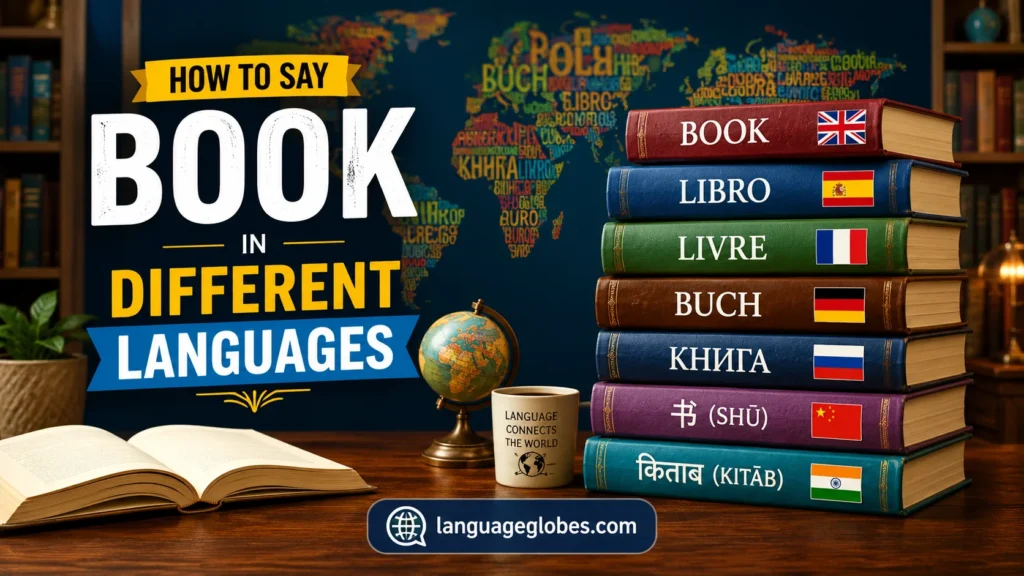
A book in different languages reveals fascinating connections between people, traditions, and knowledge worldwide. Learning how to say book helps improve language learning and strengthens multilingual communication in everyday situations. This guide explores book translation, book pronunciation, and book meaning across many global languages and worldwide languages.
Whether you are a student, traveler, reader, or language enthusiast, understanding the native word for book expands your multilingual vocabulary naturally. It also supports vocabulary building, communication skills, and deeper cultural awareness through meaningful language exploration. Since books represent wisdom, imagination, literature, and a valuable knowledge source, their names carry significance across cultures.
In this comprehensive language guide, you will discover word translation, language pronunciation, and useful translation examples from diverse spoken languages and written languages. We also examine language families, writing systems, language history, and the rich linguistic diversity found throughout Europe, Asia, Africa, and the Middle East.
These insights encourage cross cultural learning, greater cultural understanding, and appreciation for global diversity and cultural identity. Along with a practical pronunciation guide, translation guide, and example sentence references, this resource supports effective language study and learning vocabulary. Because books connect cultures, books connect people, and books connect ideas, understanding this universal word enriches international communication and lifelong curiosity.
Also read this: How to Say Ugly in Different Languages
Interesting Facts About Book
- The word “book” comes from the Old English word “bōc.”
- Books have existed for thousands of years, evolving from clay tablets and scrolls.
- The world’s largest libraries contain millions of books in hundreds of languages.
- Every culture has its own literary traditions and unique words for books.
- Learning common nouns like “book” is one of the fastest ways to build vocabulary in a new language.
- Books are symbols of education, knowledge, creativity, and cultural heritage.
- Many languages use entirely different scripts to write the word “book.”
- Some languages have borrowed their word for book from neighboring cultures or historical influences.
How to Say Book in Different Languages
The word “book” is used daily in schools, libraries, homes, and workplaces worldwide. Below are translations from various regions and language families.
European Languages
Europe is home to dozens of languages belonging mainly to the Germanic, Romance, Slavic, Celtic, and Baltic language families. Books have played an important role in European history, from ancient manuscripts to modern literature. Learning the word “book” in European languages can help travelers, students, and language learners communicate more effectively.
| Language | Country/Region | Translation | Pronunciation | Example Sentence |
| 🇺🇸 American English | United States | Book | Buk | This book is interesting. |
| 🇬🇧 British English | United Kingdom | Book | Buk | I bought a new book yesterday. |
| 🇦🇺 Australian English | Australia | Book | Buk | That book is excellent. |
| 🇫🇷 French | France | Livre | Lee-vruh | Ce livre est intéressant. |
| 🇪🇸 Spanish | Spain | Libro | Lee-bro | Este libro es bueno. |
| 🇮🇹 Italian | Italy | Libro | Lee-bro | Questo libro è bello. |
| 🇵🇹 Portuguese | Portugal | Livro | Lee-vro | Este livro é ótimo. |
| 🇩🇪 German | Germany | Buch | Bukh | Dieses Buch ist interessant. |
| 🇳🇱 Dutch | Netherlands | Boek | Bookh | Dit boek is goed. |
| 🇸🇪 Swedish | Sweden | Bok | Book | Den här boken är bra. |
| 🇳🇴 Norwegian | Norway | Bok | Book | Denne boken er interessant. |
| 🇩🇰 Danish | Denmark | Bog | Bohg | Denne bog er god. |
| 🇫🇮 Finnish | Finland | Kirja | Keer-ya | Tämä kirja on hyvä. |
| 🇮🇸 Icelandic | Iceland | Bók | Bohk | Þetta er góð bók. |
| 🇵🇱 Polish | Poland | Książka | Kshonzh-ka | Ta książka jest dobra. |
| 🇨🇿 Czech | Czech Republic | Kniha | Kni-ha | Tato kniha je zajímavá. |
| 🇸🇰 Slovak | Slovakia | Kniha | Kni-ha | Táto kniha je dobrá. |
| 🇭🇺 Hungarian | Hungary | Könyv | Kernyv | Ez a könyv jó. |
| 🇷🇴 Romanian | Romania | Carte | Kar-te | Această carte este bună. |
| 🇬🇷 Greek | Greece | Βιβλίο | Vee-vlee-o | Αυτό το βιβλίο είναι καλό. |
| 🇷🇺 Russian | Russia | Книга | Kni-ga | Эта книга интересная. |
| 🇺🇦 Ukrainian | Ukraine | Книга | Kny-ha | Ця книга хороша. |
| 🇧🇬 Bulgarian | Bulgaria | Книга | Kni-ga | Тази книга е добра. |
| 🇭🇷 Croatian | Croatia | Knjiga | Knyi-ga | Ova knjiga je dobra. |
| 🇷🇸 Serbian | Serbia | Књига | Knyi-ga | Ova knjiga je zanimljiva. |
| 🇸🇮 Slovenian | Slovenia | Knjiga | Knyi-ga | Ta knjiga je dobra. |
| 🇱🇹 Lithuanian | Lithuania | Knyga | Kni-ga | Ši knyga gera. |
| 🇱🇻 Latvian | Latvia | Grāmata | Gra-ma-ta | Šī grāmata ir laba. |
| 🇮🇪 Irish | Ireland | Leabhar | Lyour | Is maith an leabhar é. |
| 🏴 Welsh | Wales | Llyfr | Hlifr | Mae’r llyfr yn dda. |
Asian Languages
Asia is the largest continent and home to thousands of languages and dialects. The region contains some of the world’s oldest literary traditions, including Chinese, Sanskrit, Arabic-influenced, Japanese, and Korean texts. Learning the word “book” in Asian languages offers insight into the diverse cultures and writing systems found across the continent.
| Language | Country/Region | Translation | Pronunciation | Example Sentence |
| 🇨🇳 Chinese (Mandarin) | China | 书 | Shu | 这本书很好。 |
| 🇯🇵 Japanese | Japan | 本 | Hon | この本は面白いです。 |
| 🇰🇷 Korean | South Korea | 책 | Chaek | 이 책은 재미있습니다. |
| 🇮🇳 Hindi | India | किताब | Kitaab | यह किताब अच्छी है। |
| 🇵🇰 Urdu | Pakistan | کتاب | Kitaab | یہ کتاب اچھی ہے۔ |
| 🇧🇩 Bengali | Bangladesh | বই | Boi | এই বইটি ভালো। |
| 🇮🇳 Punjabi | India/Pakistan | ਕਿਤਾਬ | Kitaab | ਇਹ ਕਿਤਾਬ ਚੰਗੀ ਹੈ। |
| 🇮🇳 Gujarati | India | પુસ્તક | Pustak | આ પુસ્તક સારું છે. |
| 🇮🇳 Marathi | India | पुस्तक | Pustak | हे पुस्तक चांगले आहे. |
| 🇮🇳 Tamil | India | புத்தகம் | Puthagam | இந்த புத்தகம் நல்லது. |
| 🇮🇳 Telugu | India | పుస్తకం | Pustakam | ఈ పుస్తకం బాగుంది. |
| 🇮🇳 Kannada | India | ಪುಸ್ತಕ | Pustaka | ಈ ಪುಸ್ತಕ ಚೆನ್ನಾಗಿದೆ. |
| 🇮🇳 Malayalam | India | പുസ്തകം | Pustakam | ഈ പുസ്തകം നല്ലതാണ്. |
| 🇳🇵 Nepali | Nepal | किताब | Kitaab | यो किताब राम्रो छ। |
| 🇱🇰 Sinhala | Sri Lanka | පොත | Potha | මේ පොත හොඳයි. |
| 🇹🇭 Thai | Thailand | หนังสือ | Nang-seu | หนังสือเล่มนี้ดีมาก |
| 🇻🇳 Vietnamese | Vietnam | Sách | Sak | Cuốn sách này hay. |
| 🇮🇩 Indonesian | Indonesia | Buku | Boo-koo | Buku ini bagus. |
| 🇲🇾 Malay | Malaysia | Buku | Boo-koo | Buku ini menarik. |
| 🇵🇭 Filipino | Philippines | Aklat | Ak-lat | Maganda ang aklat na ito. |
| 🇰🇭 Khmer | Cambodia | សៀវភៅ | Siev-phov | សៀវភៅនេះល្អណាស់។ |
| 🇱🇦 Lao | Laos | ປຶ້ມ | Peum | ປຶ້ມນີ້ດີ. |
| 🇲🇲 Burmese | Myanmar | စာအုပ် | Sa-oke | ဒီစာအုပ်ကကောင်းတယ်။ |
| 🇲🇳 Mongolian | Mongolia | Ном | Nom | Энэ ном сайн. |
African Languages
Africa is one of the most linguistically diverse continents, with thousands of languages spoken across its regions. Books are important tools for education, storytelling, and preserving cultural traditions. Learning how to say “book” in African languages provides a glimpse into the continent’s rich linguistic heritage.
| Language | Country/Region | Translation | Pronunciation | Example Sentence |
| 🇿🇦 Afrikaans | South Africa | Boek | Book | Hierdie boek is goed. |
| 🇰🇪 Swahili | East Africa | Kitabu | Kee-ta-boo | Kitabu hiki ni kizuri. |
| 🇪🇹 Amharic | Ethiopia | መጽሐፍ | Mets-haf | ይህ መጽሐፍ ጥሩ ነው። |
| 🇳🇬 Yoruba | Nigeria | Iwe | Ee-weh | Iwe yii dara. |
| 🇳🇬 Igbo | Nigeria | Akwụkwọ | A-kwo-kwo | Akwụkwọ a dị mma. |
| 🇿🇦 Zulu | South Africa | Incwadi | In-cwa-dee | Le ncwadi inhle. |
| 🇿🇦 Xhosa | South Africa | Incwadi | In-cwa-dee | Le ncwadi ilungile. |
| 🇸🇴 Somali | Somalia | Buug | Boog | Buuggan waa fiican yahay. |
| 🇷🇼 Kinyarwanda | Rwanda | Igitabo | Ee-gee-ta-bo | Igitabo ni cyiza. |
| 🇧🇼 Tswana | Botswana | Buka | Boo-ka | Buka eno e ntle. |
Middle Eastern Languages
The Middle East has a long and influential literary history. Many of the world’s oldest manuscripts, libraries, and centers of learning originated in this region. Languages such as Arabic, Persian, Turkish, and Hebrew have contributed significantly to global literature, science, and culture.
| Language | Country/Region | Translation | Pronunciation | Example Sentence |
| 🇸🇦 Arabic | Middle East | كتاب | Kitaab | هذا كتاب جيد. |
| 🇮🇷 Persian (Farsi) | Iran | کتاب | Ketab | این کتاب خوب است. |
| 🇹🇷 Turkish | Turkey | Kitap | Kee-tap | Bu kitap güzel. |
| 🇮🇱 Hebrew | Israel | ספר | Sefer | הספר הזה טוב. |
| 🇰🇼 Kurdish | Kurdistan Region | Pirtûk | Peer-took | Ev pirtûk baş e. |
| 🇴🇲 Omani Arabic | Oman | كتاب | Kitaab | هذا كتاب مفيد. |
| 🇶🇦 Qatari Arabic | Qatar | كتاب | Kitaab | هذا كتاب جميل. |
| 🇦🇪 Emirati Arabic | UAE | كتاب | Kitaab | هذا كتاب رائع. |
Additional Languages Around the World
The world is filled with many unique languages that reflect diverse histories, traditions, and cultures. Exploring these additional languages helps broaden your understanding of global communication and highlights the universal importance of books and learning.
| Language | Country/Region | Translation | Pronunciation | Example Sentence |
| 🇳🇿 Maori | New Zealand | Pukapuka | Poo-ka-poo-ka | He pai tenei pukapuka. |
| 🇼🇸 Samoan | Samoa | Tusi | Too-see | E lelei lenei tusi. |
| 🇹🇴 Tongan | Tonga | Tohi | To-hee | Oku lelei e tohi ni. |
| 🇭🇹 Haitian Creole | Haiti | Liv | Leev | Liv sa a bon. |
| 🇬🇱 Greenlandic | Greenland | Atuagaq | A-too-a-gak | Atuagaq una ajunngilaq. |
| 🇫🇯 Fijian | Fiji | Ivola | Ee-vo-la | E vinaka na ivola oqo. |
| 🇵🇬 Tok Pisin | Papua New Guinea | Buk | Book | Dispela buk em gutpela. |
| 🇪🇪 Estonian | Estonia | Raamat | Raa-mat | See raamat on hea. |
| 🇦🇱 Albanian | Albania | Libër | Lee-ber | Ky libër është i mirë. |
| 🇬🇪 Georgian | Georgia | წიგნი | Tsigni | ეს წიგნი კარგია. |
| 🇦🇲 Armenian | Armenia | Գիրք | Geek | Այս գիրքը լավ է։ |
FAQs
What is the meaning of a book in different languages?
The book meaning remains similar across many global languages, representing a source of knowledge, wisdom, literature, and learning. Exploring a book in different languages helps improve cultural understanding and appreciation of world cultures.
How do you say book in different languages around the world?
Learning how to say book in various world languages introduces useful foreign language words and expands your multilingual vocabulary. It also helps language learners communicate more confidently across cultures.
Why is learning book translation useful for language study?
Understanding book translation supports language study, language education, and effective learning vocabulary. It helps learners compare meanings across native languages and strengthen international communication skills.
How can book pronunciation improve language learning?
Practicing book pronunciation and word pronunciation improves speaking accuracy in different spoken languages. A reliable pronunciation guide also helps learners build confidence during real conversations.
What can book translations teach us about cultural diversity?
Different book translations reflect unique traditions, values, and cultural identity found across societies. They highlight cultural diversity, linguistic richness, and the importance of cross cultural learning.
Why are books important in global communication?
Books support global communication by sharing ideas, stories, and knowledge across borders. Since books connect cultures, books connect people, and books connect ideas, they play a vital role in worldwide understanding.
How do language families influence the word for book?
Different language families shape the native word for book through historical and linguistic development. Studying these patterns improves language awareness and understanding of language history.
What role do writing systems play in book vocabulary?
Various writing systems influence how book vocabulary appears in different written languages. Comparing scripts helps learners understand language comparison and appreciate global linguistic traditions.
Who can benefit from learning the word book in multiple languages?
A student, traveler, reader, or language enthusiast can benefit from learning this universal word. It strengthens communication, supports vocabulary practice, and encourages language exploration.
Where can I find translation examples and pronunciation guides for books?
A quality translation guide and language guide often include translation examples, language pronunciation, and an example sentence for better understanding. These resources serve as valuable translation reference materials for learners.
Conclusion
Understanding a book in different languages is a valuable step toward better language learning, stronger multilingual vocabulary, and deeper cultural understanding. By exploring how to say book, its book translation, book pronunciation, and book meaning across global languages and world languages, you gain insight into linguistic diversity, world cultures, and effective global communication. Whether you are a student, traveler, reader, or language enthusiast, learning this universal word supports language study, vocabulary building, and meaningful cross cultural learning. Since books connect cultures, books connect people, and books connect ideas, they remain a timeless source of knowledge, wisdom, and international connection.

James Anderson is a passionate language enthusiast and content creator at LanguageGlobes. With a keen interest in global cultures and communication, he shares insightful and engaging content to help readers explore and master new languages.