
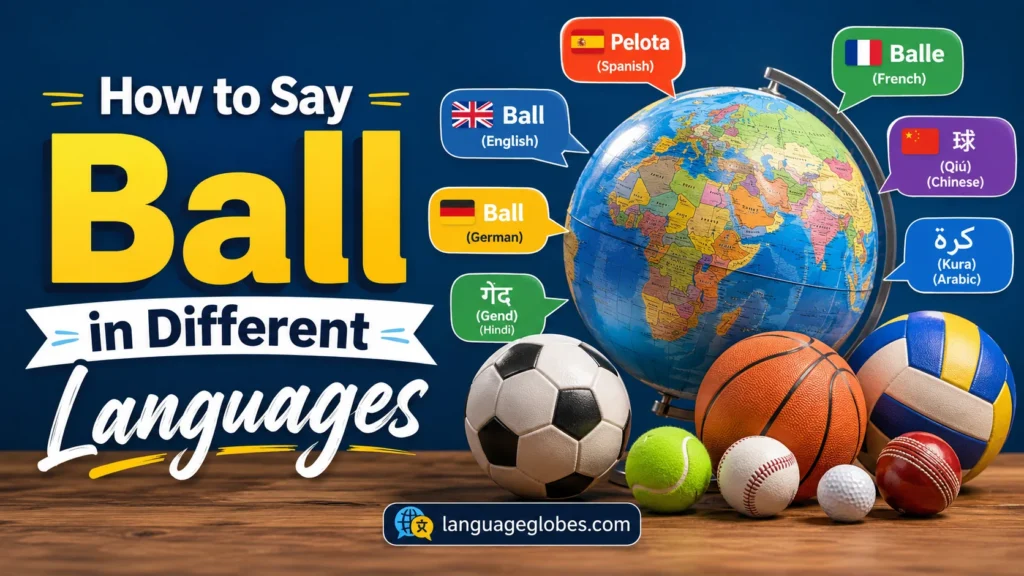
Learning how to say ball in different languages improves communication during travel, study, and everyday conversations. This comprehensive guide explains ball translation, ball meaning, and ball pronunciation using clear examples.
Discover ball in various languages across global languages, world languages, and foreign languages with natural word usage. Whether for language learning or vocabulary building, this translation reference offers practical value for everyone.
Explore multilingual expressions with helpful language comparison, pronunciation guide, example sentence, and regional information for accurate understanding. Learn terms like pelota, balón, balle, and der Ball through natural language translation and pronunciation practice.
This language guide supports language learners, students, travelers, sports enthusiasts, and anyone interested in world culture and cultural diversity. Build everyday vocabulary, strengthen communication skills, and confidently translate ball for multilingual communication worldwide.
Also Read This: How to Say Bathroom in Different Languages
Interesting Facts About Ball
- The word “ball” refers to a round object used in games, sports, and recreational activities.
- Nearly every culture around the world has traditional games involving a ball.
- Some languages use a word that directly means “sphere” or “round object” for ball.
- Football is the world’s most popular ball sport and is played in almost every country.
- Ancient civilizations in Egypt, Greece, China, and Mesoamerica all used balls in games.
- The pronunciation of the word “ball” varies greatly across languages, even when the meaning remains the same.
- Learning sports-related vocabulary is often one of the easiest ways to begin studying a new language.
- Many languages have separate words for sports balls and decorative balls.
How to Say Ball in Different Languages
Below are translations of the word “ball” from around the world.
European Languages
Europe is home to hundreds of languages and dialects with rich linguistic traditions. From Romance and Germanic languages to Slavic and Celtic languages, the continent offers remarkable diversity. Sports such as football, rugby, tennis, and basketball are extremely popular throughout Europe, making the word “ball” a common part of everyday vocabulary.
| Language | Country/Region | Translation | Pronunciation | Example Sentence |
| 🇺🇸 American English | USA | Ball | Bawl | The ball is on the field. |
| 🇬🇧 British English | UK | Ball | Bawl | The ball rolled across the pitch. |
| 🇦🇺 Australian English | Australia | Ball | Bawl | Kick the ball over here. |
| French | 🇫🇷 France | Ballon | Bah-lon | Le ballon est rouge. |
| Spanish | 🇪🇸 Spain | Pelota | Peh-loh-tah | La pelota es nueva. |
| Portuguese | 🇵🇹 Portugal | Bola | Boh-lah | A bola está aqui. |
| Italian | 🇮🇹 Italy | Palla | Pahl-lah | La palla è grande. |
| German | 🇩🇪 Germany | Ball | Bahl | Der Ball ist rund. |
| Dutch | 🇳🇱 Netherlands | Bal | Bahl | De bal is blauw. |
| Swedish | 🇸🇪 Sweden | Boll | Boll | Bollen är stor. |
| Norwegian | 🇳🇴 Norway | Ball | Bahl | Ballen er rund. |
| Danish | 🇩🇰 Denmark | Bold | Bohl | Bolden er ny. |
| Finnish | 🇫🇮 Finland | Pallo | Pahl-loh | Pallo on punainen. |
| Icelandic | 🇮🇸 Iceland | Bolti | Bol-ti | Boltinn er stór. |
| Irish | 🇮🇪 Ireland | Liathróid | Lee-a-royd | Tá an liathróid anseo. |
| Welsh | 🏴 Wales | Pêl | Payl | Mae’r bêl yn fawr. |
| Polish | 🇵🇱 Poland | Piłka | Peew-ka | Piłka jest nowa. |
| Czech | 🇨🇿 Czech Republic | Míč | Meech | Míč je kulatý. |
| Slovak | 🇸🇰 Slovakia | Lopta | Lop-tah | Lopta je nová. |
| Hungarian | 🇭🇺 Hungary | Labda | Lab-dah | A labda piros. |
| Romanian | 🇷🇴 Romania | Minge | Min-jeh | Mingea este mare. |
| Bulgarian | 🇧🇬 Bulgaria | Топка | Top-kah | Топката е нова. |
| Croatian | 🇭🇷 Croatia | Lopta | Lop-tah | Lopta je velika. |
| Serbian | 🇷🇸 Serbia | Лопта | Lop-tah | Лопта је нова. |
| Slovenian | 🇸🇮 Slovenia | Žoga | Zho-gah | Žoga je velika. |
| Ukrainian | 🇺🇦 Ukraine | М’яч | Myach | М’яч круглий. |
| Russian | 🇷🇺 Russia | Мяч | Myach | Мяч новый. |
| Belarusian | 🇧🇾 Belarus | Мяч | Myach | Мяч вялікі. |
| Greek | 🇬🇷 Greece | Μπάλα | Bah-lah | Η μπάλα είναι μεγάλη. |
| Albanian | 🇦🇱 Albania | Top | Top | Topi është i ri. |
Asian Languages
Asia is the largest continent and contains thousands of languages spoken by billions of people. The region includes major language families such as Indo-European, Sino-Tibetan, Dravidian, Altaic, and Austronesian languages. Ball games and sports are extremely popular across Asia, making this vocabulary particularly useful.
| Language | Country/Region | Translation | Pronunciation | Example Sentence |
| Chinese (Mandarin) | 🇨🇳 China | 球 | Chyoh | 这个球很大。 |
| Cantonese | 🇭🇰 Hong Kong | 球 | Kau | 呢個球好大。 |
| Japanese | 🇯🇵 Japan | ボール | Boh-ru | ボールは丸いです。 |
| Korean | 🇰🇷 South Korea | 공 | Gong | 공이 큽니다. |
| Hindi | 🇮🇳 India | गेंद | Gend | गेंद नई है। |
| Urdu | 🇵🇰 Pakistan | گیند | Gain-d | گیند نئی ہے۔ |
| Bengali | 🇧🇩 Bangladesh | বল | Bol | বলটি নতুন। |
| Punjabi | 🇮🇳🇵🇰 Punjab | ਗੇਂਦ | Gend | ਗੇਂਦ ਨਵੀਂ ਹੈ। |
| Gujarati | 🇮🇳 India | બોલ | Bol | બોલ મોટો છે. |
| Marathi | 🇮🇳 India | चेंडू | Chen-doo | चेंडू नवीन आहे. |
| Tamil | 🇮🇳 Sri Lanka | பந்து | Pan-thu | பந்து பெரியது. |
| Telugu | 🇮🇳 India | బంతి | Ban-thi | బంతి పెద్దది. |
| Kannada | 🇮🇳 India | ಚೆಂಡು | Chen-du | ಚೆಂಡು ಹೊಸದು. |
| Malayalam | 🇮🇳 India | പന്ത് | Panth | പന്ത് വലുതാണ്. |
| Sinhala | 🇱🇰 Sri Lanka | බෝලය | Boh-laya | බෝලය අලුත්ය. |
| Nepali | 🇳🇵 Nepal | बल | Bal | बल नयाँ छ। |
| Thai | 🇹🇭 Thailand | ลูกบอล | Look-ball | ลูกบอลใหญ่. |
| Vietnamese | 🇻🇳 Vietnam | Bóng | Bong | Quả bóng mới. |
| Indonesian | 🇮🇩 Indonesia | Bola | Boh-lah | Bola itu besar. |
| Malay | 🇲🇾 Malaysia | Bola | Boh-lah | Bola itu baru. |
| Filipino | 🇵🇭 Philippines | Bola | Boh-lah | Malaki ang bola. |
| Khmer | 🇰🇭 Cambodia | បាល់ | Bal | បាល់ថ្មី។ |
| Lao | 🇱🇦 Laos | ບານ | Baan | ບານໃຫຍ່. |
| Mongolian | 🇲🇳 Mongolia | Бөмбөг | Boom-bug | Бөмбөг шинэ. |
| Burmese | 🇲🇲 Myanmar | ဘောလုံး | Baw-lone | ဘောလုံးအသစ်ဖြစ်သည်။ |
African Languages
Africa is one of the most linguistically diverse continents in the world. Thousands of languages are spoken across its regions, reflecting rich cultural heritage and traditions. Football is especially popular throughout Africa, making the word “ball” a frequently used term in many communities.
| Language | Country/Region | Translation | Pronunciation | Example Sentence |
| Swahili | 🇹🇿 🇰🇪 East Africa | Mpira | Mpee-rah | Mpira ni mkubwa. |
| Zulu | 🇿🇦 South Africa | Ibhola | Ee-bho-la | Ibhola likhulu. |
| Xhosa | 🇿🇦 South Africa | Ibhola | Ee-bho-la | Ibhola litsha. |
| Afrikaans | 🇿🇦 South Africa | Bal | Bahl | Die bal is groot. |
| Yoruba | 🇳🇬 Nigeria | Bọọlu | Boh-oh-loo | Bọọlu tuntun ni. |
| Igbo | 🇳🇬 Nigeria | Bọọlụ | Boh-oh-loo | Bọọlụ ọhụrụ. |
| Hausa | 🇳🇪 🇳🇬 West Africa | Kwallo | Kwal-lo | Kwallo sabuwa ce. |
| Amharic | 🇪🇹 Ethiopia | ኳስ | Kwas | ኳሱ አዲስ ነው። |
| Somali | 🇸🇴 Somalia | Kubbad | Koo-bad | Kubbaddu waa cusub. |
| Shona | 🇿🇼 Zimbabwe | Bhora | Bho-ra | Bhora idzva. |
| Kinyarwanda | 🇷🇼 Rwanda | Umupira | Oo-moo-pee-ra | Umupira ni munini. |
| Sesotho | 🇱🇸 Lesotho | Bolo | Boh-lo | Bolo bo bocha. |
Middle Eastern Languages
The Middle East is known for its rich history, ancient civilizations, and influential languages. Many languages spoken in this region have shaped global culture, trade, science, and literature. Sports and recreational activities remain important across Middle Eastern societies, making the word “ball” widely recognized.
| Language | Country/Region | Translation | Pronunciation | Example Sentence |
| Arabic | 🌍 Middle East | كرة | Kur-ah | الكرة كبيرة. |
| Persian | 🇮🇷 Iran | توپ | Toop | توپ جدید است. |
| Turkish | 🇹🇷 Turkey | Top | Top | Top yeni. |
| Kurdish | 🇮🇶 🇹🇷 Kurdistan | Top | Top | Top nû ye. |
| Hebrew | 🇮🇱 Israel | כדור | Kah-door | הכדור חדש. |
| Armenian | 🇦🇲 Armenia | Գնդակ | Gun-dak | Գնդակը նոր է։ |
| Azerbaijani | 🇦🇿 Azerbaijan | Top | Top | Top yenidir. |
| Georgian | 🇬🇪 Georgia | ბურთი | Boor-ti | ბურთი დიდია. |
Additional Languages Around the World
Many fascinating languages are spoken across North America, South America, Oceania, and indigenous communities worldwide. Learning these translations provides a broader understanding of global communication and cultural diversity.
| Language | Country/Region | Translation | Pronunciation | Example Sentence |
| Hawaiian | 🌺 Hawaii | Pōpō | Poh-poh | Nui ka pōpō. |
| Maori | 🇳🇿 New Zealand | Poi | Poy | He nui te poi. |
| Samoan | 🇼🇸 Samoa | Polo | Poh-lo | E fou le polo. |
| Tongan | 🇹🇴 Tonga | Polo | Poh-lo | Ko e polo fo’ou. |
| Fijian | 🇫🇯 Fiji | Polo | Poh-lo | E levu na polo. |
| Haitian Creole | 🇭🇹 Haiti | Boul | Bool | Boul la nouvo. |
| Esperanto | 🌍 International | Pilko | Peel-ko | La pilko estas granda. |
| Latin | Ancient Rome | Pila | Pee-lah | Pila magna est. |
| Quechua | 🇵🇪 Peru | Pilota | Pee-lo-ta | Pilota hatunmi. |
| Guarani | 🇵🇾 Paraguay | Manga | Man-ga | Manga pyahu. |
FAQs
What is the ball meaning in different languages?
The ball meaning stays similar across many global languages and world languages, usually describing a round object used for sports, games, or play. However, pronunciation and spelling change depending on local language and culture.
How do you translate ball accurately into foreign languages?
To translate ball correctly, consider the context because the word may refer to a sports ball, toy ball, or another object. Reliable language translation includes proper word usage, local expressions, and regional differences.
Why is ball pronunciation important for language learning?
Correct ball pronunciation improves speaking confidence and helps listeners understand you clearly. It also supports language learning, pronunciation practice, and stronger communication skills in everyday conversations.
What are common ball translation examples in major languages?
Popular ball translation examples include pelota in Spanish, balón for certain sports contexts, balle in French, and der Ball in German. These examples help language learners understand natural everyday vocabulary.
How does a language comparison improve vocabulary?
A language comparison helps learners recognize similarities and differences between foreign vocabulary across different languages. This approach makes vocabulary building easier while expanding cultural understanding.
Who can benefit from this language guide?
This language guide is valuable for students, travelers, language learners, sports enthusiasts, and anyone interested in multilingual communication. It also supports teachers focused on teaching children and practical communication.
Why are example sentence and regional information useful?
An example sentence shows natural word usage, while regional information explains local variations across countries. Together, they improve understanding and help avoid common translation mistakes.
How does learning ball in various languages support cross-cultural communication?
Knowing ball in various languages encourages better cross-cultural communication and appreciation of cultural diversity. It also strengthens conversations with people from different backgrounds and communities.
Can learning common words like ball improve everyday communication?
Yes, learning common words such as ball builds strong everyday vocabulary for daily conversations. It also improves reading, speaking, and overall communication in real life.
Why is a translation reference helpful for multilingual learners?
A reliable translation reference provides accurate meanings, pronunciations, and language examples in one place. It supports multilingual study, language study, and long-term expand vocabulary goals while exploring world culture.
Conclusion
By exploring how to say ball in different languages, you gain a deeper understanding of ball translation, ball meaning, and ball pronunciation while improving language learning and vocabulary building. This language guide helps language learners, students, and travelers confidently translate ball through accurate language translation, natural word usage, and practical pronunciation practice. Learning ball in various languages also strengthens multilingual communication, encourages appreciation for world culture, and expands your everyday vocabulary for more effective communication across global languages.

Grace Hall is a passionate language enthusiast and writer at LanguageGlobes, dedicated to making global communication simple and accessible. She shares insightful content to help readers explore new languages, cultures, and connections around the world.