
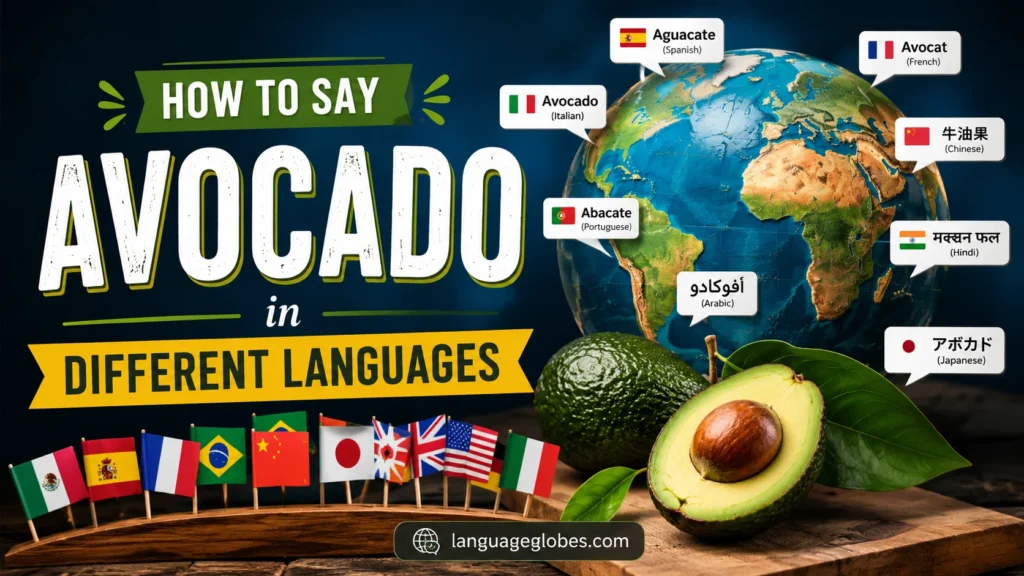
Discovering avocado in different languages reveals how this popular fruit connects people worldwide. This translation guide explores how to say avocado through cultures, regions, and unique language variations. The word avocado carries rich history from the Nahuatl word ahuacatl and ancient traditions.
Understanding avocado pronunciation helps language learners explore cultural diversity and improve global communication. The avocado meaning changes slightly across regions while preserving its role in food culture. From Spain to Mexico, translations reflect regional variations and global culinary connections.
Today, avocado translations appear across world languages with different expressions and pronunciation examples. Its creamy texture, rich nutrients, and nutritional benefits make it a valued nutritious fruit. People enjoy avocado in salads, sandwiches, smoothies, and guacamole across international menus.
Learning these food words supports travel language skills and creates stronger global connections. This expression in languages guide highlights food terminology and cultural appreciation through shared experiences. Exploring avocado fruit names introduces international culture and celebrates diverse culinary traditions worldwide.
Also read this: How to Say Ava in Different Languages
Interesting Facts About Avocado
- Avocado originated in Central and South America thousands of years ago.
- The fruit is scientifically classified as a berry.
- Avocados are rich in healthy monounsaturated fats.
- Mexico is one of the world’s largest avocado producers.
- The word “avocado” comes from the Nahuatl word “ahuacatl.”
- Avocados contain potassium, fiber, and essential vitamins.
- The fruit is used in sweet and savory dishes worldwide.
- Different countries may use slightly different names for avocado.
- Avocado trees can grow over 60 feet tall.
- Avocados have become a symbol of healthy eating in many cultures.
How to Say Avocado in Different Languages
European Languages
Europe is home to dozens of languages representing diverse cultures and traditions. Many European languages have adopted a version of the word avocado from Spanish or English, while others use localized spellings and pronunciations. Understanding these translations can be especially helpful when traveling across European countries or reading international recipes.
| Language | Country/Region | Translation | Pronunciation | Example Sentence |
| 🇺🇸 American English | USA | Avocado | av-uh-KAH-doh | I added avocado to my salad. |
| 🇬🇧 British English | UK | Avocado | av-uh-KAH-doh | Avocado toast is popular here. |
| 🇦🇺 Australian English | Australia | Avocado | av-uh-KAH-doh | I bought a fresh avocado today. |
| 🇪🇸 Spanish | Spain | Aguacate | ah-gwah-KAH-teh | Me gusta el aguacate. |
| 🇫🇷 French | France | Avocat | ah-vo-KAH | J’aime l’avocat dans la salade. |
| 🇩🇪 German | Germany | Avocado | ah-vo-KAH-do | Die Avocado ist lecker. |
| 🇮🇹 Italian | Italy | Avocado | ah-vo-KAH-do | Mangio un avocado fresco. |
| 🇵🇹 Portuguese | Portugal | Abacate | ah-bah-KAH-teh | Eu gosto de abacate. |
| 🇳🇱 Dutch | Netherlands | Avocado | ah-vo-KAH-do | Ik eet een avocado. |
| 🇸🇪 Swedish | Sweden | Avokado | ah-vo-KAH-do | Avokado är nyttigt. |
| 🇳🇴 Norwegian | Norway | Avokado | ah-vo-KAH-do | Jeg liker avokado. |
| 🇩🇰 Danish | Denmark | Avocado | ah-vo-KAH-do | Avocado smager godt. |
| 🇫🇮 Finnish | Finland | Avokado | ah-vo-KAH-do | Avokado on terveellistä. |
| 🇵🇱 Polish | Poland | Awokado | ah-vo-KAH-do | Lubię awokado. |
| 🇨🇿 Czech | Czech Republic | Avokádo | ah-vo-KAA-do | Jím avokádo často. |
| 🇸🇰 Slovak | Slovakia | Avokádo | ah-vo-KAA-do | Avokádo je chutné. |
| 🇭🇺 Hungarian | Hungary | Avokádó | ah-vo-KAA-doh | Szeretem az avokádót. |
| 🇷🇴 Romanian | Romania | Avocado | ah-vo-KAH-do | Îmi place avocado. |
| 🇬🇷 Greek | Greece | Αβοκάντο | avo-KAN-to | Μου αρέσει το αβοκάντο. |
| 🇷🇺 Russian | Russia | Авокадо | ah-vo-KAH-do | Я люблю авокадо. |
Asian Languages
Asia is the largest continent and contains an incredible variety of languages and cultures. While avocado is not native to many Asian countries, it has become increasingly popular due to globalization, healthy eating trends, and international cuisine. Many Asian languages use transliterations that closely resemble the original word.
| Language | Country/Region | Translation | Pronunciation | Example Sentence |
| 🇨🇳 Chinese (Mandarin) | China | 牛油果 | nyoh-you-gwoh | 我喜欢牛油果。 |
| 🇯🇵 Japanese | Japan | アボカド | ah-bo-ka-do | アボカドが好きです。 |
| 🇰🇷 Korean | South Korea | 아보카도 | ah-bo-ka-do | 아보카도를 먹어요. |
| 🇮🇳 Hindi | India | एवोकाडो | eh-vo-KAA-do | मुझे एवोकाडो पसंद है। |
| 🇵🇰 Urdu | Pakistan | ایووکاڈو | eh-vo-KAA-do | مجھے ایووکاڈو پسند ہے۔ |
| 🇧🇩 Bengali | Bangladesh | অ্যাভোকাডো | ae-vo-KAA-do | আমি অ্যাভোকাডো পছন্দ করি। |
| 🇮🇳 Punjabi | India/Pakistan | ਐਵੋਕਾਡੋ | ae-vo-KAA-do | ਮੈਨੂੰ ਐਵੋਕਾਡੋ ਪਸੰਦ ਹੈ। |
| 🇮🇳 Gujarati | India | એવોકાડો | eh-vo-KAA-do | મને એવોકાડો ગમે છે. |
| 🇮🇳 Marathi | India | ॲव्होकॅडो | ae-vo-KAA-do | मला ॲव्होकॅडो आवडते. |
| 🇮🇳 Tamil | India | அவகாடோ | ava-KAA-do | எனக்கு அவகாடோ பிடிக்கும். |
| 🇮🇳 Telugu | India | అవకాడో | ava-KAA-do | నాకు అవకాడో ఇష్టం. |
| 🇮🇳 Kannada | India | ಅವಕಾಡೊ | ava-KAA-do | ನನಗೆ ಅವಕಾಡೊ ಇಷ್ಟ. |
| 🇮🇳 Malayalam | India | അവക്കാഡോ | ava-KAA-do | എനിക്ക് അവക്കാഡോ ഇഷ്ടമാണ്. |
| 🇹🇭 Thai | Thailand | อะโวคาโด | a-vo-KA-do | ฉันชอบอะโวคาโด |
| 🇻🇳 Vietnamese | Vietnam | Bơ | buh | Tôi thích quả bơ. |
| 🇮🇩 Indonesian | Indonesia | Alpukat | al-poo-kat | Saya suka alpukat. |
| 🇲🇾 Malay | Malaysia | Avokado | ah-vo-KAH-do | Saya suka avokado. |
| 🇵🇭 Filipino | Philippines | Abukado | ah-boo-KAH-do | Gusto ko ang abukado. |
| 🇳🇵 Nepali | Nepal | एभोकाडो | eh-vo-KAA-do | मलाई एभोकाडो मन पर्छ। |
| 🇱🇰 Sinhala | Sri Lanka | අලිගැට පේර | ali-gata pera | මම අලිගැට පේර කැමතියි. |
African Languages
Africa is home to thousands of languages and rich cultural traditions. Avocados are widely grown and consumed in several African countries, particularly in East and Southern Africa. Many African languages have either adopted the international term or developed local names for the fruit.
| Language | Country/Region | Translation | Pronunciation | Example Sentence |
| 🇿🇦 Afrikaans | South Africa | Avokado | ah-vo-KAH-do | Ek hou van avokado. |
| 🇰🇪 Swahili | East Africa | Parachichi | pa-ra-CHEE-chee | Ninapenda parachichi. |
| 🇪🇹 Amharic | Ethiopia | አቮካዶ | ah-vo-KAH-do | አቮካዶ እወዳለሁ። |
| 🇳🇬 Yoruba | Nigeria | Avokado | ah-vo-KAH-do | Mo fẹ́ avokado. |
| 🇳🇬 Igbo | Nigeria | Ube oyibo | oo-bay oy-ee-bo | A na m eri ube oyibo. |
| 🇳🇬 Hausa | Nigeria | Avocado | ah-vo-KAH-do | Ina son avocado. |
| 🇿🇦 Zulu | South Africa | Ukwatapheya | oo-kwa-ta-PHE-ya | Ngithanda ukwatapheya. |
| 🇰🇪 Kikuyu | Kenya | Avocado | ah-vo-KAH-do | Nĩngwendete avocado. |
| 🇲🇬 Malagasy | Madagascar | Zavoka | za-VO-ka | Tiako ny zavoka. |
| 🇸🇴 Somali | Somalia | Avokado | ah-vo-KAH-do | Waxaan jeclahay avokado. |
Middle Eastern Languages
The Middle East has a long history of agriculture, trade, and cultural exchange. Although avocado cultivation became widespread relatively recently in the region, the fruit is now commonly found in markets, restaurants, and homes. Many Middle Eastern languages use transliterated versions of the word avocado.
| Language | Country/Region | Translation | Pronunciation | Example Sentence |
| 🇸🇦 Arabic | Middle East | أفوكادو | avo-KA-do | أحب الأفوكادو. |
| 🇮🇷 Persian | Iran | آووکادو | aa-vo-KAA-do | من آووکادو دوست دارم. |
| 🇹🇷 Turkish | Turkey | Avokado | ah-vo-KAH-do | Avokado seviyorum. |
| 🇮🇱 Hebrew | Israel | אבוקדו | avo-KA-do | אני אוהב אבוקדו. |
| 🇮🇶 Kurdish | Kurdistan Region | Avokado | ah-vo-KAH-do | Ez hez dikim avokado. |
| 🇴🇲 Omani Arabic | Oman | أفوكادو | avo-KA-do | أحب الأفوكادو الطازج. |
| 🇶🇦 Qatari Arabic | Qatar | أفوكادو | avo-KA-do | أكلت أفوكادو اليوم. |
| 🇦🇪 Emirati Arabic | UAE | أفوكادو | avo-KA-do | الأفوكادو صحي. |
| 🇱🇧 Lebanese Arabic | Lebanon | أفوكادو | avo-KA-do | بحب الأفوكادو. |
| 🇯🇴 Jordanian Arabic | Jordan | أفوكادو | avo-KA-do | الأفوكادو لذيذ. |
Additional Languages Around the World
Beyond Europe, Asia, Africa, and the Middle East, many other languages across the Americas and Oceania have their own words or adapted forms of avocado. These languages reflect the global spread of this nutritious fruit and demonstrate how cultures borrow and adapt vocabulary.
| Language | Country/Region | Translation | Pronunciation | Example Sentence |
| 🇲🇽 Mexican Spanish | Mexico | Aguacate | ah-gwah-KAH-teh | El aguacate es delicioso. |
| 🇧🇷 Brazilian Portuguese | Brazil | Abacate | ah-ba-ka-te | Eu gosto de abacate. |
| 🇭🇹 Haitian Creole | Haiti | Zaboka | za-bo-ka | Mwen renmen zaboka. |
| 🇳🇿 Māori | New Zealand | Awhekātō | a-weh-KAA-to | He pai ki ahau te awhekātō. |
| 🇼🇸 Samoan | Samoa | Avoka | ah-vo-ka | Ou te fiafia i le avoka. |
| 🇹🇴 Tongan | Tonga | ʻAvoka | ah-vo-ka | Oku ou saiʻia ʻa e avoka. |
| 🇫🇯 Fijian | Fiji | Avokado | ah-vo-KAH-do | Au taleitaka na avokado. |
| 🇬🇱 Greenlandic | Greenland | Avocado | ah-vo-KAH-do | Avocado mamartuuvoq. |
| 🇮🇸 Icelandic | Iceland | Lárpera | lahr-pe-ra | Mér finnst lárpera góð. |
| 🇮🇪 Irish | Ireland | Abhacáid | av-a-kawd | Is maith liom abhacáid. |
| 🏴 Welsh | Wales | Afocado | af-o-KA-do | Rwy’n hoffi afocado. |
| 🇪🇪 Estonian | Estonia | Avokaado | ah-vo-KAA-do | Mulle meeldib avokaado. |
| 🇱🇻 Latvian | Latvia | Avokado | ah-vo-KAH-do | Man garšo avokado. |
| 🇱🇹 Lithuanian | Lithuania | Avokadas | ah-vo-KA-das | Man patinka avokadas. |
| 🇺🇦 Ukrainian | Ukraine | Авокадо | ah-vo-KAH-do | Я люблю авокадо. |
| 🇧🇬 Bulgarian | Bulgaria | Авокадо | ah-vo-KAH-do | Обичам авокадо. |
| 🇭🇷 Croatian | Croatia | Avokado | ah-vo-KAH-do | Volim avokado. |
| 🇷🇸 Serbian | Serbia | Авокадо | ah-vo-KAH-do | Волим авокадо. |
| 🇸🇮 Slovenian | Slovenia | Avokado | ah-vo-KAH-do | Rad imam avokado. |
| 🇦🇱 Albanian | Albania | Avokado | ah-vo-KAH-do | Më pëlqen avokado. |
FAQs
How do you say avocado in different languages?
The word avocado is translated differently across world languages while keeping its connection to global food culture. This guide shares common avocado translations, pronunciation examples, and language variations from different regions.
What is the avocado meaning and origin of the word avocado?
The avocado meaning comes from the Nahuatl word ahuacatl, which was the original name used by ancient cultures. The word avocado reflects a rich history, traditions, and cultural connections.
How is avocado pronunciation different around the world?
Avocado pronunciation changes based on local accents and languages. Learning how to read avocado correctly helps language learners understand food terminology and improve communication.
Why is avocado popular in global food culture?
The avocado is a popular fruit because of its creamy texture, rich nutrients, and nutritional benefits. It appears in international menus and many worldwide cuisines.
How do Spanish-speaking countries say avocado?
In the Spanish-speaking world, the word varies by region, especially in Spain, Mexico, and South America. These regional variations show how languages adapt food names.
What are the health benefits of avocado?
The avocado fruit provides minerals, nutrients, and health benefits that support a balanced diet and healthy lifestyle. It is often considered a nutritious food choice.
How does avocado connect with cultural diversity?
The different names of avocado highlight cultural diversity, traditional foods, and culinary traditions. Learning these terms creates appreciation for international culture.
How is avocado used in different recipes worldwide?
People use avocado in salads, sandwiches, smoothies, and guacamole. Its flexible flavor makes it popular among food lovers and global cooks.
Why should travelers learn avocado in other languages?
Knowing avocado in a new language helps travelers communicate easily when exploring local markets and restaurants. It also improves understanding of food culture.
How many languages have avocado translations?
There are avocado translations in over 100 languages, showing its global popularity. These language variations demonstrate how food creates global connections.
Conclusion
Exploring how to say avocado in different languages reveals the connection between food culture, language learning, and global connections. The avocado translation journey shows how this popular fruit carries history, traditions, and cultural diversity across regions. From the Nahuatl word ahuacatl to modern world languages, avocado translations highlight unique language variations. Learning these expressions helps travelers, food lovers, and language learners appreciate international culture through a simple yet meaningful word.

Joshua Lewis is a passionate language enthusiast and content creator at LanguageGlobes.com. He specializes in exploring global languages, cultures, and communication trends, helping readers connect with the world through words.