
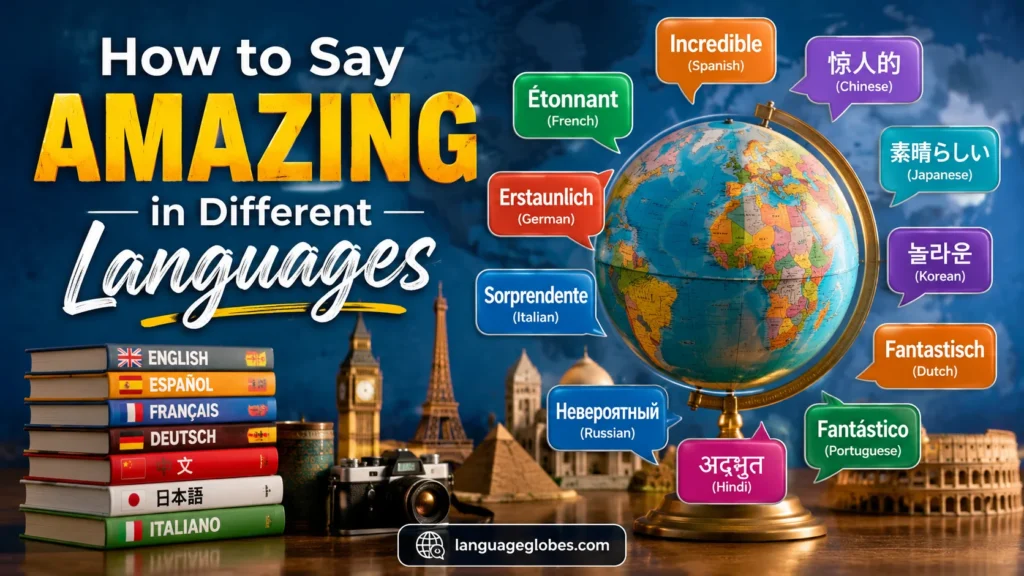
Learning amazing in different languages reveals how the same word can express feelings across different languages. From wonder and awe to heartfelt expressions, every culture shares unique ways to describe positive emotions and admiration. These translations help travelers, language learners, and students discover how people communicate in a native language.
Understanding cultural equivalents builds stronger connections, respect, and more meaningful conversations between people worldwide. Different regions share beautiful, wonderful, and extraordinary ways to express appreciation through language. This guide explores amazing translations with cultural insights for clearer global communication.
Explore how major languages present common translations and help readers pronounce amazing through pronunciation support. These language expressions show universal feeling of beauty, excellence, and surprise across many regions of the world. Readers can learn international languages while exploring cross cultural connection and multilingual learning with curiosity and openness.
The article highlights positive expressions and admiration words that create better conversations in a connected world. Discover global cultures and their unique ways to share impressive, surprising, and awe-inspiring messages through communication.
Also Read This: How to Say Ability in Different Languages
Interesting Facts About Amazing
- The word amazing comes from the English verb “amaze,” which means to fill someone with wonder or surprise.
- It is one of the most commonly used positive adjectives in modern English.
- Many cultures have multiple words that can translate to “amazing,” depending on the context.
- In some languages, the translation emphasizes beauty, while in others it highlights excellence or astonishment.
- Learning compliments like “amazing” is often one of the fastest ways to connect with native speakers.
- Positive words are among the most remembered vocabulary items when learning a new language.
- Social media, travel, and international communication have increased the popularity of multilingual compliments.
- Saying “amazing” in another language demonstrates cultural awareness and respect.
How to Say Amazing in Different Languages
Below are translations of the word amazing in more than 70 languages from around the world.
European Languages
Europe is home to hundreds of languages and dialects that reflect centuries of history, culture, and tradition. From the Romance languages of Southern Europe to the Germanic and Slavic languages of Northern and Eastern Europe, people use different words to express admiration and wonder. Learning how to say “amazing” in European languages can help travelers communicate appreciation and connect with locals more naturally.
| Language | Country/Region | Translation | Pronunciation | Example Sentence |
| 🇺🇸 American English | USA | Amazing | uh-MAY-zing | This view is amazing. |
| 🇬🇧 British English | UK | Amazing | uh-MAY-zing | The performance was amazing. |
| 🇦🇺 Australian English | Australia | Amazing | uh-MAY-zing | That beach is amazing. |
| French | 🇫🇷 France | Incroyable | an-kruh-yabl | C’est incroyable. |
| Spanish | 🇪🇸 Spain | Asombroso | ah-som-bro-so | Es asombroso. |
| Portuguese | 🇵🇹 Portugal | Incrível | in-kree-vel | Isso é incrível. |
| Italian | 🇮🇹 Italy | Straordinario | stra-or-dee-na-rio | È straordinario. |
| German | 🇩🇪 Germany | Erstaunlich | er-shtown-likh | Das ist erstaunlich. |
| Dutch | 🇳🇱 Netherlands | Geweldig | khe-vel-dikh | Dat is geweldig. |
| Swedish | 🇸🇪 Sweden | Fantastisk | fan-tas-tisk | Det är fantastisk. |
| Norwegian | 🇳🇴 Norway | Fantastisk | fan-tas-tisk | Det er fantastisk. |
| Danish | 🇩🇰 Denmark | Fantastisk | fan-tas-tisk | Det er fantastisk. |
| Finnish | 🇫🇮 Finland | Hämmästyttävä | ham-ma-stu-ta-va | Tämä on hämmästyttävä. |
| Icelandic | 🇮🇸 Iceland | Ótrúlegt | oh-troo-legt | Þetta er ótrúlegt. |
| Irish | 🇮🇪 Ireland | Iontach | un-takh | Tá sé iontach. |
| Welsh | 🏴 Wales | Anhygoel | an-hug-oil | Mae’n anhygoel. |
| Polish | 🇵🇱 Poland | Niesamowity | nye-sa-mo-vee-ty | To niesamowite. |
| Czech | 🇨🇿 Czech Republic | Úžasný | oo-zhas-nee | To je úžasné. |
| Slovak | 🇸🇰 Slovakia | Úžasný | oo-zhas-nee | To je úžasné. |
| Hungarian | 🇭🇺 Hungary | Csodálatos | cho-da-la-tosh | Ez csodálatos. |
| Romanian | 🇷🇴 Romania | Uimitor | oo-ee-mee-tor | Este uimitor. |
| Bulgarian | 🇧🇬 Bulgaria | Невероятен | ne-ve-ro-ya-ten | Това е невероятно. |
| Croatian | 🇭🇷 Croatia | Nevjerojatan | nev-ye-ro-ya-tan | Ovo je nevjerojatno. |
| Serbian | 🇷🇸 Serbia | Невероватан | ne-ve-ro-va-tan | Ovo je neverovatno. |
| Slovenian | 🇸🇮 Slovenia | Neverjeten | ne-ver-ye-ten | To je neverjetno. |
| Ukrainian | 🇺🇦 Ukraine | Дивовижний | di-vo-vizh-nyi | Це дивовижно. |
| Russian | 🇷🇺 Russia | Удивительный | oo-dee-vee-tel-ny | Это удивительно. |
| Greek | 🇬🇷 Greece | Καταπληκτικός | ka-ta-plee-ktee-kos | Είναι καταπληκτικό. |
| Albanian | 🇦🇱 Albania | I mrekullueshëm | ee mre-ku-loo-esh-em | Kjo është e mrekullueshme. |
Asian Languages
Asia is the largest continent in the world and contains an incredible variety of languages, writing systems, and cultures. From East Asia and South Asia to Southeast Asia and Central Asia, people use unique expressions to describe something extraordinary. Learning these words can enrich your travel experiences and help you appreciate the linguistic diversity of the region.
| Language | Country/Region | Translation | Pronunciation | Example Sentence |
| Chinese (Mandarin) | 🇨🇳 China | 惊人 | jing-ren | 这太惊人了。 |
| Japanese | 🇯🇵 Japan | 素晴らしい | su-ba-ra-shii | それは素晴らしいです。 |
| Korean | 🇰🇷 South Korea | 놀라운 | nol-la-un | 정말 놀라운 일이에요. |
| Hindi | 🇮🇳 India | अद्भुत | ad-bhoot | यह अद्भुत है। |
| Urdu | 🇵🇰 Pakistan | حیرت انگیز | hai-rat an-gez | یہ حیرت انگیز ہے۔ |
| Bengali | 🇧🇩 Bangladesh | অসাধারণ | o-sha-dha-ron | এটা অসাধারণ। |
| Punjabi | 🇮🇳/🇵🇰 Punjab | ਸ਼ਾਨਦਾਰ | shaan-daar | ਇਹ ਸ਼ਾਨਦਾਰ ਹੈ। |
| Gujarati | 🇮🇳 India | અદ્ભુત | ad-bhut | આ અદ્ભુત છે. |
| Marathi | 🇮🇳 India | आश्चर्यकारक | ash-char-ya-ka-rak | हे आश्चर्यकारक आहे. |
| Tamil | 🇮🇳 India | அற்புதமான | ar-pu-tha-maan | இது அற்புதமானது. |
| Telugu | 🇮🇳 India | అద్భుతమైన | ad-bhu-ta-maina | ఇది అద్భుతమైనది. |
| Kannada | 🇮🇳 India | ಅದ್ಭುತ | ad-bhu-ta | ಇದು ಅದ್ಭುತವಾಗಿದೆ. |
| Malayalam | 🇮🇳 India | അത്ഭുതകരമായ | ath-bhu-tha-ka-ra-ma-ya | ഇത് അത്ഭുതകരമാണ്. |
| Sinhala | 🇱🇰 Sri Lanka | පුදුමාකාර | pu-du-maa-ka-ra | මෙය පුදුමාකාරයි. |
| Nepali | 🇳🇵 Nepal | अचम्मको | a-cham-ma-ko | यो अचम्मको छ। |
| Thai | 🇹🇭 Thailand | น่าทึ่ง | na-thueng | มันน่าทึ่งมาก. |
| Vietnamese | 🇻🇳 Vietnam | Tuyệt vời | twyet-voi | Điều này thật tuyệt vời. |
| Indonesian | 🇮🇩 Indonesia | Luar biasa | loo-ar bee-a-sa | Ini luar biasa. |
| Malay | 🇲🇾 Malaysia | Menakjubkan | me-na-kjub-kan | Ini menakjubkan. |
| Filipino | 🇵🇭 Philippines | Kamangha-mangha | ka-mang-ha mang-ha | Ito ay kamangha-mangha. |
| Mongolian | 🇲🇳 Mongolia | Гайхалтай | gai-khal-tai | Энэ гайхалтай. |
| Kazakh | 🇰🇿 Kazakhstan | Таңғажайып | tang-ga-zhai-yp | Бұл таңғажайып. |
| Uzbek | 🇺🇿 Uzbekistan | Ajoyib | a-joy-ib | Bu ajoyib. |
| Khmer | 🇰🇭 Cambodia | អស្ចារ្យ | as-cha-rya | វាអស្ចារ្យណាស់។ |
African Languages
Africa is one of the most linguistically diverse continents, with thousands of languages spoken across its regions. Many African languages have rich oral traditions and unique ways of expressing admiration, gratitude, and excitement. Learning these translations provides a glimpse into the cultural richness and diversity of African communities.
| Language | Country/Region | Translation | Pronunciation | Example Sentence |
| Swahili | 🇹🇿 Tanzania/Kenya | Ajabu | a-ja-boo | Hii ni ajabu. |
| Zulu | 🇿🇦 South Africa | Kuyamangalisa | koo-ya-man-ga-lee-sa | Lokhu kuyamangalisa. |
| Xhosa | 🇿🇦 South Africa | Iyamangalisa | i-ya-man-ga-lee-sa | Oku kuyamangalisa. |
| Afrikaans | 🇿🇦 South Africa | Ongelooflik | on-ge-lof-lik | Dit is ongelooflik. |
| Yoruba | 🇳🇬 Nigeria | Iyanu | ee-ya-noo | Eyi jẹ iyanu. |
| Igbo | 🇳🇬 Nigeria | Dị ịtụnanya | dee ee-too-nan-ya | Nke a dị ịtụnanya. |
| Hausa | 🇳🇬 Nigeria | Abin Mamaki | a-bin ma-ma-ki | Wannan abin mamaki ne. |
| Amharic | 🇪🇹 Ethiopia | አስደናቂ | as-de-na-kee | ይህ አስደናቂ ነው። |
| Somali | 🇸🇴 Somalia | Cajiib | ca-jeeb | Tani waa cajiib. |
| Shona | 🇿🇼 Zimbabwe | Zvinoshamisa | zvi-no-sha-mi-sa | Izvi zvinoshamisa. |
| Kinyarwanda | 🇷🇼 Rwanda | Biratangaje | bee-ra-tan-ga-je | Biratangaje cyane. |
| Sesotho | 🇱🇸 Lesotho | Hlollang | hlo-lang | Sena sea hlollang. |
Middle Eastern Languages
The Middle East has a long history of literature, trade, science, and cultural exchange. Languages from this region often contain expressive words that communicate admiration, respect, and amazement. Whether you are learning Arabic, Persian, Turkish, or another regional language, knowing positive expressions can help create meaningful interactions.
| Language | Country/Region | Translation | Pronunciation | Example Sentence |
| Arabic | 🌍 Middle East | مدهش | mu-dhish | هذا مدهش. |
| Persian (Farsi) | 🇮🇷 Iran | شگفت انگیز | she-geft an-giz | این شگفت انگیز است. |
| Turkish | 🇹🇷 Turkey | Harika | ha-ri-ka | Bu harika. |
| Hebrew | 🇮🇱 Israel | מדהים | ma-de-him | זה מדהים. |
| Kurdish | 🌍 Kurdistan Region | شاندار | shan-dar | Ev şandar e. |
| Azerbaijani | 🇦🇿 Azerbaijan | Möhtəşəm | moh-ta-shem | Bu möhtəşəmdir. |
| Armenian | 🇦🇲 Armenia | Զարմանալի | zar-ma-na-lee | Սա զարմանալի է։ |
| Georgian | 🇬🇪 Georgia | საოცარი | sa-o-tsa-ri | ეს საოცარია. |
Additional Languages Around the World
Many other languages across Oceania, the Americas, and indigenous communities have their own unique words for expressing admiration and wonder. Exploring these languages highlights the incredible diversity of human communication and cultural expression around the globe.
| Language | Country/Region | Translation | Pronunciation | Example Sentence |
| Maori | 🇳🇿 New Zealand | Mīharo | mee-ha-ro | He mīharo tēnei. |
| Hawaiian | 🇺🇸 Hawaii | Kupanaha | koo-pa-na-ha | He kupanaha kēia. |
| Samoan | 🇼🇸 Samoa | Ofoofogia | o-fo-o-fo-gi-a | E ofoofogia lenei. |
| Tongan | 🇹🇴 Tonga | Fakaofo | fa-ka-o-fo | Oku fakaofo. |
| Fijian | 🇫🇯 Fiji | Vakurabuitaki | va-ku-ra-boo-i-ta-ki | E vakurabuitaki oqo. |
| Tahitian | 🇵🇫 Tahiti | Faahiahia | fa-a-hi-a-hi-a | E faahiahia teie. |
| Haitian Creole | 🇭🇹 Haiti | Etonan | ay-to-nan | Sa etonan anpil. |
| Quechua | 🇵🇪 Peru | Musphay | moos-fai | Kayqa musphaymi. |
| Guarani | 🇵🇾 Paraguay | Hechapyrã | he-cha-pi-ra | Kóva hechapyrã. |
| Navajo | 🇺🇸 USA | Hózhǫ́ | ho-zho | Díí hózhǫ́. |
FAQs
What does amazing mean in different languages?
The phrase amazing in different languages shows how cultures express wonder, awe, and strong positive emotions through unique words. These translations help people understand global ways of sharing admiration.
Why do people learn the word amazing in different languages?
Learning this word in different languages improves communication and creates stronger connections with people from various cultures. It also helps explore global cultures and their expressions.
How can I say amazing in other languages?
You can find amazing translations in many international languages, where each native language offers unique language expressions. These cultural equivalents reflect different ways of showing appreciation.
What emotions does the word amazing express?
The word represents positive emotions, admiration, and a feeling of surprise or excitement. It is often used for a beautiful place, delicious food, or a person’s achievement.
How does learning amazing translations help language learners?
For language learners and students, learning these translations improves vocabulary and supports multilingual learning. It also provides useful cultural insights about communication.
How do different cultures express the meaning of amazing?
Different cultures use various positive expressions to describe something wonderful, impressive, or extraordinary. These differences show the beauty of cultural diversity.
Can travelers use amazing words in other languages?
Yes, travelers can use these words to create friendly conversations and show respect. Learning simple admiration words helps build better cross cultural connection.
How do I pronounce amazing in different languages?
To pronounce amazing correctly, learners can explore pronunciation guides and practice each language expression. This makes global communication easier and more natural.
Why is amazing considered a universal feeling?
The idea of amazing connects people because wonder, beauty, and excellence are shared human experiences. Different regions of the world express this feeling in unique ways.
What makes amazing translations meaningful across the world?
These accurate translations reveal unique ways people share appreciation and admiration. They highlight how language creates meaningful connections through international languages and shared emotions.
Conclusion
Exploring amazing in different languages helps you discover how different languages express wonder, awe, and positive emotions across global cultures. These translations reveal unique language expressions that improve communication, encourage cross cultural connection, and create deeper understanding. Learning these admiration words adds value to your vocabulary while celebrating the cultural diversity of the world. Whether you are a traveler, student, or language learner, these positive expressions make conversations more meaningful and memorable.

Joshua Lewis is a passionate language enthusiast and content creator at LanguageGlobes.com. He specializes in exploring global languages, cultures, and communication trends, helping readers connect with the world through words.