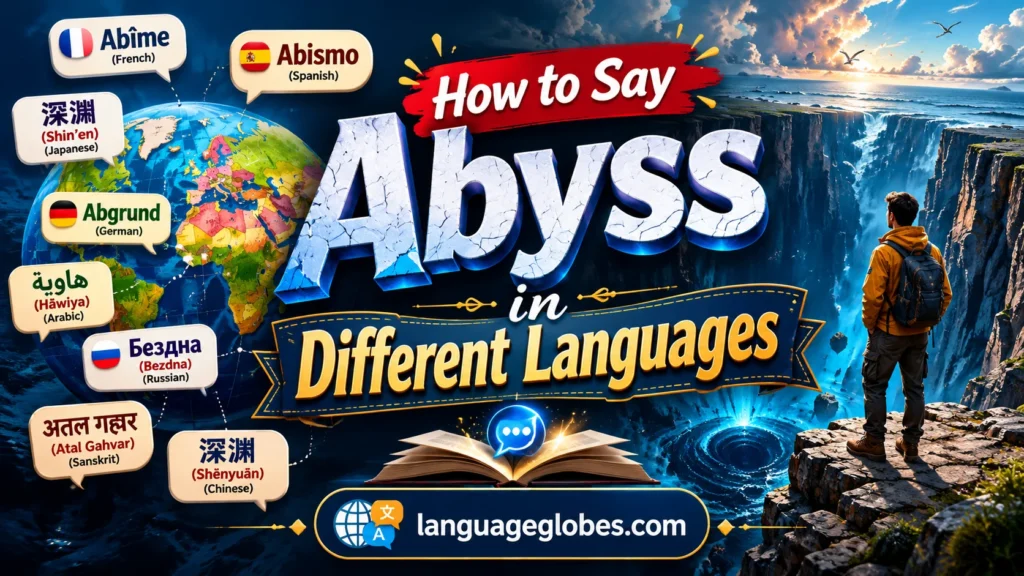
Learning how to say abyss in different languages reveals how people describe the deep immeasurable space beyond understanding. Across cultures, this word can express a chasm, void, or literal meaning connected with profound depths and vastness. This word abyss carries ideas of depth, human language, and how societies understand uncertainty, darkness, and mystery.
Many poets, writers, philosophers, and storytellers use it to explore the unknown, hidden fears, and unexplored territories. The term also appears in emotional experiences, spiritual beliefs, mythology, and philosophical concepts across world cultures.
This guide helps language learners, travelers, and students discover vocabulary with better cultural understanding through translations. Exploring global languages provides correct native terms, English pronunciations, and a useful pronunciation guide for multilingual translations.
From Arabic hawiyah to other expressions, these meanings expand language skills and improve communication skills. Understanding abyss translations offers a deeper view of mystery depth and diverse expressions found worldwide. It becomes a valuable reference guide for exploring word meaning through reading, learning, and curiosity.
Also read this: How to Say Above in Different Languages
Interesting Facts About Abyss
- The word abyss originates from the Greek word abyssos, meaning “bottomless.”
- In literature, an abyss often symbolizes mystery, fear, or the unknown.
- Oceanographers use the term “abyssal zone” to describe extremely deep parts of the ocean.
- Many religious texts mention an abyss as a place of great depth or spiritual significance.
- The concept of an abyss appears in myths and legends across numerous cultures.
- Philosophers often use the abyss as a metaphor for existential questions.
- The word can describe both physical depths and emotional states.
- Modern science uses abyss-related terminology when studying deep-sea ecosystems.
- The symbolic meaning of an abyss varies widely between cultures.
- Learning translations of abstract words like abyss helps deepen cultural understanding.
How to Say Abyss in Different Languages
European Languages
Europe is home to many of the world’s most widely spoken languages. These languages belong to several language families, including Romance, Germanic, Slavic, and Celtic groups. While the translations differ, many European languages share historical roots that influence their vocabulary for concepts such as depth, void, and abyss.
| Language | Country/Region | Translation | Pronunciation | Example Sentence |
| 🇺🇸 American English | United States | Abyss | uh-BISS | The explorer stared into the abyss. |
| 🇬🇧 British English | United Kingdom | Abyss | uh-BISS | The abyss seemed endless. |
| 🇦🇺 Australian English | Australia | Abyss | uh-BISS | The diver feared the abyss below. |
| 🇫🇷 French | France | Abîme | ah-BEEM | Il regardait l’abîme. |
| 🇪🇸 Spanish | Spain | Abismo | ah-BEES-mo | Miró hacia el abismo. |
| 🇵🇹 Portuguese | Portugal | Abismo | ah-BEEZ-moo | Ele observou o abismo. |
| 🇮🇹 Italian | Italy | Abisso | ah-BEES-so | Guardò nell’abisso. |
| 🇩🇪 German | Germany | Abgrund | AHB-groont | Er blickte in den Abgrund. |
| 🇳🇱 Dutch | Netherlands | Afgrond | AF-gront | Hij keek in de afgrond. |
| 🇸🇪 Swedish | Sweden | Avgrund | AV-groond | Han såg ner i avgrunden. |
| 🇳🇴 Norwegian | Norway | Avgrunn | AV-groon | Han stirret ned i avgrunnen. |
| 🇩🇰 Danish | Denmark | Afgrund | AF-groon | Han kiggede ned i afgrunden. |
| 🇫🇮 Finnish | Finland | Kuilu | KOO-ee-loo | Hän katsoi kuiluun. |
| 🇮🇸 Icelandic | Iceland | Hyldýpi | HIL-dee-pi | Hann horfði í hyldýpið. |
| 🇵🇱 Polish | Poland | Otchłań | OHT-hwan | Spojrzał w otchłań. |
| 🇨🇿 Czech | Czech Republic | Propast | PRO-past | Díval se do propasti. |
| 🇸🇰 Slovak | Slovakia | Priepasť | PREE-eh-past | Pozeral do priepasti. |
| 🇭🇺 Hungarian | Hungary | Mélység | MAY-lay-shayg | Az mélységbe nézett. |
| 🇷🇴 Romanian | Romania | Abis | ah-BEES | A privit în abis. |
| 🇧🇬 Bulgarian | Bulgaria | Бездна | BEZ-dna | Той гледаше в бездната. |
| 🇭🇷 Croatian | Croatia | Bezdan | BEZ-dan | Gledao je u bezdan. |
| 🇷🇸 Serbian | Serbia | Бездан | BEZ-dan | Гледао је у бездан. |
| 🇸🇮 Slovenian | Slovenia | Brezno | BREZ-no | Gledal je v brezno. |
| 🇺🇦 Ukrainian | Ukraine | Безодня | beh-ZOD-nya | Він дивився в безодню. |
| 🇷🇺 Russian | Russia | Бездна | BYEZ-dna | Он смотрел в бездну. |
| 🇬🇷 Greek | Greece | Άβυσσος | A-vee-sos | Κοίταξε την άβυσσο. |
Asian Languages
Asia is the largest continent and contains thousands of languages representing diverse cultures and traditions. Many Asian languages have unique words for abyss that reflect local philosophies, spiritual traditions, and connections to nature. Some translations emphasize deep chasms, while others highlight immeasurable depths.
| Language | Country/Region | Translation | Pronunciation | Example Sentence |
| 🇨🇳 Chinese (Simplified) | China | 深渊 | Shen-Yuan | 他凝视着深渊。 |
| 🇹🇼 Chinese (Traditional) | Taiwan | 深淵 | Shen-Yuan | 他凝視著深淵。 |
| 🇯🇵 Japanese | Japan | 深淵 | Shin-en | 彼は深淵を見つめた。 |
| 🇰🇷 Korean | South Korea | 심연 | Shim-yeon | 그는 심연을 바라보았다. |
| 🇮🇳 Hindi | India | अथाह गहराई | A-thaah Gah-ra-ee | उसने अथाह गहराई को देखा। |
| 🇮🇳 Bengali | Bangladesh/India | অতল গহ্বর | O-tol Go-hor | সে অতল গহ্বরের দিকে তাকাল। |
| 🇮🇳 Punjabi | India/Pakistan | کھائی | Kha-ee | اس نے کھائی کی طرف دیکھا۔ |
| 🇵🇰 Urdu | Pakistan | پاتال گہرائی | Pataal Geh-ra-ee | وہ پاتال گہرائی کو دیکھ رہا تھا۔ |
| 🇮🇳 Gujarati | India | અગાધ ખાઈ | A-gaadh Kha-ee | તેણે અગાધ ખાઈ જોઈ. |
| 🇮🇳 Marathi | India | अथांग दरी | A-thaang Da-ree | त्याने अथांग दरी पाहिली. |
| 🇮🇳 Tamil | India | ஆழ்குழி | Aazh-ku-li | அவர் ஆழ்குழியை பார்த்தார். |
| 🇮🇳 Telugu | India | అగాధం | A-gaa-dham | అతను అగాధాన్ని చూశాడు. |
| 🇮🇳 Kannada | India | ಅತಳ | A-ta-la | ಅವನು ಅತಳವನ್ನು ನೋಡಿದನು. |
| 🇮🇳 Malayalam | India | അഗാധം | A-gaa-dham | അവൻ അഗാധത്തെ നോക്കി. |
| 🇹🇭 Thai | Thailand | เหวลึก | Way-Luek | เขามองลงไปในเหวลึก |
| 🇻🇳 Vietnamese | Vietnam | Vực thẳm | Vook-Tham | Anh ấy nhìn xuống vực thẳm. |
| 🇮🇩 Indonesian | Indonesia | Jurang | Joo-rang | Dia melihat jurang itu. |
| 🇲🇾 Malay | Malaysia | Jurang | Joo-rang | Dia memandang jurang itu. |
| 🇵🇭 Filipino | Philippines | Bangin | Bang-in | Tumingin siya sa bangin. |
| 🇰🇭 Khmer | Cambodia | ជ្រោះជ្រៅ | Chroh Chrau | គាត់មើលទៅជ្រោះជ្រៅ។ |
| 🇱🇦 Lao | Laos | ເຫວເລິກ | Way-Lerk | ລາວເບິ່ງເຫວເລິກ. |
| 🇲🇳 Mongolian | Mongolia | Ангал | An-gal | Тэр ангал руу харлаа. |
| 🇳🇵 Nepali | Nepal | अतल | A-tal | उसले अतलतर्फ हेर्यो। |
African Languages
Africa is home to extraordinary linguistic diversity, with thousands of languages spoken across the continent. Many African languages express the concept of an abyss through words describing deep valleys, pits, chasms, or profound depths found in nature.
| Language | Country/Region | Translation | Pronunciation | Example Sentence |
| 🇿🇦 Swahili | East Africa | Kuzimu | Koo-zee-moo | Aliitazama kuzimu. |
| 🇿🇦 Zulu | South Africa | Umhosha | Um-ho-sha | Wabheka umhosha. |
| 🇿🇦 Xhosa | South Africa | Umwonyo | Um-wo-nyo | Wajonga umwonyo. |
| 🇳🇬 Yoruba | Nigeria | Kòtò Jinlẹ̀ | Ko-to Jin-le | Ó wo kòtò jinlẹ̀ náà. |
| 🇳🇬 Igbo | Nigeria | Olulu miri emi | O-loo-loo | O lere anya n’olulu ahụ. |
| 🇳🇬 Hausa | Nigeria | Rami mai zurfi | Rah-mee Mai Zoor-fee | Ya kalli ramin. |
| 🇪🇹 Amharic | Ethiopia | ጥልቅ ጉድጓድ | Tilik Gudgwad | ጉድጓዱን አየ። |
| 🇰🇪 Somali | Somalia | God dheer | God Dheer | Wuxuu eegay godka dheer. |
| 🇿🇼 Shona | Zimbabwe | Gomba rakadzika | Gom-ba | Akatarisa gomba rakadzika. |
| 🇧🇼 Tswana | Botswana | Sekoti se segolo | Se-ko-ti | O ne a leba sekoti. |
Middle Eastern Languages
The Middle East has a rich linguistic history that stretches back thousands of years. Languages from this region often connect the concept of an abyss with spirituality, ancient literature, deserts, seas, and philosophical thought. These translations reveal deep cultural and historical influences.
| Language | Country/Region | Translation | Pronunciation | Example Sentence |
| 🇸🇦 Arabic | Middle East | هاوية | Hawiya | نظر إلى الهاوية. |
| 🇮🇷 Persian (Farsi) | Iran | پرتگاه | Part-gah | او به پرتگاه نگاه کرد. |
| 🇹🇷 Turkish | Türkiye | Uçurum | Oo-choo-room | Uçuruma baktı. |
| 🇮🇱 Hebrew | Israel | תהום | Te-hom | הוא הביט אל התהום. |
| 🇰🇼 Kurdish | Kurdistan Region | Abys | A-bis | Ew li abyssê temaşe kir. |
| 🇦🇲 Armenian | Armenia | Անդունդ | An-doond | Նա նայեց անդունդին։ |
| 🇬🇪 Georgian | Georgia | უფსკრული | Oop-skroo-lee | მან უფსკრულს შეხედა. |
| 🇦🇿 Azerbaijani | Azerbaijan | Uçurum | Oo-choo-room | O uçuruma baxdı. |
Additional Languages Around the World
Many other languages from Oceania, the Americas, and indigenous communities have unique expressions for profound depths and chasms. Learning these translations helps create a broader understanding of global communication and cultural diversity.
| Language | Country/Region | Translation | Pronunciation | Example Sentence |
| 🇳🇿 Māori | New Zealand | Poka hōhonu | Po-ka Ho-ho-noo | I titiro ia ki te poka hōhonu. |
| 🇼🇸 Samoan | Samoa | To | Toh | Sa tilotilo o ia i le to. |
| 🇹🇴 Tongan | Tonga | Luo loloto | Loo-oh Lo-lo-to | Na’a ne sio ki he luo loloto. |
| 🇭🇹 Haitian Creole | Haiti | Abim | Ah-beem | Li gade abim nan. |
| 🇬🇱 Greenlandic | Greenland | Itissuseq | Ee-tis-su-seq | Takuvaa itissuseq. |
| 🇨🇦 Inuktitut | Arctic Canada | ᐃᑎᔪᖅ | I-ti-yuq | ᐃᑎᔪᖅ ᑕᑯᔪᖅ. |
| 🇺🇸 Hawaiian | Hawaii | Lua hohonu | Loo-ah Ho-ho-noo | Nānā ʻo ia i ka lua hohonu. |
| 🇵🇾 Guarani | Paraguay | Yvykua pypuku | Uv-i-kwa Pi-poo-koo | Ohecha yvykua pypuku. |
| 🇵🇪 Quechua | Peru | Ukhu wayq’u | Oo-khoo Wai-koo | Payqa ukhu wayq’uta qhawarqan. |
| 🇲🇽 Nahuatl | Mexico | Tlaxaloni | Tla-sha-lo-ni | Quitlachixqui tlaxaloni. |
FAQs
What is the meaning of abyss in different languages?
The word abyss describes a deep and often immeasurable space connected with a void, chasm, or great depth. Its literal meaning and metaphorical meaning vary across world cultures and human language.
How do you say abyss in various global languages?
The translation of abyss changes between native languages and cultures. Exploring abyss translations helps learners understand diverse expressions and improve their multilingual vocabulary.
What is the literal meaning and metaphorical meaning of abyss?
The literal meaning refers to a bottomless pit, extreme depth, or unknown space, while the metaphorical meaning represents uncertainty, darkness, mystery, and emotional experiences.
How is abyss used in literature and storytelling?
Many poets, writers, and storytellers use abyss to describe profound depths, unknown places, fears, and powerful human emotions. It often appears in literature with symbolic meanings.
How can I learn the pronunciation guide for abyss?
A pronunciation guide helps learners understand English pronunciations and native speech patterns. Learning the correct sound improves communication skills and overall language skills.
Why is understanding abyss important for language learners?
Learning words like abyss supports vocabulary expansion and improves cultural understanding. It helps students, travelers, and language enthusiasts connect with world languages.
What does abyss represent in mythology and spiritual beliefs?
In mythology and spiritual beliefs, the abyss can represent mystery, creation, danger, or the unknown. Different societies connect it with unique philosophical concepts.
How does the word abyss connect with philosophy and human thoughts?
The concept of an abyss explores uncertainty, vastness, and the search for meaning. Philosophers often use it to discuss the unknown and human existence.
Can abyss describe emotional experiences as well as physical spaces?
Yes, abyss can describe emotional depth, fear, isolation, or confusion. It is commonly used as a powerful concept beyond physical ocean depth or sea references.
Where can I find a complete language guide for the word abyss?
A detailed language guide provides translations, native terms, and pronunciation details for global use. It works as a reference guide for exploring word meaning worldwide.
Conclusion
Exploring how to say abyss across different languages reveals the beauty of human language, cultural understanding, and global expressions. The word abyss carries meanings of depth, mystery, and the unknown, connecting world cultures through translations and shared ideas. This reference guide helps language learners discover native terms, pronunciation guide details, and expand their vocabulary with confidence. Understanding these abyss translations creates deeper appreciation for global languages, literature, and the diverse ways people describe vastness and profound depths.

Lucy Carter is a curious mind and language lover who writes for Language Globes. She enjoys discovering new languages and sharing simple, helpful ideas that make learning fun and accessible for everyone.