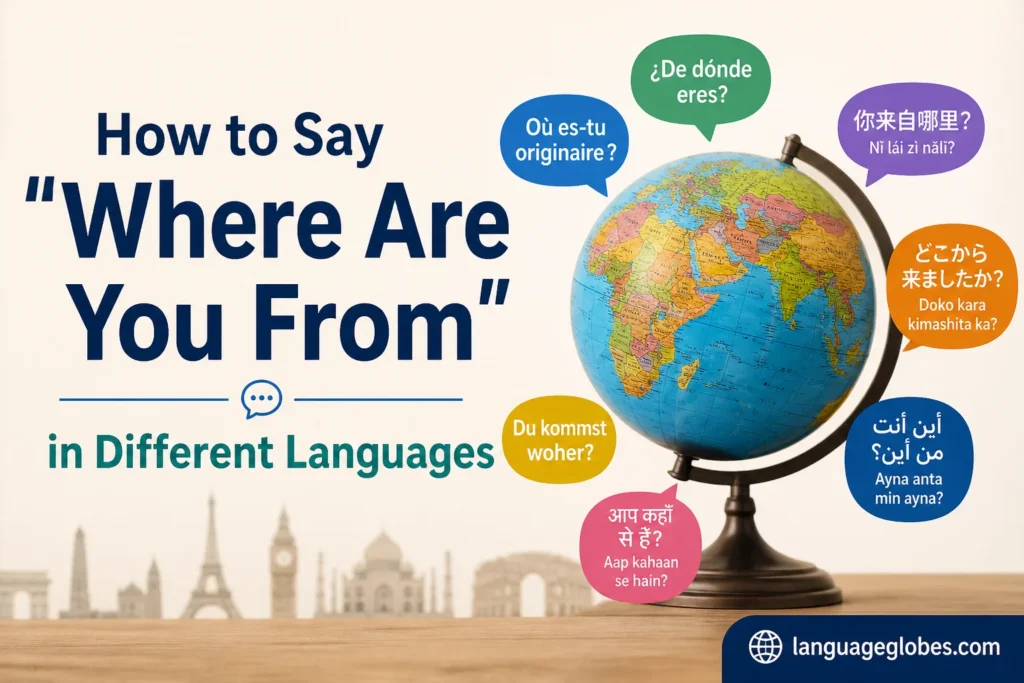
In my experience, How to Say “Where Are You From” in Different Languages becomes a powerful way to connect with people across cultures easily. From my own traveling and learning journey, I’ve seen how a simple question like where are you from can start conversations and build meaningful relationships. This common approach helps you ask in different languages and show real interest in someone’s background, heritage, and experiences, creating deeper cultural exchange in a globalized world shaped by migration, travel, and global communication.
When you learn to say this in multiple languages, your goal becomes clearer—to communicate with others politely and confidently. This article acts as a guide to help you discover translations, meanings, and pronunciation tips with easy example sentences. Each example is designed to express yourself quickly, whether you are abroad, online, or exploring a multicultural community. I’ve personally noticed that using even one local phrase can make someone smile and turn a moment into a real connection.
If you search for ways to inquire about one’s origin, you’ll notice this is one of the most natural conversation starters. It goes beyond mere curiosity—it shows respect and demonstrates a genuine wish to know another person’s identity. Just as yes varies in different languages, this phrase also changes, making it a gateway to better understanding. As you delve into all 70 variations, this small effort truly fosters relationships, especially when making friends and meeting new people you meet along the way, wherever life comes.
Interesting Facts About “Where Are You From”
- Asking about someone’s origin is a universal way to start conversations and build rapport.
- Different cultures may have unique ways of phrasing this question, reflecting local customs and politeness.
- Learning even a few words in another language can instantly make interactions more positive and memorable.
- In some cultures, the question is seen as highly personal, while in others, it’s a common icebreaker.
European Languages
Europe is home to diverse languages shaped by centuries of history, migration, and cultural exchange. From the romance languages of the south to the Germanic and Slavic tongues of the north and east, Europe offers a rich tapestry of linguistic traditions.
| Language | Country/Region | Translation | Pronunciation | Example Sentence |
| English (American) 🇺🇸 | United States | Where are you from? | /wɛr ɑːr ju frəm/ | Where are you from originally? |
| English (British) 🇬🇧 | United Kingdom | Where are you from? | /wɛə ɑː ju frɒm/ | Where are you from, if you don’t mind me asking? |
| English (Australian) 🇦🇺 | Australia | Where are you from? | /wɛə ɑː ju frəm/ | Where are you from, mate? |
| Spanish 🇪🇸 | Spain | ¿De dónde eres? | /de ‘ðonde ‘eɾes/ | ¿De dónde eres tú? |
| French 🇫🇷 | France | D’où venez-vous ? | /du ve.ne vu/ | Bonjour! D’où venez-vous ? |
| German 🇩🇪 | Germany | Woher kommst du? | /voːˈheːɐ̯ kɔmst du/ | Hallo! Woher kommst du? |
| Italian 🇮🇹 | Italy | Di dove sei? | /di ‘dove sei/ | Ciao! Di dove sei? |
| Portuguese 🇵🇹 | Portugal | De onde você é? | /dʒi ‘õdʒi vo’se ɛ/ | Olá! De onde você é? |
| Russian 🇷🇺 | Russia | Откуда вы? | /otˈkuda vɨ/ | Привет! Откуда вы? |
| Dutch 🇳🇱 | Netherlands | Waar kom je vandaan? | /ʋaːr kɔm jə vɑn’daːn/ | Hallo! Waar kom je vandaan? |
| Swedish 🇸🇪 | Sweden | Var kommer du ifrån? | /var ‘kɔmːər dʉ i’frɔːn/ | Hej! Var kommer du ifrån? |
| Polish 🇵🇱 | Poland | Skąd jesteś? | /skɔnt ‘jɛstɛɕ/ | Cześć! Skąd jesteś? |
| Greek 🇬🇷 | Greece | Από πού είσαι; | /apo pu ‘ise/ | Γειά σου! Από πού είσαι; |
| Norwegian 🇳🇴 | Norway | Hvor kommer du fra? | /vʊr ‘kɔmːər dʉ frɑː/ | Hei! Hvor kommer du fra? |
| Finnish 🇫🇮 | Finland | Mistä olet kotoisin? | /ˈmistɑ ‘olet ‘kotoisin/ | Hei! Mistä olet kotoisin? |
| Hungarian 🇭🇺 | Hungary | Honnan jöttél? | /ˈhonːɒn ˈjøːteːl/ | Szia! Honnan jöttél? |
Asian Languages
Asia is the largest continent with incredible linguistic diversity. From tonal languages like Mandarin to syllabic scripts like Japanese, each language carries centuries of history and cultural nuance.
| Language | Country/Region | Translation | Pronunciation | Example Sentence |
| Chinese (Mandarin) 🇨🇳 | China | 你从哪里来? | /nǐ cóng nǎ lǐ lái?/ | 你好,你从哪里来? |
| Japanese 🇯🇵 | Japan | どこから来ましたか? | /doko kara kimashita ka?/ | こんにちは、どこから来ましたか? |
| Korean 🇰🇷 | South Korea | 어디에서 오셨어요? | /eodieseo osyeosseoyo?/ | 안녕하세요! 어디에서 오셨어요? |
| Hindi 🇮🇳 | India | आप कहाँ से हैं? | /aap kahan se hain?/ | नमस्ते! आप कहाँ से हैं? |
| Bengali 🇧🇩 | Bangladesh | তুমি কোথা থেকে এসেছ? | /tumi kotha theke esecho?/ | হ্যালো! তুমি কোথা থেকে এসেছ? |
| Thai 🇹🇭 | Thailand | คุณมาจากที่ไหน? | /khun ma jaak thee nai?/ | สวัสดี! คุณมาจากที่ไหน? |
| Vietnamese 🇻🇳 | Vietnam | Bạn đến từ đâu? | /ban den tu dau?/ | Xin chào! Bạn đến từ đâu? |
| Urdu 🇵🇰 | Pakistan | آپ کہاں سے ہیں؟ | /aap kahan se hain?/ | ہیلو! آپ کہاں سے ہیں؟ |
| Filipino/Tagalog 🇵🇭 | Philippines | Taga saan ka? | /taːga ‘sa.an ka?/ | Kumusta! Taga saan ka? |
| Malay 🇲🇾 | Malaysia | Dari mana asal anda? | /dari mana asal anda?/ | Hai! Dari mana asal anda? |
| Indonesian 🇮🇩 | Indonesia | Dari mana asalmu? | /dari mana ‘asalmu?/ | Halo! Dari mana asalmu? |
| Tamil 🇮🇳 | India/Sri Lanka | நீங்கள் எங்கிருந்து வந்தீர்கள்? | /neenga engirundhu vandheerka?/ | வணக்கம்! நீங்கள் எங்கிருந்து வந்தீர்கள்? |
| Telugu 🇮🇳 | India | మీరు ఎక్కడి నుండి వచ్చారు? | /meeru ekkadi nundi vachaaru?/ | హలో! మీరు ఎక్కడి నుండి వచ్చారు? |
| Punjabi 🇮🇳/🇵🇰 | India/Pakistan | ਤੁਸੀਂ ਕਿੱਥੋਂ ਆਏ ਹੋ? | /tusi kithon aaye ho?/ | ਸਤ ਸ੍ਰੀ ਅਕਾਲ! ਤੁਸੀਂ ਕਿੱਥੋਂ ਆਏ ਹੋ? |
| Arabic (Modern Standard) 🇸🇦 | Saudi Arabia | من أين أنت؟ | /min ayna anta?/ | مرحبا! من أين أنت؟ |
African Languages
Africa is home to thousands of languages across diverse ethnic groups. From Bantu languages to Afro-Asiatic languages, Africa’s linguistic heritage is incredibly rich and expressive.
| Language | Country/Region | Translation | Pronunciation | Example Sentence |
| Swahili 🇰🇪 | Kenya | Unatoka wapi? | /u.na.to.ka wa.pi/ | Hujambo! Unatoka wapi? |
| Zulu 🇿🇦 | South Africa | Uvela kuphi? | /u’ve.la ‘ku.pi/ | Sawubona! Uvela kuphi? |
| Xhosa 🇿🇦 | South Africa | Uvela phi? | /u’ve.la fi/ | Molo! Uvela phi? |
| Yoruba 🇳🇬 | Nigeria | Nibo ni o ti wa? | /ni.bo ni o ti wa/ | Bawo! Nibo ni o ti wa? |
| Hausa 🇳🇬/🇳🇮 | Nigeria/Niger | Daga ina ka fito? | /da.ga i.na ka fi.to/ | Sannu! Daga ina ka fito? |
| Amharic 🇪🇹 | Ethiopia | ከየት ነህ? | /kə yet neh?/ | ሰላም! ከየት ነህ? |
| Somali 🇸🇴 | Somalia | Xagee ka timid? | /xa’geː ka ‘ti.mid/ | Salaan! Xagee ka timid? |
| Shona 🇿🇼 | Zimbabwe | Unobva kupi? | /u.no.bva ku.pi/ | Mhoro! Unobva kupi? |
| Igbo 🇳🇬 | Nigeria | Ị si ebee? | /i si ‘e.beː/ | Ndewo! Ị si ebee? |
| Malagasy 🇲🇬 | Madagascar | Avy aiza ianao? | /a.vi a’iza i.nao/ | Salama! Avy aiza ianao? |
Read More: How to Say “Have a Good Day” in Different Languages
Middle Eastern Languages
Middle Eastern languages carry deep cultural and historical significance. From Semitic languages like Arabic and Hebrew to Persian, they reflect the region’s rich civilizations and literary traditions.
| Language | Country/Region | Translation | Pronunciation | Example Sentence |
| Arabic 🇸🇦 | Saudi Arabia | من أين أنت؟ | /min ayna anta?/ | مرحبا! من أين أنت؟ |
| Hebrew 🇮🇱 | Israel | מאיפה אתה? | /me’eifo ata?/ | שלום! מאיפה אתה? |
| Turkish 🇹🇷 | Turkey | Nerelisiniz? | /ne.re.li.si.niz/ | Merhaba! Nerelisiniz? |
| Persian/Farsi 🇮🇷 | Iran | اهل کجا هستید؟ | /ahl-e koja hastid?/ | سلام! اهل کجا هستید؟ |
| Kurdish 🇮🇶/🇹🇷 | Iraq/Turkey | Tu ji ku yî? | /tu ʒi ku ji/ | Slaw! Tu ji ku yî? |
| Arabic (Egyptian) 🇪🇬 | Egypt | إنت منين؟ | /enta menīn?/ | مرحبا! إنت منين؟ |
FAQ
1. Why is learning how to say “Where are you from?” important?
It helps build cross-cultural connections, shows interest in others, and can start meaningful conversations.
2. Are there cultural differences in asking about someone’s origin?
Yes. In some cultures, it’s a polite icebreaker; in others, it may be seen as too personal.
3. Can I use a direct translation of “Where are you from?” everywhere?
Not always. It’s best to learn the culturally appropriate version or context for asking the question.
4. Which languages are easiest for English speakers to learn this phrase in?
Languages like Spanish, French, German, and Italian are often easier due to shared alphabets and familiar grammar.
5. Is pronunciation really important when asking this question?
Yes. Proper pronunciation shows respect and makes the conversation smoother.
Conclusion
Learning how to say “Where are you from?” in different languages is more than memorizing words—it is a gateway to understanding, empathy, and global friendship. Every language offers a unique way to connect with someone, respect their background, and bridge cultural gaps. By embracing linguistic diversity, we celebrate human connection and open ourselves to a world full of stories, experiences, and shared humanity.
This article covers 70+ languages across Europe, Asia, Africa, and the Middle East, providing translations, pronunciations, and example sentences to make your interactions smoother and more meaningful.

Lucy Carter is a curious mind and language lover who writes for Language Globes. She enjoys discovering new languages and sharing simple, helpful ideas that make learning fun and accessible for everyone.