
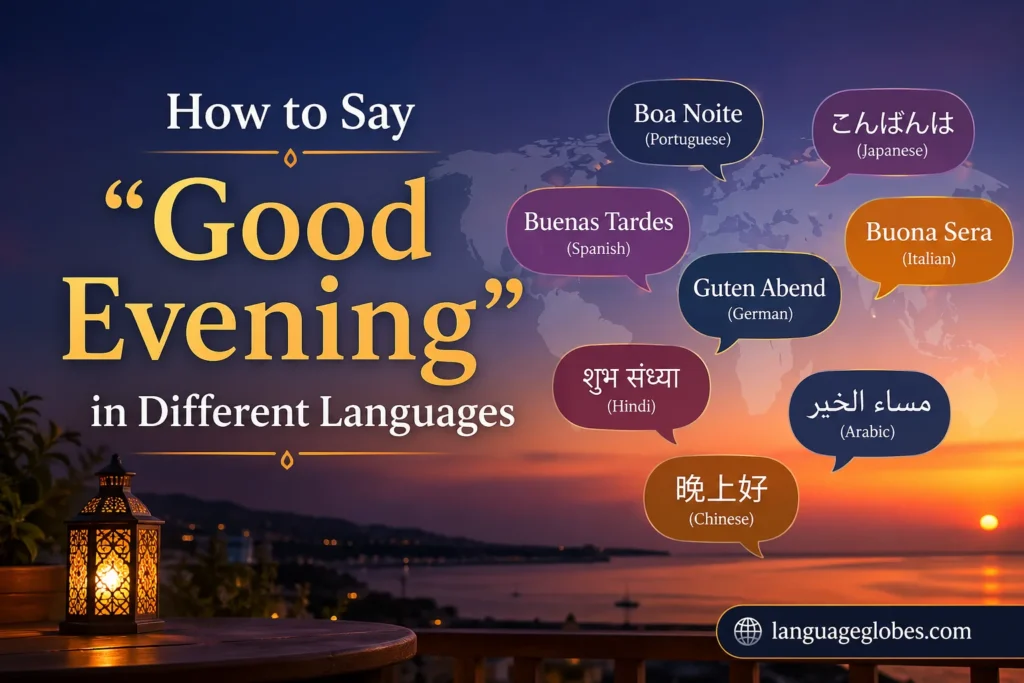
When people search How to Say “Good Evening” in Different Languages, they want to greet others politely during time day transitions with warmth and respect. I’ve noticed while traveling and chatting with international friends that this small gesture of saying a greeting is a universal way of showing courtesy, warmth, and respect. It sets the tone for pleasant interactions after a long day’s work is done, and helps create a positive impression in both personal and professional moments.
In every Language, it is more than just a means of communication; it acts as a bridge that connects hearts, cultures, and traditions across the world. While phrases like I love you represent deep emotional bonds, simple greetings such as Good Evening also carry kindness. In many societies, the way you greet someone reflects your upbringing, social values, and even your relationship with a person, and this phrase, widely used worldwide, varies in pronunciation and structure, reflecting linguistic diversity and cultural nuances within each global community.
From my own experience, whether in a bustling city like Japan or a quiet town in Italy, learning these easy pronunciations through examples can help you learn better. Understanding how to express respect can truly enhance connections with locals. This article will explore, offering a small tour around the globe, where each greeting from Bonsoir in French to Assalamu Alaikum in Muslim cultures tells a story. By learning how to say these, you not only expand your vocabulary, but also gain insight into how people express goodwill, and Whether you’re new to a language or simply curious, this guide will introduce you to over 70 ways across continents, helping you show appreciation and build meaningful connections.
Interesting Facts About How to Say Good Evening in Different Languages
- 🌆 “Good Evening” is typically used from late afternoon until nighttime in most cultures.
- 🗣️ Some languages have formal and informal versions of evening greetings.
- 🌍 In many cultures, greetings are essential for showing respect and politeness.
- 🤝 In countries like Japan and Korea, greetings often include bowing or gestures.
- 🌙 Some languages use greetings that also imply peace or blessings, not just time of day.
- ✨ Learning greetings is often the first step in mastering a new language.
🌍 European Languages
Europe is home to a wide variety of languages influenced by Latin, Germanic, and Slavic roots. Greetings in European cultures often reflect politeness and social etiquette. Whether formal or casual, saying “Good Evening” properly can leave a positive impression in both social and professional settings.
Table: “Good Evening” in European Languages
| Language | Country/Region | Translation | Pronunciation | Example Sentence |
| English (US 🇺🇸) | USA | Good Evening | gud ee-ven-ing | Good evening, how are you? |
| English (UK 🇬🇧) | UK | Good Evening | gud ee-ven-ing | Good evening, welcome. |
| English (AU 🇦🇺) | Australia | Good Evening | gud ee-ven-ing | Good evening, mate! |
| French 🇫🇷 | France | Bonsoir | bon-swahr | Bonsoir, comment allez-vous ? |
| Spanish 🇪🇸 | Spain | Buenas tardes | bwe-nas tar-des | Buenas tardes, señor. |
| German 🇩🇪 | Germany | Guten Abend | goo-ten ah-bent | Guten Abend, wie geht’s? |
| Italian 🇮🇹 | Italy | Buonasera | bwo-na-se-ra | Buonasera, signore. |
| Portuguese 🇵🇹 | Portugal | Boa noite | bo-a noy-te | Boa noite, tudo bem? |
| Dutch 🇳🇱 | Netherlands | Goedenavond | khoo-den-ah-vond | Goedenavond, welkom. |
| Swedish 🇸🇪 | Sweden | God kväll | goo kvell | God kväll, hur mår du? |
| Danish 🇩🇰 | Denmark | God aften | goo af-ten | God aften! |
| Norwegian 🇳🇴 | Norway | God kveld | goo kvel | God kveld, velkommen. |
| Finnish 🇫🇮 | Finland | Hyvää iltaa | hoo-va il-taa | Hyvää iltaa! |
| Polish 🇵🇱 | Poland | Dobry wieczór | do-bri vye-choor | Dobry wieczór! |
| Czech 🇨🇿 | Czech Republic | Dobrý večer | do-bree ve-cher | Dobrý večer! |
| Slovak 🇸🇰 | Slovakia | Dobrý večer | do-bree ve-cher | Dobrý večer! |
| Hungarian 🇭🇺 | Hungary | Jó estét | yo es-tate | Jó estét! |
| Romanian 🇷🇴 | Romania | Bună seara | boo-na se-a-ra | Bună seara! |
| Greek 🇬🇷 | Greece | Καλησπέρα | ka-lee-spe-ra | Καλησπέρα! |
| Irish 🇮🇪 | Ireland | Tráthnóna maith | traw-no-na mah | Tráthnóna maith! |
🌏 Asian Languages
Asia is the largest and most linguistically diverse continent. Greetings here often carry deep cultural meaning and are sometimes accompanied by gestures like bows or hand placements. Saying “Good Evening” properly in Asian cultures can show respect and cultural awareness.
Table: “Good Evening” in Asian Languages
| Language | Country/Region | Translation | Pronunciation | Example Sentence |
| Chinese (Mandarin) 🇨🇳 | China | 晚上好 | wan shang hao | 晚上好,你好吗? |
| Japanese 🇯🇵 | Japan | こんばんは | kon-ban-wa | こんばんは! |
| Korean 🇰🇷 | Korea | 안녕하세요 (evening use) | an-nyeong-ha-se-yo | 안녕하세요! |
| Hindi 🇮🇳 | India | शुभ संध्या | shubh san-dhya | शुभ संध्या! |
| Urdu 🇵🇰 | Pakistan | شام بخیر | shaam ba-khair | شام بخیر! |
| Bengali 🇧🇩 | Bangladesh | শুভ সন্ধ্যা | shubho shondha | শুভ সন্ধ্যা! |
| Tamil 🇮🇳 | India | மாலை வணக்கம் | maa-lai va-nak-kam | மாலை வணக்கம் |
| Telugu 🇮🇳 | India | శుభ సాయంత్రం | shu-bha saa-yan-tram | శుభ సాయంత్రం |
| Thai 🇹🇭 | Thailand | สวัสดีตอนเย็น | sa-wat-dee ton-yen | สวัสดีตอนเย็น |
| Vietnamese 🇻🇳 | Vietnam | Chào buổi tối | chow boo-oy toy | Chào buổi tối! |
| Indonesian 🇮🇩 | Indonesia | Selamat malam | se-la-mat ma-lam | Selamat malam! |
| Malay 🇲🇾 | Malaysia | Selamat petang | se-la-mat pe-tang | Selamat petang! |
| Filipino 🇵🇭 | Philippines | Magandang gabi | ma-gan-dang ga-bi | Magandang gabi! |
| Sinhala 🇱🇰 | Sri Lanka | සුභ සන්ධ්යාවක් | su-bha san-dhyaa | සුභ සන්ධ්යාවක් |
| Nepali 🇳🇵 | Nepal | शुभ साँझ | shubh saanjh | शुभ साँझ |
| Khmer 🇰🇭 | Cambodia | សួស្តីល្ងាច | suor-sdei lngach | សួស្តីល្ងាច |
| Lao 🇱🇦 | Laos | ສະບາຍດີຕອນແລງ | sa-bai-dee ton laeng | ສະບາຍດີ |
| Burmese 🇲🇲 | Myanmar | မင်္ဂလာညနေခင်းပါ | min-ga-la nya-nay | မင်္ဂလာပါ |
🌍 African Languages
Africa’s linguistic diversity reflects its rich cultural heritage. Greetings are extremely important in African societies and often go beyond simple words—they represent respect, community, and human connection.
Table: “Good Evening” in African Languages
| Language | Country/Region | Translation | Pronunciation | Example Sentence |
| Swahili 🇰🇪 | East Africa | Habari za jioni | ha-ba-ri za jee-o-ni | Habari za jioni! |
| Zulu 🇿🇦 | South Africa | Sawubona kusihlwa | sa-woo-bo-na ku-sihl-wa | Sawubona kusihlwa |
| Xhosa 🇿🇦 | South Africa | Molo ngokuhlwa | mo-lo ngo-ku-hlwa | Molo ngokuhlwa |
| Yoruba 🇳🇬 | Nigeria | Kaalẹ́ | ka-a-le | Kaalẹ́! |
| Igbo 🇳🇬 | Nigeria | Mgbede ọma | mm-be-de o-ma | Mgbede ọma! |
| Hausa 🇳🇬 | Nigeria | Barka da yamma | bar-ka da yam-ma | Barka da yamma |
| Amharic 🇪🇹 | Ethiopia | መልካም ምሽት | mel-kam mi-shit | መልካም ምሽት |
| Somali 🇸🇴 | Somalia | Fiid wanaagsan | feed wa-naag-san | Fiid wanaagsan |
| Shona 🇿🇼 | Zimbabwe | Manheru akanaka | man-he-ru a-ka-na-ka | Manheru akanaka |
| Afrikaans 🇿🇦 | South Africa | Goeienaand | khoo-ee-naand | Goeienaand |
| Malagasy 🇲🇬 | Madagascar | Manao ahoana ny hariva | ma-nao a-ho-a-na | Manao ahoana |
| Kinyarwanda 🇷🇼 | Rwanda | Mwiriwe | mwee-ree-weh | Mwiriwe |
| Wolof 🇸🇳 | Senegal | Naka nga def ci ngoon | na-ka nga def | Naka nga def |
| Tigrinya 🇪🇷 | Eritrea | ምሸት ሰላም | mi-shet se-lam | ምሸት ሰላም |
Read More: How to Say “Good Night” in Different Languages
🌍 Middle Eastern Languages
Middle Eastern languages are deeply connected to history, religion, and tradition. Greetings here often carry meanings of peace and blessings, making them more than simple time-based expressions.
Table: “Good Evening” in Middle Eastern Languages
| Language | Country/Region | Translation | Pronunciation | Example Sentence |
| Arabic 🇸🇦 | Middle East | مساء الخير | ma-sa al-khair | مساء الخير! |
| Persian 🇮🇷 | Iran | عصر بخیر | asr be-kheir | عصر بخیر |
| Turkish 🇹🇷 | Turkey | İyi akşamlar | ee-yi ak-sham-lar | İyi akşamlar |
| Hebrew 🇮🇱 | Israel | ערב טוב | erev tov | ערב טוב |
| Kurdish 🇮🇶 | Iraq | Êvar baş | e-var bash | Êvar baş |
| Pashto 🇦🇫 | Afghanistan | ماښام مو پخير | ma-kham mo pa-khair | ماښام مو پخير |
| Armenian 🇦🇲 | Armenia | Բարի երեկո | ba-ri ye-re-ko | Բարի երեկո |
| Azerbaijani 🇦🇿 | Azerbaijan | Axşamınız xeyir | ak-sha-mi-niz khe-yir | Axşamınız xeyir |
| Georgian 🇬🇪 | Georgia | საღამო მშვიდობისა | sa-gha-mo mshvi-do-bi-sa | საღამო მშვიდობისა |
| Syriac | Middle East | ܪܡܫܐ ܫܠܡܐ | ram-sha shla-ma | ܪܡܫܐ ܫܠܡܐ |
❓ FAQ: Saying “I Love You” in Different Languages
1. Why is learning greetings important?
Greetings help build relationships and show respect in different cultures.
2. Is “Good Evening” formal or informal?
It is generally considered a polite and formal greeting.
3. What is the difference between “Good Evening” and “Good Night”?
“Good Evening” is used when greeting, while “Good Night” is used when parting.
4. Do all languages have a direct translation?
Not always—some languages use phrases that imply time and respect instead.
5. Is pronunciation important?
Yes, correct pronunciation helps avoid misunderstandings.
6. Can greetings vary within the same country?
Yes, dialects and regions can influence how greetings are spoken.
7. What is the most widely recognized greeting?
“Hello” is universal, but “Good Evening” is widely understood in English-speaking regions.
8. Are gestures important with greetings?
Yes, especially in Asian and Middle Eastern cultures.
9. Is it useful for travelers?
Absolutely—it helps create positive interactions.
10. How can I practice?
Use language apps, listen to native speakers, and practice daily.
Conclusion
Learning how to say “Good Evening” in different languages is a simple yet powerful way to connect with people around the world. It shows respect, builds relationships, and enhances cultural understanding. Whether you’re traveling, studying, or simply exploring languages, these small phrases can make a big difference.
In a globalized world, even a small effort to speak someone’s language can leave a lasting impression. So the next time the sun sets, try greeting someone in a new language—you might just brighten their evening. 🌆✨

Grace Hall is a passionate language enthusiast and writer at LanguageGlobes, dedicated to making global communication simple and accessible. She shares insightful content to help readers explore new languages, cultures, and connections around the world.