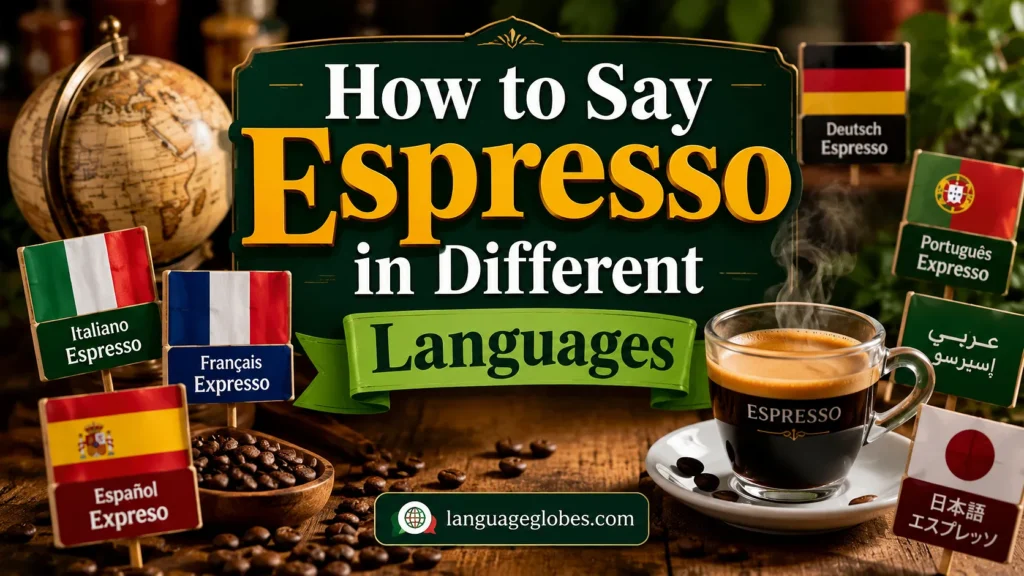
Espresso is a beloved coffee drink known for its strong flavor and thick consistency. This globally recognized word has traveled across different languages, reflecting the universal appeal of coffee.
Because it originated in Italy, its pronunciation, spelling, and local adaptations can vary across cultures. Learning these coffee-related vocabulary terms helps travelers order confidently and communicate effectively.
Exploring espresso in different languages reveals fascinating language variations and coffee traditions around the world. From Italian forms to Spanish, French, and Mandarin Chinese, each translation reflects unique cultural differences.
This pronunciation guide makes it easier for every coffee lover, language learner, and world traveler to understand local coffee terminology. Discovering these ways to say espresso also offers a simple path toward language learning and cultural exploration.
Also Read This: How to Say Earning in Different Languages
Interesting Facts About Espresso
- Espresso originated in Italy in the early 20th century.
- The word “espresso” means “pressed out” or “expressed” in Italian.
- Most languages use a variation of the Italian word “espresso.”
- Espresso serves as the base for popular drinks like cappuccino, latte, and macchiato.
- A traditional espresso shot is usually served in a small cup.
- Italy remains one of the most influential countries in global coffee culture.
- Espresso machines use pressure to force hot water through finely ground coffee.
- Many countries have developed unique espresso-based coffee traditions.
- Learning coffee vocabulary is useful for travelers visiting cafés worldwide.
- Espresso is among the most recognized beverage names across different languages.
How to Say Espresso in Different Languages
European Languages
Europe is home to many of the world’s most influential coffee cultures. Since espresso originated in Italy, many European languages have adopted the Italian term directly. However, pronunciation often changes according to local linguistic traditions. The following table shows how espresso is expressed across Europe.
| Language | Country/Region | Translation | Pronunciation | Example Sentence |
| Italian 🇮🇹 | Italy | Espresso | es-PRES-so | Vorrei un espresso. |
| American English 🇺🇸 | United States | Espresso | es-PRESS-oh | I would like an espresso. |
| British English 🇬🇧 | United Kingdom | Espresso | es-PRESS-oh | I’d like an espresso, please. |
| Australian English 🇦🇺 | Australia | Espresso | es-PRESS-oh | Can I get an espresso? |
| French 🇫🇷 | France | Expresso | ex-PRES-so | Je voudrais un expresso. |
| Spanish 🇪🇸 | Spain | Espresso | es-PRE-so | Quiero un espresso. |
| Portuguese 🇵🇹 | Portugal | Expresso | ex-PRE-so | Quero um expresso. |
| German 🇩🇪 | Germany | Espresso | es-PRES-so | Ich möchte einen Espresso. |
| Dutch 🇳🇱 | Netherlands | Espresso | es-PRES-so | Ik wil een espresso. |
| Swedish 🇸🇪 | Sweden | Espresso | es-PRES-so | Jag vill ha en espresso. |
| Norwegian 🇳🇴 | Norway | Espresso | es-PRES-so | Jeg vil ha en espresso. |
| Danish 🇩🇰 | Denmark | Espresso | es-PRES-so | Jeg vil gerne have en espresso. |
| Finnish 🇫🇮 | Finland | Espresso | ES-pres-so | Haluan espresson. |
| Icelandic 🇮🇸 | Iceland | Espresso | es-PRES-so | Ég vil fá espresso. |
| Polish 🇵🇱 | Poland | Espresso | es-PRE-so | Poproszę espresso. |
| Czech 🇨🇿 | Czech Republic | Espresso | es-PRE-so | Dám si espresso. |
| Slovak 🇸🇰 | Slovakia | Espresso | es-PRE-so | Prosím espresso. |
| Hungarian 🇭🇺 | Hungary | Eszpresszó | es-PRES-zo | Kérek egy eszpresszót. |
| Romanian 🇷🇴 | Romania | Espresso | es-PRE-so | Vreau un espresso. |
| Greek 🇬🇷 | Greece | Εσπρέσο | es-PRE-so | Θέλω έναν εσπρέσο. |
| Russian 🇷🇺 | Russia | Эспрессо | es-PRES-so | Я хочу эспрессо. |
| Ukrainian 🇺🇦 | Ukraine | Еспресо | es-PRE-so | Я хочу еспресо. |
| Croatian 🇭🇷 | Croatia | Espresso | es-PRE-so | Želim espresso. |
| Serbian 🇷🇸 | Serbia | Espresso | es-PRE-so | Želim espresso. |
Asian Languages
Asia is home to thousands of languages and some of the world’s fastest-growing coffee markets. While many Asian countries use a local adaptation of the word espresso, pronunciations often reflect the sounds and writing systems of each language. Coffee culture continues to grow rapidly throughout Asia.
| Language | Country/Region | Translation | Pronunciation | Example Sentence |
| Chinese (Mandarin) 🇨🇳 | China | 意式浓缩咖啡 | yee-shrr nong-shwo ka-fay | 我要一杯意式浓缩咖啡。 |
| Japanese 🇯🇵 | Japan | エスプレッソ | e-su-pu-res-so | エスプレッソをください。 |
| Korean 🇰🇷 | South Korea | 에스프레소 | e-su-peu-re-so | 에스프레소 주세요. |
| Hindi 🇮🇳 | India | एस्प्रेसो | es-pre-so | मुझे एक एस्प्रेसो चाहिए। |
| Urdu 🇵🇰 | Pakistan | ایسپریسو | es-pre-so | مجھے ایک ایسپریسو چاہیے۔ |
| Bengali 🇧🇩 | Bangladesh | এসপ্রেসো | es-pre-so | আমি একটি এসপ্রেসো চাই। |
| Punjabi 🇮🇳 | Punjab | ਐਸਪ੍ਰੈਸੋ | es-pre-so | ਮੈਨੂੰ ਐਸਪ੍ਰੈਸੋ ਚਾਹੀਦਾ ਹੈ। |
| Tamil 🇮🇳 | Tamil Nadu | எஸ்பிரெசோ | es-pi-re-so | எனக்கு எஸ்பிரெசோ வேண்டும். |
| Telugu 🇮🇳 | Andhra Pradesh | ఎస్ప్రెస్సో | es-pre-so | నాకు ఎస్ప్రెస్సో కావాలి. |
| Marathi 🇮🇳 | Maharashtra | एस्प्रेसो | es-pre-so | मला एस्प्रेसो पाहिजे. |
| Gujarati 🇮🇳 | Gujarat | એસ્પ્રેસો | es-pre-so | મને એસ્પ્રેસો જોઈએ. |
| Thai 🇹🇭 | Thailand | เอสเปรสโซ | es-pre-so | ฉันต้องการเอสเปรสโซ |
| Vietnamese 🇻🇳 | Vietnam | Espresso | es-pre-so | Tôi muốn một espresso. |
| Indonesian 🇮🇩 | Indonesia | Espresso | es-pre-so | Saya ingin espresso. |
| Malay 🇲🇾 | Malaysia | Espresso | es-pre-so | Saya mahu espresso. |
| Filipino 🇵🇭 | Philippines | Espresso | es-pre-so | Gusto ko ng espresso. |
| Khmer 🇰🇭 | Cambodia | អេសប្រេសូ | es-pre-so | ខ្ញុំចង់បានអេសប្រេសូ។ |
| Lao 🇱🇦 | Laos | ເອສເປຣສໂຊ | es-pre-so | ຂ້ອຍຕ້ອງການເອສເປຣສໂຊ |
| Mongolian 🇲🇳 | Mongolia | Эспрессо | es-pre-so | Би эспрессо авмаар байна. |
| Nepali 🇳🇵 | Nepal | एस्प्रेसो | es-pre-so | मलाई एस्प्रेसो चाहिन्छ। |
African Languages
Africa has extraordinary linguistic diversity with thousands of languages spoken across the continent. Coffee itself has deep African roots, particularly in East Africa. Many African languages use adapted versions of international coffee terminology, including espresso.
| Language | Country/Region | Translation | Pronunciation | Example Sentence |
| Swahili 🇹🇿 | East Africa | Espresso | es-pre-so | Ningependa espresso. |
| Zulu 🇿🇦 | South Africa | I-Espresso | ee-es-pre-so | Ngifuna i-espresso. |
| Xhosa 🇿🇦 | South Africa | Espresso | es-pre-so | Ndifuna i-espresso. |
| Afrikaans 🇿🇦 | South Africa | Espresso | es-pre-so | Ek wil graag espresso hê. |
| Amharic 🇪🇹 | Ethiopia | ኤስፕሬሶ | es-pre-so | ኤስፕሬሶ እፈልጋለሁ። |
| Somali 🇸🇴 | Somalia | Espresso | es-pre-so | Waxaan rabaa espresso. |
| Yoruba 🇳🇬 | Nigeria | Espresso | es-pre-so | Mo fẹ espresso. |
| Igbo 🇳🇬 | Nigeria | Espresso | es-pre-so | Achọrọ m espresso. |
| Hausa 🇳🇬 | Nigeria | Espresso | es-pre-so | Ina son espresso. |
| Shona 🇿🇼 | Zimbabwe | Espresso | es-pre-so | Ndinoda espresso. |
| Kinyarwanda 🇷🇼 | Rwanda | Espresso | es-pre-so | Ndashaka espresso. |
| Luganda 🇺🇬 | Uganda | Espresso | es-pre-so | Njagala espresso. |
Middle Eastern Languages
The Middle East has a rich coffee heritage that dates back centuries. Traditional coffee remains an important part of hospitality and social gatherings. While espresso is a modern coffee style, it has become widely available throughout the region and is often referred to using localized versions of the Italian term.
| Language | Country/Region | Translation | Pronunciation | Example Sentence |
| Arabic 🇸🇦 | Middle East | إسبريسو | is-bree-so | أريد إسبريسو. |
| Persian 🇮🇷 | Iran | اسپرسو | es-pre-so | یک اسپرسو میخواهم. |
| Turkish 🇹🇷 | Türkiye | Espresso | es-pre-so | Bir espresso istiyorum. |
| Hebrew 🇮🇱 | Israel | אספרסו | es-pre-so | אני רוצה אספרסו. |
| Kurdish | Kurdistan Region | Espresso | es-pre-so | Ez espresso dixwazim. |
Additional Languages Around the World
Languages from North America, South America, Oceania, and indigenous communities contribute to the rich tapestry of global communication. In many cases, the word espresso remains close to its Italian origin because of its worldwide recognition.
| Language | Country/Region | Translation | Pronunciation | Example Sentence |
| Haitian Creole 🇭🇹 | Haiti | Espresso | es-pre-so | Mwen vle espresso. |
| Maori 🇳🇿 | New Zealand | Espresso | es-pre-so | E hiahia ana ahau ki te espresso. |
| Samoan 🇼🇸 | Samoa | Espresso | es-pre-so | Ou te mana’o i se espresso. |
| Tongan 🇹🇴 | Tonga | Espresso | es-pre-so | Oku ou fie espresso. |
| Hawaiian 🇺🇸 | Hawaii | Espresso | es-pre-so | Makemake au i ka espresso. |
| Greenlandic 🇬🇱 | Greenland | Espresso | es-pre-so | Espresso piumavara. |
| Quechua 🇵🇪 | Peru | Espresso | es-pre-so | Espresso munani. |
| Guarani 🇵🇾 | Paraguay | Espresso | es-pre-so | Aipota espresso. |
| Aymara 🇧🇴 | Bolivia | Espresso | es-pre-so | Espresso munta. |
| Navajo 🇺🇸 | United States | Espresso | es-pre-so | Espresso yishą́. |
| Cherokee 🇺🇸 | United States | Espresso | es-pre-so | Espresso agwaduliha. |
| Basque 🇪🇸 | Basque Region | Espresso | es-pre-so | Espresso bat nahi dut. |
| Catalan 🇪🇸 | Catalonia | Espresso | es-PRE-so | Vull un espresso. |
| Galician 🇪🇸 | Galicia | Espresso | es-PRE-so | Quero un espresso. |
| Luxembourgish 🇱🇺 | Luxembourg | Espresso | es-PRE-so | Ech wëll en Espresso. |
| Maltese 🇲🇹 | Malta | Espresso | es-PRE-so | Nixtieq espresso. |
FAQs
What is espresso called in different languages?
Espresso is a globally recognized word used across different languages with small language variations. Many cultures use forms closely related to Italian because espresso originated in Italy.
How do you say espresso in Italian?
In Italian, espresso is commonly called espresso, reflecting its original Italian coffee tradition. Its pronunciation is important when learning local coffee vocabulary.
How is espresso translated in Spanish?
In Spanish, you may see el expresso on some local menus, although usage can vary by region. Understanding this local spelling helps travelers with coffee ordering.
What is espresso called in French?
In French, espresso is commonly written l’espresso. This shows how language borrowing allows words to adapt while remaining familiar across coffee traditions.
How do you say espresso in Mandarin Chinese?
In Mandarin Chinese, espresso can be written as 浓缩咖啡 and pronounced nóng suō kā fēi. This translation describes concentrated coffee and reflects local cultural vocabulary.
Why does espresso have similar names worldwide?
The word espresso spread through international coffee culture and language adaptation. Many languages borrowed or adapted the term, creating recognizable word variations.
How can I pronounce espresso correctly?
To pronounce espresso, focus on the Italian pronunciation and avoid adding an extra sound after the first syllable. A reliable pronunciation guide can help language learners practice naturally.
Is espresso the same word in every language?
No, espresso in different languages can have different spelling, pronunciation, and translations. These language differences reflect regional coffee traditions and everyday usage.
Why learn ways to say espresso when traveling?
Learning ways to say espresso can make coffee ordering easier for travelers. It also helps you understand café vocabulary, communicate effectively, and enjoy local coffee culture.
What can espresso translations teach about language and culture?
Espresso translation reveals how coffee-related vocabulary travels between cultures and develops local forms. Exploring coffee traditions around the world combines language learning with cultural exploration.
Conclusion
Learning espresso in different languages is a simple way to explore global coffee culture, language variations, and coffee traditions around the world. From Italian to Spanish, French, and Mandarin Chinese, each translation offers useful insight into local coffee vocabulary and cultural differences. Understanding espresso pronunciation and local spelling can also make coffee ordering easier for travelers. Whether you are a coffee lover, language learner, or world traveler, these ways to say espresso make every café experience more enjoyable.

Grace Hall is a passionate language enthusiast and writer at LanguageGlobes, dedicated to making global communication simple and accessible. She shares insightful content to help readers explore new languages, cultures, and connections around the world.