The eyeball is a key part of human anatomy that supports vision and helps us see the world around us. This spherical structure is part of the eye, one of the most important organs in the human body, helping us recognize faces, read, work, travel, and communicate.
Learning the translation of eyeball can expand human body vocabulary while introducing useful everyday words in a foreign language. It also offers a simple way to explore language, culture, and different linguistic traditions.
For language learners, travelers, students, healthcare professionals, and translators, knowing this scientific term can support clearer communication. Exploring eyeball in different languages reveals how world cultures describe the round part of the eye through distinct words and expressions.
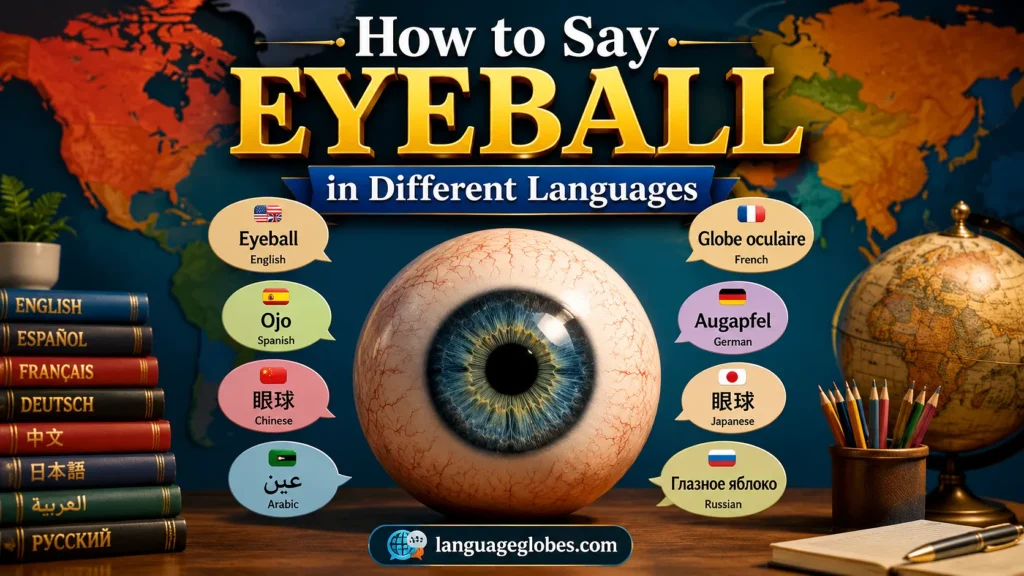
From globe oculaire in French to Augapfel in German and globo ocular in Spanish, these translations provide useful insight into human anatomy vocabulary. Understanding these terms can make language classes, daily conversations, medicine, and education more engaging while building meaningful cross-cultural connections.
Also Read This: How to Say Eyeliner in Different Languages
Interesting Facts About Eyeball
- The eyeball works together with the brain to create visual images.
- Human eyes can distinguish millions of different colors.
- The eyeball is protected by eyelids, eyelashes, and tears.
- Many languages use the same word for both “eye” and “eyeball.”
- The average eyeball is about 24 millimeters in diameter.
- Eye-related vocabulary is among the earliest words taught in language learning.
- Several cultures use eye-related expressions to symbolize wisdom, awareness, and protection.
- Medical terminology for the eyeball often comes from Latin and Greek origins.
- The eyeball is one of the fastest-reacting organs in the human body.
- Learning body-part vocabulary helps improve practical communication when traveling abroad.
How to Say Eyeball in Different Languages
European Languages
Europe is home to hundreds of languages belonging to several language families, including Germanic, Romance, Slavic, Celtic, and Baltic languages. Although many European languages share historical roots, their pronunciation and vocabulary often differ significantly. The translations below show how the word “eyeball” is expressed across Europe.
| Language | Country/Region | Translation | Pronunciation | Example Sentence |
| 🇺🇸 American English | USA | Eyeball | eye-ball | My eyeball feels irritated today. |
| 🇬🇧 British English | United Kingdom | Eyeball | eye-ball | The doctor examined my eyeball. |
| 🇦🇺 Australian English | Australia | Eyeball | eye-ball | Sand got into my eyeball. |
| French | 🇫🇷 France | Globe oculaire | glob oh-kyu-lair | Mon globe oculaire est sain. |
| Spanish | 🇪🇸 Spain | Globo ocular | glo-bo o-ku-lar | El globo ocular está sano. |
| Portuguese | 🇵🇹 Portugal | Globo ocular | glo-bo o-ku-lar | O globo ocular é importante. |
| Italian | 🇮🇹 Italy | Bulbo oculare | bool-bo o-koo-la-re | Il bulbo oculare è delicato. |
| German | 🇩🇪 Germany | Augapfel | ow-ga-pfel | Mein Augapfel ist gesund. |
| Dutch | 🇳🇱 Netherlands | Oogbol | oog-bol | Mijn oogbol doet pijn. |
| Swedish | 🇸🇪 Sweden | Ögonglob | ur-gon-glob | Min ögonglob är frisk. |
| Norwegian | 🇳🇴 Norway | Øyeeple | ur-yep-le | Øyeeplet fungerer godt. |
| Danish | 🇩🇰 Denmark | Øjeæble | oy-eh-eb-le | Mit øjeæble er sundt. |
| Finnish | 🇫🇮 Finland | Silmämuna | sil-ma-mu-na | Silmämuna on terve. |
| Icelandic | 🇮🇸 Iceland | Augasteinn | oi-ga-stain | Augasteinninn er heilbrigður. |
| Polish | 🇵🇱 Poland | Gałka oczna | gaw-ka och-na | Gałka oczna jest zdrowa. |
| Czech | 🇨🇿 Czech Republic | Oční koule | och-nee ko-le | Oční koule je zdravá. |
| Slovak | 🇸🇰 Slovakia | Očná guľa | och-na goo-lya | Očná guľa je zdravá. |
| Hungarian | 🇭🇺 Hungary | Szemgolyó | sem-go-yo | A szemgolyó érzékeny. |
| Romanian | 🇷🇴 Romania | Glob ocular | glob o-ku-lar | Globul ocular este sănătos. |
| Bulgarian | 🇧🇬 Bulgaria | Очна ябълка | och-na ya-bal-ka | Очната ябълка е здрава. |
| Croatian | 🇭🇷 Croatia | Očna jabučica | och-na ya-boo-chi-tsa | Očna jabučica je zdrava. |
| Serbian | 🇷🇸 Serbia | Очна јабучица | och-na ya-boo-chi-tsa | Очна јабучица је здрава. |
| Slovenian | 🇸🇮 Slovenia | Zrklo | zerk-lo | Zrklo je zdravo. |
| Ukrainian | 🇺🇦 Ukraine | Очне яблуко | och-ne yab-lo-ko | Очне яблуко здорове. |
| Russian | 🇷🇺 Russia | Глазное яблоко | glaz-no-ye yab-la-ka | Глазное яблоко здорово. |
| Belarusian | 🇧🇾 Belarus | Вочнае яблык | voch-na-ye yab-lik | Вочнае яблык здаровае. |
| Lithuanian | 🇱🇹 Lithuania | Akies obuolys | a-ki-es o-bo-lis | Akies obuolys sveikas. |
| Latvian | 🇱🇻 Latvia | Acs ābols | ats a-bols | Acs ābols ir vesels. |
| Irish | 🇮🇪 Ireland | Liathróid súl | lee-a-royd sool | Tá an liathróid súl slán. |
| Welsh | 🏴 Wales | Pelen llygad | pe-len lhug-ad | Mae’r belen llygad yn iach. |
Asian Languages
Asia is the world’s largest continent and contains an incredible variety of languages. From East Asia and South Asia to Southeast Asia and Central Asia, these languages reflect thousands of years of history, literature, and cultural development. Body-part vocabulary such as “eyeball” is essential in daily communication throughout the region.
| Language | Country/Region | Translation | Pronunciation | Example Sentence |
| Chinese (Mandarin) | 🇨🇳 China | 眼球 | yan chyoh | 我的眼球很健康。 |
| Japanese | 🇯🇵 Japan | 眼球 | gan-kyoo | 眼球は健康です。 |
| Korean | 🇰🇷 South Korea | 안구 | an-goo | 안구가 건강합니다. |
| Hindi | 🇮🇳 India | नेत्रगोलक | nay-tra-go-lak | मेरा नेत्रगोलक स्वस्थ है। |
| Urdu | 🇵🇰 Pakistan | چشمِ کرہ | chashm-e-kurah | میری چشمِ کرہ صحت مند ہے۔ |
| Bengali | 🇧🇩 Bangladesh | চক্ষুগোলক | chok-khu-go-lok | আমার চক্ষুগোলক সুস্থ। |
| Punjabi | India/Pakistan | ਅੱਖ ਦਾ ਗੋਲਾ | akh da go-la | ਮੇਰਾ ਅੱਖ ਦਾ ਗੋਲਾ ਠੀਕ ਹੈ। |
| Tamil | 🇮🇳 India | கண் உருண்டை | kan u-run-dai | என் கண் உருண்டை ஆரோக்கியமானது. |
| Telugu | 🇮🇳 India | నేత్రగోళం | nay-tra-go-lam | నా నేత్రగోళం ఆరోగ్యంగా ఉంది. |
| Kannada | 🇮🇳 India | ನೇತ್ರಗೋಳ | nay-tra-gol | ನನ್ನ ನೇತ್ರಗೋಳ ಆರೋಗ್ಯಕರವಾಗಿದೆ. |
| Malayalam | 🇮🇳 India | നേത്രഗോളം | nay-tra-go-lam | എന്റെ നേത്രഗോളം ആരോഗ്യകരമാണ്. |
| Marathi | 🇮🇳 India | नेत्रगोलक | nay-tra-go-lak | माझा नेत्रगोलक निरोगी आहे. |
| Gujarati | 🇮🇳 India | આંખનો ગોળો | aankh-no go-lo | મારી આંખનો ગોળો સ્વસ્થ છે. |
| Nepali | 🇳🇵 Nepal | नेत्रगोलक | nay-tra-go-lak | मेरो नेत्रगोलक स्वस्थ छ। |
| Sinhala | 🇱🇰 Sri Lanka | ඇස් ගෝලය | aes go-la-ya | මගේ ඇස් ගෝලය සෞඛ්ය සම්පන්නයි. |
| Thai | 🇹🇭 Thailand | ลูกตา | look-ta | ลูกตาของฉันแข็งแรง |
| Vietnamese | 🇻🇳 Vietnam | Nhãn cầu | nyan kau | Nhãn cầu của tôi khỏe mạnh. |
| Indonesian | 🇮🇩 Indonesia | Bola mata | bo-la ma-ta | Bola mata saya sehat. |
| Malay | 🇲🇾 Malaysia | Bola mata | bo-la ma-ta | Bola mata saya sihat. |
| Filipino | 🇵🇭 Philippines | Bola ng mata | bo-la nang ma-ta | Malusog ang bola ng mata ko. |
| Khmer | 🇰🇭 Cambodia | គ្រាប់ភ្នែក | krap pnek | គ្រាប់ភ្នែករបស់ខ្ញុំមានសុខភាពល្អ។ |
| Lao | 🇱🇦 Laos | ໜ່ວຍຕາ | nuay ta | ໜ່ວຍຕາຂອງຂ້ອຍດີ. |
| Mongolian | 🇲🇳 Mongolia | Нүдний алим | nud-nii a-lim | Нүдний алим эрүүл байна. |
| Kazakh | 🇰🇿 Kazakhstan | Көз алмасы | koz al-ma-si | Көз алмасы сау. |
| Uzbek | 🇺🇿 Uzbekistan | Ko’z olmasi | kuz ol-ma-si | Ko’z olmasi sog’lom. |
African Languages
Africa is home to more than 2,000 languages, making it one of the most linguistically diverse regions in the world. These languages belong to several major language families, including Afroasiatic, Niger-Congo, Nilo-Saharan, and Khoisan. Learning African vocabulary offers insight into rich cultural traditions and diverse communities.
| Language | Country/Region | Translation | Pronunciation | Example Sentence |
| Swahili | 🌍 East Africa | Mboni ya jicho | m-bo-ni ya ji-cho | Mboni ya jicho langu ni nzuri. |
| Zulu | 🇿🇦 South Africa | Inhlamvu yeso | in-hlam-vu ye-so | Inhlamvu yeso lami iphilile. |
| Xhosa | 🇿🇦 South Africa | Ibhola leliso | i-bho-la le-li-so | Ibhola leliso lam liphilile. |
| Afrikaans | 🇿🇦 South Africa | Oogbal | oog-bal | My oogbal is gesond. |
| Yoruba | 🇳🇬 Nigeria | Bọ́ọ̀lù ojú | bo-lu o-ju | Bọ́ọ̀lù ojú mi dára. |
| Igbo | 🇳🇬 Nigeria | Bọọlụ anya | bo-o-lu an-ya | Bọọlụ anya m dị mma. |
| Hausa | 🇳🇬 Nigeria | Kwallon ido | kwa-lon ee-do | Kwallon ido na lafiya. |
| Amharic | 🇪🇹 Ethiopia | የዓይን ኳስ | ye-ayn kwas | የዓይን ኳስ ጤናማ ነው። |
| Somali | 🇸🇴 Somalia | Kubbadda isha | kub-ba-da i-sha | Kubbadda isha way caafimaad qabtaa. |
| Shona | 🇿🇼 Zimbabwe | Bhora reziso | bho-ra re-zi-so | Bhora reziso rangu rakanaka. |
Middle Eastern Languages
The Middle East has been a center of civilization, trade, science, and culture for thousands of years. Languages spoken in this region include Arabic, Persian, Hebrew, Turkish, Kurdish, and many others. These languages have influenced global literature, religion, and scholarship.
| Language | Country/Region | Translation | Pronunciation | Example Sentence |
| Arabic | 🌍 Middle East | كرة العين | ku-rat al-ayn | كرة العين سليمة. |
| Persian (Farsi) | 🇮🇷 Iran | کره چشم | ko-reh cheshm | کره چشم من سالم است. |
| Hebrew | 🇮🇱 Israel | גלגל העין | gal-gal ha-ayin | גלגל העין שלי בריא. |
| Turkish | 🇹🇷 Turkey | Göz küresi | goz ku-re-si | Göz küresi sağlıklıdır. |
| Kurdish | Iraq/Turkey | Topya çavê | to-pya cha-ve | Topya çavê min baş e. |
| Azerbaijani | 🇦🇿 Azerbaijan | Göz alması | goz al-ma-si | Göz alması sağlamdır. |
| Armenian | 🇦🇲 Armenia | Ակնագունդ | ak-na-goond | Ակնագունդը առողջ է։ |
| Georgian | 🇬🇪 Georgia | თვალის კაკალი | tva-lis ka-ka-li | თვალის კაკალი ჯანმრთელია. |
Additional Languages Around the World
The following languages come from Oceania, indigenous communities, and other regions around the globe. Together, they demonstrate the incredible diversity of human communication and the many ways people describe the same anatomical structure.
| Language | Country/Region | Translation | Pronunciation | Example Sentence |
| Maori | 🇳🇿 New Zealand | Poi karu | poy ka-roo | He ora taku poi karu. |
| Hawaiian | 🇺🇸 Hawaii | Pōpō maka | po-po ma-ka | Ua ola ka pōpō maka. |
| Samoan | 🇼🇸 Samoa | Polo mata | po-lo ma-ta | E lelei lo’u polo mata. |
| Tongan | 🇹🇴 Tonga | Polo mata | po-lo ma-ta | Oku lelei hoku polo mata. |
| Fijian | 🇫🇯 Fiji | Bolo ni mata | bo-lo ni ma-ta | E vinaka na bolo ni mata. |
| Greenlandic | 🇬🇱 Greenland | Ijitsiaq | ee-yit-si-ak | Ijitsiaq peqqippoq. |
| Basque | 🇪🇸 Spain | Begi-globoa | be-gi glo-bo-a | Begi-globoa osasuntsua da. |
| Esperanto | International | Okulglobo | o-kool-glo-bo | Mia okulglobo estas sana. |
FAQs
What does eyeball mean in human anatomy?
The eyeball is the spherical structure inside the eye that supports vision. It is an important part of the human body that helps us see the world around us.
How do you say eyeball in different languages?
The translation of eyeball varies across languages and cultures. Common examples include globe oculaire in French, Augapfel in German, and globo ocular in Spanish.
Why learn the word eyeball in a foreign language?
Learning eyeball in another foreign language can expand human body vocabulary and improve communication. It can also help language learners, students, and travelers communicate more naturally.
What are some common translations for eyeball?
Common translations include globe oculaire, Augapfel, and globo ocular. These terms show how different world cultures describe the round part of the eye.
How is eyeball used in daily conversations?
The word eyeball may appear in daily conversations, descriptions, medicine, and science. Understanding its meaning can also support practical human body vocabulary.
Who can benefit from learning human body vocabulary?
Language learners, travelers, students, healthcare professionals, and translators can benefit from learning human body vocabulary. These terms can improve communication in many settings.
How does learning eyeball translations connect with culture?
Different linguistic traditions use distinct words and expressions for body parts. Studying these differences offers useful insights into culture and cross-cultural connections.
What is the scientific term for the round part of the eye?
The eyeball is the common scientific term for the rounded structure of the eye. It plays a central role in vision and is part of the human body.
Can learning eyeball translations help with language classes?
Yes, learning eyeball translations can make language classes more practical and memorable. It also supports education, human anatomy vocabulary, and everyday communication.
How can I learn to pronounce eyeball in other languages?
You can study pronunciation guides alongside each translation to learn accurate forms. Comparing spoken terms can make foreign language learning easier and more useful.
Conclusion
Learning eyeball in different languages is a simple way to explore human anatomy, vision, language, and culture together. Understanding each translation of eyeball can strengthen human body vocabulary, improve communication, and support language learners in everyday situations. From globe oculaire in French to Augapfel in German and globo ocular in Spanish, these words reveal fascinating linguistic traditions and cross-cultural connections. Exploring these terms can make foreign language learning more useful, practical, and enjoyable.

Grace Hall is a passionate language enthusiast and writer at LanguageGlobes, dedicated to making global communication simple and accessible. She shares insightful content to help readers explore new languages, cultures, and connections around the world.