
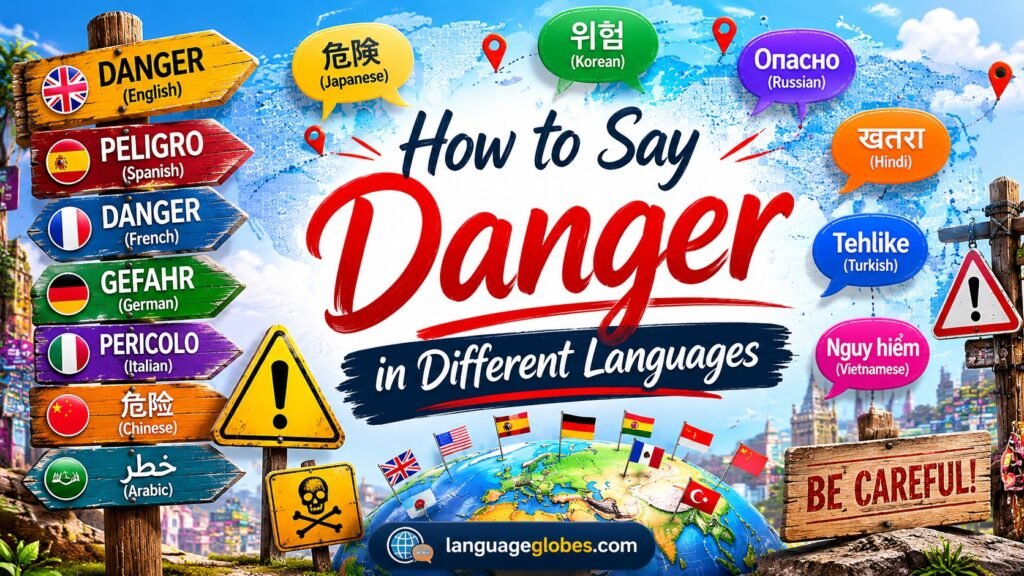
Danger is a powerful word used to warn people about risks, threats, and unsafe situations. Learning how to say danger in different languages helps travelers understand warning signs, emergency instructions, and safety communication.
The concept of danger is a universal concept, but every language and culture expresses this important warning uniquely. This guide explores danger translation across world languages, including European languages, Asian languages, African languages, and Middle Eastern languages.
You will discover useful translations, pronunciation guides, example sentences, and regional information for international safety signs. Understanding these warning words can improve personal safety, communication, and confidence when visiting foreign countries.
Also Read This: How to Say Daughter in Different Languages
Interesting Facts About Danger
- The word “danger” comes from the Old French word “dangier.”
- Danger signs are among the most universally recognized symbols worldwide.
- Many international safety standards use local language translations of danger to protect people.
- Learning danger-related vocabulary can be useful when traveling internationally.
- The concept of danger exists in every known language and culture.
- Warning signs often combine words and symbols to overcome language barriers.
- Some languages have multiple words for different levels of danger or risk.
- Emergency services worldwide rely on clear danger communication to save lives.
How to Say Danger in Different Languages
European Languages
Europe is home to dozens of languages belonging to several language families. While pronunciation and grammar differ significantly, the concept of danger is expressed in every European language. Understanding these translations can be especially useful for travelers exploring Europe’s diverse countries and cultures.
| Language | Country/Region | Translation | Pronunciation | Example Sentence |
| 🇺🇸 American English | USA | Danger | DAYN-jer | Danger ahead. |
| 🇬🇧 British English | UK | Danger | DAYN-juh | Danger is present. |
| 🇦🇺 Australian English | Australia | Danger | DAYN-jah | Watch out, danger ahead. |
| 🇫🇷 French | France | Danger | Dahn-zhay | Il y a un danger ici. |
| 🇪🇸 Spanish | Spain | Peligro | Peh-LEE-gro | Hay peligro aquí. |
| 🇵🇹 Portuguese | Portugal | Perigo | Peh-REE-go | Há perigo aqui. |
| 🇮🇹 Italian | Italy | Pericolo | Peh-REE-ko-lo | C’è pericolo qui. |
| 🇩🇪 German | Germany | Gefahr | Geh-FAHR | Hier besteht Gefahr. |
| 🇳🇱 Dutch | Netherlands | Gevaar | Geh-VAHR | Hier is gevaar. |
| 🇸🇪 Swedish | Sweden | Fara | FA-ra | Det finns fara här. |
| 🇳🇴 Norwegian | Norway | Fare | FA-reh | Det er fare her. |
| 🇩🇰 Danish | Denmark | Fare | FA-reh | Der er fare her. |
| 🇫🇮 Finnish | Finland | Vaara | VAA-ra | Täällä on vaara. |
| 🇮🇸 Icelandic | Iceland | Hætta | HAI-ta | Hér er hætta. |
| 🇵🇱 Polish | Poland | Niebezpieczeństwo | Nyeh-bez-pye-CHEN-stvo | To niebezpieczeństwo. |
| 🇨🇿 Czech | Czech Republic | Nebezpečí | Neh-bez-peh-chee | To je nebezpečí. |
| 🇸🇰 Slovak | Slovakia | Nebezpečenstvo | Neh-bez-peh-CHEN-stvo | Je tu nebezpečenstvo. |
| 🇭🇺 Hungarian | Hungary | Veszély | Veh-SHAY | Itt veszély van. |
| 🇷🇴 Romanian | Romania | Pericol | Peh-ree-KOL | Este pericol aici. |
| 🇬🇷 Greek | Greece | Κίνδυνος | KEEN-thee-nos | Υπάρχει κίνδυνος εδώ. |
| 🇷🇺 Russian | Russia | Опасность | O-pas-nost | Здесь опасность. |
| 🇺🇦 Ukrainian | Ukraine | Небезпека | Ne-bez-PE-ka | Тут небезпека. |
| 🇧🇬 Bulgarian | Bulgaria | Опасност | O-pas-nost | Тук има опасност. |
| 🇭🇷 Croatian | Croatia | Opasnost | O-pas-nost | Ovdje je opasnost. |
| 🇷🇸 Serbian | Serbia | Опасност | O-pas-nost | Ово је опасност. |
Asian Languages
Asia is the largest continent and contains thousands of languages spoken by billions of people. From East Asia to South Asia and Southeast Asia, languages vary greatly in script, pronunciation, and structure. Learning how to say danger in Asian languages can be particularly helpful for international travelers and language learners.
| Language | Country/Region | Translation | Pronunciation | Example Sentence |
| 🇨🇳 Chinese (Mandarin) | China | 危险 | Wei-xian | 这里有危险。 |
| 🇯🇵 Japanese | Japan | 危険 | Kee-ken | ここは危険です。 |
| 🇰🇷 Korean | South Korea | 위험 | Wee-heom | 여기는 위험합니다. |
| 🇮🇳 Hindi | India | खतरा | Kha-ta-ra | यहाँ खतरा है। |
| 🇵🇰 Urdu | Pakistan | خطرہ | Khat-ra | یہاں خطرہ ہے۔ |
| 🇧🇩 Bengali | Bangladesh | বিপদ | Bee-pod | এখানে বিপদ আছে। |
| 🇮🇳 Punjabi | Punjab | ਖ਼ਤਰਾ | Khat-ra | ਇੱਥੇ ਖ਼ਤਰਾ ਹੈ। |
| 🇮🇳 Gujarati | India | જોખમ | Jo-kham | અહીં જોખમ છે. |
| 🇮🇳 Marathi | India | धोका | Dho-ka | येथे धोका आहे. |
| 🇮🇳 Tamil | India | ஆபத்து | Aa-pa-thu | இங்கு ஆபத்து உள்ளது. |
| 🇮🇳 Telugu | India | ప్రమాదం | Pra-ma-dam | ఇక్కడ ప్రమాదం ఉంది. |
| 🇮🇳 Kannada | India | ಅಪಾಯ | A-pa-ya | ಇಲ್ಲಿ ಅಪಾಯ ಇದೆ. |
| 🇮🇳 Malayalam | India | അപകടം | A-pa-ka-dam | ഇവിടെ അപകടമുണ്ട്. |
| 🇳🇵 Nepali | Nepal | खतरा | Kha-ta-ra | यहाँ खतरा छ। |
| 🇱🇰 Sinhala | Sri Lanka | අනතුර | A-na-thu-ra | මෙහි අනතුරක් ඇත. |
| 🇹🇭 Thai | Thailand | อันตราย | Un-ta-rai | ที่นี่อันตราย |
| 🇻🇳 Vietnamese | Vietnam | Nguy hiểm | Ngoo-ee-hiem | Đây là nguy hiểm. |
| 🇮🇩 Indonesian | Indonesia | Bahaya | Ba-ha-ya | Ada bahaya di sini. |
| 🇲🇾 Malay | Malaysia | Bahaya | Ba-ha-ya | Terdapat bahaya di sini. |
| 🇵🇭 Filipino | Philippines | Panganib | Pa-ngah-neeb | May panganib dito. |
| 🇰🇭 Khmer | Cambodia | គ្រោះថ្នាក់ | Kroh-thnak | មានគ្រោះថ្នាក់។ |
| 🇱🇦 Lao | Laos | ອັນຕະລາຍ | Un-ta-lai | ນີ້ແມ່ນອັນຕະລາຍ. |
African Languages
Africa is one of the most linguistically diverse continents in the world, with thousands of languages spoken across its regions. Many African languages have rich oral traditions and unique linguistic characteristics. Knowing important words such as danger can help visitors and learners communicate more effectively across the continent.
| Language | Country/Region | Translation | Pronunciation | Example Sentence |
| 🇿🇦 Swahili | East Africa | Hatari | Ha-ta-ri | Kuna hatari hapa. |
| 🇿🇦 Zulu | South Africa | Ingozi | In-go-zi | Kukhona ingozi lapha. |
| 🇿🇦 Xhosa | South Africa | Ingozi | In-go-zi | Kukho ingozi apha. |
| 🇿🇦 Afrikaans | South Africa | Gevaar | Geh-vaar | Daar is gevaar hier. |
| 🇳🇬 Yoruba | Nigeria | Ewu | Eh-woo | Ewu wa nibi. |
| 🇳🇬 Igbo | Nigeria | Ihe egwu | Ee-he eh-gwu | E nwere ihe egwu ebe a. |
| 🇳🇬 Hausa | Nigeria | Hadari | Ha-da-ri | Akwai hadari a nan. |
| 🇪🇹 Amharic | Ethiopia | አደጋ | A-de-ga | አደጋ አለ። |
| 🇸🇴 Somali | Somalia | Khatar | Kha-tar | Khatar baa jira. |
| 🇲🇬 Malagasy | Madagascar | Loza | Loo-za | Misy loza eto. |
Middle Eastern Languages
The Middle East has a long history of civilization, trade, and cultural exchange. Languages from this region have influenced many other languages around the world. Learning warning-related vocabulary such as danger can be particularly useful when visiting historical sites, cities, and cultural landmarks throughout the region.
| Language | Country/Region | Translation | Pronunciation | Example Sentence |
| 🇸🇦 Arabic | Middle East | خطر | Kha-tar | هناك خطر هنا. |
| 🇮🇷 Persian (Farsi) | Iran | خطر | Kha-tar | اینجا خطر وجود دارد. |
| 🇹🇷 Turkish | Turkey | Tehlike | Teh-lee-keh | Burada tehlike var. |
| 🇮🇱 Hebrew | Israel | סכנה | Sa-ka-na | יש כאן סכנה. |
| 🇰🇼 Kurdish | Kurdistan Region | Metirsî | Meh-tir-see | Li vir metirsî heye. |
| 🇴🇲 Omani Arabic | Oman | خطر | Kha-tar | يوجد خطر هنا. |
| 🇶🇦 Qatari Arabic | Qatar | خطر | Kha-tar | هنا خطر. |
| 🇦🇪 Emirati Arabic | UAE | خطر | Kha-tar | يوجد خطر هنا. |
Additional Languages Around the World
The world contains many more languages beyond the major regional groups. These languages represent unique cultures, traditions, and histories. Exploring their vocabulary helps broaden our understanding of global communication and linguistic diversity.
| Language | Country/Region | Translation | Pronunciation | Example Sentence |
| 🇳🇿 Maori | New Zealand | Morearea | Mo-re-a-re-a | He morearea kei konei. |
| 🇼🇸 Samoan | Samoa | Matautia | Ma-tau-ti-a | E matautia lenei nofoaga. |
| 🇹🇴 Tongan | Tonga | Fakatu’utāmaki | Fa-ka-too-ta-ma-kee | ʻOku fakatuʻutāmaki. |
| 🇭🇹 Haitian Creole | Haiti | Danje | Dan-jay | Gen danje isit la. |
| 🇮🇪 Irish | Ireland | Contúirt | Kon-toort | Tá contúirt anseo. |
| 🏴 Welsh | Wales | Perygl | Peh-rig-ul | Mae perygl yma. |
| 🇪🇪 Estonian | Estonia | Oht | Oht | Siin on oht. |
| 🇱🇻 Latvian | Latvia | Briesmas | Bree-es-mas | Šeit ir briesmas. |
| 🇱🇹 Lithuanian | Lithuania | Pavojus | Pa-vo-yus | Čia yra pavojus. |
| 🇸🇮 Slovenian | Slovenia | Nevarnost | Ne-var-nost | Tukaj je nevarnost. |
| 🇧🇦 Bosnian | Bosnia | Opasnost | O-pas-nost | Ovdje je opasnost. |
| 🇦🇱 Albanian | Albania | Rrezik | Rreh-zik | Ka rrezik këtu. |
| 🇬🇪 Georgian | Georgia | საფრთხე | Sapr-tkhe | აქ საფრთხეა. |
| 🇦🇲 Armenian | Armenia | Վտանգ | Vtan-g | Այստեղ վտանգ կա։ |
| 🇲🇳 Mongolian | Mongolia | Аюул | A-yul | Энд аюул байна. |
FAQs
What does danger mean in different languages?
Danger is a universal concept describing potential for harm, risks, or threats. Learning danger in different languages helps people understand warnings across cultures.
How do you say danger in Spanish?
In Spanish, danger is peligro, a common word used on warning signs and caution signs. It is important for safety communication in Spanish-speaking regions.
How do you say danger in Arabic?
In Arabic, danger can be translated as khatar, which refers to a threat or possible harm. This warning word appears in many emergency instructions and safety contexts.
Why is learning danger translations useful when traveling abroad?
Knowing danger translation helps travelers recognize international safety signs and understand urgent warnings. It can improve personal safety when visiting foreign countries.
How is danger expressed across world languages?
Different world languages have unique translations for danger based on their language, culture, and traditions. These terms communicate safety and caution in everyday situations.
Where might you see danger warnings?
You may encounter danger warnings in workplaces, on roads, and in public spaces. Such warning signs help people identify unsafe situations and respond quickly.
What are some common contexts for the word danger?
The word danger appears in emergency language, travel notices, safety instructions, and public warnings. It can describe a risk, threat, or situation involving potential for harm.
Can language and culture affect danger translations?
Yes, culture, history, and traditions can influence how societies communicate warnings. Understanding these cultural insights makes language translations more meaningful and accurate.
Which languages are included in danger translations?
A comprehensive guide can cover European languages, Asian languages, African languages, and Middle Eastern languages. Exploring these regional information helps learners compare global warning terms.
How can I pronounce and understand danger in other languages?
Pronunciation guides, example sentences, and audio pronunciation can help you pronounce danger and hear pronunciations correctly. These resources make foreign language vocabulary easier to learn and remember.
Conclusion
Learning danger in different languages makes international communication easier and supports personal safety while traveling abroad. Understanding danger translation, warning signs, and emergency language helps you recognize risks and threats in foreign countries. Exploring world languages also reveals how culture and societies express safety and caution. These useful translations can help every traveler, student, and language enthusiast communicate more confidently in unfamiliar situations.

Grace Hall is a passionate language enthusiast and writer at LanguageGlobes, dedicated to making global communication simple and accessible. She shares insightful content to help readers explore new languages, cultures, and connections around the world.