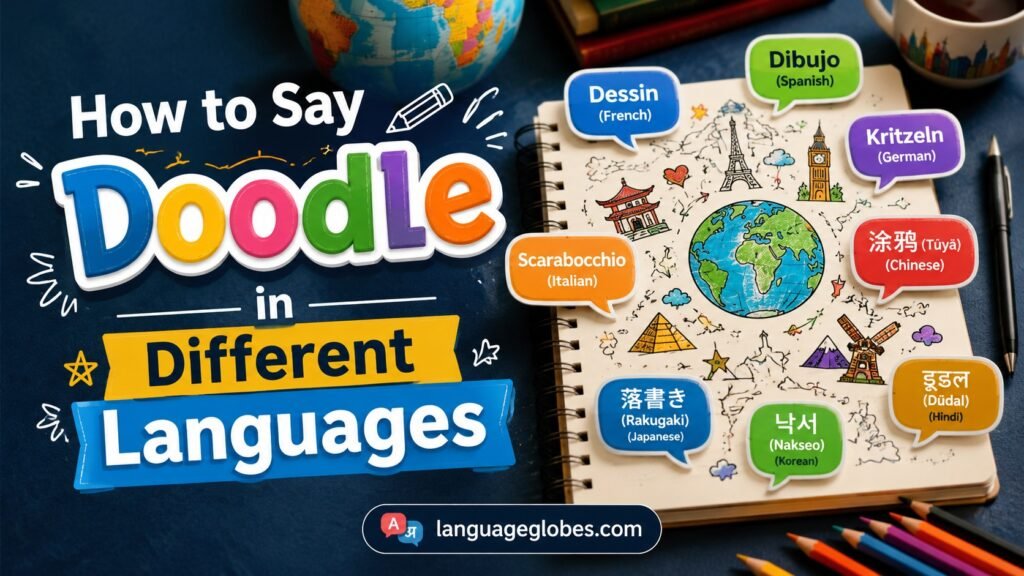
A doodle is a casual drawing often created absentmindedly while thinking, studying, or relaxing. This universal activity offers a creative outlet through scribbles, simple drawings, and sketches. Across cultures around the world, doodling can become a form of playful expression.
Learning how to say doodle reveals interesting differences in language, cultural context, and artistic expression. This guide explores doodle in different languages, including useful translations, pronunciations, and examples. You will also discover how visual expression connects communication, creativity, and language learning.
From notebook margins to a digital pad, doodles can communicate creative ideas without words. Understanding this doodle vocabulary can help travelers, students, teachers, and language enthusiasts explore global languages naturally.
Also Read This: How to Say Double in Different Languages
Interesting Facts About Doodle
- The word “doodle” originally referred to simple or absent-minded drawings.
- Doodling can improve concentration and memory retention.
- Many famous artists began ideas through quick doodles and sketches.
- Educational studies suggest doodling helps some learners stay engaged.
- Digital doodling has become popular through tablets and graphic design software.
- Search engines often use creative doodles to celebrate historical events and famous people.
- Doodling is practiced in nearly every culture around the world.
- Different languages often translate doodle as “sketch,” “scribble,” or “casual drawing.”
- Doodles can be artistic, humorous, educational, or purely decorative.
- Many psychologists view doodling as a form of creative self-expression.
How to Say Doodle in Different Languages
The word “doodle” can have slightly different meanings depending on culture and language. In some regions, it refers to a quick sketch, while in others it means a scribble or casual drawing. Below are translations from around the world.
European Languages
Europe is home to many language families, including Germanic, Romance, and Slavic languages. Art and creativity have deep roots across the continent, and most European languages have words that describe doodles as sketches, scribbles, or quick drawings. These translations are widely understood and commonly used in artistic and educational settings.
| Language | Country/Region | Translation | Pronunciation | Example Sentence |
| 🇺🇸 American English | USA | Doodle | doo-dl | I made a doodle during class. |
| 🇬🇧 British English | United Kingdom | Doodle | doo-dl | She drew a doodle in her notebook. |
| 🇦🇺 Australian English | Australia | Doodle | doo-dl | He likes to doodle while talking. |
| French | 🇫🇷 France | Gribouillage | gree-boo-yazh | J’ai fait un gribouillage. |
| Spanish | 🇪🇸 Spain | Garabato | ga-ra-ba-to | Hice un garabato rápido. |
| Portuguese | 🇵🇹 Portugal | Rabisco | ra-bis-co | Fiz um rabisco no papel. |
| Italian | 🇮🇹 Italy | Scarabocchio | ska-ra-bo-kkyo | Ho fatto uno scarabocchio. |
| German | 🇩🇪 Germany | Kritzelei | krit-se-lai | Ich machte eine Kritzelei. |
| Dutch | 🇳🇱 Netherlands | Krabbel | kra-bel | Ik maakte een krabbel. |
| Swedish | 🇸🇪 Sweden | Klotter | klo-ter | Jag gjorde ett klotter. |
| Norwegian | 🇳🇴 Norway | Krusedull | kru-se-dul | Jeg tegnet en krusedull. |
| Danish | 🇩🇰 Denmark | Krusedulle | kru-se-du-le | Jeg lavede en krusedulle. |
| Finnish | 🇫🇮 Finland | Töherrys | toe-her-rus | Tein töherrystä. |
| Icelandic | 🇮🇸 Iceland | Krota | kro-ta | Ég gerði krota. |
| Polish | 🇵🇱 Poland | Bazgroły | baz-gro-wi | Zrobiłem bazgroły. |
| Czech | 🇨🇿 Czech Republic | Čmáranice | chmaa-ra-ni-tse | Udělal jsem čmáranice. |
| Slovak | 🇸🇰 Slovakia | Čmáranica | chmaa-ra-ni-tsa | Nakreslil som čmáranicu. |
| Hungarian | 🇭🇺 Hungary | Firka | fir-ka | Rajzoltam egy firkát. |
| Romanian | 🇷🇴 Romania | Mâzgălitură | muz-ga-li-tu-ra | Am făcut o mâzgălitură. |
| Bulgarian | 🇧🇬 Bulgaria | Драскулка | dras-kul-ka | Направих драскулка. |
| Croatian | 🇭🇷 Croatia | Škrabotina | shkra-bo-ti-na | Napravio sam škrabotinu. |
| Serbian | 🇷🇸 Serbia | Шкработина | shkra-bo-ti-na | Nacrtao sam škrabotinu. |
| Slovenian | 🇸🇮 Slovenia | Čečkarija | chech-ka-ri-ya | Narisal sem čečkarijo. |
| Greek | 🇬🇷 Greece | Μουντζούρα | moon-dzoo-ra | Έκανα μια μουντζούρα. |
| Ukrainian | 🇺🇦 Ukraine | Каракулі | ka-ra-ku-li | Я намалював каракулі. |
| Russian | 🇷🇺 Russia | Каракули | ka-ra-ku-li | Я сделал каракули. |
| Belarusian | 🇧🇾 Belarus | Каракулі | ka-ra-ku-li | Я намаляваў каракулі. |
| Latvian | 🇱🇻 Latvia | Ķēpājums | kye-pa-yums | Es uztaisīju ķēpājumu. |
| Lithuanian | 🇱🇹 Lithuania | Keverzonė | ke-ver-zo-ne | Padariau keverzonę. |
| Estonian | 🇪🇪 Estonia | Kritseldus | krit-sel-dus | Tegin kritselduse. |
Asian Languages
Asia contains thousands of languages and diverse artistic traditions. From East Asian calligraphy to South Asian illustration and Southeast Asian visual arts, creative expression is highly valued. Many Asian languages describe a doodle as a sketch, scribble, or quick drawing.
| Language | Country/Region | Translation | Pronunciation | Example Sentence |
| Chinese (Simplified) | 🇨🇳 China | 涂鸦 | too-ya | 我画了一个涂鸦。 |
| Chinese (Traditional) | 🇹🇼 Taiwan | 塗鴉 | too-ya | 我畫了一個塗鴉。 |
| Japanese | 🇯🇵 Japan | 落書き | ra-ku-ga-ki | 落書きを描きました。 |
| Korean | 🇰🇷 South Korea | 낙서 | nak-seo | 낙서를 했어요. |
| Hindi | 🇮🇳 India | रेखाचित्र | re-kha-chi-tra | मैंने रेखाचित्र बनाया। |
| Urdu | 🇵🇰 Pakistan | خاکہ | kha-ka | میں نے ایک خاکہ بنایا۔ |
| Bengali | 🇧🇩 Bangladesh | আঁকিবুঁকি | an-ki-bu-ki | আমি আঁকিবুঁকি করেছি। |
| Punjabi | India/Pakistan | ਖਰੜਾ | kha-ra-ra | ਮੈਂ ਖਰੜਾ ਬਣਾਇਆ। |
| Gujarati | 🇮🇳 India | રેખાંકન | re-khan-kan | મેં રેખાંકન કર્યું. |
| Marathi | 🇮🇳 India | खरडपट्टी | kha-rad-pat-ti | मी खरडपट्टी काढली. |
| Tamil | 🇮🇳 India | கிறுக்கல் | ki-ruk-kal | நான் கிறுக்கல் செய்தேன். |
| Telugu | 🇮🇳 India | గీతలు | gee-tha-lu | నేను గీతలు గీసాను. |
| Kannada | 🇮🇳 India | ಗೀಚುಬರಹ | gee-chu-ba-ra-ha | ನಾನು ಗೀಚುಬರಹ ಮಾಡಿದೆ. |
| Malayalam | 🇮🇳 India | കുത്തിവര | kuth-thi-va-ra | ഞാൻ കുത്തിവര വരച്ചു. |
| Sinhala | 🇱🇰 Sri Lanka | කුරුටු ගෑම | ku-ru-tu ga-em | මම කුරුටු ගෑම කළා. |
| Nepali | 🇳🇵 Nepal | कोरेको चित्र | ko-re-ko chi-tra | मैले कोरेको चित्र बनाएँ। |
| Thai | 🇹🇭 Thailand | ภาพขีดเขียน | paap keed-khian | ฉันวาดภาพขีดเขียน |
| Vietnamese | 🇻🇳 Vietnam | Nét nguệch ngoạc | net ngwek ngoak | Tôi vẽ nét nguệch ngoạc. |
| Indonesian | 🇮🇩 Indonesia | Coretan | cho-re-tan | Saya membuat coretan. |
| Malay | 🇲🇾 Malaysia | Contengan | chon-te-ngan | Saya membuat contengan. |
| Filipino | 🇵🇭 Philippines | Drowing na padaskol | dro-ying na pa-das-kol | Gumawa ako ng doodle. |
| Mongolian | 🇲🇳 Mongolia | Сараачлага | sa-ra-ach-la-ga | Би сараачлага хийсэн. |
| Khmer | 🇰🇭 Cambodia | គំនូរខ្សែ | kum-noo ksae | ខ្ញុំគូរគំនូរខ្សែ។ |
| Lao | 🇱🇦 Laos | ຂຽນຫຼິ້ນ | khian-lin | ຂ້ອຍຂຽນຫຼິ້ນ. |
| Burmese | 🇲🇲 Myanmar | ခြစ်ရေး | chit-yay | ကျွန်တော်ခြစ်ရေးဆွဲခဲ့သည်။ |
African Languages
Africa is home to more than a thousand languages and rich artistic traditions. Visual storytelling, symbolic art, and creative expression have long been part of African cultures. Many African languages use terms related to sketching, drawing, or scribbling when referring to doodles.
| Language | Country/Region | Translation | Pronunciation | Example Sentence |
| Swahili | 🌍 East Africa | Mchoro wa haraka | m-cho-ro wa ha-ra-ka | Nilichora mchoro wa haraka. |
| Zulu | 🇿🇦 South Africa | Umdwebo olula | oom-dwe-bo | Ngidwebe umdwebo olula. |
| Xhosa | 🇿🇦 South Africa | Umzobo olula | oom-zo-bo | Ndenze umzobo olula. |
| Afrikaans | 🇿🇦 South Africa | Krabbel | kra-bel | Ek het ‘n krabbel gemaak. |
| Yoruba | 🇳🇬 Nigeria | Yaworan kekere | ya-wo-ran ke-ke-re | Mo ya aworan kekere. |
| Igbo | 🇳🇬 Nigeria | Nse ihe osise | nse ee-he o-see-se | Emere m nse osise. |
| Hausa | 🇳🇪🇳🇬 West Africa | Zanen zube | za-nen zu-be | Na yi zanen zube. |
| Amharic | 🇪🇹 Ethiopia | ጭረት ስዕል | chi-ret see-il | ጭረት ስዕል ሠራሁ። |
| Somali | 🇸🇴 Somalia | Sawir yar | sa-weer yar | Waxaan sameeyay sawir yar. |
| Shona | 🇿🇼 Zimbabwe | Kudhirowa kuri nyore | ku-dhi-ro-wa | Ndakaita kudhirowa kuri nyore. |
| Kinyarwanda | 🇷🇼 Rwanda | Igishushanyo cyoroshye | ee-gee-shu-shan-yo | Nakoze igishushanyo. |
| Malagasy | 🇲🇬 Madagascar | Kisarisary | ki-sa-ri-sa-ri | Nanao kisarisary aho. |
Middle Eastern Languages
The Middle East has a long history of art, calligraphy, and visual storytelling. Many languages in this region use words connected to sketching or drawing when referring to doodles. These expressions reflect centuries of artistic and literary traditions.
| Language | Country/Region | Translation | Pronunciation | Example Sentence |
| Arabic | 🌍 Middle East | خربشة | khar-ba-sha | رسمت خربشة صغيرة. |
| Persian (Farsi) | 🇮🇷 Iran | خط خطی | khat kha-ti | یک خط خطی کشیدم. |
| Turkish | 🇹🇷 Türkiye | Karalama | ka-ra-la-ma | Bir karalama yaptım. |
| Hebrew | 🇮🇱 Israel | שרבוט | shar-boot | ציירתי שרבוט קטן. |
| Kurdish | Iraq/Türkiye | Karik | ka-rik | Min karik çêkir. |
| Azerbaijani | 🇦🇿 Azerbaijan | Qaralama | qa-ra-la-ma | Mən qaralama etdim. |
| Armenian | 🇦🇲 Armenia | Խզբզոց | khz-bzots | Ես խզբզոց արեցի։ |
| Georgian | 🇬🇪 Georgia | ჯღაბნა | jgha-bna | მე ჯღაბნა გავაკეთე. |
Additional Languages Around the World
Languages from Oceania, the Americas, and indigenous communities add even more diversity to how people express artistic ideas. Although terminology varies, the concept of a simple sketch or doodle exists across cultures worldwide.
| Language | Country/Region | Translation | Pronunciation | Example Sentence |
| Maori | 🇳🇿 New Zealand | Tā pikitia noa | taa pi-ki-ti-a | I hanga ahau i te tā pikitia noa. |
| Hawaiian | 🌺 Hawaii | Kiʻi kaha ʻole | kee-ee ka-ha o-le | Ua hana au i kiʻi kaha ʻole. |
| Samoan | 🇼🇸 Samoa | Ata faigofie | a-ta fa-a-si-li | Na ou faia se ata faigofie. |
| Tongan | 🇹🇴 Tonga | Tā fakatātā | taa fa-ka-taa-taa | Na’a ku tā fakatātā. |
| Fijian | 🇫🇯 Fiji | Droini rawarawa | droi-ni ra-wa-ra-wa | Au cakava e dua na droini. |
| Haitian Creole | 🇭🇹 Haiti | Grifonnen | gri-fo-nen | Mwen fè yon grifonnen. |
| Quechua | 🇵🇪 Peru | Siq’iy | si-kee | Siq’iy ruwarqani. |
| Guarani | 🇵🇾 Paraguay | Ta’anga michĩ | ta-an-ga mi-chi | Ajapo ta’anga michĩ. |
| Navajo | 🇺🇸 USA | Naaltsoos bikááʼ doodle | naal-tsoos | Shi doodle yinishyé. |
| Inuit (Inuktitut) | 🇨🇦 Canada | Titiraq | ti-ti-raq | Titiraq sanavara. |
FAQs
What does doodle mean?
A doodle is a casual form of drawing made while thinking, studying, or relaxing. It can include scribbles, simple drawings, or quick sketches created without a specific purpose.
How do you say doodle in different languages?
The phrase doodle in different languages has unique translations depending on each language and cultural context. This guide provides useful pronunciations, examples, and meanings for learners.
What is the doodle pronunciation in English?
The English doodle pronunciation sounds like “DOO-dl.” A clear phonetic pronunciation can help learners understand the word and use it naturally.
What is the doodle translation in other languages?
A doodle translation may describe a casual sketch, scribble, or little drawing, depending on the language. Some cultures may use different words for this type of visual expression.
Why do people enjoy doodling?
Doodling can support creativity, creative thinking, and artistic expression while people are learning, studying, or listening. It can also serve as a simple memory aid and enjoyable learning activity.
Is doodling considered a form of drawing?
Yes, doodling is generally a casual form of drawing involving freehand drawings, casual sketches, and doodle scribbles. Unlike detailed artwork, doodles are often spontaneous and informal.
What are some common doodle examples?
Common doodle examples include a dog drawing, small patterns, meaningless scribble, and quick freehand drawings. People often create them in notebook margins during everyday activities.
What is the doodle meaning across different cultures?
The doodle meaning can vary across cultures, although doodling commonly represents creative expression and visual communication. Exploring drawing traditions can reveal interesting differences in artistic habits.
Where does the word doodle come from?
The word origin and etymology of doodle are linked to older English usage and later associations with foolish or aimless activity. Some discussions also connect its history with German origin and expressions involving foolish designs on paper.
Can learning doodle vocabulary help with language learning?
Yes, learning doodle vocabulary can introduce useful words related to sketching, creative ideas, artistic creativity, and language translation. It also encourages cultural understanding through everyday forms of visual communication.
Conclusion
Exploring doodle in different languages shows how a simple casual drawing can become a form of creative expression and visual communication across cultures. Learning each doodle translation, pronunciation, and doodle vocabulary adds useful knowledge for language learning and cultural understanding. Whether created as scribbles, casual sketches, or freehand drawings, doodles connect creativity, artistic expression, and everyday communication. Discovering how to say doodle in global languages makes this playful activity even more meaningful.

Lucy Carter is a curious mind and language lover who writes for Language Globes. She enjoys discovering new languages and sharing simple, helpful ideas that make learning fun and accessible for everyone.