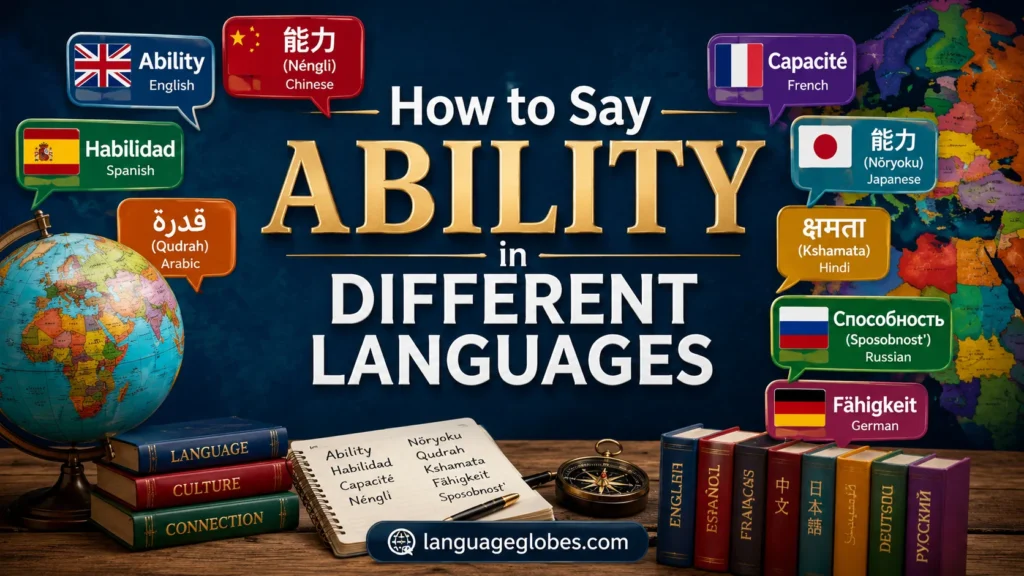
The ability to express ideas across various languages reveals a universal concept connected with human potential. This guide explores the translation of this word through linguistic diversity for curious language learners worldwide.
Understanding this term helps travelers, students, and teachers build stronger communication across global cultures. The meaning of ability often reflects power, skill, talent, and capacity in different contexts. People use it in education, careers, sports, and personal development to describe growth and achievement.
This resource shares ability in different languages with pronunciations, example sentences, and regional information for practical understanding. It helps writers, professionals, and learners understand the meaning and phrase behind this useful expression. The article connects culture, societies, and cross-cultural understanding through multilingual environments where people communicate and express their strengths.
These terms support learning, education, and real life examples while showing how languages connect human experiences worldwide. Exploring these expressions can help people discover vocabulary across countries and improve communication in everyday conversations.
Also read this: How to Say Abundant in Different Languages
Interesting Facts About Ability
- The word “ability” comes from the Latin word habilitas, meaning aptitude or capability.
- Ability is often associated with talent, skill, competence, capacity, and potential.
- Every language has a unique way of expressing the concept of ability.
- Many educational systems evaluate students based on their abilities and skills.
- The concept of ability plays a major role in psychology, leadership, and professional development.
- In many cultures, ability is considered more valuable than natural talent because it can be developed through practice.
- Ability-related vocabulary is commonly used in job interviews and academic settings worldwide.
- Learning this word in different languages helps improve multilingual communication.
How to Say Ability in Different Languages
European Languages
Europe is home to hundreds of languages and dialects that have influenced global communication, literature, science, and culture. Many European languages share historical roots, while others belong to entirely different language families. Learning how to express ability in these languages can help travelers, students, and professionals communicate more effectively throughout Europe.
| Language | Country/Region | Translation | Pronunciation | Example Sentence |
| 🇺🇸 American English | USA | Ability | uh-BIL-uh-tee | She has the ability to solve problems. |
| 🇬🇧 British English | UK | Ability | uh-BIL-i-tee | He demonstrated great ability at work. |
| 🇦🇺 Australian English | Australia | Ability | uh-BIL-uh-tee | Her ability impressed everyone. |
| 🇫🇷 French | France | Capacité | ka-pa-see-tay | Elle a la capacité de réussir. |
| 🇪🇸 Spanish | Spain | Habilidad | a-bee-lee-DAD | Tiene la habilidad de aprender rápido. |
| 🇵🇹 Portuguese | Portugal | Habilidade | a-bee-lee-DAH-de | Ela tem muita habilidade. |
| 🇮🇹 Italian | Italy | Abilità | a-bee-lee-TA | Ha grande abilità nel lavoro. |
| 🇩🇪 German | Germany | Fähigkeit | FAY-hig-kite | Er hat die Fähigkeit zu lernen. |
| 🇳🇱 Dutch | Netherlands | Vermogen | ver-MO-gen | Zij heeft veel vermogen. |
| 🇸🇪 Swedish | Sweden | Förmåga | fur-MO-ga | Hon har stor förmåga. |
| 🇳🇴 Norwegian | Norway | Evne | EV-ne | Han har evne til å lede. |
| 🇩🇰 Danish | Denmark | Evne | EV-ne | Hun har stor evne. |
| 🇫🇮 Finnish | Finland | Kyky | KU-kuu | Hänellä on hyvä kyky. |
| 🇮🇸 Icelandic | Iceland | Hæfni | HAIF-ni | Hann hefur mikla hæfni. |
| 🇵🇱 Polish | Poland | Zdolność | zdoLNOShch | Ma dużą zdolność. |
| 🇨🇿 Czech | Czech Republic | Schopnost | SKHOP-nost | Má schopnost učit se. |
| 🇸🇰 Slovak | Slovakia | Schopnosť | SKHOP-nost | Má veľkú schopnosť. |
| 🇭🇺 Hungarian | Hungary | Képesség | KAY-pesh-shayg | Nagy képessége van. |
| 🇷🇴 Romanian | Romania | Abilitate | a-bee-lee-TA-te | Are multă abilitate. |
| 🇬🇷 Greek | Greece | Ικανότητα | ee-ka-NO-ti-ta | Έχει μεγάλη ικανότητα. |
| 🇷🇺 Russian | Russia | Способность | spa-SOB-nost | У него есть способность. |
| 🇺🇦 Ukrainian | Ukraine | Здатність | zda-TNIST | Він має здатність навчатися. |
Asian Languages
Asia is the world’s largest and most populous continent, containing thousands of languages and diverse cultural traditions. From East Asia to South Asia and Southeast Asia, the concept of ability is expressed in many unique ways. These translations are useful for cultural studies, business communication, and language learning.
| Language | Country/Region | Translation | Pronunciation | Example Sentence |
| 🇨🇳 Chinese (Mandarin) | China | 能力 | néng lì | 她有很强的能力。 |
| 🇯🇵 Japanese | Japan | 能力 | nō-ryoku | 彼は高い能力を持っています。 |
| 🇰🇷 Korean | South Korea | 능력 | neung-ryeok | 그는 능력이 있습니다. |
| 🇮🇳 Hindi | India | क्षमता | ksham-ta | उसके पास क्षमता है। |
| 🇵🇰 Urdu | Pakistan | صلاحیت | salahiyat | اس کے پاس بڑی صلاحیت ہے۔ |
| 🇧🇩 Bengali | Bangladesh | সক্ষমতা | shok-kho-mo-ta | তার অনেক সক্ষমতা আছে। |
| 🇵🇰 Punjabi | Pakistan/India | صلاحیت | salahiyat | اس کول بہت صلاحیت اے۔ |
| 🇮🇳 Gujarati | India | ક્ષમતા | ksha-ma-ta | તેની પાસે ક્ષમતા છે. |
| 🇮🇳 Marathi | India | क्षमता | ksham-ta | त्याच्यात क्षमता आहे. |
| 🇮🇳 Tamil | India | திறன் | thi-ran | அவளுக்கு திறன் உள்ளது. |
| 🇮🇳 Telugu | India | సామర్థ్యం | sa-mar-thyam | అతనికి సామర్థ్యం ఉంది. |
| 🇮🇳 Kannada | India | ಸಾಮರ್ಥ್ಯ | sa-mar-thya | ಅವನಿಗೆ ಸಾಮರ್ಥ್ಯ ಇದೆ. |
| 🇮🇳 Malayalam | India | കഴിവ് | ka-zhiv | അവൾക്ക് കഴിവുണ്ട്. |
| 🇳🇵 Nepali | Nepal | क्षमता | ksha-ma-ta | उहाँसँग क्षमता छ। |
| 🇱🇰 Sinhala | Sri Lanka | හැකියාව | hae-ki-yaa-wa | ඇයට හැකියාව ඇත. |
| 🇹🇭 Thai | Thailand | ความสามารถ | kwaam-sa-mart | เขามีความสามารถมาก |
| 🇻🇳 Vietnamese | Vietnam | Khả năng | kha nang | Cô ấy có khả năng tốt. |
| 🇮🇩 Indonesian | Indonesia | Kemampuan | ke-mam-pu-an | Dia memiliki kemampuan besar. |
| 🇲🇾 Malay | Malaysia | Keupayaan | ke-u-pa-yaan | Dia mempunyai keupayaan tinggi. |
| 🇵🇭 Filipino | Philippines | Kakayahan | ka-ka-ya-han | May kakayahan siya. |
| 🇰🇭 Khmer | Cambodia | សមត្ថភាព | sa-mat-tha-pheap | គាត់មានសមត្ថភាព។ |
| 🇱🇦 Lao | Laos | ຄວາມສາມາດ | khwam-sa-mat | ລາວມີຄວາມສາມາດ. |
| 🇲🇳 Mongolian | Mongolia | Чадвар | chad-var | Тэр чадвартай. |
African Languages
Africa contains extraordinary linguistic diversity with more than 2,000 languages spoken across the continent. African languages reflect rich histories, traditions, and cultural identities. Understanding how to say ability in these languages helps foster appreciation for one of the world’s most linguistically diverse regions.
| Language | Country/Region | Translation | Pronunciation | Example Sentence |
| 🇿🇦 Swahili | East Africa | Uwezo | oo-WEH-zo | Ana uwezo mkubwa. |
| 🇿🇦 Zulu | South Africa | Ikhono | ee-KHO-no | Unamakhono amaningi. |
| 🇿🇦 Xhosa | South Africa | Isakhono | ee-sa-KHO-no | Unesakhono esikhulu. |
| 🇿🇦 Afrikaans | South Africa | Vermoë | ver-MOO-uh | Sy het groot vermoë. |
| 🇳🇬 Yoruba | Nigeria | Agbara | a-gba-ra | O ni agbara pupọ. |
| 🇳🇬 Igbo | Nigeria | Ikike | ee-kee-ke | O nwere ikike. |
| 🇳🇬 Hausa | Nigeria | Iko | EE-ko | Yana da iko sosai. |
| 🇪🇹 Amharic | Ethiopia | ችሎታ | chi-lo-ta | ችሎታ አለው። |
| 🇸🇴 Somali | Somalia | Awood | aa-wood | Wuxuu leeyahay awood. |
| 🇲🇬 Malagasy | Madagascar | Fahaizana | fa-hai-za-na | Manana fahaizana izy. |
| 🇷🇼 Kinyarwanda | Rwanda | Ubushobozi | oo-boo-sho-bo-zi | Afite ubushobozi. |
| 🇧🇼 Tswana | Botswana | Bokgoni | bo-KHO-ni | O na le bokgoni. |
Middle Eastern Languages
The Middle East is known for its rich cultural heritage, historical significance, and influential languages. These languages have contributed greatly to science, literature, philosophy, and religion. The concept of ability is commonly used when discussing skills, education, leadership, and personal achievement.
| Language | Country/Region | Translation | Pronunciation | Example Sentence |
| 🇸🇦 Arabic | Middle East | قدرة | qud-ra | لديه قدرة كبيرة. |
| 🇮🇷 Persian (Farsi) | Iran | توانایی | tava-na-ee | او توانایی زیادی دارد. |
| 🇹🇷 Turkish | Turkey | Yetenek | ye-te-nek | Büyük yeteneği var. |
| 🇮🇱 Hebrew | Israel | יכולת | ye-kho-let | יש לה יכולת רבה. |
| 🇰🇼 Kurdish | Kurdistan Region | Karîn | ka-reen | Ew karîn heye. |
| 🇴🇲 Omani Arabic | Oman | قدرة | qud-ra | لديه قدرة جيدة. |
| 🇶🇦 Qatari Arabic | Qatar | قدرة | qud-ra | عنده قدرة كبيرة. |
| 🇦🇪 Emirati Arabic | UAE | قدرة | qud-ra | عندها قدرة ممتازة. |
Additional Languages Around the World
Many other languages spoken throughout the Americas, Oceania, and various regions contribute to the world’s linguistic richness. Learning these translations broadens cultural awareness and helps people connect across borders.
| Language | Country/Region | Translation | Pronunciation | Example Sentence |
| 🇮🇪 Irish | Ireland | Cumas | KOO-mas | Tá cumas mór aige. |
| 🏴 Welsh | Wales | Gallu | GAH-thlee | Mae ganddi lawer o allu. |
| 🇲🇹 Maltese | Malta | Abbiltà | ab-bil-TA | Għandha abbiltà kbira. |
| 🇪🇪 Estonian | Estonia | Võime | VUH-ee-me | Tal on suur võime. |
| 🇱🇻 Latvian | Latvia | Spēja | SPAY-ja | Viņam ir liela spēja. |
| 🇱🇹 Lithuanian | Lithuania | Gebėjimas | ge-BAY-yi-mas | Ji turi gebėjimą. |
| 🇸🇮 Slovenian | Slovenia | Sposobnost | spo-SOB-nost | Ima veliko sposobnost. |
| 🇭🇷 Croatian | Croatia | Sposobnost | spo-SOB-nost | Ima sposobnost učenja. |
| 🇷🇸 Serbian | Serbia | Способност | spo-SOB-nost | Има велику способност. |
| 🇧🇦 Bosnian | Bosnia | Sposobnost | spo-SOB-nost | Ima veliku sposobnost. |
| 🇦🇱 Albanian | Albania | Aftësi | af-TE-see | Ai ka aftësi të mëdha. |
| 🇬🇪 Georgian | Georgia | უნარი | oo-na-ri | მას უნარი აქვს. |
| 🇦🇲 Armenian | Armenia | Կարողություն | ka-ro-ghu-tyun | Նա մեծ կարողություն ունի։ |
| 🇦🇿 Azerbaijani | Azerbaijan | Bacarıq | ba-ja-rik | Onun bacarığı var. |
| 🇰🇿 Kazakh | Kazakhstan | Қабілет | qa-bi-let | Оның қабілеті бар. |
| 🇺🇿 Uzbek | Uzbekistan | Qobiliyat | qo-bi-li-yat | Uning qobiliyati bor. |
| 🇹🇯 Tajik | Tajikistan | Қобилият | qo-bi-li-yat | Ӯ қобилият дорад. |
| 🇹🇲 Turkmen | Turkmenistan | Ukyb | oo-kib | Onuň ukyby bar. |
| 🇰🇬 Kyrgyz | Kyrgyzstan | Жөндөм | jon-dom | Анын жөндөмү бар. |
| 🇳🇿 Maori | New Zealand | Āheinga | aa-HAY-nga | He āheinga tōna. |
FAQs
What is the meaning of ability in different languages?
The meaning of ability changes slightly across various languages, but it usually represents skill, talent, capacity, or power to do something. This word connects with human potential, growth, and achievement.
How can I find the translation of ability in different languages?
You can explore the translation of ability in different languages through language learners resources, dictionaries, and accurate linguistic breakdowns. These help understand the correct context and usage.
Why is learning the word ability in various languages useful?
Learning this positive meaningful word supports communication, cross-cultural understanding, and global cultures. It helps students, travelers, and professionals connect better.
How is ability used in education and careers?
In education and careers, ability describes a person’s competence, capability, and skills to complete tasks successfully. It also supports personal development and professional growth.
How do different cultures express the concept of ability?
Different cultures and societies express ability through unique words and meanings. Understanding these differences improves communication and builds stronger relationships.
Can I learn the pronunciation of ability in all languages?
Yes, many resources provide pronunciations, audio pronunciation, and practical examples to help learners read and speak the term correctly across all languages.
How many languages include the word ability?
The concept of ability appears in more than 70 languages and even over 100 different tongues with different expressions, pronunciations, and cultural meanings.
What are some examples of ability in real life?
Real life examples of ability include the power to learn, create, lead, solve problems, and communicate effectively in personal and professional situations.
Who can benefit from learning ability in different languages?
Travelers, students, teachers, writers, and business professionals can benefit from learning this vocabulary for better multilingual environments and international connections.
Why is understanding ability important for language learning?
Understanding ability helps learners improve their vocabulary, explore major world languages, and use this phrase naturally in everyday conversations and global communication.
Conclusion
Exploring ability in different languages shows how this universal concept connects people through linguistic diversity and shared human experiences. Understanding the translation of this word across various languages helps language learners, travelers, and professionals improve communication and cross-cultural understanding. The idea of ability represents skill, talent, capacity, and human potential in many cultures and societies. Learning these expressions with pronunciations and practical examples makes learning more engaging and useful for everyday connections.

James Anderson is a passionate language enthusiast and content creator at LanguageGlobes. With a keen interest in global cultures and communication, he shares insightful and engaging content to help readers explore and master new languages.