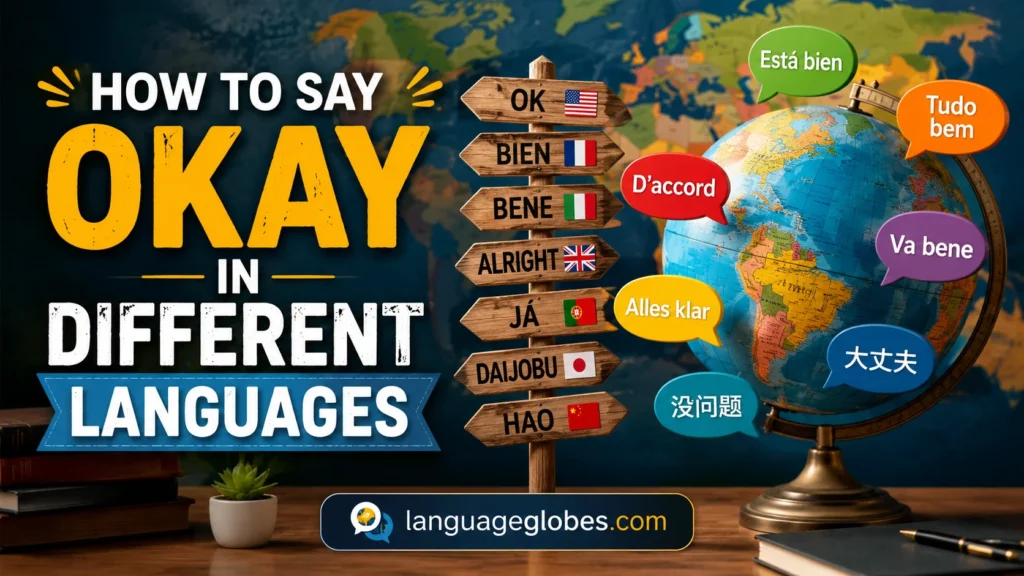
Okay is a universal expression used for agreement and confirmation worldwide. People use ok expression, affirmation, and acknowledgement across different languages in daily communication. It shows acceptance, approval, and understanding in world languages every day.
Travel and tourism rely on multilingual communication for smoother cultural exchange. Learners explore language learning, basic phrases, and communication skills for confidence building today.
This guide explains how to say okay and okay in different languages clearly for learners everywhere. It includes okay translations, translate okay, and meaning of okay usage examples in real life contexts. It helps improve communication skills in international travel and global interactions daily.
Understanding cultural awareness and cultural understanding improves respectful communication abroad significantly today. Mastering everyday conversation, common phrases, and pronunciation tips builds fluency effectively for learners worldwide.
Also read this: How to Say Peace in Different Languages
Interesting Facts About Okay
- “Okay” is one of the most recognized words in the world.
- The abbreviation “OK” became popular in the United States during the 19th century.
- Many languages have adopted “OK” directly from English.
- The word is commonly used in business, travel, education, and everyday conversations.
- Some cultures prefer words that literally mean “good” or “agreed” instead of a direct translation.
- “OK” is understood in many countries even by people who do not speak English fluently.
- The expression is often used in text messages, social media, and international communication.
- Learning simple words like “okay” can improve travel experiences and cross-cultural interactions.
How to Say Okay in Different Languages
European Languages
Europe is home to hundreds of languages and dialects. Although many Europeans understand English, each language has its own way of expressing agreement or confirmation. Learning these expressions can help travelers communicate more effectively and appreciate local cultures.
| Language | Country/Region | Translation | Pronunciation | Example Sentence |
| 🇺🇸 American English | United States | Okay | oh-kay | Okay, let’s go. |
| 🇬🇧 British English | United Kingdom | Alright | awl-right | Alright, I understand. |
| 🇦🇺 Australian English | Australia | No worries | no wur-eez | No worries, mate. |
| 🇫🇷 French | France | D’accord | da-kor | D’accord, je comprends. |
| 🇪🇸 Spanish | Spain | Vale | bah-leh | Vale, vamos. |
| 🇵🇹 Portuguese | Portugal | Está bem | es-ta beng | Está bem, obrigado. |
| 🇮🇹 Italian | Italy | Va bene | va beh-neh | Va bene, andiamo. |
| 🇩🇪 German | Germany | In Ordnung | in ord-noong | In Ordnung, danke. |
| 🇳🇱 Dutch | Netherlands | Oké | oh-kay | Oké, ik begrijp het. |
| 🇸🇪 Swedish | Sweden | Okej | oh-kay | Okej, tack. |
| 🇳🇴 Norwegian | Norway | Greit | grate | Greit, jeg kommer. |
| 🇩🇰 Danish | Denmark | Okay | oh-kay | Okay, tak. |
| 🇫🇮 Finnish | Finland | Okei | oh-kay | Okei, hyvä. |
| 🇵🇱 Polish | Poland | Dobrze | dob-zhe | Dobrze, rozumiem. |
| 🇨🇿 Czech | Czech Republic | Dobře | dob-zhe | Dobře, děkuji. |
| 🇸🇰 Slovak | Slovakia | Dobre | dob-reh | Dobre, rozumiem. |
| 🇭🇺 Hungarian | Hungary | Rendben | rend-ben | Rendben, köszönöm. |
| 🇷🇴 Romanian | Romania | Bine | bee-neh | Bine, mulțumesc. |
| 🇬🇷 Greek | Greece | Εντάξει | en-da-ksee | Εντάξει, πάμε. |
| 🇷🇺 Russian | Russia | Хорошо | ha-ra-sho | Хорошо, спасибо. |
Asian Languages
Asia is the largest continent and contains thousands of languages spoken by billions of people. From East Asia to South Asia and Southeast Asia, expressions for “okay” often reflect politeness, respect, and social harmony.
| Language | Country/Region | Translation | Pronunciation | Example Sentence |
| 🇨🇳 Chinese (Mandarin) | China | 好 | hao | 好,我们走吧。 |
| 🇯🇵 Japanese | Japan | いいです | ee des | いいです、ありがとう。 |
| 🇰🇷 Korean | South Korea | 괜찮아요 | gwen-cha-na-yo | 괜찮아요, 감사합니다. |
| 🇮🇳 Hindi | India | ठीक है | theek hai | ठीक है, चलो। |
| 🇵🇰 Urdu | Pakistan | ٹھیک ہے | theek hai | ٹھیک ہے، چلیں۔ |
| 🇧🇩 Bengali | Bangladesh | ঠিক আছে | theek ache | ঠিক আছে, চলুন। |
| 🇮🇳 Punjabi | India/Pakistan | ਠੀਕ ਹੈ | theek hai | ਠੀਕ ਹੈ, ਚੱਲੀਏ। |
| 🇮🇳 Gujarati | India | ઠીક છે | theek che | ઠીક છે, ચાલો. |
| 🇮🇳 Marathi | India | ठीक आहे | theek aahe | ठीक आहे, चला. |
| 🇮🇳 Tamil | India | சரி | sa-ri | சரி, போகலாம். |
| 🇮🇳 Telugu | India | సరే | sa-ray | సరే, వెళ్దాం. |
| 🇮🇳 Kannada | India | ಸರಿ | sa-ri | ಸರಿ, ಹೋಗೋಣ. |
| 🇮🇳 Malayalam | India | ശരി | sha-ri | ശരി, പോകാം. |
| 🇹🇭 Thai | Thailand | ได้ | dai | ได้, ไปกันเถอะ. |
| 🇻🇳 Vietnamese | Vietnam | Được | duoc | Được, cảm ơn. |
| 🇮🇩 Indonesian | Indonesia | Baik | ba-ik | Baik, terima kasih. |
| 🇲🇾 Malay | Malaysia | Baik | ba-ik | Baik, mari pergi. |
| 🇵🇭 Filipino | Philippines | Sige | see-geh | Sige, tara na. |
| 🇳🇵 Nepali | Nepal | ठिक छ | theek cha | ठिक छ, जाऔं। |
| 🇱🇰 Sinhala | Sri Lanka | හරි | ha-ri | හරි, යමු. |
African Languages
Africa is one of the most linguistically diverse continents in the world, with thousands of languages spoken across its regions. Many African languages have rich cultural histories and unique expressions for agreement and understanding.
| Language | Country/Region | Translation | Pronunciation | Example Sentence |
| 🇿🇦 Afrikaans | South Africa | Goed | khoot | Goed, ek verstaan. |
| 🇿🇦 Zulu | South Africa | Kulungile | koo-loon-gee-leh | Kulungile, ngiyabonga. |
| 🇿🇦 Xhosa | South Africa | Kulungile | koo-loon-gee-leh | Kulungile, masambe. |
| 🇰🇪 Swahili | East Africa | Sawa | sa-wa | Sawa, twende. |
| 🇪🇹 Amharic | Ethiopia | እሺ | eh-shee | እሺ እንሂድ. |
| 🇳🇬 Yoruba | Nigeria | O dara | oh da-ra | O dara, e se. |
| 🇳🇬 Igbo | Nigeria | Ọ dị mma | oh dee ma | Ọ dị mma, daalụ. |
| 🇳🇬 Hausa | Nigeria | To | toh | To, na gode. |
| 🇸🇴 Somali | Somalia | Hagaag | ha-gaag | Hagaag, mahadsanid. |
| 🇲🇬 Malagasy | Madagascar | Eny ary | en-yah ar-ee | Eny ary, andao. |
Middle Eastern Languages
The Middle East has a long history of trade, literature, and cultural exchange. Languages spoken in this region often emphasize politeness and respect in communication. Knowing these expressions can be useful for travelers, students, and professionals.
| Language | Country/Region | Translation | Pronunciation | Example Sentence |
| 🇸🇦 Arabic | Middle East | حسناً | ha-sa-nan | حسناً، شكراً. |
| 🇮🇷 Persian | Iran | باشه | ba-sheh | باشه، ممنون. |
| 🇹🇷 Turkish | Turkey | Tamam | ta-mam | Tamam, gidelim. |
| 🇮🇱 Hebrew | Israel | בסדר | be-se-der | בסדר, תודה. |
| 🇰🇼 Kurdish | Kurdistan Region | Başe | ba-she | Başe, spas. |
| 🇴🇲 Omani Arabic | Oman | زين | zain | زين، شكراً. |
| 🇶🇦 Gulf Arabic | Gulf Region | زين | zain | زين، تمام. |
| 🇦🇫 Pashto | Afghanistan | سمه ده | sa-ma da | سمه ده، مننه. |
| 🇦🇫 Dari | Afghanistan | باشه | ba-sheh | باشه، تشکر. |
| 🇦🇿 Azerbaijani | Azerbaijan | Yaxşı | yakh-shi | Yaxşı, təşəkkürlər. |
Additional Languages Around the World
Beyond Europe, Asia, Africa, and the Middle East, many fascinating languages are spoken across the Americas, Oceania, and indigenous communities worldwide. Learning these expressions broadens cultural awareness and appreciation.
| Language | Country/Region | Translation | Pronunciation | Example Sentence |
| 🇺🇸 Hawaiian | Hawaii | ʻAe | ah-eh | ʻAe, mahalo. |
| 🇳🇿 Maori | New Zealand | Ka pai | ka pie | Ka pai, haere tatou. |
| 🇼🇸 Samoan | Samoa | Lelei | leh-lay | Lelei, faafetai. |
| 🇹🇴 Tongan | Tonga | Sai | sigh | Sai, malo. |
| 🇫🇯 Fijian | Fiji | Io | ee-oh | Io, vinaka. |
| 🇨🇦 Inuktitut | Arctic Canada | Ii | ee | Ii, qujannamiik. |
| 🇺🇸 Cherokee | United States | ᎣᏏᏲ | oh-see-yo | ᎣᏏᏲ, wado. |
| 🇵🇾 Guarani | Paraguay | Oĩ porã | o-ee po-ra | Oĩ porã, aguyje. |
| 🇭🇹 Haitian Creole | Haiti | Dakò | da-koh | Dakò, mèsi. |
| 🇧🇷 Tupi | Brazil | Aé | ah-eh | Aé, obrigado. |
| 🇮🇪 Irish | Ireland | Ceart go leor | kyart guh lyor | Ceart go leor. |
| 🏴 Welsh | Wales | Iawn | yown | Iawn, diolch. |
| 🇮🇸 Icelandic | Iceland | Allt í lagi | alt ee la-yi | Allt í lagi. |
| 🇪🇪 Estonian | Estonia | Olgu | ol-goo | Olgu, aitäh. |
| 🇱🇻 Latvian | Latvia | Labi | la-bee | Labi, paldies. |
| 🇱🇹 Lithuanian | Lithuania | Gerai | ge-rai | Gerai, ačiū. |
| 🇸🇮 Slovenian | Slovenia | V redu | v reh-doo | V redu, hvala. |
| 🇭🇷 Croatian | Croatia | U redu | oo reh-doo | U redu, hvala. |
| 🇷🇸 Serbian | Serbia | U redu | oo reh-doo | U redu, hvala. |
| 🇧🇬 Bulgarian | Bulgaria | Добре | do-breh | Добре, благодаря. |
FAQs
What Does Okay Mean in Different Languages?
The word okay represents affirmation, agreement, and acceptance across different languages and world languages. It is commonly used for confirmation, approval, and understanding in everyday communication. The meaning of okay stays similar in most cultural contexts.
How Do You Say Okay in Different Languages?
You can say okay in different languages using simple okay translations based on local speech patterns. The phrase often changes in world languages, but keeps the sense of agreement expression and acknowledgement. Learning these improves multilingual communication and daily interaction skills.
Is Okay a Universal Expression?
Yes, okay is widely seen as a universal expression used for approval and confirmation globally. It works as a global expression in international communication and everyday speech. People understand it easily across different languages and cultures.
Where Is Okay Used in Travel Communication?
In travel and international travel, okay helps in cross cultural communication and smooth interaction. It supports tourism, communication abroad, and simple travel phrases. This improves cultural awareness and understanding during real experiences.
What Are Common Translations of Okay?
Common okay translations include words like all right, fine, yes, and agreed in many world languages. These represent acceptance, approval, and confirmation word usage in daily speech. They help in language translation and global understanding.
How Is Okay Used in Daily Conversation?
In everyday conversation, okay is a key communication expression for acknowledgement and agreement. It appears in common phrases, basic phrases, and frequently used word patterns. This supports clear communication skills in daily interaction.
What Is the Pronunciation of Okay in Other Languages?
The pronunciation tips for okay vary across different languages and native language systems. Despite changes, the pronunciation keeps its simple speech expression form. It helps learners in language learning and speaking practice.
Why Is Okay Important in Multilingual Communication?
Okay plays a major role in multilingual communication and international communication exchange. It strengthens communication clarity, cultural understanding, and language interpretation. This makes it essential for global communication and interaction.
Can Okay Be Used in Formal and Informal Communication?
Yes, okay works in both formal communication and informal language settings effectively. It expresses approval, acceptance, and confirmation in business and casual talk. This flexibility supports professional communication and daily usage.
How Does Okay Improve Cultural Understanding?
Using okay enhances cultural understanding, cultural appreciation, and cross language meaning awareness. It builds stronger communication across cultures and improves social interaction. This supports better cultural exchange and global connection.
Conclusion
In conclusion, okay remains a universal signal of agreement, acceptance, and confirmation across different languages and world languages. It strengthens multilingual communication and supports smooth interaction in international travel, cross cultural communication, and overall cultural understanding. Its simple use in everyday conversation, common phrases, and language learning helps improve clarity through effective translation guide and pronunciation tips. Overall, this versatile word enhances global communication, builds cultural awareness, and reflects true linguistic diversity in daily human interaction.

Grace Hall is a passionate language enthusiast and writer at LanguageGlobes, dedicated to making global communication simple and accessible. She shares insightful content to help readers explore new languages, cultures, and connections around the world.