
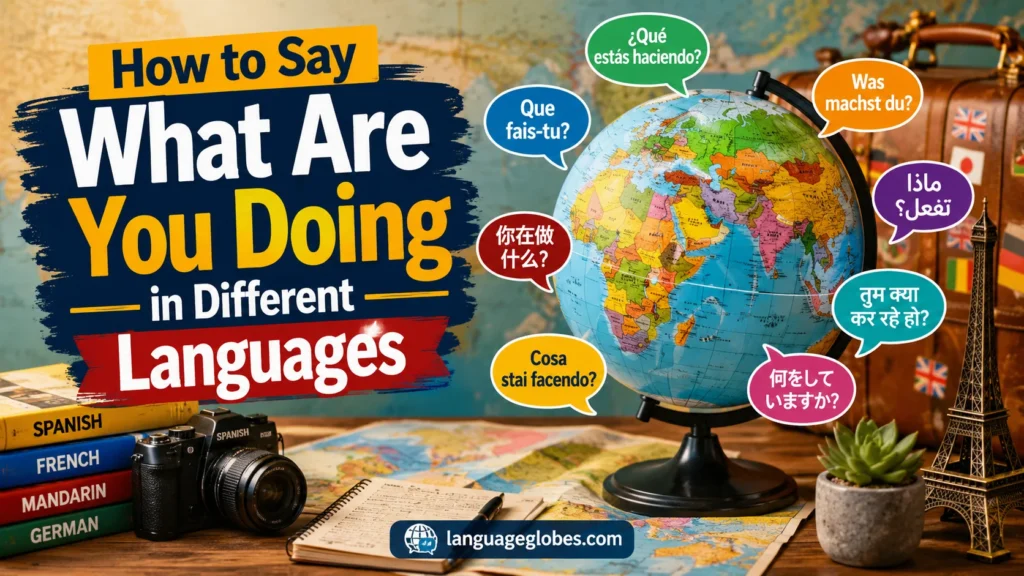
Have you ever wondered how to say what are you doing during a trip or chat? Learning what are you doing in different languages helps improve multilingual communication and everyday interactions. This common question works as a useful conversation starter in many situations worldwide. Whether meeting international friends or traveling abroad, this daily conversation phrase creates meaningful connections.
Understanding phrase meanings, language usage, and cultural context makes conversations more natural and respectful. It also supports language learning, strengthens language skills, and encourages cross cultural communication across communities.
In this complete translation guide, you will discover what are you doing translation examples across many world languages. We cover Spanish translation, French translation, German translation, and other popular foreign languages. Each phrase translation includes language pronunciation, pronunciation guide, and practical example sentences for clarity.
You will also learn about formal language, informal language, casual conversation, and respectful communication styles. These translation examples help language learners build conversation skills, improve language comprehension, and support global communication. Exploring global cultures, cultural nuances, and understanding cultures makes speaking different languages more enjoyable and effective.
Also read this: How to Say Woman in Different Languages
Interesting Facts About What Are You Doing
- “What are you doing?” is one of the most frequently used conversation starters worldwide.
- The phrase is often among the first questions taught in language learning courses.
- Some languages have formal and informal versions of the question.
- In many cultures, asking what someone is doing shows friendliness and interest.
- The phrase can be used in person, through text messages, or during phone conversations.
- Different languages may express the idea using completely different sentence structures.
- Learning everyday questions helps improve speaking confidence faster than memorizing complex vocabulary.
- The phrase is useful for travelers, business professionals, and international students.
- Many languages use different verb forms depending on who is being addressed.
- Understanding common conversational phrases helps build stronger cross-cultural relationships.
How to Say What Are You Doing in Different Languages
Below are translations of “What are you doing?” in more than 70 languages from around the world.
European Languages
Europe is home to hundreds of languages belonging to several major language families, including Romance, Germanic, Slavic, Celtic, and Baltic languages. While many European languages share historical influences, each has developed unique expressions and pronunciation patterns. Learning these phrases can make communication easier when visiting European countries and interacting with native speakers.
| Language | Country/Region | Translation | Pronunciation | Example Sentence |
| 🇺🇸 American English | USA | What are you doing? | Wuht ar yoo doo-ing | What are you doing this evening? |
| 🇬🇧 British English | UK | What are you doing? | Wuht ah yoo doo-ing | What are you doing today? |
| 🇦🇺 Australian English | Australia | What are you doing? | Wuht ah ya doo-in | What are you doing, mate? |
| 🇪🇸 Spanish | Spain | ¿Qué estás haciendo? | Keh es-tas ah-see-en-do | ¿Qué estás haciendo ahora? |
| 🇫🇷 French | France | Que fais-tu ? | Kuh feh too | Que fais-tu ce soir ? |
| 🇩🇪 German | Germany | Was machst du? | Vahs mahkhst doo | Was machst du heute? |
| 🇮🇹 Italian | Italy | Cosa stai facendo? | Ko-za sty fa-chen-do | Cosa stai facendo adesso? |
| 🇵🇹 Portuguese | Portugal | O que você está fazendo? | Oo keh vo-se es-ta fa-zen-do | O que você está fazendo? |
| 🇳🇱 Dutch | Netherlands | Wat doe je? | Vaht doo yuh | Wat doe je nu? |
| 🇸🇪 Swedish | Sweden | Vad gör du? | Vahd yur doo | Vad gör du idag? |
| 🇳🇴 Norwegian | Norway | Hva gjør du? | Hva yur doo | Hva gjør du nå? |
| 🇩🇰 Danish | Denmark | Hvad laver du? | Veth lay-ver doo | Hvad laver du nu? |
| 🇫🇮 Finnish | Finland | Mitä teet? | Mee-ta te-et | Mitä teet tänään? |
| 🇮🇸 Icelandic | Iceland | Hvað ert þú að gera? | Kvath ert thu ath gera | Hvað ert þú að gera núna? |
| 🇵🇱 Polish | Poland | Co robisz? | Tso ro-bish | Co robisz teraz? |
| 🇨🇿 Czech | Czech Republic | Co děláš? | Tso dye-lash | Co děláš teď? |
| 🇸🇰 Slovak | Slovakia | Čo robíš? | Cho ro-beesh | Čo robíš teraz? |
| 🇭🇺 Hungarian | Hungary | Mit csinálsz? | Meet chi-nalz | Mit csinálsz most? |
| 🇷🇴 Romanian | Romania | Ce faci? | Che fahch | Ce faci acum? |
| 🇧🇬 Bulgarian | Bulgaria | Какво правиш? | Kak-vo pra-vish | Какво правиш сега? |
| 🇷🇸 Serbian | Serbia | Šta radiš? | Shta ra-deesh | Šta radiš sada? |
| 🇭🇷 Croatian | Croatia | Što radiš? | Shto ra-deesh | Što radiš danas? |
| 🇸🇮 Slovenian | Slovenia | Kaj delaš? | Kai de-lash | Kaj delaš zdaj? |
| 🇺🇦 Ukrainian | Ukraine | Що ти робиш? | Sho ty ro-bysh | Що ти робиш зараз? |
| 🇷🇺 Russian | Russia | Что ты делаешь? | Shto ty dye-la-yesh | Что ты делаешь сейчас? |
| 🇬🇷 Greek | Greece | Τι κάνεις; | Tee ka-nees | Τι κάνεις τώρα; |
| 🇮🇪 Irish | Ireland | Cad atá tú a dhéanamh? | Kad a-taw too a yay-vuh | Cad atá tú a dhéanamh anois? |
| 🏴 Welsh | Wales | Beth wyt ti’n ei wneud? | Beth oo-it teen ay gwed | Beth wyt ti’n ei wneud? |
| 🇱🇹 Lithuanian | Lithuania | Ką darai? | Ka da-rai | Ką darai dabar? |
| 🇱🇻 Latvian | Latvia | Ko tu dari? | Ko too da-ri | Ko tu dari tagad? |
| 🇪🇪 Estonian | Estonia | Mida sa teed? | Mee-da sa teed | Mida sa teed praegu? |
Asian Languages
Asia is the largest continent and contains thousands of languages spoken by billions of people. The region includes major language families such as Indo-Aryan, Dravidian, Sino-Tibetan, Turkic, and Austronesian languages. Many Asian cultures place strong emphasis on politeness and respect, which often influences how questions are asked in everyday conversations.
| Language | Country/Region | Translation | Pronunciation | Example Sentence |
| 🇨🇳 Chinese (Mandarin) | China | 你在做什么? | Nee zai dzwaw shen-ma | 你在做什么? |
| 🇯🇵 Japanese | Japan | 何をしていますか? | Nani o shite imasu ka | 何をしていますか今? |
| 🇰🇷 Korean | South Korea | 뭐 하고 있어요? | Mwo ha-go iss-o-yo | 뭐 하고 있어요 지금? |
| 🇮🇳 Hindi | India | तुम क्या कर रहे हो? | Tum kya kar ra-he ho | तुम क्या कर रहे ho? |
| 🇵🇰 Urdu | Pakistan | تم کیا کر رہے ہو؟ | Tum kya kar rahe ho | تم کیا کر رہے ہو؟ |
| 🇧🇩 Bengali | Bangladesh | তুমি কি করছ? | Tumi ki kor-cho | তুমি কি করছ এখন? |
| 🇮🇳 Punjabi | India/Pakistan | ਤੁਸੀਂ ਕੀ ਕਰ ਰਹੇ ਹੋ? | Tusi ki kar rahe ho | ਤੁਸੀਂ ਕੀ ਕਰ ਰਹੇ ਹੋ? |
| 🇮🇳 Gujarati | India | તમે શું કરો છો? | Tame shu karo cho | તમે શું કરો છો? |
| 🇮🇳 Marathi | India | तू काय करत आहेस? | Tu kay karat ahes | तू काय करत आहेस? |
| 🇮🇳 Tamil | India | நீ என்ன செய்கிறாய்? | Nee enna seygirai | நீ என்ன செய்கிறாய்? |
| 🇮🇳 Telugu | India | నువ్వు ఏమి చేస్తున్నావు? | Nuvvu emi chestunnavu | నువ్వు ఏమి చేస్తున్నావు? |
| 🇮🇳 Kannada | India | ನೀನು ಏನು ಮಾಡುತ್ತಿದ್ದೀಯ? | Neenu enu maduttiddiya | ನೀನು ಏನು ಮಾಡುತ್ತಿದ್ದೀಯ? |
| 🇮🇳 Malayalam | India | നീ എന്ത് ചെയ്യുന്നു? | Nee enthu cheyyunnu | നീ എന്ത് ചെയ്യുന്നു? |
| 🇳🇵 Nepali | Nepal | तिमी के गर्दैछौ? | Timi ke gardai chau | तिमी के गर्दैछौ? |
| 🇱🇰 Sinhala | Sri Lanka | ඔයා මොකද කරන්නේ? | Oya mokada karanne | ඔයා මොකද කරන්නේ? |
| 🇹🇭 Thai | Thailand | คุณกำลังทำอะไร? | Khun gam-lang tam a-rai | คุณกำลังทำอะไรอยู่? |
| 🇻🇳 Vietnamese | Vietnam | Bạn đang làm gì? | Ban dang lam zi | Bạn đang làm gì? |
| 🇮🇩 Indonesian | Indonesia | Apa yang kamu lakukan? | Apa yang ka-moo la-koo-kan | Apa yang kamu lakukan sekarang? |
| 🇲🇾 Malay | Malaysia | Apa yang kamu buat? | Apa yang ka-moo boo-at | Apa yang kamu buat sekarang? |
| 🇵🇭 Filipino | Philippines | Ano ang ginagawa mo? | Ano ang gi-na-ga-wa mo | Ano ang ginagawa mo ngayon? |
| 🇰🇭 Khmer | Cambodia | អ្នកកំពុងធ្វើអ្វី? | Nek kom-pong tvoe avei | អ្នកកំពុងធ្វើអ្វី? |
| 🇱🇦 Lao | Laos | ເຈົ້າກຳລັງເຮັດຫຍັງ? | Jao gam-lang het nyang | ເຈົ້າກຳລັງເຮັດຫຍັງ? |
| 🇲🇳 Mongolian | Mongolia | Чи юу хийж байна? | Chi yoo heij baina | Чи юу хийж байна? |
| 🇹🇷 Turkish | Türkiye | Ne yapıyorsun? | Ne ya-pi-yor-sun | Ne yapıyorsun şimdi? |
| 🇰🇿 Kazakh | Kazakhstan | Не істеп жатырсың? | Ne istep zhatyrsyn | Не істеп жатырсың? |
| 🇺🇿 Uzbek | Uzbekistan | Nima qilyapsan? | Nee-ma ki-lyap-san | Nima qilyapsan? |
African Languages
Africa is one of the most linguistically diverse continents in the world, with more than 2,000 languages spoken across its countries. African languages belong to several major language families, including Niger-Congo, Afro-Asiatic, Nilo-Saharan, and Khoisan. Learning common phrases in African languages provides insight into the continent’s rich cultural heritage and vibrant communities.
| Language | Country/Region | Translation | Pronunciation | Example Sentence |
| 🇿🇦 Zulu | South Africa | Wenzani? | Wen-za-ni | Wenzani manje? |
| 🇿🇦 Xhosa | South Africa | Wenza ntoni? | Wen-za ntoo-ni | Wenza ntoni ngoku? |
| 🇰🇪 Swahili | East Africa | Unafanya nini? | Oo-na-fan-ya nee-nee | Unafanya nini sasa? |
| 🇪🇹 Amharic | Ethiopia | ምን እያደረግክ ነው? | Min iya-de-regk naw | ምን እያደረግክ ነው? |
| 🇳🇬 Yoruba | Nigeria | Kí ni o ń ṣe? | Kee nee o sheh | Kí ni o ń ṣe báyìí? |
| 🇳🇬 Igbo | Nigeria | Gịnị ka ị na-eme? | Gini ka i na-eme | Gịnị ka ị na-eme ugbu a? |
| 🇳🇬 Hausa | Nigeria | Me kake yi? | Meh ka-ke yee | Me kake yi yanzu? |
| 🇸🇴 Somali | Somalia | Maxaad samaynaysaa? | Ma-khad sa-man-ya-sa | Maxaad samaynaysaa hadda? |
| 🇲🇬 Malagasy | Madagascar | Inona no ataonao? | Ee-no-na no a-ta-o-nao | Inona no ataonao izao? |
| 🇷🇼 Kinyarwanda | Rwanda | Uri gukora iki? | Oo-ri ko-re-ka ee-kee | Uri gukora iki ubu? |
| 🇧🇼 Tswana | Botswana | O dira eng? | O dee-ra eng | O dira eng jaanong? |
| 🇱🇸 Sesotho | Lesotho | O etsa’ng? | O et-sang | O etsa’ng hona joale? |
| 🇳🇦 Oshiwambo | Namibia | Ota ningi shike? | O-ta nin-gi shi-ke | Ota ningi shike? |
| 🇪🇷 Tigrinya | Eritrea | እንታይ ትገብር ኣለኻ? | En-tai ti-ge-bir a-le-kha | እንታይ ትገብር ኣለኻ? |
| 🇨🇲 Lingala | Central Africa | Ozali kosala nini? | O-za-li ko-sa-la nee-nee | Ozali kosala nini sikoyo? |
Middle Eastern Languages
The Middle East is known for its rich history, ancient civilizations, and influential languages. Many languages in this region belong to the Semitic family, while others come from Indo-European and Turkic roots. These languages have shaped literature, trade, science, and culture for centuries and continue to be widely spoken across the world.
| Language | Country/Region | Translation | Pronunciation | Example Sentence |
| 🇸🇦 Arabic | Middle East | ماذا تفعل؟ | Ma-tha taf-al | ماذا تفعل الآن؟ |
| 🇮🇷 Persian (Farsi) | Iran | داری چیکار میکنی؟ | Da-ri chi-kar mi-ko-ni | داری چیکار میکنی؟ |
| 🇮🇱 Hebrew | Israel | מה אתה עושה? | Ma a-ta o-seh | מה אתה עושה עכשיו? |
| 🇦🇫 Pashto | Afghanistan | ته څه کوې؟ | Ta tsa kawai | ته څه کوې اوس؟ |
| 🇦🇫 Dari | Afghanistan | چی کار میکنی؟ | Chi kar mi-kuni | چی کار میکنی حالا؟ |
| 🇦🇲 Armenian | Armenia | Ի՞նչ ես անում։ | Inch es anum | Ի՞նչ ես անում հիմա։ |
| 🇬🇪 Georgian | Georgia | რას აკეთებ? | Ras a-ke-teb | რას აკეთებ ახლა? |
| 🇦🇿 Azerbaijani | Azerbaijan | Nə edirsən? | Ne e-dir-sen | Nə edirsən indi? |
| 🇰🇼 Kurdish | Kurdistan Region | Tu çi dikî? | Too chi di-kee | Tu çi dikî niha? |
FAQs
What Does “What Are You Doing” Mean in Different Languages?
The phrase what are you doing in different languages is a widely used daily conversation phrase and common question. Learning its phrase meanings helps improve multilingual communication and makes interactions more natural across global cultures.
How Can I Learn the Correct What Are You Doing Translation?
A reliable what are you doing translation should include proper language pronunciation, phrase translation, and cultural context. Using a trusted translation guide helps avoid misunderstandings during international communication.
Why Is “What Are You Doing” Important for Language Learning?
Learning how to say what are you doing supports language learning, improves language skills, and expands your vocabulary building. It is one of the most useful phrases for everyday conversations and foreign language practice.
What Are Some Popular Language Translations for This Phrase?
Common language translations include Spanish translation, French translation, and German translation. These examples help language learners understand how the phrase is used in major world languages.
Should I Use Formal or Informal Language When Asking This Question?
The choice between formal language and informal language depends on the situation. Understanding cultural communication styles ensures respectful communication with strangers and elders, friends, or colleagues.
How Does This Phrase Help During Traveling Abroad?
When traveling abroad, this practical phrase can help start a conversation and build personal connections. It is especially useful for travel communication and interacting with international friends.
Can Learning This Phrase Improve Cross Cultural Communication?
Yes, understanding this different languages phrase enhances cross cultural communication and promotes understanding cultures. It helps people appreciate cultural nuances and communicate more confidently.
Do Translation Examples Include Pronunciation Help?
Most quality translation examples provide a pronunciation guide, phrase pronunciation, and useful example sentences. These resources improve language comprehension and support better conversational language skills.
Which Languages Commonly Use This Question in Everyday Conversations?
The phrase appears frequently in Spanish language, French language, German language, and many other global languages. It remains a common expression in casual conversation, family conversations, and colleague conversations.
How Can I Master This Phrase Across World Languages?
Using a multilingual phrasebook, translation resource, and language reference can improve language mastery. Regular speaking different languages practice strengthens conversation skills, global communication, and overall world communication.
Conclusion
Learning what are you doing in different languages is a practical way to improve multilingual communication, strengthen language skills, and build confidence in everyday conversations. By understanding what are you doing translation, phrase meanings, language pronunciation, and cultural context, you can communicate more effectively across world languages and global cultures. Whether for language learning, travel communication, or connecting with international friends, this common question supports better cross cultural communication and meaningful interactions. Consistent practice with language translations, example sentences, and conversation skills helps develop global communication abilities and deeper appreciation for linguistic diversity.

Joshua Lewis is a passionate language enthusiast and content creator at LanguageGlobes.com. He specializes in exploring global languages, cultures, and communication trends, helping readers connect with the world through words.