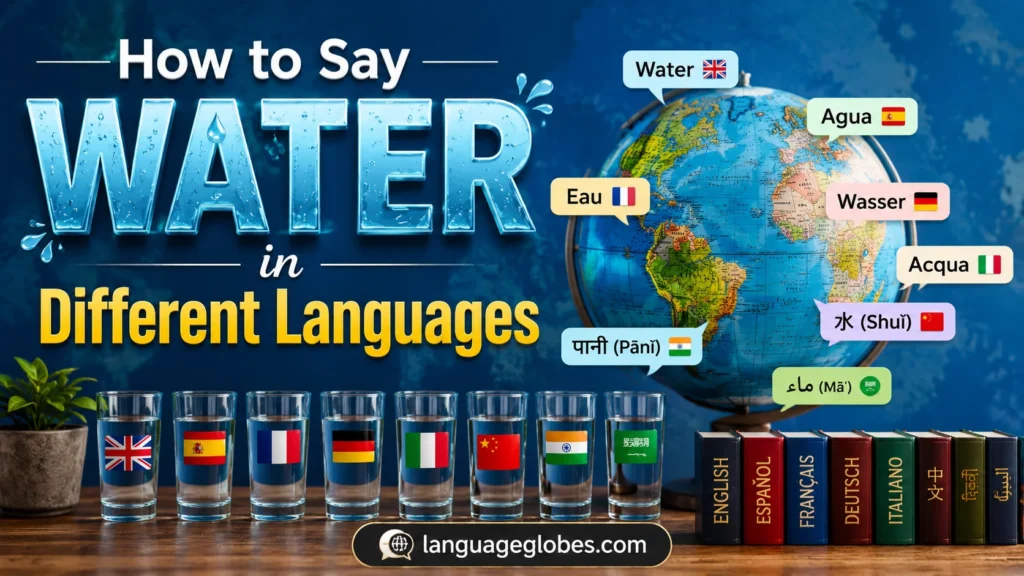
Water is a life sustaining resource essential for living beings across planet earth. Learning how to say water in different languages helps improve international communication during travel and everyday interactions. This simple water translation topic supports language learning while expanding your multilingual vocabulary naturally.
Understanding the water meaning, water pronunciation, and word translation across world languages builds stronger communication skills. It also introduces fascinating aspects of linguistic diversity, language differences, and cultural understanding worldwide. Whether you are a traveler, student, or curious learner, this language guide offers valuable insights.
Exploring the water word in global languages reveals connections between human languages, world cultures, and cultural heritage. This practical translation guide includes translation examples, pronunciation guide support, and useful example sentences for daily conversations. You will discover common words, essential words, travel phrases, and useful travel words that strengthen multilingual communication.
The article also highlights language history, language origins, linguistic traditions, and rich linguistic heritage from different world regions. Through language comparison, language exploration, and language discovery, readers gain broader language knowledge and greater appreciation for cultural diversity. This educational guide serves as an essential resource for language learners, language enthusiasts, and anyone interested in language enrichment.
Also read this: How to Say Welcome in Different Languages
Interesting Facts About Water
- Water covers approximately 71% of the Earth’s surface.
- The word “water” is among the most commonly used nouns worldwide.
- Many ancient civilizations developed near rivers and water sources.
- Different languages often have unique expressions and idioms related to water.
- Water symbolizes life, purity, renewal, and prosperity in many cultures.
- Learning basic words like water can make travel easier and more enjoyable.
- Some languages have multiple words for different forms of water, such as drinking water, river water, or rainwater.
- Water-related vocabulary is usually among the first lessons in language learning programs.
- Nearly every language family has its own unique word for water.
- Knowing how to ask for water can be essential during international travel.
How to Say Water in Different Languages
European Languages
Europe is home to hundreds of languages belonging to several language families, including Germanic, Romance, Slavic, Celtic, and Baltic languages. Although these languages evolved differently over centuries, they all have unique words for water. Learning these terms can be especially useful when traveling across Europe or studying European cultures and languages.
| Language | Country/Region | Translation | Pronunciation | Example Sentence |
| 🇺🇸 American English | USA | Water | WAW-ter | I need some water. |
| 🇬🇧 British English | UK | Water | WAW-tuh | Could I have some water? |
| 🇦🇺 Australian English | Australia | Water | WAW-duh | Can I get some water? |
| 🇫🇷 French | France | Eau | Oh | Je bois de l’eau. |
| 🇪🇸 Spanish | Spain | Agua | AH-gwa | Necesito agua. |
| 🇵🇹 Portuguese | Portugal | Água | AH-gwa | Quero água. |
| 🇮🇹 Italian | Italy | Acqua | AHK-kwa | Vorrei dell’acqua. |
| 🇩🇪 German | Germany | Wasser | VAH-ser | Ich brauche Wasser. |
| 🇳🇱 Dutch | Netherlands | Water | VAH-ter | Ik wil water. |
| 🇸🇪 Swedish | Sweden | Vatten | VAH-ten | Jag vill ha vatten. |
| 🇳🇴 Norwegian | Norway | Vann | Vahn | Jeg trenger vann. |
| 🇩🇰 Danish | Denmark | Vand | Vahn | Jeg vil have vand. |
| 🇫🇮 Finnish | Finland | Vesi | VEH-see | Tarvitsen vettä. |
| 🇮🇸 Icelandic | Iceland | Vatn | Vahtn | Ég vil vatn. |
| 🇵🇱 Polish | Poland | Woda | VO-da | Potrzebuję wody. |
| 🇨🇿 Czech | Czech Republic | Voda | VO-da | Chci vodu. |
| 🇸🇰 Slovak | Slovakia | Voda | VO-da | Potrebujem vodu. |
| 🇭🇺 Hungarian | Hungary | Víz | Veez | Kérek vizet. |
| 🇷🇴 Romanian | Romania | Apă | AH-puh | Beau apă. |
| 🇬🇷 Greek | Greece | Nero | NEH-ro | Thelo nero. |
| 🇷🇺 Russian | Russia | Voda | Va-DA | Mne nuzhna voda. |
| 🇺🇦 Ukrainian | Ukraine | Voda | VO-da | Meni potribna voda. |
| 🇧🇬 Bulgarian | Bulgaria | Voda | VO-da | Iskam voda. |
| 🇭🇷 Croatian | Croatia | Voda | VO-da | Trebam vodu. |
| 🇷🇸 Serbian | Serbia | Voda | VO-da | Treba mi voda. |
Asian Languages
Asia is the largest and most linguistically diverse continent in the world. It is home to thousands of languages spoken across East Asia, South Asia, Southeast Asia, and Central Asia. Many Asian languages use different writing systems, making their words for water especially interesting for language learners.
| Language | Country/Region | Translation | Pronunciation | Example Sentence |
| 🇨🇳 Chinese (Mandarin) | China | 水 | Shway | 我要水。 |
| 🇯🇵 Japanese | Japan | 水 | Mee-zoo | 水をください。 |
| 🇰🇷 Korean | South Korea | 물 | Mool | 물 주세요. |
| 🇮🇳 Hindi | India | पानी | Paa-nee | मुझे पानी चाहिए। |
| 🇵🇰 Urdu | Pakistan | پانی | Paa-nee | مجھے پانی چاہیے۔ |
| 🇧🇩 Bengali | Bangladesh | পানি | Paa-nee | আমার পানি চাই। |
| 🇵🇰 Punjabi | Punjab | ਪਾਣੀ | Paa-nee | ਮੈਨੂੰ ਪਾਣੀ ਚਾਹੀਦਾ ਹੈ। |
| 🇮🇳 Gujarati | India | પાણી | Paa-nee | મને પાણી જોઈએ. |
| 🇮🇳 Marathi | India | पाणी | Paa-nee | मला पाणी हवे आहे. |
| 🇮🇳 Tamil | India | தண்ணீர் | Than-neer | எனக்கு தண்ணீர் வேண்டும். |
| 🇮🇳 Telugu | India | నీరు | Nee-roo | నాకు నీరు కావాలి. |
| 🇮🇳 Kannada | India | ನೀರು | Nee-roo | ನನಗೆ ನೀರು ಬೇಕು. |
| 🇮🇳 Malayalam | India | വെള്ളം | Vel-lam | എനിക്ക് വെള്ളം വേണം. |
| 🇳🇵 Nepali | Nepal | पानी | Paa-nee | मलाई पानी चाहिन्छ। |
| 🇱🇰 Sinhala | Sri Lanka | වතුර | Va-thu-ra | මට වතුර ඕනෑ. |
| 🇹🇭 Thai | Thailand | น้ำ | Nam | ฉันต้องการน้ำ |
| 🇻🇳 Vietnamese | Vietnam | Nước | Nook | Tôi cần nước. |
| 🇮🇩 Indonesian | Indonesia | Air | Ah-eer | Saya ingin air. |
| 🇲🇾 Malay | Malaysia | Air | Ah-eer | Saya mahu air. |
| 🇰🇭 Khmer | Cambodia | ទឹក | Tuk | ខ្ញុំចង់បានទឹក។ |
| 🇱🇦 Lao | Laos | ນ້ຳ | Nam | ຂ້ອຍຕ້ອງການນ້ຳ |
| 🇲🇲 Burmese | Myanmar | ရေ | Yay | ရေလိုချင်တယ်။ |
| 🇲🇳 Mongolian | Mongolia | Ус | Oos | Надад ус хэрэгтэй. |
| 🇰🇿 Kazakh | Kazakhstan | Су | Soo | Маған су керек. |
| 🇺🇿 Uzbek | Uzbekistan | Suv | Soov | Menga suv kerak. |
African Languages
Africa is home to over 2,000 languages and some of the world’s richest linguistic traditions. The continent’s languages belong to diverse language families and reflect centuries of cultural history. Learning common words like water in African languages provides valuable insight into this remarkable diversity.
| Language | Country/Region | Translation | Pronunciation | Example Sentence |
| 🇿🇦 Zulu | South Africa | Amanzi | Ah-MAHN-zee | Ngifuna amanzi. |
| 🇿🇦 Xhosa | South Africa | Amanzi | Ah-MAHN-zee | Ndifuna amanzi. |
| 🇰🇪 Swahili | East Africa | Maji | MAH-jee | Ninahitaji maji. |
| 🇪🇹 Amharic | Ethiopia | ውሃ | Woo-ha | ውሃ እፈልጋለሁ። |
| 🇳🇬 Yoruba | Nigeria | Omi | OH-mee | Mo fẹ omi. |
| 🇳🇬 Igbo | Nigeria | Mmiri | MEE-ree | Achọrọ m mmiri. |
| 🇳🇬 Hausa | Nigeria | Ruwa | ROO-wa | Ina bukatar ruwa. |
| 🇿🇼 Shona | Zimbabwe | Mvura | MVOO-ra | Ndinoda mvura. |
| 🇧🇼 Tswana | Botswana | Metsi | MET-see | Ke batla metsi. |
| 🇱🇸 Sesotho | Lesotho | Metsi | MET-see | Ke hloka metsi. |
| 🇲🇬 Malagasy | Madagascar | Rano | RAH-no | Mila rano aho. |
| 🇸🇴 Somali | Somalia | Biyo | BEE-yo | Waxaan rabaa biyo. |
Middle Eastern Languages
The Middle East has been a center of civilization for thousands of years. Languages spoken in this region have influenced science, literature, religion, and trade across the world. Understanding how to say water in Middle Eastern languages can be helpful for travelers and language enthusiasts alike.
| Language | Country/Region | Translation | Pronunciation | Example Sentence |
| 🇸🇦 Arabic | Middle East | ماء | Maa | أريد ماء. |
| 🇮🇷 Persian (Farsi) | Iran | آب | Aab | من آب میخواهم. |
| 🇹🇷 Turkish | Turkey | Su | Soo | Su istiyorum. |
| 🇮🇱 Hebrew | Israel | מים | Mah-yim | אני צריך מים. |
| 🇰🇼 Kurdish | Kurdistan Region | Av | Ahv | Ez av dixwazim. |
| 🇦🇲 Armenian | Armenia | Ջուր | Joor | Ջուր եմ ուզում։ |
| 🇬🇪 Georgian | Georgia | წყალი | Tskha-li | წყალი მინდა. |
| 🇦🇿 Azerbaijani | Azerbaijan | Su | Soo | Mənə su lazımdır. |
Additional Languages Around the World
Beyond Europe, Asia, Africa, and the Middle East, many fascinating languages are spoken throughout the Americas, Oceania, and indigenous communities worldwide. Learning these words expands your understanding of global cultures and linguistic diversity.
| Language | Country/Region | Translation | Pronunciation | Example Sentence |
| 🇳🇿 Maori | New Zealand | Wai | Why | Kei te hiahia ahau ki te wai. |
| 🇼🇸 Samoan | Samoa | Vai | Vai | Ou te mana’o i le vai. |
| 🇹🇴 Tongan | Tonga | Vai | Vai | Oku ou fie vai. |
| 🇭🇹 Haitian Creole | Haiti | Dlo | Dloh | Mwen bezwen dlo. |
| 🇵🇭 Filipino | Philippines | Tubig | Too-big | Kailangan ko ng tubig. |
| 🇬🇱 Greenlandic | Greenland | Imiq | Ee-mik | Imiq pisariaqartippara. |
| 🇨🇦 Inuktitut | Canada | Imiq | Ee-mik | Imiq pisuk. |
| 🇲🇽 Nahuatl | Mexico | Atl | Ahtl | Nicnequi atl. |
| 🇵🇾 Guarani | Paraguay | Y | Uh | Aikotevẽ y. |
| 🇵🇪 Quechua | Peru | Yaku | Yah-koo | Yaku munani. |
| 🇺🇸 Hawaiian | Hawaii | Wai | Why | Makemake au i ka wai. |
| 🇨🇦 Cree | Canada | Nipiy | NEE-pee | Nipiy nitawihtên. |
FAQs
What Does Water Mean in Different Languages?
The water meaning remains the same across human languages, but the translated words vary between different world languages. Learning these translations improves language knowledge, multilingual communication, and understanding of cultural diversity.
Why Should I Learn How to Say Water in Different Languages?
Knowing how to say water in different languages is useful for international travel, daily conversations, and global communication. It is one of the most important essential words in any travel vocabulary collection.
How Can Water Translation Help Language Learning?
Water translation helps build vocabulary, supports language learning, and improves language skills through practical usage. It also strengthens language practice by teaching a common and frequently used term.
What Is the Correct Water Pronunciation in Foreign Languages?
Water pronunciation differs across foreign languages because of unique sounds and pronunciation variations. Using a pronunciation guide and regular pronunciation practice can help learners speak more accurately.
Why Is Water Considered an Essential Word in Language Study?
Water is one of the most important common words used in everyday life. As part of everyday vocabulary, it plays a key role in language study, communication skills, and practical conversations.
How Does the Word Water Reflect Cultural Identity?
The water word often reflects a community’s cultural identity, cultural heritage, and linguistic traditions. Studying language expressions related to water provides deeper insight into world cultures and human culture.
Can Learning Water in Multiple Languages Improve Travel Communication?
Yes, learning this travel vocabulary helps with traveler phrases, useful travel words, and smoother cross cultural communication. It is especially helpful when requesting drinking water during international travel.
What Can Language Comparison Teach Us About Water Translations?
Language comparison reveals interesting language differences, spelling variations, and language origins behind the word water. It also supports language exploration and a broader understanding of linguistic diversity.
How Is Water Represented Across World Regions and Global Languages?
The word water appears differently throughout global languages, including Europe languages, Asian languages, African languages, and Middle Eastern languages. These variations showcase remarkable language diversity across different world regions.
Where Can I Find Reliable Water Translation and Pronunciation Resources?
A trusted language resource, translation guide, or educational guide can provide accurate word translation, translation examples, and language pronunciation details. These resources support multilingual learning, language discovery, and ongoing vocabulary expansion.
Conclusion
Learning how to say water in different languages is a simple yet powerful way to expand your multilingual vocabulary, strengthen language learning, and improve international communication. Exploring water translation, water pronunciation, and word translation across world languages helps build practical vocabulary, enrich language knowledge, and support meaningful cross cultural communication. It also offers valuable insights into linguistic diversity, cultural heritage, world cultures, and the rich language origins that shape human expression. Whether for travel vocabulary, daily conversations, or personal growth, this educational guide serves as an essential resource for deeper language discovery and lasting cultural understanding.

Joshua Lewis is a passionate language enthusiast and content creator at LanguageGlobes.com. He specializes in exploring global languages, cultures, and communication trends, helping readers connect with the world through words.