
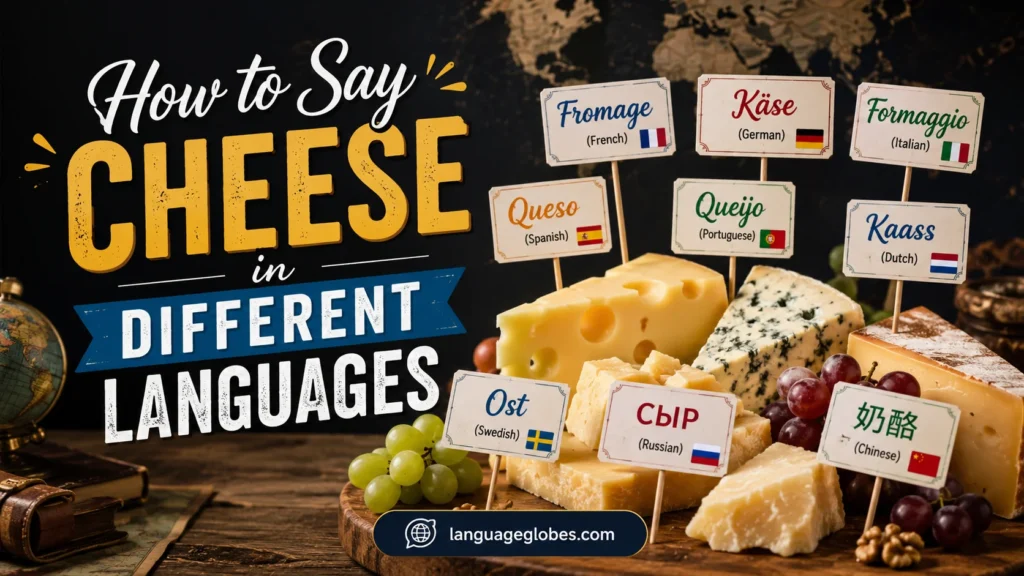
If you have ever wondered how to say cheese in different languages, this guide makes learning simple and enjoyable. Understanding the cheese translation in various world languages helps improve language learning and enriches travel communication. As a popular dairy product, cheese connects people through food and language, shared experiences, and unique cultural traditions.
Exploring the cheese word across regions also reveals fascinating aspects of cultural identity and local food traditions. From European languages to Asian languages, each term reflects distinct culinary traditions and rich food culture. This practical language guide includes helpful cheese pronunciation, useful example sentences, and interesting cultural facts.
Beyond language, cheese plays an important role in global cuisine and international food traditions worldwide. Discover famous cheese names like French brie, Italian mozzarella, Swiss cheese, and Indian paneer while exploring cheese around the world. Whether enjoying pizza in Italy, fondue in Switzerland, or visiting a local market, every travel experience offers new insights into cheese culture.
Learning multilingual cheese terms can help you connect with local people and appreciate regional flavors more deeply. This easy pronunciation guide highlights how a universal food reflects history, tradition, and culinary diversity. Whether you are curious about language or food, this journey through global cuisine is both informative and rewarding.
Also read this: How to Say Congratulations in Different Languages
Interesting Facts About Cheese
- Cheese has been made for over 7,000 years.
- France produces more than 1,000 varieties of cheese.
- The English word “cheese” comes from the Old English word cēse.
- Some cheeses are made from cow milk, while others use goat, sheep, yak, or camel milk.
- Cheese is rich in calcium, protein, and vitamins.
- Different cultures use cheese in breads, desserts, sandwiches, pasta, and soups.
- Saying “cheese” before photographs became popular in America during the 1940s.
- Italy is famous for mozzarella and parmesan cheese.
- Switzerland is known for cheese fondue.
- Vegan cheese alternatives are becoming increasingly popular worldwide.
European Languages
Europe is famous for its rich cheese-making traditions. Countries such as France, Italy, Switzerland, and the Netherlands are internationally known for their delicious cheeses. European languages have evolved over centuries, and many cheese-related words have fascinating historical origins connected to Latin and Germanic languages.
Below is a table showing how to say cheese in different European languages.
| Language | Country/Region | Translation | Pronunciation | Example Sentence |
| American English 🇺🇸 | United States | Cheese | Cheez | I love cheese on burgers. |
| British English 🇬🇧 | United Kingdom | Cheese | Cheez | Cheese tastes great with crackers. |
| Australian English 🇦🇺 | Australia | Cheese | Cheez | Australians enjoy cheese platters. |
| French 🇫🇷 | France | Fromage | Froh-mahj | J’aime le fromage. |
| Spanish 🇪🇸 | Spain | Queso | Keh-so | Me gusta el queso. |
| Italian 🇮🇹 | Italy | Formaggio | For-maj-joh | Il formaggio è delizioso. |
| German 🇩🇪 | Germany | Käse | Keh-zuh | Ich esse Käse. |
| Portuguese 🇵🇹 | Portugal | Queijo | Kay-zhoo | Eu adoro queijo. |
| Dutch 🇳🇱 | Netherlands | Kaas | Kahs | Ik hou van kaas. |
| Swedish 🇸🇪 | Sweden | Ost | Oost | Jag gillar ost. |
| Norwegian 🇳🇴 | Norway | Ost | Oost | Jeg liker ost. |
| Danish 🇩🇰 | Denmark | Ost | Oost | Jeg elsker ost. |
| Finnish 🇫🇮 | Finland | Juusto | Yoo-sto | Juusto on hyvää. |
| Icelandic 🇮🇸 | Iceland | Ostur | Os-tur | Ég borða ostur. |
| Polish 🇵🇱 | Poland | Ser | Sehr | Lubię ser. |
| Czech 🇨🇿 | Czech Republic | Sýr | Seer | Mám rád sýr. |
| Slovak 🇸🇰 | Slovakia | Syr | Seer | Syr je chutný. |
| Hungarian 🇭🇺 | Hungary | Sajt | Shoyt | Szeretem a sajtot. |
| Romanian 🇷🇴 | Romania | Brânză | Brun-zuh | Îmi place brânza. |
| Greek 🇬🇷 | Greece | Τυρί | Tee-ree | Μου αρέσει το τυρί. |
| Russian 🇷🇺 | Russia | Сыр | Seer | Я люблю сыр. |
| Ukrainian 🇺🇦 | Ukraine | Сир | Seer | Я люблю сир. |
| Belarusian 🇧🇾 | Belarus | Сыр | Seer | Я ем сыр. |
| Bulgarian 🇧🇬 | Bulgaria | Сирене | See-reh-neh | Обичам сирене. |
| Serbian 🇷🇸 | Serbia | Сир | Seer | Волим сир. |
| Croatian 🇭🇷 | Croatia | Sir | Seer | Volim sir. |
| Slovenian 🇸🇮 | Slovenia | Sir | Seer | Rad imam sir. |
| Lithuanian 🇱🇹 | Lithuania | Sūris | Soo-ris | Aš mėgstu sūrį. |
| Latvian 🇱🇻 | Latvia | Siers | See-ers | Man garšo siers. |
| Estonian 🇪🇪 | Estonia | Juust | Yoost | Mulle meeldib juust. |
| Irish 🇮🇪 | Ireland | Cáis | Kawsh | Is maith liom cáis. |
| Welsh 🏴 | Wales | Caws | Kows | Dw i’n hoffi caws. |
| Albanian 🇦🇱 | Albania | Djathë | Jah-thuh | Më pëlqen djathi. |
Asian Languages
Asia is home to thousands of languages and unique food traditions. Although cheese was not historically common in every Asian cuisine, it has become increasingly popular in modern dishes, snacks, and fusion foods. Asian languages often use different scripts and pronunciation systems, making these translations especially interesting.
Here is how to say cheese in various Asian languages.
| Language | Country/Region | Translation | Pronunciation | Example Sentence |
| Chinese (Mandarin) 🇨🇳 | China | 奶酪 | Nai-lao | 我喜欢奶酪。 |
| Japanese 🇯🇵 | Japan | チーズ | Chii-zu | チーズが好きです。 |
| Korean 🇰🇷 | South Korea | 치즈 | Chi-jeu | 저는 치즈를 좋아해요. |
| Hindi 🇮🇳 | India | पनीर | Pa-neer | मुझे पनीर पसंद है। |
| Urdu 🇵🇰 | Pakistan | پنیر | Paneer | مجھے پنیر پسند ہے۔ |
| Bengali 🇧🇩 | Bangladesh | পনির | Po-neer | আমি পনির পছন্দ করি। |
| Punjabi 🇵🇰 | Punjab | پنیر | Pa-neer | مینوں پنیر پسند اے۔ |
| Tamil 🇮🇳 | India | சீஸ் | Sees | எனக்கு சீஸ் பிடிக்கும். |
| Telugu 🇮🇳 | India | చీజ్ | Cheez | నాకు చీజ్ ఇష్టం. |
| Marathi 🇮🇳 | India | चीज | Cheez | मला चीज आवडते. |
| Gujarati 🇮🇳 | India | ચીઝ | Cheez | મને ચીઝ ગમે છે. |
| Malayalam 🇮🇳 | India | ചീസ് | Cheez | എനിക്ക് ചീസ് ഇഷ്ടമാണ്. |
| Kannada 🇮🇳 | India | ಚೀಸ್ | Cheez | ನನಗೆ ಚೀಸ್ ಇಷ್ಟ. |
| Thai 🇹🇭 | Thailand | ชีส | Chees | ฉันชอบชีส |
| Vietnamese 🇻🇳 | Vietnam | Phô mai | Fo-my | Tôi thích phô mai. |
| Indonesian 🇮🇩 | Indonesia | Keju | Keh-joo | Saya suka keju. |
| Malay 🇲🇾 | Malaysia | Keju | Keh-joo | Saya suka keju. |
| Filipino 🇵🇭 | Philippines | Keso | Keh-so | Mahilig ako sa keso. |
| Khmer 🇰🇭 | Cambodia | ឈីស | Chees | ខ្ញុំចូលចិត្តឈីស។ |
| Lao 🇱🇦 | Laos | ຊີສ | Chees | ຂ້ອຍມັກຊີສ. |
| Nepali 🇳🇵 | Nepal | चीज | Cheez | मलाई चीज मन पर्छ। |
| Sinhala 🇱🇰 | Sri Lanka | චීස් | Chees | මම චීස් කැමතියි. |
| Burmese 🇲🇲 | Myanmar | ချိစ် | Chit | ကျွန်ုပ်ချိစ်ကြိုက်သည်။ |
| Mongolian 🇲🇳 | Mongolia | Бяслаг | Byas-lag | Би бяслагт дуртай. |
African Languages
Africa is a continent with incredible linguistic diversity, containing thousands of languages and dialects. Dairy products and cheese are important in many African cultures, especially in regions with strong farming and pastoral traditions. African cuisine often combines local ingredients with traditional dairy-based foods.
Below are translations for cheese in several African languages.
| Language | Country/Region | Translation | Pronunciation | Example Sentence |
| Swahili 🇰🇪 | East Africa | Jibini | Jee-bee-nee | Ninapenda jibini. |
| Zulu 🇿🇦 | South Africa | Ushizi | Oo-shee-zee | Ngithanda ushizi. |
| Xhosa 🇿🇦 | South Africa | Itshizi | It-shee-zee | Ndiyathanda itshizi. |
| Afrikaans 🇿🇦 | South Africa | Kaas | Kahs | Ek hou van kaas. |
| Hausa 🇳🇬 | Nigeria | Cuku | Choo-koo | Ina son cuku. |
| Yoruba 🇳🇬 | Nigeria | Warankasi | Wah-ran-kah-see | Mo fẹ warankasi. |
| Igbo 🇳🇬 | Nigeria | Chiiz | Cheez | A hụrụ m chiiz n’anya. |
| Somali 🇸🇴 | Somalia | Farmaajo | Far-maa-jo | Waxaan jeclahay farmaajo. |
| Amharic 🇪🇹 | Ethiopia | አይብ | Ayib | አይብ እወዳለሁ። |
| Shona 🇿🇼 | Zimbabwe | Chizi | Chee-zee | Ndinoda chizi. |
| Kinyarwanda 🇷🇼 | Rwanda | Foromaje | Fo-ro-mah-je | Nkunda foromaje. |
| Malagasy 🇲🇬 | Madagascar | Fromazy | Fro-mah-zee | Tiako ny fromazy. |
| Sesotho 🇱🇸 | Lesotho | Chisi | Chee-see | Ke rata chisi. |
| Tswana 🇧🇼 | Botswana | Chisi | Chee-see | Ke rata chisi. |
| Oromo 🇪🇹 | Ethiopia | Ayibii | Ay-ee-bee | Ani ayibii jaalladha. |
Middle Eastern Languages
The Middle East has a long history of dairy farming and cheese production. Soft cheeses, salty cheeses, and yogurt-based dairy products are common throughout the region. Middle Eastern cuisines often include cheese in breads, pastries, salads, and breakfast dishes.
Here is how to say cheese in Middle Eastern languages.
| Language | Country/Region | Translation | Pronunciation | Example Sentence |
| Arabic 🇸🇦 | Saudi Arabia | جبن | Jubn | أنا أحب الجبن. |
| Persian 🇮🇷 | Iran | پنیر | Pa-neer | من پنیر دوست دارم. |
| Turkish 🇹🇷 | Turkey | Peynir | Pay-neer | Peyniri seviyorum. |
| Hebrew 🇮🇱 | Israel | גבינה | Gvee-na | אני אוהב גבינה. |
| Kurdish 🇮🇶 | Kurdistan | Penîr | Pe-neer | Ez penîr hez dikim. |
| Armenian 🇦🇲 | Armenia | Պանիր | Pa-neer | Ես սիրում եմ պանիր։ |
| Azerbaijani 🇦🇿 | Azerbaijan | Pendir | Pen-deer | Mən pendir sevirəm. |
| Georgian 🇬🇪 | Georgia | ყველი | Kve-li | მე მიყვარს ყველი. |
| Pashto 🇦🇫 | Afghanistan | پنیر | Pa-neer | زه پنیر خوښوم. |
Why Learning Food Words in Different Languages Matters
Learning food vocabulary like “cheese” can greatly improve communication when traveling or interacting with people from different cultures. Food is often one of the first ways people connect with others, and knowing local words shows respect and curiosity about another culture.
Here are a few benefits of learning words in multiple languages:
- Helps travelers order food confidently
- Creates better cultural understanding
- Improves language-learning skills
- Makes conversations more enjoyable
- Encourages appreciation of international cuisine
- Helps people connect through shared experiences
FAQ About Saying Cheese in Different Languages
What is the importance of learning cheese in different languages?
Learning cheese in different languages improves language learning and makes travel communication easier in different regions. It also helps you understand food and language, local customs, and unique cultural traditions connected to global cuisine.
How does cheese translation vary across world languages?
A cheese translation can differ significantly across world languages because each culture has its own linguistic history. Exploring the cheese word in European languages, Asian languages, African languages, and Middle Eastern languages reveals rich cultural identity and regional diversity.
Why is cheese connected to cultural and culinary traditions?
Cheese is more than a dairy product because it represents long-standing culinary traditions, food traditions, and local heritage. Many regions celebrate cheese culture through traditional recipes, family customs, and unique international food experiences.
What are some famous cheese names around the world?
Popular cheese names include French brie, Italian mozzarella, Swiss cheese, and Indian paneer, each linked to specific regions and traditions. These varieties showcase the diversity of cheese around the world and highlight the richness of global cuisine.
How can a pronunciation guide help when traveling?
A good pronunciation guide helps travelers correctly say multilingual cheese names when speaking with local people. It enhances travel experience, supports smoother communication in a local market, and builds confidence when exploring new food cultures.
Conclusion
By learning cheese in different languages, you gain valuable insights into world languages, food and language, and diverse cultural traditions around the globe. Understanding cheese translation, cheese pronunciation, and popular cheese names strengthens travel communication while helping you connect with local people and appreciate authentic global cuisine. From European languages and Asian languages to African languages and Middle Eastern languages, every cheese word reflects unique food traditions, culinary traditions, and rich cultural identity. This practical language guide makes exploring cheese around the world easier, more enjoyable, and more meaningful for every traveler and food enthusiast.

James Anderson is a passionate language enthusiast and content creator at LanguageGlobes. With a keen interest in global cultures and communication, he shares insightful and engaging content to help readers explore and master new languages.