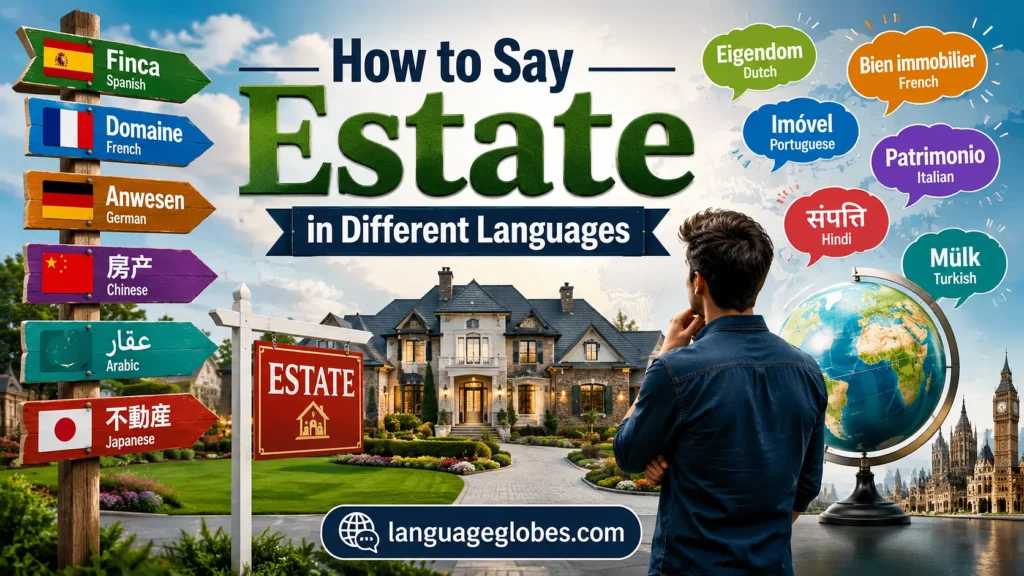
The word Estate has different uses depending on language, culture, and legal context. Understanding estate meaning helps explain real estate, property, inheritance, and collective assets clearly. In some contexts, an estate means a substantial area of land or property.
In others, it describes a person’s assets, liabilities, and possessions after death. This guide explores estate translation across global languages with practical meanings and pronunciation help.
You will discover estate in different languages, estate pronunciation, and useful example sentences. These translations support language learners, travelers, students, and professionals communicating across cultures. Understanding these terms also builds cross-cultural communication and strengthens everyday vocabulary.
Also Read This: How to Say Escape in Different Languages
Interesting Facts About Estate
- The word “estate” comes from the Old French word “estat,” meaning condition, position, or property.
- In legal terms, an estate often refers to everything a person owns at the time of death.
- Real estate is one of the largest industries worldwide and exists in every country.
- Many languages have different words for agricultural estates, housing estates, and inherited estates.
- The concept of estates has played an important role in history, especially in Europe where large estates were owned by noble families.
- Estate planning is a common legal process used to manage assets and inheritance.
- Some countries use separate terms for private estates and government-owned land.
- Learning property-related vocabulary is useful for travel, business, law, and international investments.
How to Say Estate in Different Languages
European Languages
Europe is home to many of the world’s most influential language families, including Romance, Germanic, and Slavic languages. Property ownership and inheritance have long been important aspects of European societies. The translations below reflect how different European cultures express the concept of an estate.
| Language | Country/Region | Translation | Pronunciation | Example Sentence |
| 🇺🇸 American English | USA | Estate | ih-STAYT | The estate includes several acres of land. |
| 🇬🇧 British English | United Kingdom | Estate | ih-STAYT | The family inherited a large estate. |
| 🇦🇺 Australian English | Australia | Estate | ih-STAYT | They bought a house in a new estate. |
| French | 🇫🇷 France | Domaine | doh-MEN | Ce domaine est très vaste. |
| Spanish | 🇪🇸 Spain | Hacienda | ah-see-EN-da | La hacienda pertenece a la familia. |
| Portuguese | 🇵🇹 Portugal | Propriedade | pro-pri-eh-DAH-de | A propriedade é muito grande. |
| Italian | 🇮🇹 Italy | Tenuta | teh-NOO-ta | La tenuta ha molti vigneti. |
| German | 🇩🇪 Germany | Gut | Goot | Das Gut liegt auf dem Land. |
| Dutch | 🇳🇱 Netherlands | Landgoed | LAND-khoot | Het landgoed is prachtig. |
| Swedish | 🇸🇪 Sweden | Gods | Goos | Godset är mycket stort. |
| Norwegian | 🇳🇴 Norway | Eiendom | AY-en-dom | Eiendommen er verdifull. |
| Danish | 🇩🇰 Denmark | Gods | Goss | Godset har en lang historie. |
| Finnish | 🇫🇮 Finland | Kartano | KAR-ta-no | Kartano sijaitsee järven lähellä. |
| Icelandic | 🇮🇸 Iceland | Búgarður | BOO-gar-thur | Búgarðurinn er fallegur. |
| Polish | 🇵🇱 Poland | Posiadłość | po-sha-DWO-shch | To duża posiadłość. |
| Czech | 🇨🇿 Czech Republic | Panství | PAN-stvee | Panství je velmi staré. |
| Slovak | 🇸🇰 Slovakia | Panstvo | PAN-stvo | Panstvo patrí rodine. |
| Hungarian | 🇭🇺 Hungary | Birtok | BEER-tok | A birtok nagyon nagy. |
| Romanian | 🇷🇴 Romania | Moșie | MO-shee-eh | Moșia aparține familiei. |
| Bulgarian | 🇧🇬 Bulgaria | Имение | ee-ME-ni-ye | Имението е красиво. |
| Croatian | 🇭🇷 Croatia | Imanje | ee-MAN-ye | Imanje je veliko. |
| Serbian | 🇷🇸 Serbia | Имање | ee-MAN-ye | Имање је пространо. |
| Slovenian | 🇸🇮 Slovenia | Posestvo | po-SEST-vo | Posestvo je veliko. |
| Greek | 🇬🇷 Greece | Κτήμα | KTEE-ma | Το κτήμα είναι μεγάλο. |
| Ukrainian | 🇺🇦 Ukraine | Маєток | ma-YE-tok | Маєток дуже великий. |
| Russian | 🇷🇺 Russia | Поместье | pa-MES-tye | Поместье находится за городом. |
Asian Languages
Asia contains thousands of languages spoken across diverse cultures and civilizations. Many Asian societies have long traditions of land ownership, agriculture, and family inheritance. Understanding these translations provides insight into the region’s rich linguistic diversity.
| Language | Country/Region | Translation | Pronunciation | Example Sentence |
| Chinese (Mandarin) | 🇨🇳 China | 庄园 | zhuāng yuán | 这个庄园很大。 |
| Cantonese | 🇭🇰 Hong Kong | 莊園 | jong yun | 呢個莊園好大。 |
| Japanese | 🇯🇵 Japan | 邸宅 | tei-taku | その邸宅は有名です。 |
| Korean | 🇰🇷 South Korea | 영지 | yeong-ji | 그 영지는 넓습니다. |
| Hindi | 🇮🇳 India | जागीर | ja-geer | यह जागीर बहुत बड़ी है। |
| Urdu | 🇵🇰 Pakistan | جاگیر | ja-geer | یہ جاگیر بہت بڑی ہے۔ |
| Bengali | 🇧🇩 Bangladesh | জমিদারি | jo-mi-da-ri | জমিদারি খুব বড়। |
| Punjabi | India/Pakistan | ਜਗੀਰ | ja-geer | ਇਹ ਜਗੀਰ ਵੱਡੀ ਹੈ। |
| Gujarati | 🇮🇳 India | જાગીર | ja-geer | આ જાગીર મોટી છે. |
| Marathi | 🇮🇳 India | जहागीर | ja-ha-geer | ही जहागीर मोठी आहे. |
| Tamil | 🇮🇳 India | தோட்டம் | tho-ttam | இந்த தோட்டம் பெரியது. |
| Telugu | 🇮🇳 India | జమీందారీ | ja-meen-da-ri | ఈ జమీందారీ పెద్దది. |
| Kannada | 🇮🇳 India | ಜಮೀನು ಆಸ್ತಿ | ja-mee-nu aas-ti | ಈ ಆಸ್ತಿ ದೊಡ್ಡದು. |
| Malayalam | 🇮🇳 India | എസ്റ്റേറ്റ് | es-tate | ഈ എസ്റ്റേറ്റ് വലുതാണ്. |
| Thai | 🇹🇭 Thailand | ที่ดิน | tee-din | ที่ดินนี้ใหญ่มาก |
| Vietnamese | 🇻🇳 Vietnam | Điền trang | dien trang | Điền trang rất lớn. |
| Indonesian | 🇮🇩 Indonesia | Perkebunan | per-ke-boo-nan | Perkebunan itu luas. |
| Malay | 🇲🇾 Malaysia | Estet | es-tet | Estet itu besar. |
| Filipino | 🇵🇭 Philippines | Ari-arian | a-ri-a-ri-an | Malaki ang ari-arian. |
| Khmer | 🇰🇭 Cambodia | អចលនទ្រព្យ | a-cha-la-na-troap | អចលនទ្រព្យនេះធំ។ |
| Lao | 🇱🇦 Laos | ທີ່ດິນ | tee din | ທີ່ດິນນີ້ໃຫຍ່. |
| Mongolian | 🇲🇳 Mongolia | Эдлэн | ed-len | Эдлэн том байна. |
| Nepali | 🇳🇵 Nepal | जागिर | ja-geer | यो जागिर ठूलो छ। |
| Sinhala | 🇱🇰 Sri Lanka | වතුයාය | va-thu-ya-ya | මෙම වතුයාය විශාලයි. |
African Languages
Africa is one of the most linguistically diverse continents, with thousands of languages spoken across its regions. Property, land, and family inheritance remain important cultural and economic concepts throughout Africa.
| Language | Country/Region | Translation | Pronunciation | Example Sentence |
| Swahili | 🇹🇿 Tanzania/Kenya | Mali | MA-li | Mali hii ni kubwa. |
| Zulu | 🇿🇦 South Africa | Ifa | EE-fa | Ifa inkulu kakhulu. |
| Xhosa | 🇿🇦 South Africa | Ilifa | ee-LEE-fa | Ilifa likhulu. |
| Afrikaans | 🇿🇦 South Africa | Landgoed | LAND-khoot | Die landgoed is groot. |
| Yoruba | 🇳🇬 Nigeria | Ohun-ini | o-hoon-ee-nee | Ohun-ini naa tobi. |
| Igbo | 🇳🇬 Nigeria | Ala | AH-la | Ala ahụ buru ibu. |
| Hausa | 🇳🇬 Nigeria | Gada | GA-da | Gadar tana da girma. |
| Amharic | 🇪🇹 Ethiopia | ንብረት | nib-ret | ንብረቱ ትልቅ ነው። |
| Somali | 🇸🇴 Somalia | Hanti | HAN-ti | Hantidu waa weyn tahay. |
| Shona | 🇿🇼 Zimbabwe | Nhaka | nya-ka | Nhaka iyi yakakura. |
| Kinyarwanda | 🇷🇼 Rwanda | Umutungo | oo-moo-too-ngo | Umutungo munini. |
| Luganda | 🇺🇬 Uganda | Obugagga | o-boo-ga-ga | Obugagga bunene. |
Middle Eastern Languages
The Middle East has a rich history of land ownership, agriculture, and inheritance traditions that date back thousands of years. These languages reflect the region’s cultural and historical importance in trade, governance, and property management.
| Language | Country/Region | Translation | Pronunciation | Example Sentence |
| Arabic | 🌍 Middle East | ضيعة | dee-ah | هذه الضيعة كبيرة. |
| Persian | 🇮🇷 Iran | ملک | melk | این ملک بزرگ است. |
| Turkish | 🇹🇷 Türkiye | Malikane | ma-li-ka-ne | Malikane çok büyük. |
| Hebrew | 🇮🇱 Israel | אחוזה | a-khu-za | האחוזה גדולה מאוד. |
| Kurdish | Iraq/Türkiye | Mîlk | meelk | Mîlk mezin e. |
| Pashto | 🇦🇫 Afghanistan | جایداد | jai-dad | دا جایداد لوی دی. |
| Azerbaijani | 🇦🇿 Azerbaijan | Mülk | myulk | Bu mülk böyükdür. |
| Armenian | 🇦🇲 Armenia | Կալվածք | kal-vatsk | Կալվածքը մեծ է։ |
Additional Languages Around the World
Languages from Oceania, the Americas, and indigenous communities contribute significantly to global linguistic diversity. Learning these translations helps create a broader understanding of how different societies discuss property and estates.
| Language | Country/Region | Translation | Pronunciation | Example Sentence |
| Maori | 🇳🇿 New Zealand | Whenua | fe-noo-a | He nui te whenua. |
| Hawaiian | 🇺🇸 Hawaii | Waiwai | why-vai | Nui ka waiwai. |
| Samoan | 🇼🇸 Samoa | Meatotino | mea-to-ti-no | E tele le meatotino. |
| Tongan | 🇹🇴 Tonga | Koloa | ko-lo-a | Oku lahi e koloa. |
| Fijian | 🇫🇯 Fiji | Qele | nge-le | E levu na qele. |
| Haitian Creole | 🇭🇹 Haiti | Pwopriyete | pwo-pri-ye-te | Pwopriyete a gwo. |
| Quechua | Peru | Hatun allpa | ha-toon al-pa | Hatun allpaqa hatunmi. |
| Guarani | Paraguay | Yvy | uh-vuh | Ko yvy tuicha. |
| Navajo | USA | Nihikéyah | ni-hi-kay-yah | Nihikéyah t’áá ajiłii’. |
| Inuit | Arctic Regions | Nuna | noo-na | Nuna angijuq. |
FAQs
What does estate mean in different languages?
The estate meaning changes by language and context, often referring to property, land, possessions, or inherited assets. Estate translation should consider legal context, culture, and local usage.
How do you say estate in different languages?
Estate in different languages can have terms connected to property, land ownership, or inheritance. A multilingual translation guide helps learners understand language-specific estate terms.
What is the meaning of estate in legal context?
In a legal context, an estate can include a person’s assets, liabilities, property, and possessions. Estate law, inheritance law, and property law may define the term differently.
How is estate used in real estate?
In real estate, an estate commonly refers to land, buildings, or a substantial property area. Real estate terminology may vary across global languages and regions.
How do you pronounce estate in English?
The English pronunciation of estate is commonly written as “ih-STAYT.” An estate pronunciation guide with audio pronunciation and examples can support pronunciation practice.
What is estate translation by context?
Estate translation by context considers whether the word refers to property, inheritance, land, or assets. This approach helps avoid confusing property meaning, land meaning, and inheritance meaning.
Why learn estate terminology in foreign languages?
Learning estate terminology helps with international business, property discussions, legal matters, and cross-cultural communication. It also expands foreign language vocabulary for practical situations.
What is an estate in inheritance terms?
In inheritance, an estate can include assets left behind, property, possessions, and financial obligations. Understanding inheritance concepts makes property inheritance and related legal terms easier to understand.
Where can I find estate translations in multiple languages?
A multilingual dictionary or language reference can provide estate translations, pronunciation, and translation examples. Comparing European languages, Asian languages, and other linguistic regions reveals useful differences.
How can learning the word estate improve vocabulary?
Learning the estate word alongside property vocabulary, inheritance vocabulary, and land vocabulary creates a stronger vocabulary foundation. It also supports language practice, vocabulary expansion, and communication across cultures.
Conclusion
Understanding estate in different languages makes estate translation easier across legal, financial, and everyday contexts. Exploring property, land ownership, inheritance concepts, and estate terminology helps clarify cultural language differences and builds stronger cross-cultural communication. With practical translation examples, estate pronunciation, and multilingual vocabulary, learners can confidently use the right term in different situations.

Joshua Lewis is a passionate language enthusiast and content creator at LanguageGlobes.com. He specializes in exploring global languages, cultures, and communication trends, helping readers connect with the world through words.