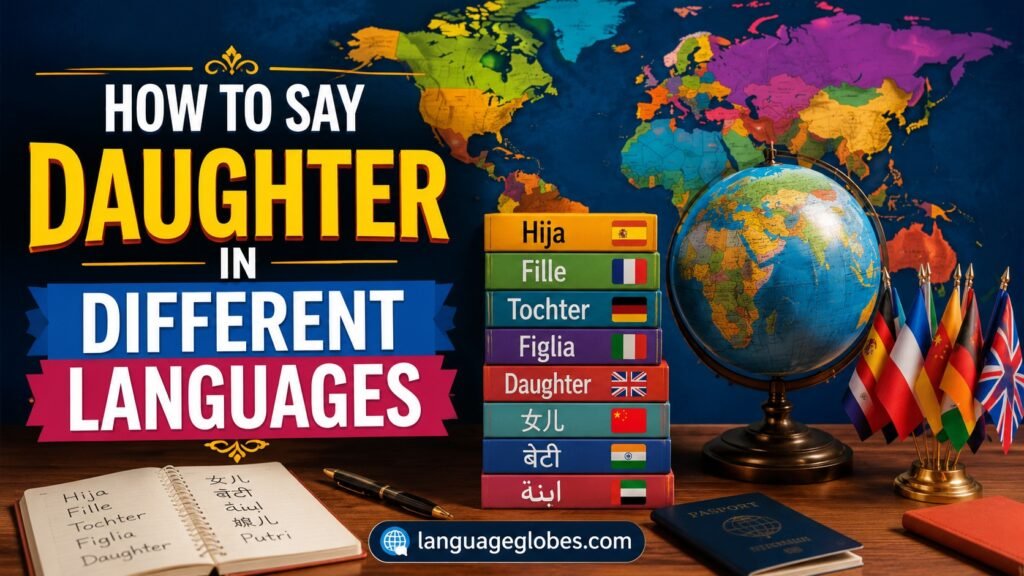
Learning how to say daughter in different languages reveals cherished relationships. Across families, words for daughters express love, care, and hope. These terms reflect cultures, family bond, and traditions passed through generations. Exploring translations also shows how cultural diversity shapes family vocabulary worldwide.
This guide explores daughter translations across global languages and regional language families. You will find daughter in French, daughter in Spanish, and daughter in Italian clearly explained. Each entry can include pronunciation, spelling, and useful cultural context for learners. Whether you are a traveler, student, or language enthusiast, these words build understanding.
Also Read This: How to Say Dark in Different Languages
Interesting Facts About Daughter
- The word “daughter” originates from the Old English word “dohtor.”
- Nearly every language has a unique word for daughter that reflects its linguistic history.
- Family-related words are often among the first vocabulary terms taught when learning a new language.
- In many cultures, daughters play a significant role in preserving family traditions and values.
- Some languages use different words for biological daughters and daughters-in-law.
- The concept of daughter exists in every known language, highlighting the universal importance of family relationships.
- Many traditional songs, poems, and stories around the world celebrate daughters.
- Learning family vocabulary helps language learners communicate in everyday situations more effectively.
How to Say Daughter in Different Languages
Below are translations of the word “daughter” in languages spoken across the globe.
European Languages
Europe is home to hundreds of languages belonging to several language families, including Romance, Germanic, Slavic, Celtic, and Baltic languages. Although these languages developed differently over centuries, they all have special words to describe close family relationships. Learning how to say “daughter” in European languages provides insight into the continent’s rich cultural and linguistic heritage.
| Language | Country/Region | Translation | Pronunciation | Example Sentence |
| 🇺🇸 American English | USA | Daughter | Daw-ter | My daughter loves reading books. |
| 🇬🇧 British English | UK | Daughter | Doh-tuh | My daughter is at school today. |
| 🇦🇺 Australian English | Australia | Daughter | Daw-tuh | My daughter enjoys swimming. |
| 🇫🇷 French | France | Fille | Fee-yuh | Ma fille est gentille. |
| 🇪🇸 Spanish | Spain | Hija | Ee-ha | Mi hija es inteligente. |
| 🇵🇹 Portuguese | Portugal | Filha | Feel-ya | Minha filha é feliz. |
| 🇮🇹 Italian | Italy | Figlia | Fee-lya | Mia figlia studia molto. |
| 🇩🇪 German | Germany | Tochter | Tokh-ter | Meine Tochter ist nett. |
| 🇳🇱 Dutch | Netherlands | Dochter | Dokh-ter | Mijn dochter speelt buiten. |
| 🇸🇪 Swedish | Sweden | Dotter | Dot-ter | Min dotter är snäll. |
| 🇳🇴 Norwegian | Norway | Datter | Dat-ter | Min datter er flink. |
| 🇩🇰 Danish | Denmark | Datter | Dat-ter | Min datter læser bøger. |
| 🇫🇮 Finnish | Finland | Tytär | Too-tar | Tyttäreni on iloinen. |
| 🇵🇱 Polish | Poland | Córka | Tsoor-ka | Moja córka jest miła. |
| 🇨🇿 Czech | Czech Republic | Dcera | Dtse-ra | Moje dcera je chytrá. |
| 🇸🇰 Slovak | Slovakia | Dcéra | Dtseh-ra | Moja dcéra je šťastná. |
| 🇭🇺 Hungarian | Hungary | Lány | Laan-y | A lányom kedves. |
| 🇷🇴 Romanian | Romania | Fiică | Fee-ee-kuh | Fiica mea este bună. |
| 🇷🇺 Russian | Russia | Дочь | Doch | Моя дочь умная. |
| 🇺🇦 Ukrainian | Ukraine | Донька | Don-ka | Моя донька гарна. |
| 🇧🇬 Bulgarian | Bulgaria | Дъщеря | Dush-te-ria | Моя дъщеря е добра. |
| 🇬🇷 Greek | Greece | Κόρη | Ko-ree | Η κόρη μου είναι έξυπνη. |
| 🇮🇪 Irish | Ireland | Iníon | In-een | Tá mo iníon sona. |
| 🏴 Welsh | Wales | Merch | Merkh | Mae fy merch yn hapus. |
Asian Languages
Asia is the largest continent and contains thousands of languages spoken by billions of people. The region includes major language families such as Indo-Aryan, Dravidian, Sino-Tibetan, Turkic, and Austronesian. Family values are deeply rooted in many Asian societies, making the word “daughter” especially meaningful across cultures.
| Language | Country/Region | Translation | Pronunciation | Example Sentence |
| 🇨🇳 Chinese (Mandarin) | China | 女儿 | Nyu-er | 我的女儿很聪明。 |
| 🇯🇵 Japanese | Japan | 娘 | Musume | 私の娘は優しいです。 |
| 🇰🇷 Korean | South Korea | 딸 | Ttal | 내 딸은 학생입니다. |
| 🇮🇳 Hindi | India | बेटी | Beti | मेरी बेटी बहुत प्यारी है। |
| 🇮🇳 Urdu | Pakistan | بیٹی | Beti | میری بیٹی بہت ذہین ہے۔ |
| 🇮🇳 Bengali | Bangladesh | মেয়ে | Meye | আমার মেয়ে ভালো। |
| 🇮🇳 Punjabi | India/Pakistan | ਧੀ | Dhee | ਮੇਰੀ ਧੀ ਸੋਹਣੀ ਹੈ। |
| 🇮🇳 Gujarati | India | દીકરી | Dikri | મારી દીકરી ખુશ છે. |
| 🇮🇳 Marathi | India | मुलगी | Mulgi | माझी मुलगी हुशार आहे. |
| 🇮🇳 Tamil | India | மகள் | Magal | என் மகள் நல்லவள். |
| 🇮🇳 Telugu | India | కుమార్తె | Kumarte | నా కుమార్తె చదువుతోంది. |
| 🇮🇳 Kannada | India | ಮಗಳು | Magalu | ನನ್ನ ಮಗಳು ಚೆನ್ನಾಗಿದೆ. |
| 🇮🇳 Malayalam | India | മകൾ | Makal | എന്റെ മകൾ സന്തോഷവതിയാണ്. |
| 🇳🇵 Nepali | Nepal | छोरी | Chhori | मेरी छोरी राम्री छ। |
| 🇱🇰 Sinhala | Sri Lanka | දියණිය | Diyaniya | මගේ දියණිය හොඳයි. |
| 🇹🇭 Thai | Thailand | ลูกสาว | Look-sao | ลูกสาวของฉันน่ารัก |
| 🇻🇳 Vietnamese | Vietnam | Con gái | Kon-gai | Con gái tôi rất ngoan. |
| 🇮🇩 Indonesian | Indonesia | Putri | Poot-ree | Putri saya pintar. |
| 🇲🇾 Malay | Malaysia | Anak perempuan | A-nak per-em-puan | Anak perempuan saya baik. |
| 🇵🇭 Filipino | Philippines | Anak na babae | A-nak na ba-ba-ye | Mabait ang anak kong babae. |
| 🇰🇭 Khmer | Cambodia | កូនស្រី | Kon-srey | កូនស្រីរបស់ខ្ញុំល្អ។ |
| 🇱🇦 Lao | Laos | ລູກສາວ | Look-sao | ລູກສາວຂ້ອຍດີ. |
| 🇲🇳 Mongolian | Mongolia | Охин | O-khin | Миний охин сайн. |
| 🇰🇿 Kazakh | Kazakhstan | Қыз | Kyz | Менің қызым жақсы. |
| 🇺🇿 Uzbek | Uzbekistan | Qiz | Kiz | Mening qizim aqlli. |
African Languages
Africa is one of the most linguistically diverse continents in the world, with more than 2,000 languages spoken across its countries. Family and community are central elements of many African cultures, and words relating to family relationships often carry deep cultural significance.
| Language | Country/Region | Translation | Pronunciation | Example Sentence |
| 🇿🇦 Swahili | East Africa | Binti | Bin-tee | Binti yangu ni mzuri. |
| 🇿🇦 Zulu | South Africa | Indodakazi | In-do-da-ka-zi | Indodakazi yami ihlakaniphile. |
| 🇿🇦 Xhosa | South Africa | Intombi | In-tom-bi | Intombi yam intle. |
| 🇳🇬 Yoruba | Nigeria | Ọmọbìnrin | O-mo-bin-rin | Ọmọbìnrin mi dara. |
| 🇳🇬 Igbo | Nigeria | Nwa nwanyị | Nwa nwa-nyi | Nwa nwanyị m mara mma. |
| 🇳🇬 Hausa | Nigeria | ‘Ya | Ya | ‘Yata tana da hankali. |
| 🇪🇹 Amharic | Ethiopia | ሴት ልጅ | Set Lij | ሴት ልጄ ጎበዝ ናት። |
| 🇰🇪 Somali | Somalia | Gabar | Ga-bar | Gabartaydu way fiican tahay. |
| 🇿🇼 Shona | Zimbabwe | Mwanasikana | Mwa-na-si-ka-na | Mwanasikana wangu akanaka. |
| 🇧🇼 Tswana | Botswana | Morwadi | Mo-rwa-dee | Morwadi wa me o botlhale. |
| 🇲🇬 Malagasy | Madagascar | Zanakavavy | Za-na-ka-va-vee | Tsara ny zanakavaviko. |
| 🇷🇼 Kinyarwanda | Rwanda | Umukobwa | U-mu-kob-wa | Umukobwa wanjye ni mwiza. |
| 🇱🇸 Sesotho | Lesotho | Morali | Mo-ra-lee | Morali oa ka o motle. |
| 🇺🇬 Luganda | Uganda | Muwala | Mu-wa-la | Muwala wange mulungi. |
Middle Eastern Languages
The Middle East is known for its rich history, ancient civilizations, and influential languages. Many languages spoken in this region belong to the Semitic language family. Family relationships are highly valued, and words such as daughter are frequently used in everyday conversation and cultural traditions.
| Language | Country/Region | Translation | Pronunciation | Example Sentence |
| 🇸🇦 Arabic | Middle East | ابنة | Ibna | ابنتي جميلة. |
| 🇮🇷 Persian (Farsi) | Iran | دختر | Dokhtar | دختر من باهوش است. |
| 🇹🇷 Turkish | Turkey | Kız | Kuz | Kızım çok akıllı. |
| 🇮🇱 Hebrew | Israel | בת | Bat | הבת שלי חכמה. |
| 🇰🇼 Kurdish | Kurdistan Region | Keç | Ketch | Keça min baş e. |
| 🇴🇲 Omani Arabic | Oman | بنت | Bint | بنتي جميلة. |
| 🇶🇦 Qatari Arabic | Qatar | بنت | Bint | بنتي ذكية. |
| 🇦🇪 Emirati Arabic | UAE | بنت | Bint | بنتي رائعة. |
| 🇸🇾 Syriac | Syria | Bratha | Bra-tha | Bratha shepri. |
| 🇦🇲 Armenian | Armenia | Դուստր | Doos-tr | Իմ դուստրը խելացի է։ |
Additional Languages Around the World
Languages outside the major regional categories contribute greatly to the world’s linguistic diversity. These languages are spoken across islands, indigenous communities, and multicultural societies, each preserving unique traditions and cultural identities.
| Language | Country/Region | Translation | Pronunciation | Example Sentence |
| 🇳🇿 Maori | New Zealand | Tamāhine | Ta-maa-hi-ne | He tamāhine pai taku. |
| 🇼🇸 Samoan | Samoa | Afafine | A-fa-fee-ne | O la’u afafine e lelei. |
| 🇹🇴 Tongan | Tonga | ‘Ofefine | O-fe-fee-ne | Ko hoku ‘ofefine lelei. |
| 🇫🇯 Fijian | Fiji | Goneyalewa | Go-ne-ya-le-wa | Sa vinaka na goneyalewa. |
| 🇬🇱 Greenlandic | Greenland | Paniga | Pa-ni-ga | Paniga nuannaarpoq. |
| 🇭🇹 Haitian Creole | Haiti | Pitit fi | Pee-teet fee | Pitit fi mwen bèl. |
| 🇪🇸 Basque | Basque Region | Alaba | A-la-ba | Nire alaba polita da. |
| 🇨🇦 Inuktitut | Arctic Canada | Paniaq | Pa-ni-ak | Paniaq quviasuppoq. |
| 🇵🇾 Guarani | Paraguay | Tajyra | Ta-jy-ra | Che rajy iporã. |
| 🇵🇬 Tok Pisin | Papua New Guinea | Pikinini meri | Pi-ki-ni-ni me-ri | Pikinini meri bilong mi gutpela. |
| 🇱🇺 Luxembourgish | Luxembourg | Duechter | Doykh-ter | Meng Duechter ass léif. |
| 🇪🇪 Estonian | Estonia | Tütar | Too-tar | Minu tütar on tark. |
| 🇱🇻 Latvian | Latvia | Meita | May-ta | Mana meita ir gudra. |
| 🇱🇹 Lithuanian | Lithuania | Dukra | Doo-kra | Mano dukra protinga. |
FAQs
How do you say daughter in different languages?
The word daughter has unique translations across different languages and cultures. These words reflect family relationships, love, and the universal value of family.
What is daughter in French?
In French, daughter in French is fille, a common term for a female child. Its pronunciation is roughly like “fee-yuh.”
How do you say daughter in Spanish?
Daughter in Spanish is hija, which is widely used for a daughter or female offspring. It is an important part of family-related vocabulary.
What is daughter in Italian?
Daughter in Italian is figlia, a word connected with family relationships and affection. Its spelling and pronunciation reflect the distinctive features of Italian.
How do you say daughter in German?
Daughter in German is Tochter, meaning a female child within a family. Learning this local term can support basic language learning.
Why are daughter translations important across cultures?
Daughter translations reveal how family bond, love, and care are expressed across global cultures. They also encourage cultural appreciation and greater understanding between communities.
Where can I learn daughter in different languages with pronunciation?
A useful comprehensive resource can provide daughter translations, pronunciation, spelling, and regional information. This helps language enthusiasts and students learn words accurately.
How does language show the meaning of daughter?
The word daughter meaning can carry deep emotional significance within families and communities. Different terms may reflect cultural traditions, affection, and family continuity.
What can learning daughter in other languages teach us?
Learning daughter across global languages provides insight into linguistic diversity, cultural significance, and family vocabulary. It can also strengthen cultural understanding and language exploration.
Why should language enthusiasts learn family words like daughter?
Studying family-related vocabulary helps learners understand everyday communication and cultural diversity. It also supports language research, global communication, and meaningful connections across generations.
Conclusion
Learning how to say daughter in different languages offers a meaningful look into family relationships, cultural diversity, and global communication. Exploring daughter translations reveals how love, care, and family bond are expressed across cultures. From fille and hija to figlia and Tochter, each word reflects unique language families and traditions. These translations can deepen cultural understanding while making language learning more engaging and practical for everyone.

Grace Hall is a passionate language enthusiast and writer at LanguageGlobes, dedicated to making global communication simple and accessible. She shares insightful content to help readers explore new languages, cultures, and connections around the world.