
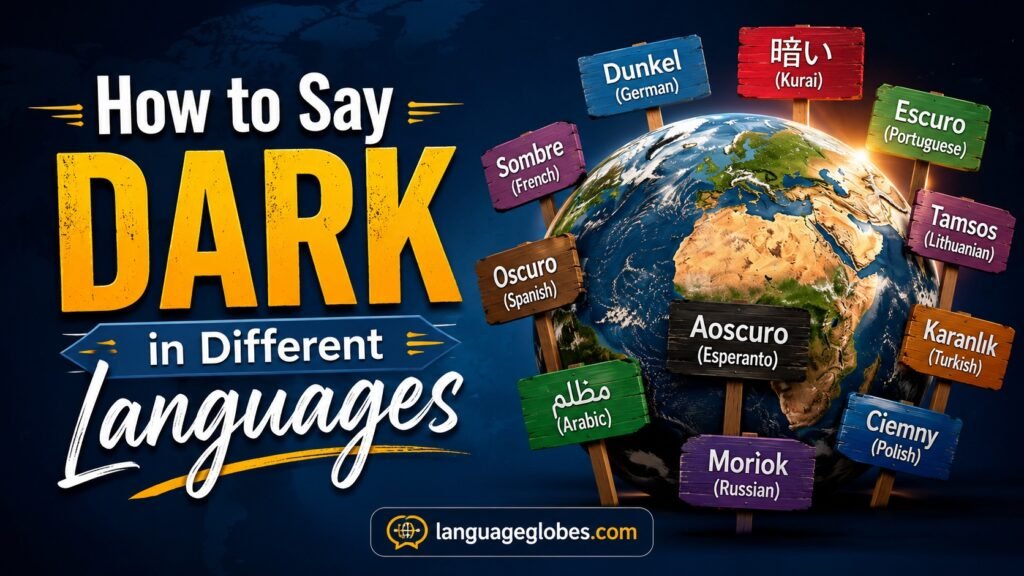
Dark describes the absence of light, often connected with deep shades and rich shades. Learning dark in different languages reveals how world languages express color, mood, and cultural understanding. These language translations can help a language learner, student, or traveler communicate naturally across global cultures.
The word can describe dark night, dark clouds, dark colors, and dark rooms in everyday conversations. It also carries meanings linked to mystery, fear, elegance, depth, and a mysterious atmosphere. Exploring pronunciation guides, common translations, and cultural insights makes vocabulary learning more useful and memorable.
Also Read This: How to Say Darling in Different Languages
Interesting Facts About Dark
- The concept of dark exists in every known language and culture.
- Many cultures associate darkness with mystery, wisdom, rest, or spirituality.
- The word dark often has both literal and symbolic meanings.
- Ancient civilizations used darkness to explain natural phenomena before scientific discoveries.
- In literature, dark themes are commonly used to create suspense and emotional depth.
- Different languages may use separate words for darkness, blackness, and dimness.
- The idea of darkness plays an important role in art, religion, mythology, and science.
- Learning descriptive words like dark helps improve language fluency faster.
How to Say Dark in Different Languages
Below are translations of the word “dark” in more than 70 languages from around the world.
European Languages
Europe is home to hundreds of languages belonging to several language families, including Germanic, Romance, Slavic, Celtic, and Baltic languages. While many European languages share common roots, their vocabulary and pronunciation often differ significantly. Learning how to say dark in European languages provides an interesting glimpse into the region’s linguistic diversity.
| Language | Country/Region | Translation | Pronunciation | Example Sentence |
| 🇺🇸 American English | USA | Dark | Dark | The room is dark. |
| 🇬🇧 British English | UK | Dark | Daak | The room is dark. |
| 🇦🇺 Australian English | Australia | Dark | Daark | The sky looks dark tonight. |
| French | 🇫🇷 France | Sombre | Som-bruh | La pièce est sombre. |
| Spanish | 🇪🇸 Spain | Oscuro | Os-koo-ro | La habitación está oscura. |
| Portuguese | 🇵🇹 Portugal | Escuro | Es-koo-ro | O quarto está escuro. |
| Italian | 🇮🇹 Italy | Scuro | Skoo-ro | La stanza è scura. |
| German | 🇩🇪 Germany | Dunkel | Doon-kel | Das Zimmer ist dunkel. |
| Dutch | 🇳🇱 Netherlands | Donker | Don-ker | De kamer is donker. |
| Swedish | 🇸🇪 Sweden | Mörk | Murk | Rummet är mörkt. |
| Norwegian | 🇳🇴 Norway | Mørk | Murk | Rommet er mørkt. |
| Danish | 🇩🇰 Denmark | Mørk | Murk | Værelset er mørkt. |
| Finnish | 🇫🇮 Finland | Tumma | Toom-ma | Huone on tumma. |
| Icelandic | 🇮🇸 Iceland | Dimmur | Dim-mur | Herbergið er dimmt. |
| Polish | 🇵🇱 Poland | Ciemny | Chem-ni | Pokój jest ciemny. |
| Czech | 🇨🇿 Czech Republic | Tmavý | Tma-vee | Pokoj je tmavý. |
| Slovak | 🇸🇰 Slovakia | Tmavý | Tma-vee | Izba je tmavá. |
| Hungarian | 🇭🇺 Hungary | Sötét | Shu-tate | A szoba sötét. |
| Romanian | 🇷🇴 Romania | Întunecat | In-too-ne-cat | Camera este întunecată. |
| Bulgarian | 🇧🇬 Bulgaria | Тъмен | Tuh-men | Стаята е тъмна. |
| Croatian | 🇭🇷 Croatia | Mračan | Mra-chan | Soba je mračna. |
| Serbian | 🇷🇸 Serbia | Таман | Ta-man | Soba je tamna. |
| Slovenian | 🇸🇮 Slovenia | Temen | Te-men | Soba je temna. |
| Lithuanian | 🇱🇹 Lithuania | Tamsus | Tam-soos | Kambarys tamsus. |
| Latvian | 🇱🇻 Latvia | Tumšs | Toomsh | Istaba ir tumša. |
| Estonian | 🇪🇪 Estonia | Tume | Too-me | Tuba on tume. |
| Irish | 🇮🇪 Ireland | Dorcha | Dor-kha | Tá an seomra dorcha. |
| Welsh | 🏴 Wales | Tywyll | Tuh-with | Mae’r ystafell yn dywyll. |
| Greek | 🇬🇷 Greece | Σκοτεινός | Sko-te-nos | Το δωμάτιο είναι σκοτεινό. |
| Albanian | 🇦🇱 Albania | I errët | Ee er-ret | Dhoma është e errët. |
Asian Languages
Asia is the largest continent and contains thousands of languages spoken by billions of people. From East Asia and South Asia to Southeast Asia and Central Asia, each region has unique linguistic traditions. Understanding how to say dark in Asian languages helps learners appreciate the cultural richness of this vast continent.
| Language | Country/Region | Translation | Pronunciation | Example Sentence |
| Chinese (Mandarin) | 🇨🇳 China | 黑暗 | Hei-an | 房间很黑暗。 |
| Japanese | 🇯🇵 Japan | 暗い | Ku-rai | 部屋は暗いです。 |
| Korean | 🇰🇷 South Korea | 어두운 | Eo-doo-un | 방이 어두워요. |
| Hindi | 🇮🇳 India | अंधेरा | An-dhe-ra | कमरा अंधेरा है। |
| Urdu | 🇵🇰 Pakistan | اندھیرا | Andhera | کمرہ اندھیرا ہے۔ |
| Bengali | 🇧🇩 Bangladesh | অন্ধকার | On-dho-kar | ঘর অন্ধকার। |
| Punjabi | India/Pakistan | ਹਨੇਰਾ | Ha-ne-ra | ਕਮਰਾ ਹਨੇਰਾ ਹੈ। |
| Gujarati | 🇮🇳 India | અંધારું | An-dha-roo | રૂમ અંધારું છે. |
| Marathi | 🇮🇳 India | अंधार | An-dhaar | खोली अंधार आहे. |
| Tamil | 🇮🇳 India | இருள் | I-rul | அறை இருள் நிறைந்தது. |
| Telugu | 🇮🇳 India | చీకటి | Chee-ka-ti | గది చీకటిగా ఉంది. |
| Kannada | 🇮🇳 India | ಕತ್ತಲೆ | Kat-ta-le | ಕೊಠಡಿ ಕತ್ತಲಾಗಿದೆ. |
| Malayalam | 🇮🇳 India | ഇരുട്ട് | I-root | മുറി ഇരുട്ടാണ്. |
| Sinhala | 🇱🇰 Sri Lanka | අඳුරු | An-du-roo | කාමරය අඳුරුය. |
| Nepali | 🇳🇵 Nepal | अँध्यारो | An-dhya-ro | कोठा अँध्यारो छ। |
| Thai | 🇹🇭 Thailand | มืด | Meud | ห้องมืดมาก. |
| Vietnamese | 🇻🇳 Vietnam | Tối | Toy | Căn phòng tối. |
| Indonesian | 🇮🇩 Indonesia | Gelap | Geh-lap | Ruangan itu gelap. |
| Malay | 🇲🇾 Malaysia | Gelap | Geh-lap | Bilik itu gelap. |
| Filipino | 🇵🇭 Philippines | Madilim | Ma-di-lim | Madilim ang silid. |
| Khmer | 🇰🇭 Cambodia | ងងឹត | Ngong-et | បន្ទប់ងងឹត។ |
| Lao | 🇱🇦 Laos | ມືດ | Meud | ຫ້ອງມືດ. |
| Mongolian | 🇲🇳 Mongolia | Харанхуй | Kha-ran-khui | Өрөө харанхуй байна. |
| Uzbek | 🇺🇿 Uzbekistan | Qorong’i | Ko-ron-gi | Xona qorong’i. |
| Kazakh | 🇰🇿 Kazakhstan | Қараңғы | Ka-rang-gy | Бөлме қараңғы. |
African Languages
Africa is one of the most linguistically diverse continents in the world, with thousands of languages spoken across its regions. African languages belong to several language families and reflect rich cultural traditions. Learning words like dark in African languages offers a fascinating look into this diversity.
| Language | Country/Region | Translation | Pronunciation | Example Sentence |
| Swahili | 🇹🇿 Tanzania/Kenya | Giza | Gee-za | Chumba ni giza. |
| Zulu | 🇿🇦 South Africa | Mnyama | Mnya-ma | Igumbi limnyama. |
| Xhosa | 🇿🇦 South Africa | Mnyama | Mnya-ma | Igumbi limnyama. |
| Afrikaans | 🇿🇦 South Africa | Donker | Don-ker | Die kamer is donker. |
| Yoruba | 🇳🇬 Nigeria | Dúdú | Doo-doo | Yara naa dúdú. |
| Igbo | 🇳🇬 Nigeria | Ọchịchịrị | O-chi-chi-ri | Ime ụlọ ahụ ọchịchịrị. |
| Hausa | 🇳🇬 Nigeria | Duhu | Doo-hoo | Dakin yana duhu. |
| Somali | 🇸🇴 Somalia | Madow | Ma-dow | Qolku waa madow. |
| Amharic | 🇪🇹 Ethiopia | ጨለማ | Che-le-ma | ክፍሉ ጨለማ ነው። |
| Shona | 🇿🇼 Zimbabwe | Rima | Ree-ma | Imba ine rima. |
Middle Eastern Languages
The Middle East is a crossroads of civilizations with languages that have influenced global culture, science, and literature for centuries. Many of these languages have deep historical roots and remain important today. Learning how to say dark in Middle Eastern languages provides insight into this remarkable cultural heritage.
| Language | Country/Region | Translation | Pronunciation | Example Sentence |
| Arabic | 🌍 Middle East | مظلم | Muz-lim | الغرفة مظلمة. |
| Persian (Farsi) | 🇮🇷 Iran | تاریک | Ta-reek | اتاق تاریک است. |
| Turkish | 🇹🇷 Türkiye | Karanlık | Ka-ran-lik | Oda karanlık. |
| Hebrew | 🇮🇱 Israel | חשוך | Kha-shookh | החדר חשוך. |
| Kurdish | Iraq/Türkiye | Tarî | Ta-ree | Oda tarî ye. |
| Azerbaijani | 🇦🇿 Azerbaijan | Qaranlıq | Ka-ran-lik | Otaq qaranlıqdır. |
Additional Languages Around the World
The world contains many unique languages beyond the major regional groups. These languages reflect diverse histories, traditions, and ways of life. Exploring them helps expand our understanding of human communication and cultural expression.
| Language | Country/Region | Translation | Pronunciation | Example Sentence |
| Maori | 🇳🇿 New Zealand | Pōuri | Po-oo-ri | He pōuri te rūma. |
| Hawaiian | 🌺 Hawaii | Pouli | Po-oo-lee | He pouli ka lumi. |
| Samoan | 🇼🇸 Samoa | Pogisa | Po-gee-sa | Ua pogisa le potu. |
| Tongan | 🇹🇴 Tonga | Po’uli | Po-oo-lee | ʻOku poʻuli ʻa e loki. |
| Fijian | 🇫🇯 Fiji | Butobuto | Boo-to-boo-to | E butobuto na rumu. |
| Tahitian | 🇵🇫 Tahiti | Poiri | Po-ee-ri | E poiri te piha. |
| Luxembourgish | 🇱🇺 Luxembourg | Däischter | Dai-shter | D’Zëmmer ass däischter. |
| Maltese | 🇲🇹 Malta | Dlam | Dlam | Il-kamra dlam. |
| Basque | Spain/France | Ilun | Ee-loon | Gela iluna da. |
| Catalan | Spain | Fosc | Fosk | L’habitació és fosca. |
| Galician | Spain | Escuro | Es-koo-ro | O cuarto está escuro. |
| Belarusian | 🇧🇾 Belarus | Цёмны | Tsyom-ny | Пакой цёмны. |
| Ukrainian | 🇺🇦 Ukraine | Темний | Tem-nyi | Кімната темна. |
| Russian | 🇷🇺 Russia | Темный | Tyom-nyi | Комната темная. |
| Armenian | 🇦🇲 Armenia | Մութ | Moot | Սենյակը մութ է։ |
FAQs
What does dark mean in different languages?
Dark commonly refers to the absence of light, but its meaning can also describe deep shades, rich shades, mood, and atmosphere. Exploring dark in different languages shows how world languages express these ideas.
How do you say dark in different languages?
The word dark has many common translations across multiple languages, including Spanish oscuro, French sombre, and German dunkel. These language translations help learners understand linguistic diversity.
Why learn dark in different languages?
Learning dark in different languages supports language learning, vocabulary learning, and cultural understanding. It also shows how global cultures use descriptive language differently.
How is dark used in everyday conversations?
People use dark to describe dark night, dark clouds, dark colors, and dark rooms. These examples make the word useful for everyday conversations and practical communication.
How can I learn how to pronounce dark?
Use pronunciation guides to compare how dark sounds in different foreign languages. A clear pronunciation guide can make language comparison and speaking practice easier.
What are the cultural meanings of dark?
Beyond color, dark can suggest mystery, fear, elegance, or depth. These meanings reveal important aspects of cultural expression and emotional expression.
Is dark only used to describe color?
No, dark can describe mood, atmosphere, and ideas as well as a color shade. Its atmospheric meaning may appear in literature, art, storytelling, and daily speech.
What are some examples of dark in different languages?
Examples include oscuro in Spanish, sombre in French, and dunkel in German. Arabic also has ظلام, demonstrating the variety found across international translations.
How can travelers use dark in foreign languages?
A traveler can learn this vocabulary word to describe surroundings, lighting, colors, or weather. Understanding dark in foreign languages can support practical communication during travel.
What can learning dark in multiple languages teach us?
Studying dark across multiple languages provides useful linguistic insights into ways of thinking, visual description, and cultural meanings. It also expands multilingual vocabulary for stronger global communication.
Conclusion
Learning dark in different languages offers a simple way to explore language translations, linguistic diversity, and cultural understanding. From dark colors and dark night to mysterious atmosphere and emotional expression, the word carries rich meanings across global cultures. Exploring common translations, pronunciation guides, and cultural insights can strengthen vocabulary learning while making communication more meaningful. Whether you are a traveler, student, or language learner, this multilingual journey can deepen your appreciation of world languages.

Grace Hall is a passionate language enthusiast and writer at LanguageGlobes, dedicated to making global communication simple and accessible. She shares insightful content to help readers explore new languages, cultures, and connections around the world.