
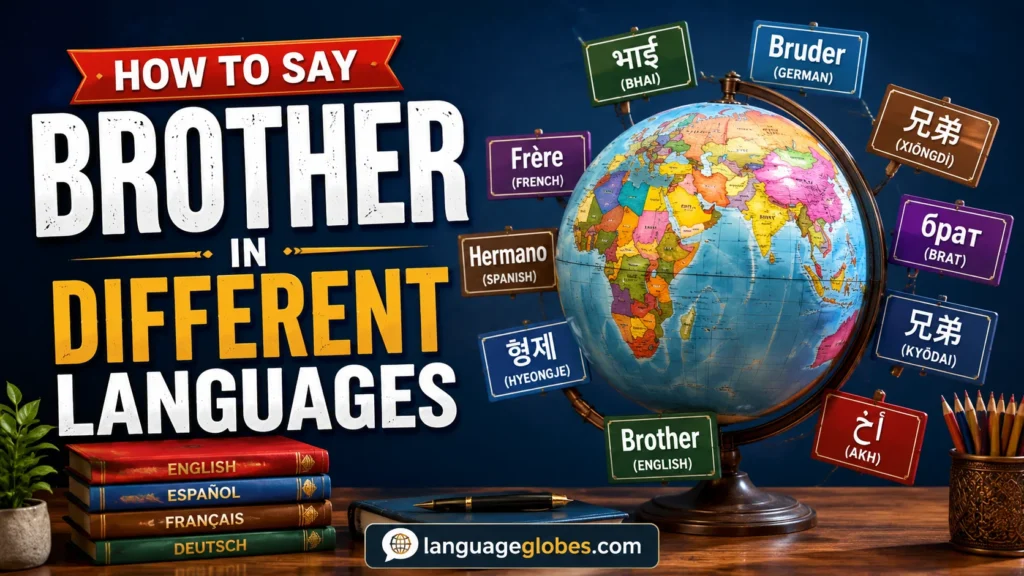
Learning how to say Brother in Different Languages strengthens communication and builds meaningful human connection across worldwide cultures. This comprehensive guide explains the meaning, translation, language pronunciation, spelling, and language examples for this common term.
Understanding this family vocabulary improves language learning, supports international communication, and deepens cultural understanding naturally. Whether traveling, studying, or meeting international friends, these translations encourage confidence and genuine curiosity about the world.
This translation guide explores global languages, language diversity, and fascinating language variations through valuable cultural insights and practical resources. Discover French frère, Spanish hermano, German Bruder, and Italian fratello with a helpful pronunciation guide.
The word brother reflects family, sibling, family bond, familial relationship, love, support, protection, respect, trust, and lasting loyalty. Explore this multilingual guide to learn languages, appreciate cultural diversity, and communicate naturally during daily conversations.
Also Read This: How to Say Beautiful Hair in Different Languages
Interesting Facts About Brother
- The word “brother” comes from the Old English word “brōþor.”
- Many languages use similar roots for brother because they evolved from ancient language families.
- In several cultures, people call close friends “brother” even when they are not related.
- Religious communities often use the term brother to express unity and fellowship.
- The word brother appears frequently in literature, movies, songs, and historical texts.
- Some languages have different words for older and younger brothers.
- Asian languages often distinguish between elder and younger siblings.
- The concept of brotherhood is recognized in nearly every culture worldwide.
- Many greetings and expressions include the word brother as a sign of respect.
- Learning family-related vocabulary is often one of the first steps in language learning.
How to Say Brother in Different Languages
European Languages
Europe is home to hundreds of languages belonging mainly to Germanic, Romance, Slavic, Celtic, and Baltic language families. Although these languages differ in pronunciation and grammar, many share historical roots. The word for brother often sounds surprisingly similar across European languages because of their shared linguistic heritage.
| Language | Country/Region | Translation | Pronunciation | Example Sentence |
| 🇺🇸 American English | United States | Brother | Bruh-thur | My brother is my best friend. |
| 🇬🇧 British English | United Kingdom | Brother | Bruh-thuh | My brother lives in London. |
| 🇦🇺 Australian English | Australia | Brother | Bruh-thuh | My brother loves cricket. |
| 🇫🇷 French | France | Frère | Frehr | Mon frère est gentil. |
| 🇪🇸 Spanish | Spain | Hermano | Er-ma-no | Mi hermano es amable. |
| 🇵🇹 Portuguese | Portugal | Irmão | Eer-mown | Meu irmão é inteligente. |
| 🇮🇹 Italian | Italy | Fratello | Fra-tel-lo | Mio fratello è simpatico. |
| 🇩🇪 German | Germany | Bruder | Broo-der | Mein Bruder ist nett. |
| 🇳🇱 Dutch | Netherlands | Broer | Broor | Mijn broer is aardig. |
| 🇸🇪 Swedish | Sweden | Bror | Broor | Min bror är snäll. |
| 🇳🇴 Norwegian | Norway | Bror | Broor | Min bror er hyggelig. |
| 🇩🇰 Danish | Denmark | Bror | Brohr | Min bror er venlig. |
| 🇫🇮 Finnish | Finland | Veli | Veh-lee | Veljeni on mukava. |
| 🇮🇸 Icelandic | Iceland | Bróðir | Bro-thir | Bróðir minn er góður. |
| 🇷🇺 Russian | Russia | Брат | Brat | Мой брат хороший. |
| 🇺🇦 Ukrainian | Ukraine | Брат | Brat | Мій брат добрий. |
| 🇵🇱 Polish | Poland | Brat | Braht | Mój brat jest miły. |
| 🇨🇿 Czech | Czech Republic | Bratr | Bra-tr | Můj bratr je hodný. |
| 🇸🇰 Slovak | Slovakia | Brat | Braht | Môj brat je milý. |
| 🇭🇺 Hungarian | Hungary | Fivér | Fee-ver | A fivérem kedves. |
| 🇷🇴 Romanian | Romania | Frate | Fra-te | Fratele meu este bun. |
| 🇬🇷 Greek | Greece | Αδελφός | A-del-fos | Ο αδελφός μου είναι καλός. |
| 🇮🇪 Irish | Ireland | Deartháir | Jar-hair | Tá mo dheartháir deas. |
| 🇲🇹 Maltese | Malta | Ħu | Hoo | Ħija ħu tiegħi. |
| 🇱🇹 Lithuanian | Lithuania | Brolis | Bro-lis | Mano brolis geras. |
Asian Languages
Asia is the largest continent and contains thousands of languages from diverse language families. Many Asian cultures place a strong emphasis on family relationships and respect for siblings. Some languages even have separate words for older and younger brothers, reflecting the importance of family hierarchy.
| Language | Country/Region | Translation | Pronunciation | Example Sentence |
| 🇨🇳 Chinese (Mandarin) | China | 哥哥 | Guh-guh | 我的哥哥很好。 |
| 🇯🇵 Japanese | Japan | 兄 | Ani | 私の兄は優しいです。 |
| 🇰🇷 Korean | South Korea | 형 | Hyung | 형은 친절합니다. |
| 🇮🇳 Hindi | India | भाई | Bhai | मेरा भाई अच्छा है। |
| 🇵🇰 Urdu | Pakistan | بھائی | Bhai | میرا بھائی اچھا ہے۔ |
| 🇧🇩 Bengali | Bangladesh | ভাই | Bhai | আমার ভাই ভালো। |
| 🇵🇰 Punjabi | Punjab | ਭਰਾ | Bhra | ਮੇਰਾ ਭਰਾ ਚੰਗਾ ਹੈ। |
| 🇮🇳 Gujarati | India | ભાઈ | Bhai | મારો ભાઈ સારો છે. |
| 🇮🇳 Marathi | India | भाऊ | Bhau | माझा भाऊ चांगला आहे. |
| 🇳🇵 Nepali | Nepal | दाजु | Daju | मेरो दाजु राम्रो छ। |
| 🇱🇰 Sinhala | Sri Lanka | සහෝදරයා | Saho-daraya | මගේ සහෝදරයා හොඳයි. |
| 🇹🇭 Thai | Thailand | พี่ชาย | Pee-chai | พี่ชายของฉันใจดี |
| 🇻🇳 Vietnamese | Vietnam | Anh trai | Anh Try | Anh trai tôi tốt lắm. |
| 🇮🇩 Indonesian | Indonesia | Saudara laki-laki | Sao-da-ra | Saudara laki-laki saya baik. |
| 🇲🇾 Malay | Malaysia | Abang | A-bang | Abang saya baik. |
| 🇵🇭 Filipino | Philippines | Kapatid na lalaki | Ka-pa-tid | Mabait ang kapatid ko. |
| 🇰🇭 Khmer | Cambodia | បងប្រុស | Bong Pros | បងប្រុសខ្ញុំល្អណាស់។ |
| 🇱🇦 Lao | Laos | ອ້າຍ | Ai | ອ້າຍຂ້ອຍໃຈດີ. |
| 🇲🇲 Burmese | Myanmar | အစ်ကို | Ah-ko | အစ်ကိုကောင်းပါတယ်။ |
| 🇲🇳 Mongolian | Mongolia | Ах | Akh | Ах минь сайн хүн. |
African Languages
Africa is one of the most linguistically diverse continents in the world, with more than 2,000 languages spoken across its regions. Family and community relationships play a central role in African cultures, making words such as brother especially important in everyday communication.
| Language | Country/Region | Translation | Pronunciation | Example Sentence |
| 🇿🇦 Zulu | South Africa | Umfowethu | Oom-fo-we-tu | Umfowethu muhle. |
| 🇿🇦 Xhosa | South Africa | Umntakwethu | Oom-ta-kwe-tu | Umntakwethu ulungile. |
| 🇰🇪 Swahili | East Africa | Ndugu | N-doo-goo | Ndugu yangu ni mzuri. |
| 🇪🇹 Amharic | Ethiopia | ወንድም | Wen-dim | ወንድሜ ጥሩ ነው። |
| 🇳🇬 Yoruba | Nigeria | Arakunrin | A-ra-koon-rin | Arakunrin mi dara. |
| 🇳🇬 Igbo | Nigeria | Nwanne nwoke | Nwa-ne wo-ke | Nwanne nwoke m di mma. |
| 🇳🇬 Hausa | Nigeria | Dan uwa | Dan oo-wa | Dan uwana yana da kirki. |
| 🇰🇪 Somali | Somalia | Walaal | Wa-laal | Walaalkay waa fiican yahay. |
| 🇧🇼 Tswana | Botswana | Morwarre | Mo-rwa-rre | Morwarre wa me o molemo. |
| 🇲🇬 Malagasy | Madagascar | Rahalahy | Ra-ha-la-hi | Tsara ny rahalahiko. |
| 🇷🇼 Kinyarwanda | Rwanda | Umuvandimwe | Oo-mu-van-di-mwe | Umuvandimwe wanjye ni mwiza. |
| 🇿🇼 Shona | Zimbabwe | Mukoma | Moo-ko-ma | Mukoma wangu akanaka. |
| 🇿🇦 Afrikaans | South Africa | Broer | Broor | My broer is vriendelik. |
| 🇲🇼 Chichewa | Malawi | M’bale | M-ba-le | M’bale wanga ndi wabwino. |
| 🇺🇬 Luganda | Uganda | Muganda wange | Moo-gan-da | Muganda wange mulungi. |
Middle Eastern Languages
The Middle East has a rich linguistic history influenced by ancient civilizations, trade routes, and religious traditions. Family ties are deeply valued throughout the region, and the word brother is often used both literally and affectionately among friends and community members.
| Language | Country/Region | Translation | Pronunciation | Example Sentence |
| 🇸🇦 Arabic | Middle East | أخ | Akh | أخي كريم. |
| 🇮🇷 Persian (Farsi) | Iran | برادر | Baradar | برادر من مهربان است. |
| 🇹🇷 Turkish | Turkey | Erkek kardeş | Er-kek kar-desh | Erkek kardeşim iyi biridir. |
| 🇮🇱 Hebrew | Israel | אח | Ach | אח שלי נחמד. |
| 🇰🇼 Kurdish | Kurdistan Region | Birayê | Bee-ra-ye | Birayê min başe. |
| 🇴🇲 Omani Arabic | Oman | أخ | Akh | أخي طيب. |
| 🇶🇦 Qatari Arabic | Qatar | أخ | Akh | أخي محترم. |
| 🇦🇪 Emirati Arabic | UAE | أخ | Akh | أخي لطيف. |
| 🇸🇾 Syriac | Syria | ܐܚܐ | Akha | ܐܚܐ ܛܒܐ ܗܘ. |
| 🇦🇲 Armenian | Armenia | Եղբայր | Yegh-bair | Եղբայրս բարի է։ |
Additional Languages Around the World
Languages from Oceania, indigenous communities, and other regions add even more diversity to the way people express family relationships. These languages showcase the richness of human communication and cultural heritage around the globe.
| Language | Country/Region | Translation | Pronunciation | Example Sentence |
| 🇳🇿 Maori | New Zealand | Tungāne | Too-nga-ne | He pai taku tungāne. |
| 🇼🇸 Samoan | Samoa | Uso | Oo-so | O lo’u uso e lelei. |
| 🇹🇴 Tongan | Tonga | Tuonga’ane | Too-ong-ga-a-ne | Ko hoku tuonga’ane lelei. |
| 🇫🇯 Fijian | Fiji | Taciqu | Tha-thi-ngoo | E vinaka na taciqu. |
| 🇭🇹 Haitian Creole | Haiti | Frè | Fray | Frè mwen bon anpil. |
| 🇬🇱 Greenlandic | Greenland | Angutaa | A-ngu-taa | Angutaa ajunngilaq. |
| 🇪🇪 Estonian | Estonia | Vend | Vend | Mu vend on tore. |
| 🇱🇻 Latvian | Latvia | Brālis | Bra-lis | Mans brālis ir labs. |
| 🇸🇮 Slovenian | Slovenia | Brat | Braht | Moj brat je prijazen. |
| 🇭🇷 Croatian | Croatia | Brat | Braht | Moj brat je dobar. |
| 🇷🇸 Serbian | Serbia | Брат | Brat | Мој брат је добар. |
| 🇧🇦 Bosnian | Bosnia | Brat | Braht | Moj brat je dobar. |
| 🇲🇰 Macedonian | North Macedonia | Брат | Brat | Мојот брат е добар. |
| 🇦🇱 Albanian | Albania | Vëlla | Vella | Vëllai im është i mirë. |
| 🇬🇪 Georgian | Georgia | ძმა | Dzma | ჩემი ძმა კარგია. |
FAQs
What does the brother translation mean in different languages?
The translation of brother represents a male sibling or family member in many global languages. Its meaning reflects family bond, love, support, respect, and trust, although expressions may vary across cultures.
Why should I learn how to say brother in different languages?
Learning brother in different languages improves language learning, communication, and international communication. It also helps while traveling, studying, meeting international friends, and understanding cultural diversity.
How can I pronounce brother correctly in different languages?
Use a reliable pronunciation guide with language pronunciation, audio pronunciation, and language examples to pronounce brother accurately. Listening and practicing regularly improves confidence during daily conversations.
What are the translations of brother in popular European languages?
In French, brother is frère, in Spanish it is hermano, in German it is Bruder, and in Italian it is fratello. These translations are commonly used in both spoken languages and written languages.
Is there a difference between older brother and younger brother in other languages?
Yes, many global languages use separate words for older brother and younger brother. These distinctions often reflect family relationships, culture, and long standing traditions.
How does learning family terms improve language skills?
Learning family vocabulary, family terms, and brother strengthens vocabulary and makes communication more natural. It also supports language learning by teaching commonly used words in everyday situations.
Why is the word brother important across different cultures?
The word brother carries strong cultural significance because it represents kinship, familial relationship, loyalty, protection, and human connection. It also highlights shared values across worldwide cultures.
Can a translation guide help me communicate while traveling?
A good translation guide and language guide make communication easier during travel and interactions with people from different countries. They also improve cross cultural communication and reduce misunderstandings.
What is included in a comprehensive multilingual language guide?
A comprehensive guide usually includes translation, spelling, pronunciation, word meaning, language comparison, language variations, and practical language expressions. It often provides useful resources and examples for learners.
How do multilingual translations promote global understanding?
Multilingual translations encourage global communication, cultural understanding, and appreciation of language diversity. They help people learn languages, connect with different societies, and build stronger friendship through meaningful communication.
Conclusion
In conclusion, learning how to say brother in different languages enriches language learning, strengthens communication, and builds lasting human connection across global languages and worldwide cultures. Understanding the meaning, translation, pronunciation, spelling, and cultural insights behind this important family vocabulary helps you communicate naturally during traveling, studying, and daily conversations. This multilingual guide and translation guide supports deeper cultural understanding, celebrates language diversity, and makes connecting with people around the world more meaningful and confident.

Lucy Carter is a curious mind and language lover who writes for Language Globes. She enjoys discovering new languages and sharing simple, helpful ideas that make learning fun and accessible for everyone.